Picture this: Your business is thriving. Sales are up, profits are solid, and you’ve just closed a major deal with a key supplier. Then, a notice from the Income Tax Department lands on your desk. It’s about a compliance failure you didn’t even know existed, and it comes with a penalty that threatens to wipe out a chunk of your hard-earned profit.
This isn’t a scare tactic. It’s a reality for many businesses grappling with a seemingly small but powerful provision: Section 194Q of the Income Tax Act.
Introduced back in 2021, this rule fundamentally changed the game for high-value purchases. But here’s the thing—many businesses still get it wrong. They misunderstand the thresholds, get tangled in the overlap with other tax rules, or simply aren’t aware of their obligations until it’s too late.
This article cuts through the noise. We’re not just going to rehash the legal jargon. We’re going to give you the playbook—the same one we use to guide our clients—to master Section 194Q. You’ll learn exactly who needs to comply, when the rules kick in, and how to build a bulletproof process that keeps you safe from penalties. Let’s get started.
The First Test: Are You a ‘Buyer’ Under Section 194Q?
Before you even think about deducting tax, you have to answer one critical question: Does the law even see you as a ‘Buyer’ with a capital ‘B’? This isn’t about your job title; it’s about your numbers.
The rule is surprisingly simple. You are considered a ‘Buyer’ for the purposes of Section 194Q if your total sales, gross receipts, or turnover from your business exceeded ₹10 crore during the financial year immediately preceding the one you’re in now.
Let’s break that down for Financial Year 2026-27:
- You need to look at your business turnover for FY 2025-26.
- If that number was more than ₹10 crore, congratulations (or condolences?), you’re a designated ‘Buyer’ for all purchases made in FY 2026-27.
- If your turnover was ₹10 crore or less, you can breathe easy. Section 194Q doesn’t apply to you for this year. Stop reading and go grab a coffee.
This turnover test is the gatekeeper. It’s designed to keep smaller businesses out of the administrative loop and focus only on larger entities. Based on our experience, this is the first place businesses make a mistake—they either forget to check the previous year’s turnover or miscalculate it.
| Criteria | Description | Yes/No Example (for FY 2026-27) |
|---|---|---|
| Turnover Threshold | Did your business turnover exceed ₹10 crore in the preceding financial year? | If turnover in FY 2025-26 was ₹12 crore, Yes. If it was ₹9 crore, No. |
| Business Income Only | Is the turnover from ‘business’ activities? | Rental income or capital gains don’t count towards this ₹10 crore limit. |
| First Year of Business | Are you in your first year of operations? | A new business in FY 2026-27 has a turnover of ₹0 in FY 2025-26, so No, 194Q does not apply. |
⚠️ Watch Out
Don’t forget to check your status every single year! Your eligibility as a ‘Buyer’ can change. A high-growth company might not be a ‘Buyer’ one year but easily cross the ₹10 crore threshold the next. This must be an annual check in your financial compliance calendar.
The Trigger: When to Actually Deduct TDS
Okay, so you’ve passed the first test and are officially a ‘Buyer’. Does this mean you deduct tax on every single purchase? Absolutely not. That would be a nightmare.
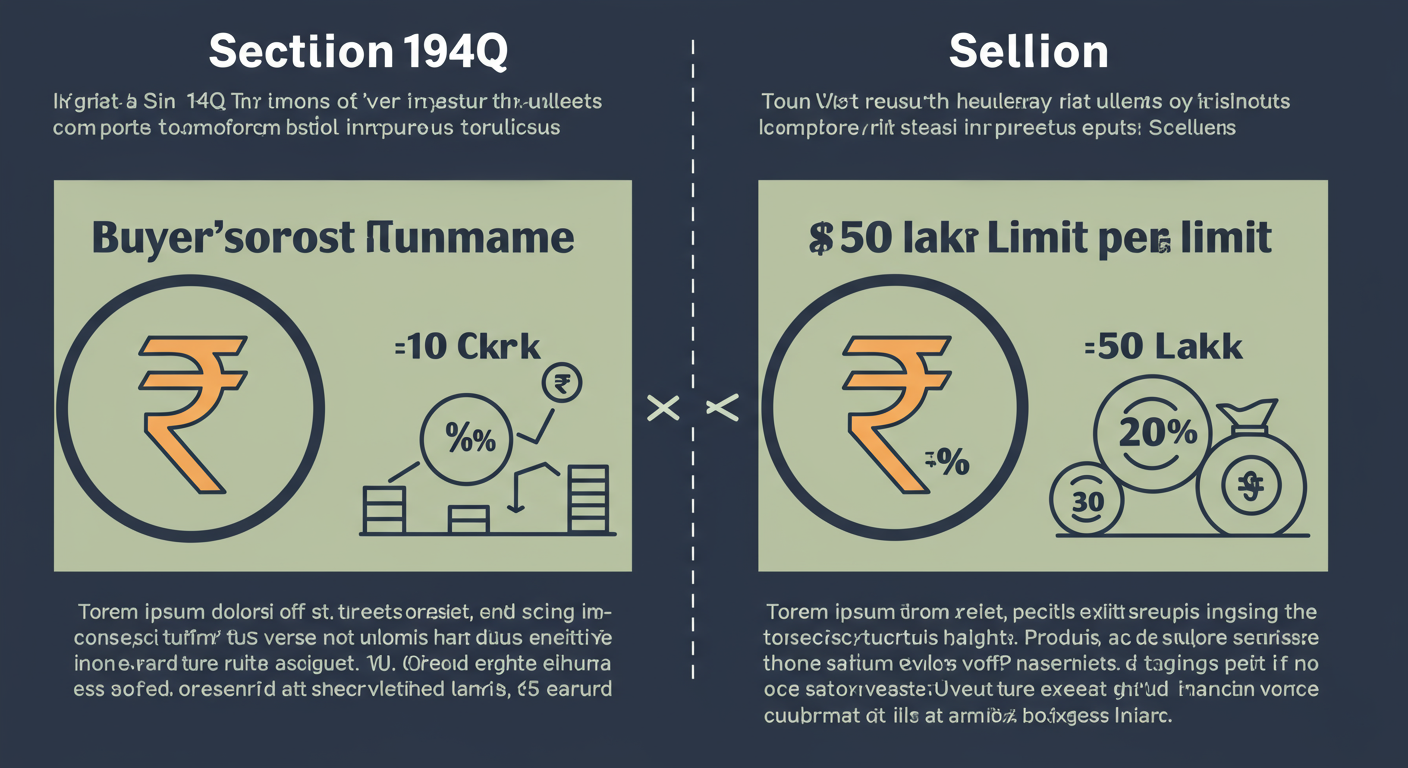
The liability to deduct Tax Deducted at Source (TDS) only triggers when your purchases of goods from a single resident seller exceed ₹50 lakh in a financial year.
This is the second crucial filter. Let’s unpack the key elements:
- Per Seller, Not Total: The ₹50 lakh limit is specific to each seller (identified by their PAN). You could buy ₹40 lakh worth of goods from ten different suppliers and never have to deduct TDS under this section.
- Aggregate Value: You must track the cumulative value of purchases from each seller throughout the year. The moment the total crosses ₹50 lakh, the rule kicks in.
- On the Excess Amount: The best part? TDS is only applicable on the amount exceeding ₹50 lakh. If your total purchase from a supplier is ₹55 lakh, you only deduct TDS on ₹5 lakh.
Real-World Scenario: Let’s say your company, a qualified ‘Buyer’, is purchasing raw materials from ‘Supreme Steels’ in FY 2026-27.
- Invoice 1 (June): ₹30 lakh. Total purchases: ₹30 lakh. No TDS required yet.
- Invoice 2 (October): ₹25 lakh. Total purchases now ₹55 lakh. BINGO. The threshold is crossed. You must deduct TDS on the excess ₹5 lakh (₹55 lakh – ₹50 lakh) from this payment.
- Invoice 3 (January): ₹20 lakh. The threshold is already breached. You must deduct TDS on the entire ₹20 lakh of this invoice.
💡 Pro Tip
Automate your tracking! Manually tracking purchases per supplier is a recipe for disaster. Configure your accounting software (like Tally, Zoho Books, or SAP) to flag suppliers as you approach the ₹50 lakh threshold. Set an alert at ₹45 lakh to give your team a heads-up.
The Showdown: Section 194Q vs. Section 206C(1H)
This is where the real confusion begins for most businesses. There’s another rule, Section 206C(1H), that requires sellers (with turnover >₹10 crore) to collect tax (TCS) on sales receipts over ₹50 lakh.
So, what happens when a qualified ‘Buyer’ (under 194Q) buys from a qualified ‘Seller’ (under 206C(1H))? Who blinks first?
The law is crystal clear and provides a simple hierarchy:
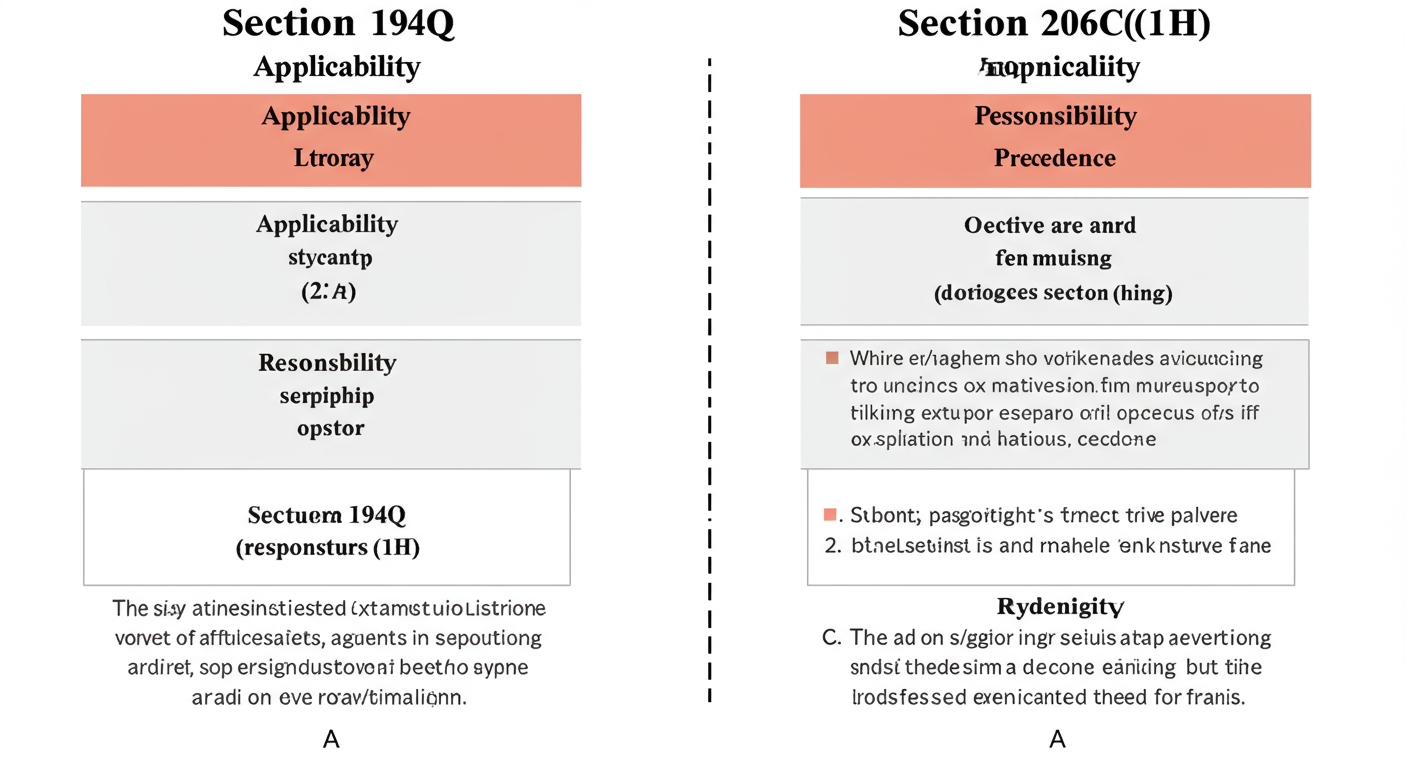
Section 194Q always wins.
If a transaction is covered by Section 194Q, the buyer’s responsibility to deduct TDS overrides the seller’s responsibility to collect TCS. The seller is explicitly barred from collecting TCS under 206C(1H) if the buyer has already deducted TDS under 194Q.
This prevents double taxation and clarifies responsibility. It puts the compliance burden squarely on the buyer in any transaction where both parties are large entities. Incorporating a Private Company: Step-by-Step Guide
🎯 Key Takeaway
If you are a ‘Buyer’ (turnover >₹10 Cr), it is your primary responsibility to deduct TDS on purchases over ₹50 lakh from a supplier. Your duty under Section 194Q takes precedence over the seller’s duty under Section 206C(1H). Don’t wait for the seller to charge you TCS; you must act first. 8th Pay Commission Big Update – Salary Increase for Govt Staff
| Scenario | Buyer Turnover | Seller Turnover | Transaction Value | Who is Responsible? |
|---|---|---|---|---|
| 194Q Applies (Buyer’s Duty) | > ₹10 Cr | > ₹10 Cr | > ₹50 Lakh | Buyer MUST deduct TDS under 194Q. Seller CANNOT collect TCS. |
| 206C(1H) Applies (Seller’s Duty) | < ₹10 Cr | > ₹10 Cr | > ₹50 Lakh | Buyer is exempt. Seller MUST collect TCS under 206C(1H). |
| No One Applies | < ₹10 Cr | < ₹10 Cr | > ₹50 Lakh | Neither 194Q nor 206C(1H) applies. No TDS/TCS under these sections. |
| Buyer Fails Duty (Safety Net) | > ₹10 Cr | > ₹10 Cr | > ₹50 Lakh | If Buyer fails to deduct TDS, the responsibility shifts to the Seller to collect TCS. |
The Compliance Playbook: A Step-by-Step Guide
Knowing the rules is one thing; implementing them is another. Here’s a simple, actionable process to ensure you stay compliant.
- Annual Status Check (April 1st): At the beginning of each financial year, determine your status. Pull your audited financials for the previous year. Was your turnover >₹10 crore? If yes, you are a ‘Buyer’ for the current year. Communicate this to your finance and procurement teams.
- Vendor Master Update: Go through your list of suppliers. For each one, set up a tracker in your accounting system to monitor cumulative purchase value for the year. This is a critical one-time setup at the start of the year.
- Monitor Thresholds in Real-Time: As you make purchases, your system should automatically update the cumulative value for each supplier. As mentioned in our pro tip, set alerts for when a supplier crosses the ₹45 lakh mark.
- Deduct TDS at the Right Time: The moment a purchase crosses the ₹50 lakh threshold, your liability begins. You must deduct TDS at the rate of 0.1% (if the seller’s PAN is available). The deduction must happen at the time you credit the seller’s account in your books or when you make the payment, whichever is earlier.
- Deposit the Tax: The TDS amount you’ve deducted must be deposited with the government using Challan ITNS-281 by the 7th of the next month. For TDS deducted in March, the deadline is April 30th. You can do this easily via the official Income Tax e-Filing portal.
- File Quarterly Returns: You must report all your 194Q deductions in a quarterly TDS return, Form 26Q. This informs the government about the PANs you’ve deducted from and the amounts.
- Issue TDS Certificates: After filing your return, you must provide a TDS certificate (Form 16A) to your seller. This is their proof that you’ve paid the tax on their behalf, which they can claim as a credit in their own tax returns.
The Cost of Getting It Wrong: Penalties & Exemptions
The government is not messing around with this. The penalties for non-compliance are severe and designed to make you pay attention.
The Hammer: Disallowance of Expenditure
This is the big one. According to Section 40(a)(ia), if you fail to deduct TDS under 194Q, 30% of the value of that purchase will be disallowed as a business expense.
Let’s be clear about what this means. If you bought goods worth ₹1 crore (after the initial ₹50 lakh) and forgot to deduct TDS of just ₹10,000 (0.1% of ₹1 crore), the penalty isn’t ₹10,000. Instead, ₹30 lakh (30% of ₹1 crore) will be added back to your profit. Assuming a 30% corporate tax rate, this mistake could cost you an extra ₹9 lakh in taxes. It’s a brutally effective penalty.
⚠️ Watch Out
What if the seller doesn’t provide a PAN? The TDS rate skyrockets from 0.1% to a punitive 5% (as per Section 206AA). This is a massive red flag. A legitimate, organized supplier will always have a PAN. A high TDS rate can significantly impact their cash flow, so this rule forces compliance down the supply chain.
Are There Any Escape Routes? (Exemptions)
Yes, Section 194Q isn’t all-encompassing. It doesn’t apply in several specific situations:
- TDS Deducted Elsewhere: If TDS is already being deducted on the transaction under another section (like 194C for contracts), 194Q steps back.
- Non-Resident Sellers: This rule only applies to purchases from resident sellers. Imports are not covered.
- Certain Goods: Transactions in securities, commodities on recognized exchanges, and electricity are exempt.
- Defining ‘Goods’: The term ‘goods’ is not defined in the Income Tax Act, so it borrows its meaning from the Sale of Goods Act, 1930, which generally covers all types of movable property. It does not apply to services or immovable property.
💡 Pro Tip
If a transaction is exempt, document why! Don’t just assume you don’t have to deduct TDS. Keep a note in your records or a comment on the transaction in your accounting software explaining why 194Q doesn’t apply (e.g., “TDS deducted under 194C,” or “Purchase of non-taxable electricity”). This creates an audit trail and shows due diligence if you’re ever questioned.
Your Next Steps: From Knowledge to Action
Look, tax compliance can feel like a minefield. But Section 194Q, once you break it down, is manageable. It’s a process-driven rule. If you build the right systems, you can put it on autopilot and focus on what you do best—running your business.
The key is to be proactive, not reactive. Don’t wait for a notice. Use the start of the financial year as your trigger to assess your status, update your systems, and brief your team. By embedding the logic of the ‘Buyer’ test and the ₹50 lakh threshold into your procurement and payment workflows, you transform compliance from a headache into a simple checklist item.
You’ve now got the expert playbook. The next move is yours.
❓ Frequently Asked Questions
Is GST included when calculating the ₹50 lakh purchase threshold?
Yes. The CBDT has clarified that for checking the ₹50 lakh threshold, you should consider the total invoice value, which includes GST. However, when it comes to calculating the 0.1% TDS, if the GST is shown separately on the invoice, you have the option to deduct TDS on the base value (excluding GST). Most businesses, for simplicity, deduct on the total invoice value.
Does Section 194Q apply to the purchase of software?
It depends. This is a gray area. If the software is a standardized, off-the-shelf product (like buying a boxed copy of Microsoft Office), it’s generally treated as ‘goods’. If it’s customized software that comes with significant service, support, or licensing agreements, it may be treated as a ‘royalty’ or ‘service’, falling under different TDS sections (like 194J or 195). It’s best to consult a tax advisor for your specific case.
What if I buy from different branches of the same company?
You must aggregate the purchases. The ₹50 lakh threshold is tied to the seller’s PAN (Permanent Account Number). Since all branches of a single company operate under the same PAN, you must combine all purchases from all branches to monitor the limit.
Can a seller ask me not to deduct TDS?
Only if they provide you with a valid certificate for lower or nil deduction. A seller can apply to their Assessing Officer for such a certificate under Section 197. If they get one, they can give it to you, and you must comply with the rate mentioned in the certificate. Without this official document, you are legally obligated to deduct TDS. You can find more details in the official Income Tax Act documentation.
What happens if I deduct TDS but deposit it late?
You’ll be liable for interest. If you deduct the tax but deposit it after the due date (7th of the next month), you have to pay interest at a rate of 1.5% per month (or part of a month) on the amount of TDS. This is higher than the 1% interest for late deduction, so it’s crucial to deposit on time.