Introduction to the GST Composition Scheme in 2026
As the Indian economy continues its robust growth trajectory, the Goods and Services Tax (GST) framework remains a cornerstone of fiscal policy. For small and medium-sized enterprises (SMEs), navigating the complexities of tax compliance can be daunting. This is where the GST composition scheme eligibility and benefits come into play, offering a simplified alternative to the standard GST regime. Designed specifically to reduce the compliance burden on small taxpayers, this scheme allows businesses to pay tax at a fixed percentage of their turnover and file simplified returns. In 2026, understanding these provisions is more critical than ever as the government introduces more digital integrations and streamlined processes for small businesses.
The primary objective of this scheme is to bring relief to small traders, manufacturers, and restaurant owners who may not have the resources to maintain detailed accounting records required under the regular GST scheme. By opting for this path, businesses can focus more on growth and less on the administrative hurdles of monthly filing. If you are looking for the best way of GST registration, evaluating the composition scheme is a vital first step for any emerging entrepreneur.
Understanding the Core of GST Composition Scheme Eligibility and Benefits
To leverage the advantages of this simplified tax regime, one must first grasp the fundamental criteria that define who can join. The GST composition scheme eligibility and benefits are primarily tied to the annual aggregate turnover of the business. For the majority of states in India, the turnover limit for eligibility is set at Rs. 1.5 crore. However, for special category states, including the North-Eastern states and Himachal Pradesh, this limit is adjusted to Rs. 75 lakhs to account for regional economic variations.
It is important to note that aggregate turnover is calculated on an all-India basis under a single Permanent Account Number (PAN). This includes the value of all taxable supplies, exempt supplies, and exports of goods or services. However, it excludes taxes such as CGST, SGST/UTGST, IGST, and cess. Understanding these thresholds is the first step in determining whether your business can transition from a complex tax structure to a more manageable one.
Detailed Analysis of GST Composition Scheme Eligibility and Benefits
Beyond the turnover figures, certain categories of taxpayers are explicitly excluded from the composition scheme. These exclusions are designed to ensure that the scheme remains a benefit for localized, small-scale operations. For instance, businesses involved in the supply of non-taxable goods (like alcohol for human consumption), inter-state outward suppliers of goods, and manufacturers of specific items like ice cream, pan masala, or tobacco products cannot opt for this scheme. Furthermore, those providing services through an e-commerce operator who is required to collect tax at source (TCS) are also generally ineligible, though recent amendments have introduced some relaxations for small e-commerce sellers.
Turnover Limit: General
For most Indian states, the aggregate turnover limit for manufacturers and traders to remain eligible for the composition scheme is Rs. 1.5 Crore per financial year.
Turnover Limit: Special States
In states like Arunachal Pradesh, Manipur, Meghalaya, Mizoram, Nagaland, Sikkim, Tripura, and Uttarakhand, the limit is Rs. 75 Lakhs.
Service Providers
Pure service providers (other than restaurants) have a specific turnover threshold of Rs. 50 Lakhs to opt for the composition scheme under Section 10(2A).
Why Small Businesses Prefer GST Composition Scheme Eligibility and Benefits
The popularity of this scheme stems from its inherent simplicity. One of the most significant GST composition scheme eligibility and benefits is the reduction in the number of returns. Unlike regular taxpayers who may have to file multiple returns every month, composition dealers only need to file one annual return (GSTR-4) and make quarterly payments through a simple statement (CMP-08). This drastically reduces the time and cost associated with tax consultancy and data entry.
Moreover, the lower rate of tax ensures better liquidity for the business. Since the tax rate is a small percentage of the turnover, businesses can maintain a more predictable cash flow. For a small manufacturer, paying 1% tax is often more manageable than dealing with the intricacies of 12% or 18% brackets, even if it means sacrificing the Input Tax Credit (ITC). This trade-off is often worth it for businesses with low profit margins or those dealing directly with end consumers who cannot claim ITC themselves.
Tax Rates Under the Composition Scheme
The tax rates under the composition scheme are fixed and relatively low, making it an attractive option for high-volume, low-margin businesses. These rates are divided based on the nature of the business activity. It is crucial for business owners to correctly identify their category to ensure accurate tax payments and avoid penalties from the Central Board of Indirect Taxes and Customs (CBIC).
- Manufacturers and Traders: They are required to pay 1% of the turnover (0.5% CGST and 0.5% SGST). For traders, this 1% is calculated only on the turnover of taxable supplies of goods.
- Restaurants (not serving alcohol): This category pays 5% of the turnover (2.5% CGST and 2.5% SGST). This is one of the most common applications of the scheme in urban areas.
- Other Service Providers: Under the notification for mixed suppliers and service providers, the rate is 6% (3% CGST and 3% SGST).
Is Your Business Eligible? GST Composition Scheme Eligibility and Benefits in 2026
As we look toward the 2026 fiscal year, the criteria for GST composition scheme eligibility and benefits remain focused on domestic, small-scale operations. A common question arises regarding inter-state transactions. Traditionally, composition dealers were prohibited from making inter-state outward supplies. While they can still purchase goods from other states, selling across state lines usually triggers a mandatory switch to the regular scheme. For businesses looking to expand their footprint nationally, this is a critical factor to consider during their GST Services consultation.
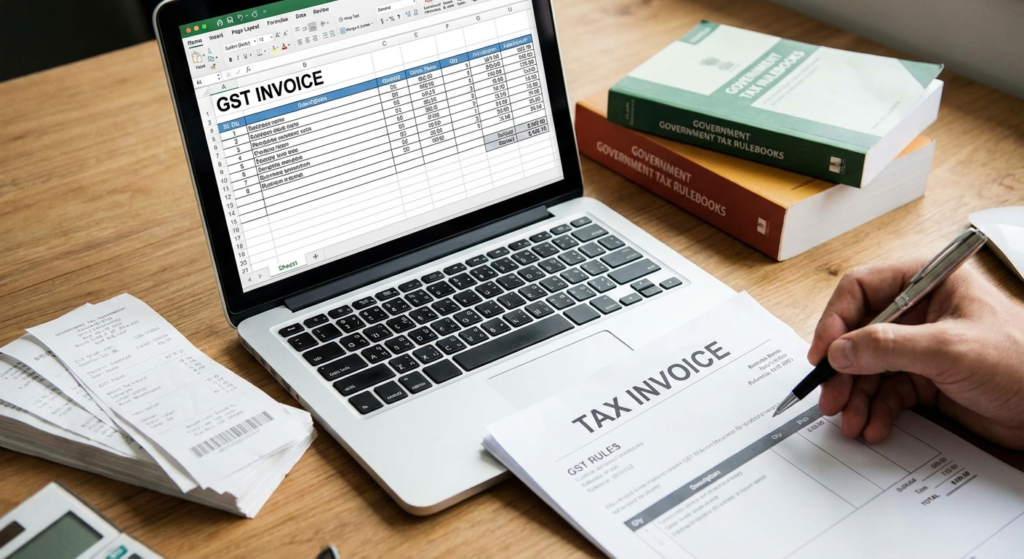
Another eligibility factor is the “Bill of Supply.” Unlike regular dealers who issue a “Tax Invoice” and collect GST from customers, composition dealers must issue a “Bill of Supply.” They are strictly prohibited from collecting GST from their customers. This means the tax liability comes out of the business’s own pocket, which is why the rates are kept intentionally low. The phrase “composition taxable person, not eligible to collect tax on supplies” must be prominently displayed on every bill of supply issued by the business.
Pros of the Scheme
Reduced compliance, lower tax liability, and high liquidity due to limited tax outgo at lower rates.
Cons of the Scheme
No Input Tax Credit (ITC) availability, limited territory of business (no inter-state sales), and inability to collect tax.
Maximizing Business Growth: GST Composition Scheme Eligibility and Benefits
For a growing business, the GST composition scheme eligibility and benefits offer a “buffer period” where the entrepreneur can focus on market penetration rather than complex accounting. By saving on the costs of a full-time accountant and sophisticated ERP software, small businesses can reinvest those funds into marketing or product development. According to guidelines from the GST Council, the scheme is intended to be a stepping stone. Once a business crosses the 1.5 crore threshold, it naturally matures into the regular scheme, having already established a solid operational foundation.
Practical examples show that local retail stores and small-scale manufacturing units benefit the most. For instance, a local bakery with an annual turnover of Rs. 80 lakhs would find the 1% tax rate and quarterly payment system much more sustainable than the monthly filing required under the regular scheme. The ease of doing business under this umbrella cannot be overstated, especially in a competitive market like India.
Critical Limitations Alongside GST Composition Scheme Eligibility and Benefits
While the advantages are numerous, it is equally important to discuss the limitations that come with GST composition scheme eligibility and benefits. The most significant drawback is the loss of Input Tax Credit. In a regular GST setup, you can set off the tax paid on purchases against the tax collected on sales. In the composition scheme, the tax paid on inputs (purchases) becomes a cost to the business. This can make the business less competitive if it relies heavily on expensive raw materials that carry high GST rates.
Furthermore, because a composition dealer cannot issue a tax invoice, other businesses (B2B customers) who buy from them cannot claim ITC. This often restricts composition dealers to B2C (Business to Consumer) transactions. If your primary clients are large corporations who require tax invoices to claim credit, opting for the composition scheme might actually hinder your business growth. It is a strategic decision that requires a deep dive into your customer base and supply chain.
Compliance and Filing Process for 2026
The compliance landscape for 2026 continues to emphasize digital transparency. Composition dealers must use Form GST CMP-08 to declare their turnover and pay tax every quarter. The deadline for this is usually the 18th of the month following the end of the quarter. Additionally, the annual return GSTR-4 must be filed by the 30th of April following the end of the financial year. Failure to adhere to these timelines can lead to penalties, although they are generally lower than those for regular taxpayers.
If a business decides that the scheme is no longer beneficial, or if they accidentally cross the turnover threshold, they must file an intimation to withdraw from the scheme within seven days. Transitioning back to the regular scheme allows the business to start claiming ITC on the stock held on the day of conversion, providing a smooth transition for scaling operations.
Conclusion: Making the Right Choice
The GST composition scheme remains a vital tool for the empowerment of small businesses in India. By balancing the GST composition scheme eligibility and benefits against its limitations, business owners can make an informed choice that aligns with their operational scale and growth ambitions. Whether you are a small manufacturer or a local service provider, the simplicity of quarterly payments and reduced documentation can provide the peace of mind needed to thrive in a digital economy. Always consult with a professional to ensure your business stays compliant while maximizing the fiscal benefits available under the law.
FAQs
Yes, a business registered under the GST composition scheme can purchase goods or services from other states. However, they are generally restricted from making inter-state outward supplies (sales).
No, one of the primary conditions of the scheme is that the taxpayer cannot claim any input tax credit on their purchases. The tax paid on inputs is considered a business expense.
Composition dealers need to file one annual return (GSTR-4) and submit a quarterly statement (CMP-08) for tax payment. This is much simpler than the monthly returns required for regular taxpayers.
No, businesses supplying alcohol for human consumption are excluded from the GST regime and, consequently, cannot opt for the GST composition scheme.
Once your turnover exceeds the prescribed limit, you become ineligible for the scheme immediately. You must inform the tax authorities and switch to the regular GST scheme within seven days.
Yes, you can switch from the regular scheme to the composition scheme, but usually only at the beginning of a financial year. You must file Form GST CMP-02 before the start of the year.