Picture this: Your NGO has a groundbreaking project ready to go. You’ve got the team, the passion, and a clear vision to make a real impact. The only thing missing? Funding. And you know that a single international grant could scale your work tenfold.
But there’s a wall. A big, bureaucratic wall called the Foreign Contribution (Regulation) Act, or FCRA. In 2026, navigating the maze of FCRA registration is tougher than ever, and a single misstep can lock you out from global funding for years. I’ve seen it happen.
Forget the generic advice. This is your insider’s playbook. We’re going to break down exactly what the Ministry of Home Affairs (MHA) is looking for, how to build a bulletproof application, and the critical compliance rules you can’t afford to ignore. Let’s get you funded.
Two Paths to Foreign Funding: FCRA Registration vs. Prior Permission
Before you even think about filling out a form, you need to understand the two distinct gateways to receiving foreign funds. This isn’t a minor choice—it fundamentally shapes your NGO’s funding strategy for the next few years. Choosing the wrong path can lead to delays and frustration. Based on our experience with hundreds of applications, the right choice depends entirely on your NGO’s age and financial history.
Normal Registration is the gold standard. It’s a five-year license to receive funds from any foreign source, for any project aligned with your objectives. But it’s reserved for established players.
Prior Permission (PP) is the stepping stone. It’s a project-specific, donor-specific permit. It’s perfect for newer NGOs that have a committed donor but don’t yet meet the stringent history requirements for full registration.
Here’s how they stack up:
| Feature | Normal FCRA Registration | Prior Permission (PP) |
|---|---|---|
| Best For | Established NGOs (3+ years old) with a proven track record. | New NGOs with a specific, committed foreign donor. |
| Eligibility Criteria | Must be active for 3+ years and have spent ₹15 Lakhs on core activities. | No minimum age or spending required, but a specific project and donor commitment letter is mandatory. |
| Flexibility | High. Can receive funds from any number of foreign donors. | Low. Restricted to the specific donor and amount approved for a single project. |
| Validity | 5 years, with renewal required. | Project-specific. Expires once the approved amount is received. |
| Application Form | Form FC-3A | Form FC-3B |
🎯 Key Takeaway
Don’t rush into a full FCRA registration application if you’re a new NGO. The Prior Permission route is a strategic first step. It allows you to build a compliance history and prove your credibility to the MHA, paving the way for a successful full registration down the line.
The Unbreakable Eligibility Checklist for FCRA Registration
So, you’re aiming for the full, five-year registration. Good. But the MHA has set a high bar to ensure only genuine, active organizations get access to foreign funds. Before you invest time and money, you must tick every single one of these boxes. Trust me on this one, there are no shortcuts.
- Legal Structure: Your organization must be formally registered as a Trust, Society, or Section 8 Company. This is non-negotiable.
- The 3-Year Rule: Your NGO must have been in existence for at least three financial years. A paper registration isn’t enough; you need to demonstrate consistent activity.
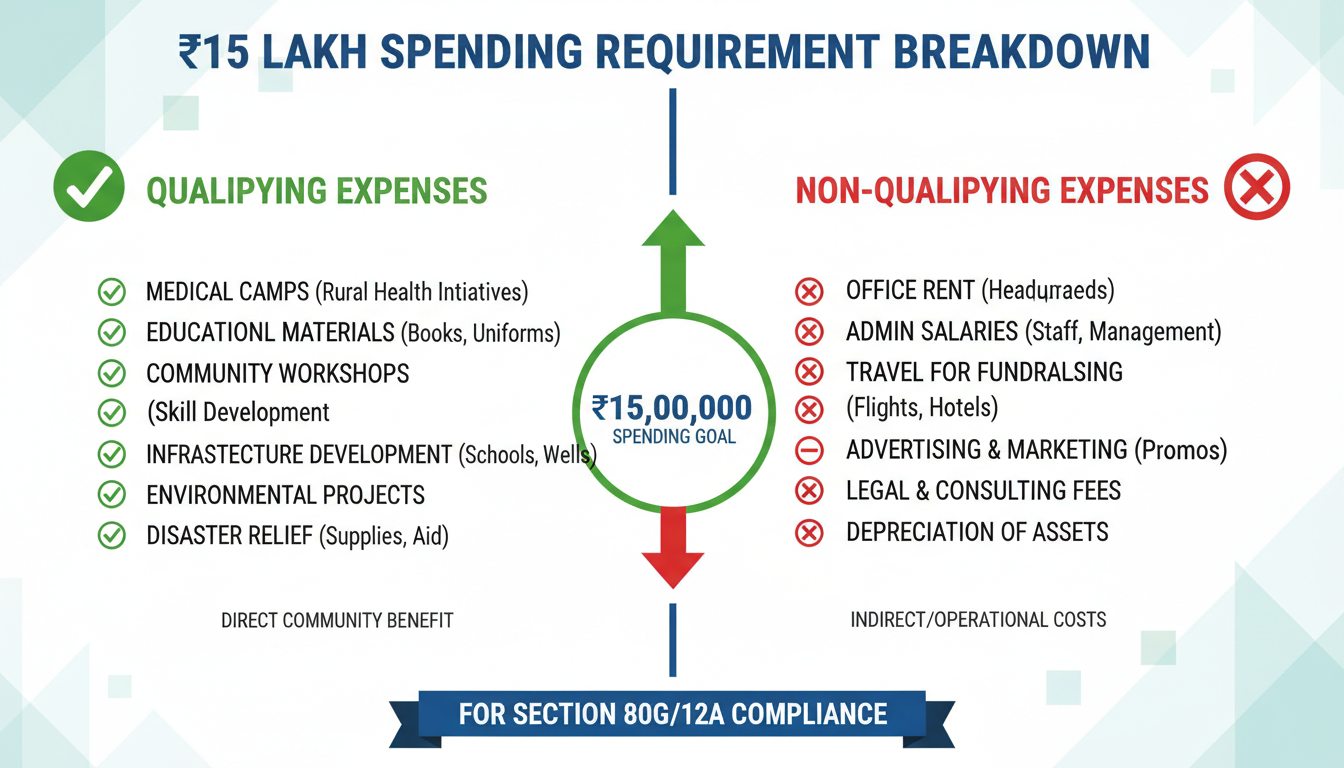
- The ₹15 Lakh Spending Threshold: This is where most applications fail. You must have spent a minimum of ₹15,00,000 (around $18,000 USD) over the last three years on your core social objectives.
⚠️ Watch Out
Administrative expenses do NOT count towards the ₹15 Lakh threshold. This includes salaries for non-project staff, office rent, electricity, and other overheads. The MHA will scrutinize your audited statements to ensure the spending was directly on programmatic activities. Commingling these costs is a huge red flag.
The Document Gauntlet: Assembling Your Bulletproof Application
The entire FCRA application process is digital, but your success hinges on the quality and consistency of your documents. The MHA and Intelligence Bureau (IB) cross-reference everything. Any discrepancy, no matter how small, can lead to rejection.
Here’s your essential document checklist:
- Organizational Documents:
- Self-certified copy of your Registration Certificate (Trust Deed, Society Registration, etc.).
- Self-certified copy of your Memorandum of Association (MoA) or Bye-laws.
- PAN card of the NGO.
- Financial Records:
- Audited financial statements (Balance Sheet, Income & Expenditure) for the last three years.
- A detailed activity report for the last three years, showcasing your work on the ground. This should align perfectly with your financial statements.
- Digital Prerequisites:
- A valid NGO Darpan ID from the NITI Aayog portal. This is mandatory. You can register on the official NGO Darpan website.
- Digital signatures (DSC) for the chief functionary.
- Key Personnel Details:
- Aadhaar cards for all office bearers, directors, or trustees.
- A signed affidavit from each key member declaring they haven’t been convicted of any offense or involved in religious conversion activities.
💡 Pro Tip
Your 3-year activity report is your chance to tell a story. Don’t just submit a dry list of events. Include photos, beneficiary testimonials, and clear metrics. Show the MHA the impact of your ₹15 Lakh spending. This narrative provides crucial context that auditors and IB officers look for during verification.
The 2026 Application Playbook: A Step-by-Step Guide
Ready to apply? Let’s walk through the process. Follow these steps meticulously. From hands-on testing, we know that skipping a detail here can set you back months.
Step 1: Open the Mandatory SBI FCRA Account
This is a critical, unskippable first step. As per the latest amendments to the Foreign Contribution (Regulation) Act, all foreign contributions must be received only in a designated “FCRA Account” at the State Bank of India, New Delhi Main Branch (NDMB), branch code 00691. You can open this account from any SBI branch in the country, but it will be homed at the NDMB. You cannot even start the application without this account number.
Step 2: Register on the FCRA Online Portal
Head to the official MHA portal at fcraonline.nic.in. Create a user ID and password. This will be your dashboard for the entire lifecycle of your registration, from application to annual filings.
Step 3: Fill Out Form FC-3A
This is the main application form for new registration. It’s a detailed form that asks for information about your NGO, its office bearers, the bank account details, and your main objectives. Be precise. Ensure the names and details of your board members match exactly what’s on the NGO Darpan portal. LLP Registration Process 2024: Easy Guide
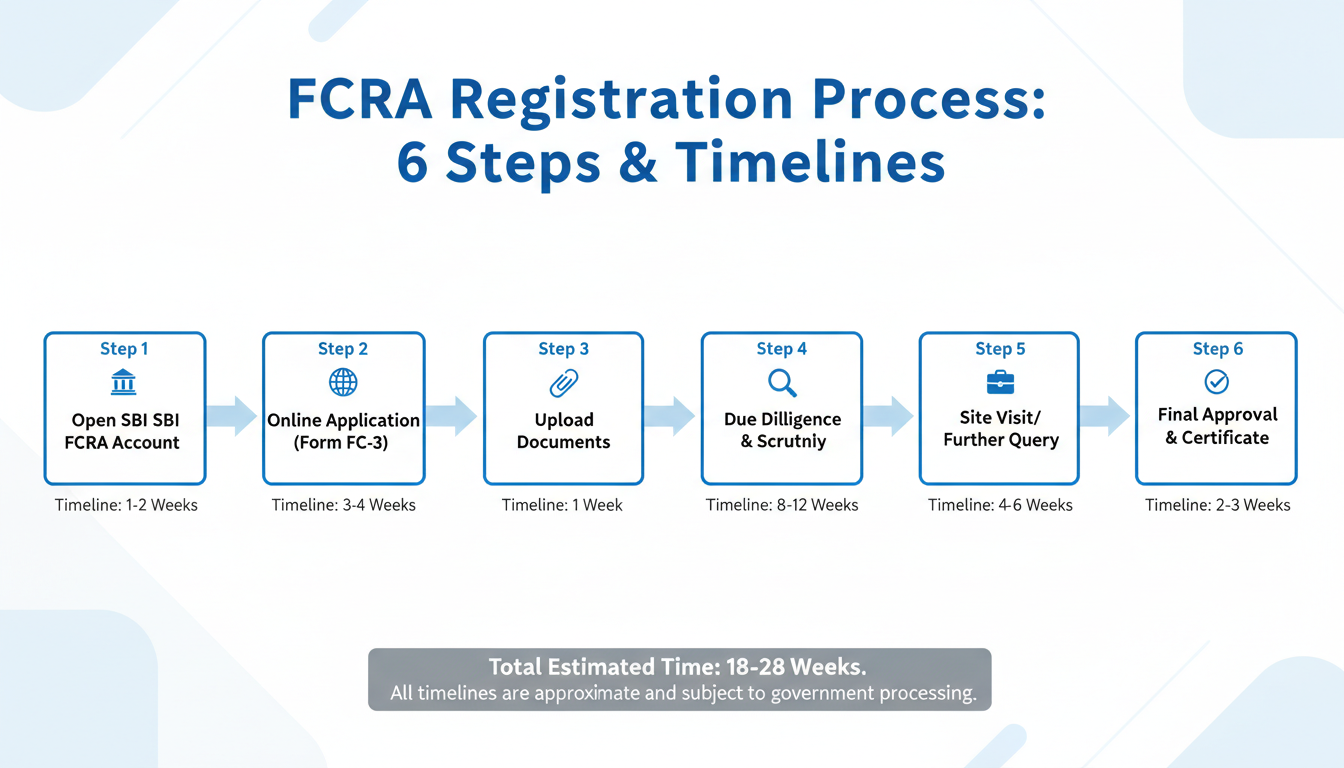
Step 4: Upload Documents and Pay the Fee
Scan and upload all the documents from the checklist above. The portal has specific size and format requirements, so pay close attention. Once uploaded, you’ll be directed to pay the government fee, which is currently ₹10,000 for new registration. Startup Company Registration India: 7-Step Launch Guide (202
Step 5: The Intelligence Bureau (IB) Verification
This is the black box of the process. After you submit, your application is forwarded to the IB. They conduct a thorough background check on your organization and its key members. This often includes a physical visit to your registered office. They’ll verify your existence, check your books, and assess the genuineness of your activities.
Step 6: Await the Decision
The MHA is legally required to make a decision within 90 days, but in practice, the process can take 3-6 months or even longer, depending on the complexity of your case and the IB’s report. You can track your application status on the portal.
💡 Pro Tip
Prepare for the IB visit. Have a dedicated file ready with hard copies of all submitted documents, your last three years of activity reports, and your audited financials. Ensure your office is operational and that the person meeting the officer can confidently explain your projects and impact. A positive IB report is arguably the most important factor for approval.
After Approval: The Real Work Begins (FCRA Compliance)
Getting the registration certificate feels like the finish line, but it’s actually the starting gun for a new race: compliance. The MHA is ruthless about enforcement, and non-compliance can lead to penalties, suspension, or even cancellation of your license.
Here are the non-negotiable rules you must live by:
| Compliance Task | Rule / Form | Deadline | Key Consideration |
|---|---|---|---|
| Annual Return Filing | Form FC-4 | Within 9 months of the financial year-end (i.e., by December 31st). | Mandatory even if you receive zero foreign funds (a ‘NIL’ return must be filed). |
| Administrative Expense Cap | Section 8 of FCRA | Ongoing | You cannot spend more than 20% of your foreign funds on administrative overheads. |
| Quarterly Intimation | Rule 13(b) | Within 15 days of the quarter-end. | You must report the receipt of foreign funds on the FCRA portal every quarter. |
| No Sub-granting | Section 7 of FCRA | Ongoing | You cannot transfer foreign funds to any other person or NGO that is not FCRA-registered. This is a major violation. |
⚠️ Watch Out
The ban on sub-granting is absolute. In the past, larger NGOs acted as intermediaries, channeling funds to smaller grassroots partners. This is now illegal. If you receive foreign funds, your organization must be the one implementing the project directly. Failure to comply with this is one of the fastest ways to lose your FCRA license.
Conclusion: Your Gateway to Global Impact
Securing an FCRA registration is a marathon, not a sprint. It demands patience, precision, and an unwavering commitment to transparency. The path is deliberately challenging to filter for serious, well-managed organizations.
But the reward is immense. It’s the key that unlocks a world of partnerships and resources, empowering you to amplify your impact beyond your wildest dreams. By understanding the two paths (Registration vs. Prior Permission), building a rock-solid three-year track record, and treating compliance as a core part of your mission, you can successfully navigate this complex journey.
Your next step? Conduct a ruthless internal audit against the eligibility checklist. If you meet the criteria, start assembling your documents today. The world is waiting for the change only you can make.
❓ Frequently Asked Questions
What happens if my FCRA application is rejected?
If your application is rejected, the MHA will provide a reason. You cannot re-apply for three years. However, you can file a revision application to the Home Secretary within one year of the rejection, presenting your case and any new evidence. It’s a difficult process, which is why getting it right the first time is so crucial.
Can an individual receive foreign funds without FCRA?
No, an individual cannot register under FCRA. However, they can receive foreign funds without MHA permission up to a certain limit (currently ₹1,00,000 in a financial year) from close relatives abroad. For any other purpose, the funds must be routed through an FCRA-registered organization.
Is the SBI New Delhi Main Branch account really mandatory?
Yes, 100% mandatory. There are no exceptions. All initial receipts of foreign contributions must land in this specific account. After receiving the funds there, you are permitted to transfer them to another FCRA-designated utilization account in any scheduled bank in India for operational convenience.
What is the validity of an FCRA registration and when should I renew?
FCRA registration is valid for five years from the date of approval. You must apply for renewal using Form FC-3C within the six-month window before it expires. Do not wait until the last minute; if your registration lapses, you cannot legally receive any more foreign funds.
Can I change the office bearers or address of my NGO after getting FCRA?
Yes, but you must inform the MHA. Any change in more than 50% of your key office bearers or a change in your registered address must be reported to the authorities using Form FC-6D within 15 days. Keeping your records updated is a key part of ongoing compliance.