
Imagine pouring your life savings into a brilliant startup idea, only to discover a single, poorly-worded sentence in a legal document makes your entire business model illegal. It sounds like a nightmare, but it happens. That document is the Memorandum of Association, and understanding the MOA full form is the first step to avoiding this catastrophic mistake.
This isn’t just another dry legal breakdown. This is your strategic guide to mastering the single most important document your company will ever have. It’s your company’s constitution, its charter, and its public declaration to the world.
By the time you finish this article, you’ll not only know what an MOA is, but you’ll understand how to leverage its six core clauses to protect your vision, attract investors, and build a business on an unshakeable legal foundation. Let’s get started.
What is an MOA, Really? (Beyond the Acronym)
The MOA full form is Memorandum of Association. Think of it as your company’s birth certificate and passport, all rolled into one. It’s a public document filed with the Registrar of Companies (ROC) that defines the company’s very existence. It tells the world:
- Who you are (your name).
- Where you are (your registered office).
- Why you exist (your objectives).
- How much risk the owners are taking (your liability).
- What your financial structure looks like (your capital).
But here’s the critical part: the MOA sets the boundaries. It draws a line in the sand, and any action your company takes that crosses this line is deemed ultra vires—a Latin term meaning “beyond the powers.”
And this is where it gets serious. An ultra vires act is legally void from the start. It cannot be ratified or made valid, not even if every single shareholder agrees to it. This principle is a powerful protection for investors and creditors, ensuring their money isn’t used for a wild new venture they never signed up for. From our hands-on experience with company formations, getting this document right from day one saves immense legal headaches down the road.
⚠️ Watch Out
The “Ultra Vires” doctrine is absolute. If your MOA says you’re a software company, and you use company funds to buy a coffee shop, that transaction is legally void. You can’t fix it later. This is why the Object Clause is the most scrutinized part of your MOA.
The 6 Essential Clauses of an MOA: Deconstructing Your Company’s Blueprint
The Memorandum of Association isn’t a single block of text. As mandated by India’s Companies Act, 2013, it’s meticulously structured into six distinct clauses. Each one is a foundational pillar. Let’s break them down, not as a lawyer, but as a fellow entrepreneur.
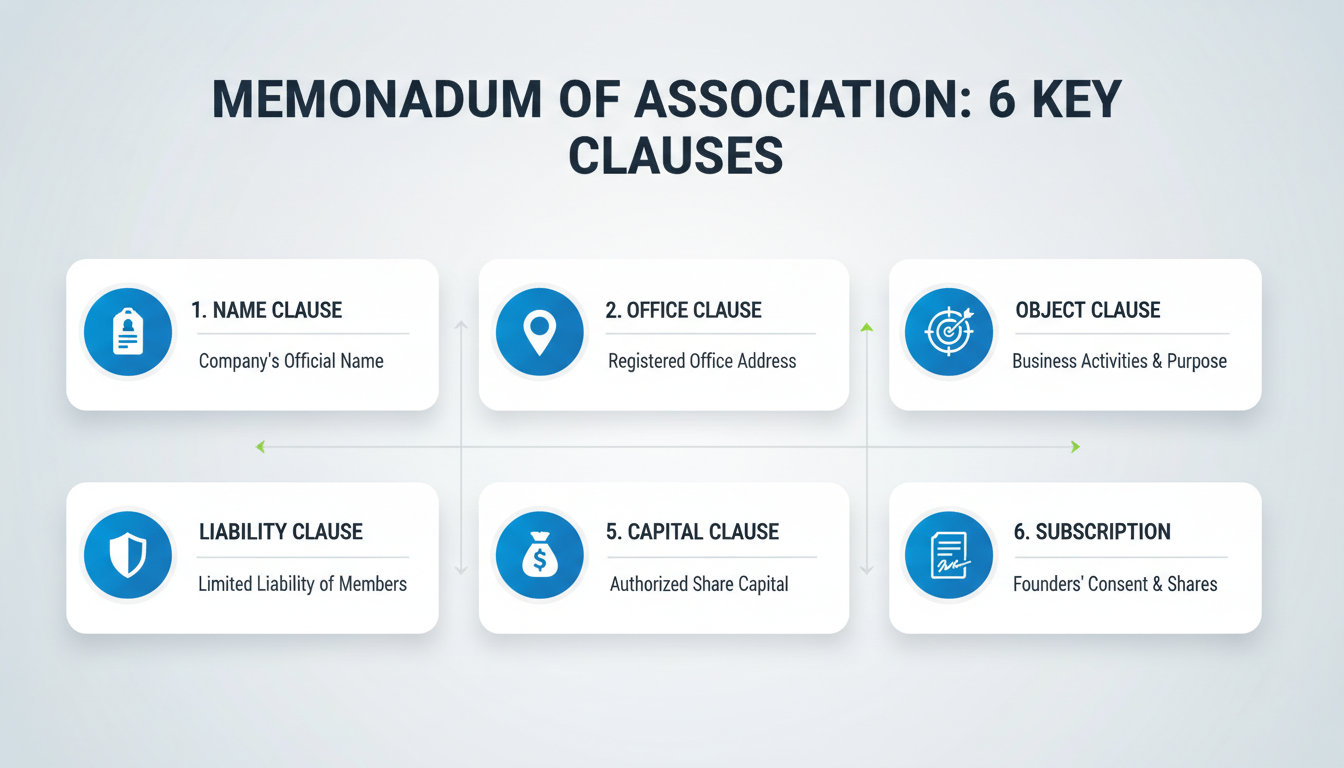
1. The Name Clause
What it is: This clause officially states the full, legal name of your company. Simple, right?
Why it matters: This is your corporate identity. The name must be unique and not deceptively similar to any existing company or trademark. It also must end with “Limited” for a public company or “Private Limited” for a private company. This suffix isn’t just a formality; it’s a clear signal to the public about the company’s structure and the limited liability of its members.
💡 Pro Tip
Before you even draft your MOA, use the Ministry of Corporate Affairs (MCA) portal’s ‘RUN’ (Reserve Unique Name) service. Based on our testing, this is the fastest way to check for name availability and reserve your desired name, preventing delays during the incorporation process.
2. The Registered Office Clause (or Domicile Clause)
What it is: This specifies the State or Union Territory where the company’s registered office will be located. You don’t need the full address at the time of filing, just the state.
Why it matters: This clause determines your company’s legal jurisdiction. It dictates which Registrar of Companies (ROC) you’ll report to and which state’s courts will have authority over your company’s legal matters. It also impacts local state laws and taxes. Shifting your registered office to another state later is a complex and costly process, so choose wisely.
3. The Object Clause
What it is: This is the heart and soul of your MOA. It details the precise business activities your company is authorized to undertake. It’s usually split into:
- Main Objects: The primary business you’re setting up to do (e.g., “To develop and sell enterprise software solutions”).
- Ancillary Objects: Activities necessary to support the main objects (e.g., “To market the software, provide customer support, and conduct research and development”).
Why it matters: This clause defines your entire scope of operations. If it’s too narrow, you’ll have to amend the MOA every time you want to expand into a related field. If it’s too broad and vague, investors may get nervous about a lack of focus. A well-drafted Object Clause provides clarity and direction for management and assurance for investors.
4. The Liability Clause
What it is: A declaration of the liability of the company’s members. For most startups and businesses, this will state that liability is “limited by shares.”
Why it matters: This is the corporate shield. It means that if the company goes into debt, a shareholder’s personal assets are safe. Their maximum liability is limited to the amount unpaid on the shares they hold. This single concept is a cornerstone of modern capitalism, encouraging risk-taking and entrepreneurship.
5. The Capital Clause
What it is: This clause states the company’s authorized share capital—the maximum amount of capital it is legally permitted to raise by issuing shares. It also defines how this capital is divided into shares of a fixed face value (e.g., ₹10,00,000 divided into 1,00,000 shares of ₹10 each).
Why it matters: A company cannot issue shares beyond this authorized limit. To raise more capital than specified here, you must first go through the process of amending the MOA to increase the authorized capital, which involves paying additional government fees. It sets the initial financial ceiling for the company.
6. The Subscription Clause (or Association Clause)
What it is: The final clause is a formal declaration by the first subscribers (the founding members/promoters). They state their intention to form a company and agree to take at least one share each.
Why it matters: This is the “we’re all in this together” moment, legally formalized. Each subscriber signs the MOA in the presence of a witness, binding them to the company’s formation. It’s the act that officially brings the company into existence in the eyes of the law. Trade License Registration Requirements India: The 2025 Expert Guide
MOA vs. AOA: The Constitution vs. The Rulebook
It’s easy to confuse the MOA with its sibling document, the Articles of Association (AOA). They’re both critical, but they serve very different purposes. Getting this distinction right is fundamental to good corporate governance. Unlocking the Mystery: How to Check MSME Registration by PAN number:-
If the MOA is the constitution that defines the company’s powers and purpose, the AOA is the internal rulebook that governs how the company is run day-to-day.
| Basis of Difference | Memorandum of Association (MOA) | Articles of Association (AOA) |
|---|---|---|
| Core Purpose | Defines the company’s objectives and scope of operations (The ‘What’ and ‘Why’). | Outlines the internal rules and regulations for managing the company (The ‘How’). |
| Relationship | Governs the relationship between the company and the outside world (investors, creditors). | Governs the internal relationship between the company and its members/directors. |
| Supremacy | The supreme document. It overrides the AOA. Any clause in the AOA that contradicts the MOA is void. | Subordinate to both the MOA and the Companies Act. |
| Alteration | Difficult and complex. Requires a special resolution and often, government approval. | Relatively easier. Can be altered by passing a special resolution of shareholders. |
| Compulsion | Mandatory for every company to have its own MOA. | A company limited by shares can adopt Table F of the Companies Act as its AOA. |
🎯 Key Takeaway
The MOA sets the boundaries your company cannot cross. The AOA sets the rules for how you operate within those boundaries. Nothing in the AOA can give the company power to do something forbidden by the MOA.
How to Amend Your MOA: A Step-by-Step Guide
Businesses evolve. You might pivot, expand into new markets, or need to raise more capital. When this happens, you’ll need to alter your MOA. This is a serious corporate action, and the process is deliberately rigorous to protect shareholders.
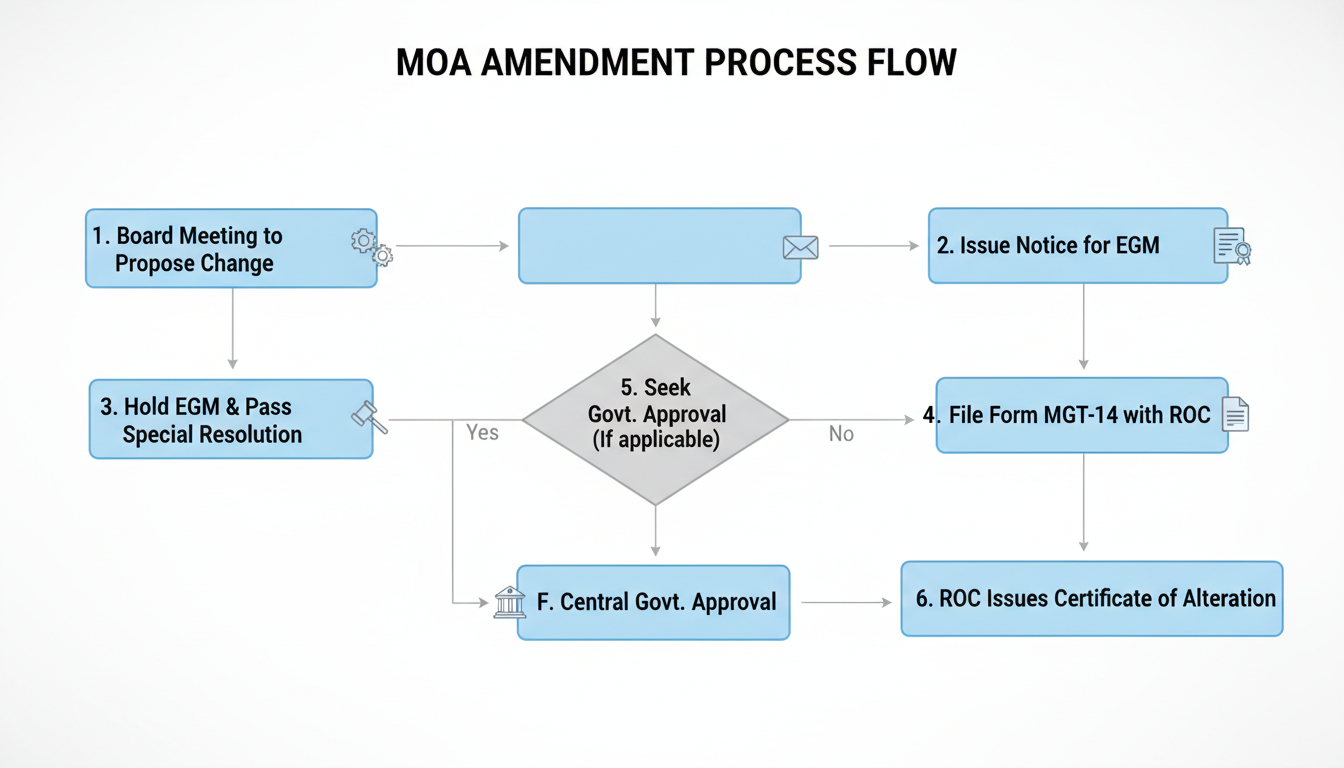
- Convene a Board Meeting: The Board of Directors must first meet and pass a resolution to approve the proposed alteration. They will also set the date, time, and agenda for an Extraordinary General Meeting (EGM) of the shareholders.
- Shareholder Approval via Special Resolution: This is the key step. At the EGM, the shareholders must approve the change by passing a Special Resolution. This isn’t a simple majority; according to corporate law experts, it requires the votes cast in favor to be at least three times the votes cast against it.
- File with the Registrar of Companies (ROC): Within 30 days of passing the special resolution, the company must file Form MGT-14 with the ROC, attaching the resolution and the altered MOA.
- Obtain Necessary Approvals: Certain changes, like a name change or shifting the registered office to another state, require additional approval from the Central Government or other regulatory bodies.
- Receive the New Certificate: Once the ROC is satisfied, they will register the alteration and issue a fresh certificate of incorporation (in case of a name change) or a confirmation of the alteration. The change is only effective from this date.
💡 Pro Tip
When drafting your Object Clause, think 3-5 years ahead. Include related activities you might pursue. For example, a restaurant business could include “food delivery services, catering, and sale of packaged food products” as ancillary objects to avoid a future MOA amendment.
Why the MOA Matters to Everyone (Not Just You)
The MOA isn’t an internal secret. It’s a public charter that provides critical information and protection to every single person who interacts with your company.
For Investors: The Ultimate Due Diligence Tool
Before writing a check, any savvy investor will scrutinize your MOA, particularly the Object Clause. It tells them exactly where their money can and cannot go. It’s their assurance that you won’t take their investment for a software company and suddenly decide to speculate in real estate. In our experience, a clear, focused Object Clause builds immense investor confidence.
For Lenders & Creditors: A Measure of Legitimacy
A bank considering a loan or a supplier extending credit uses the MOA to verify the company’s legitimacy and scope. As detailed by financial resources like Investopedia, it’s a fundamental part of their risk assessment. They need to know the business they’re lending to is legally authorized to conduct its operations.
For You, The Founder: Your Guiding Compass
The MOA keeps you and your management team accountable. It’s a constant reminder of the mission agreed upon by the shareholders. It prevents impulsive decisions that deviate from the core business, ensuring that company resources are used to further the stated objectives. It’s the bedrock of good governance.
Here’s a practical look at how a well-drafted clause makes a difference:
| Poorly Drafted Object Clause (Before) | Well-Drafted Object Clause (After) | |
|---|---|---|
| Main Object | To make software. | To design, develop, customize, implement, maintain, test, and benchmark software solutions for the financial services industry. |
| Ancillary Objects | To do other things. | To provide consultancy, advisory services, technical support, and corporate training related to the main object; to host solutions on the cloud; and to enter into partnerships for marketing and distribution. |
| Impact | Vague, unprofessional. Restricts activities like consulting or training. Raises red flags for investors. | Clear, specific, and forward-thinking. Provides operational flexibility while maintaining focus. Builds confidence. |
⚠️ Watch Out
Don’t just copy-paste a generic MOA template. This document is too important. A template might not cover the specific nuances of your industry or your future growth plans, forcing you into a costly and time-consuming amendment process later.
Your MOA: From Legal Hurdle to Strategic Asset
Look, legal documents can feel intimidating. But the Memorandum of Association isn’t just a piece of paper you file and forget. It’s the DNA of your company.
We’ve broken down the MOA full form and its six critical clauses. We’ve contrasted it with the AOA, walked through the amendment process, and shown why it’s a vital tool for everyone from your investors to your own leadership team. Understanding it is non-negotiable.
Your next step? Don’t treat this as a box-ticking exercise. Before you incorporate, sit down with your co-founders and a legal professional. Meticulously map out your vision and translate it into a clear, powerful, and forward-thinking MOA. It’s one of the most valuable investments you can make in your company’s future.
❓ Frequently Asked Questions
What is the full form of MOA and AOA?
The MOA full form is Memorandum of Association, which acts as the company’s constitution. The AOA full form is Articles of Association, which serves as the company’s internal rulebook. The MOA is supreme to the AOA.
Can a company operate outside its MOA object clause?
Absolutely not. Any business activity conducted outside the scope of the Object Clause is ‘ultra vires’ (beyond powers) and legally void. To start a new line of business, you must first amend the MOA through a special resolution of shareholders.
What happens if there’s a conflict between the MOA and AOA?
The Memorandum of Association (MOA) will always prevail. It is the company’s primary charter. Any rule in the Articles of Association (AOA) that is inconsistent with the MOA is considered invalid to the extent of the inconsistency.
Who signs the MOA during company incorporation?
The MOA is signed by the initial subscribers. For a private company, a minimum of two subscribers is required, and for a public company, a minimum of seven. These subscribers become the first shareholders of the company.
Is the MOA a public document?
Yes, it is. Once filed with the Registrar of Companies (ROC), the MOA becomes a public document accessible to anyone. This transparency is crucial for investors, creditors, and partners to understand the company’s purpose and powers before engaging with it, a principle upheld by governance bodies like the Institute of Company Secretaries of India (ICSI).
Read Also:
- Master Your 2026 GST Invoicing Rules
- What is a CIN Certificate? The Ultimate 2026 Guide for India
- MGT Full Form: The 2026 Director’s Guide to MCA Compliance
- Decoding Your 2026 Restaurant Bill
- How to View Company Master Data in India (2026 Pro Guide)
- DPT 3 Due Date 2026: Your Ultimate Guide to MCA Filing & Compliance
- PAS 6 Due Date 2026: The Unlisted Company’s Guide to Flawless Filing
- MCA Director Master Data: The Ultimate Guide for 2026
- EIC: Empire vs. Export in 2026