Imagine this: you wake up one morning, check your email, and discover you’ve been automatically disqualified from every board you sit on. Your Director Identification Number (DIN) is deactivated. You’re legally barred from being appointed to any company for the next five years. A nightmare? Absolutely. But for thousands of directors in India, this isn’t a hypothetical scenario—it’s the harsh reality of running afoul of Section 164 of the Companies Act, 2013.
Most directors think it won’t happen to them. They believe disqualification is reserved for outright fraud or criminal conviction. That’s a dangerous assumption.
This article isn’t just another dry legal summary. We’re going to pull back the curtain and show you how this powerful law works in the real world. You’ll learn the critical differences between personal vs. company defaults, the devastating domino effect of a single compliance slip-up, and most importantly, the exact steps you can take to protect your career and reputation. Let’s get started.
What is Section 164, Really? Why It’s Every Director’s Responsibility
At its heart, Section 164 isn’t designed to be purely punitive. It’s a gatekeeper. The law’s primary goal is to protect shareholders, creditors, and the public by ensuring that the people managing a company are fit for the job. Think of it as a minimum standard of conduct and accountability for corporate leadership.
The law is split into two devastatingly simple, yet powerful, subsections:
- Section 164(1): This focuses on you. It lists personal disqualifications based on your individual status, actions, or legal troubles. These are red flags directly tied to your personal integrity and fitness.
- Section 164(2): This is the one that catches so many directors by surprise. It holds you accountable for the failures of the company. It’s a form of vicarious liability that says, “If your company fails to comply, your right to be a director anywhere is at risk.”
Understanding this distinction is the first step toward bulletproofing your directorship. One is about your personal house being in order; the other is about ensuring the corporate house you help manage is, too.
Section 164(1): The Personal Pitfalls That Can End a Career
Section 164(1) lays out a clear list of personal disqualifications. These are non-negotiable. If you fall into any of these categories, you’re out. It’s that simple. We can group these into a few key areas of risk.
Financial & Mental Fitness
The law presumes that to manage a company’s affairs, your own must be in order.
- Unsound Mind: If a competent court declares you of unsound mind, you’re disqualified. This ensures directors have the necessary mental capacity for sound judgment.
- Undischarged Insolvent: If you’ve been declared bankrupt and haven’t been discharged, you cannot serve as a director. The logic is simple: if you can’t manage your own finances, how can you be trusted with a company’s?
- Pending Insolvency Application: The law is proactive. Even just applying to be declared insolvent is enough to trigger disqualification while the application is pending.
Legal & Ethical Lapses
This is where past actions come back to haunt you. A criminal record or a history of non-compliance can be an absolute barrier.
- Criminal Conviction: Being convicted of any offense involving moral turpitude or otherwise and sentenced to imprisonment for six months or more is a major disqualifier. This ban lasts for the duration of the sentence plus an additional five years after release.
- Court or Tribunal Order: If the National Company Law Tribunal (NCLT) or another court has specifically passed an order disqualifying you, that order stands.
- Related Party Transactions: If you’ve been convicted of an offense under Section 188 (related party transactions) within the last five years, you’re disqualified. This directly targets conflicts of interest.
- Non-payment of Share Calls: A surprisingly common one. If you hold shares and fail to pay a required “call” for payment on them for over six months, you’re out. It signals a failure to meet your basic obligations as a shareholder.
⚠️ Watch Out
The “moral turpitude” clause is intentionally broad. It generally refers to acts that are base, vile, or depraved, shocking the public conscience. According to legal precedent, this can include crimes related to fraud, theft, and dishonesty. Don’t assume a conviction is “minor” enough to ignore.
Here’s a quick summary of the personal disqualification grounds under Section 164(1).
| Category | Ground for Disqualification | Key Detail |
|---|---|---|
| Mental Fitness | Declared of unsound mind by a court | The declaration must be currently in force. |
| Financial Status | Undischarged Insolvent | Status as “bankrupt” has not been formally cleared. |
| Insolvency application is pending | Disqualified even before a final order is passed. | |
| Legal & Ethical | Convicted of an offense | Sentence of 6+ months imprisonment. Disqualification lasts for sentence + 5 years. |
| Convicted for related party transactions (Sec 188) | Disqualification for 5 years from the date of conviction. | |
| Failed to pay call on shares | Payment overdue for more than 6 months. |
Section 164(2): The Corporate Domino Effect That Topples Directors
This is the big one. The one that keeps diligent directors up at night. Section 164(2) links your personal eligibility to your company’s compliance record. It doesn’t matter how pristine your personal record is; if you’re on the board of a defaulting company, you go down with it.
The triggers are deceptively simple:
- Failure to File Financials: The company has not filed its financial statements or annual returns for any continuous period of three financial years.
- Failure to Repay Debts: The company has failed to repay deposits, redeem debentures, or pay declared dividends, and this failure continues for one year or more.
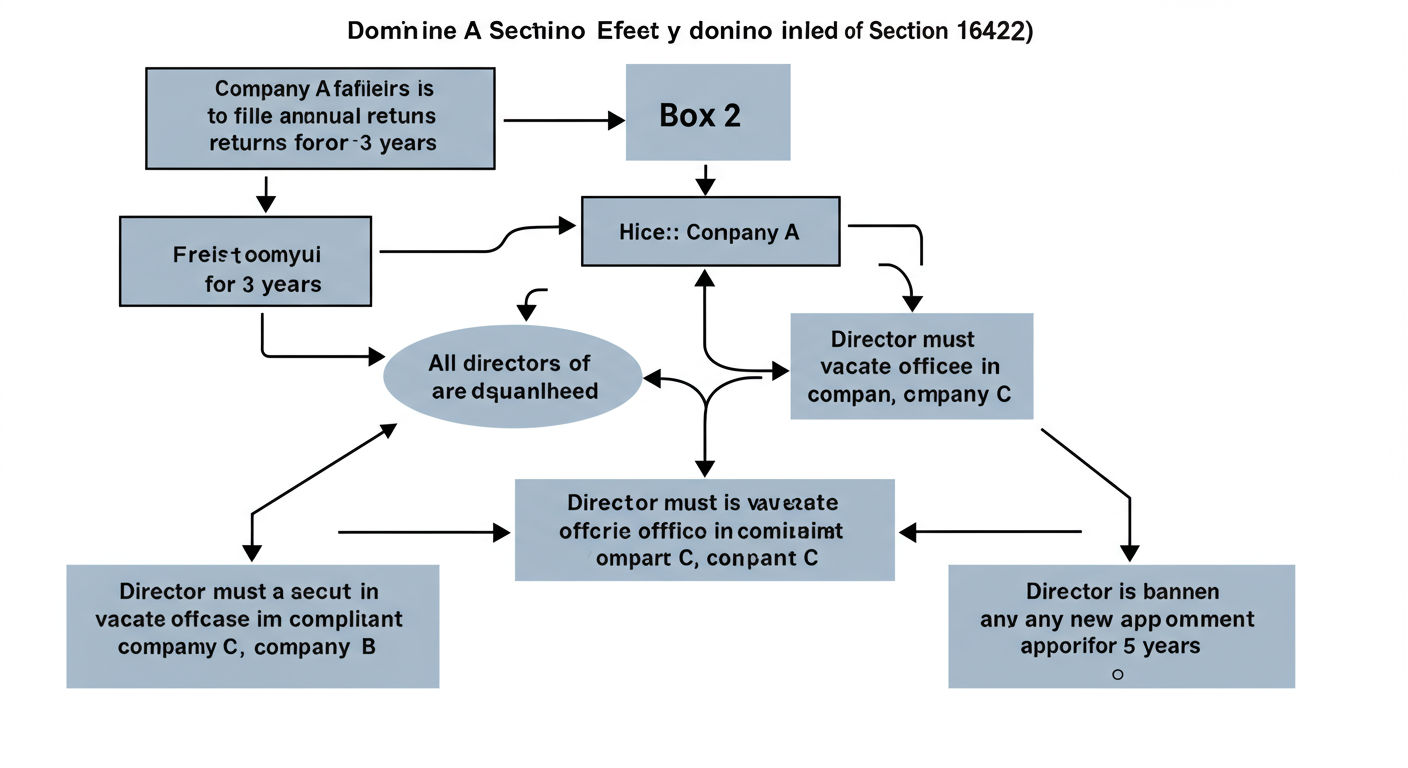
Here’s the kicker: if you are a director of “Company A” when it triggers one of these defaults, you are immediately disqualified. This means you are not only barred from being re-appointed in Company A, but you are also disqualified from being appointed in any other company for five years. Even worse, under Section 167, you must immediately vacate your office in all other compliant companies (like “Company B” and “Company C”) where you also serve as a director.
It’s a catastrophic domino effect. One company’s failure to file paperwork can instantly vaporize your entire portfolio of directorships.
💡 Pro Tip
In our experience, the most common trigger for Section 164(2) is the failure to file annual returns. This is often not a malicious act but simple administrative negligence, especially in smaller private companies. Set up a compliance calendar with hard deadlines and assign clear responsibility to prevent this easily avoidable disaster.
🎯 Key Takeaway
Your directorship is not siloed. A compliance failure in one company you oversee can trigger your disqualification across all companies. This vicarious liability under Section 164(2) is the single biggest risk for directors with multiple board seats. GST Number Kaise Le (2026): Your Step-by-Step Guide
Section 164(1) vs. 164(2): A Head-to-Head Comparison
Understanding the nuances between these two subsections is critical for assessing your risk. They operate very differently and have distinct consequences. व्हीलचेयर टेनिस पैरालंपिक्स: खेल का उत्सव
| Aspect | Section 164(1) – Personal Disqualification | Section 164(2) – Company Default Disqualification |
|---|---|---|
| Basis of Disqualification | Based on the individual’s personal status, conduct, or legal history. | Based on the company’s compliance failures (filings or debt repayment). |
| Who is at Fault? | The individual director. | The company, but the director bears the consequence. |
| Scope of Impact | Disqualified from being appointed or continuing in any company. | Disqualified from re-appointment in the defaulting company and from appointment in any other company. |
| Duration of Ban | Varies by ground (e.g., 5 years post-sentence for conviction). | A fixed period of 5 years from the date of default. |
| Primary Remedy | Address the personal issue (e.g., win an appeal, get discharged from insolvency). | The defaulting company must “make good the default” (e.g., file all overdue returns). |
The Aftermath: Real-World Consequences of Disqualification
Getting flagged under Section 164 isn’t just a slap on the wrist. The consequences are immediate, severe, and public.
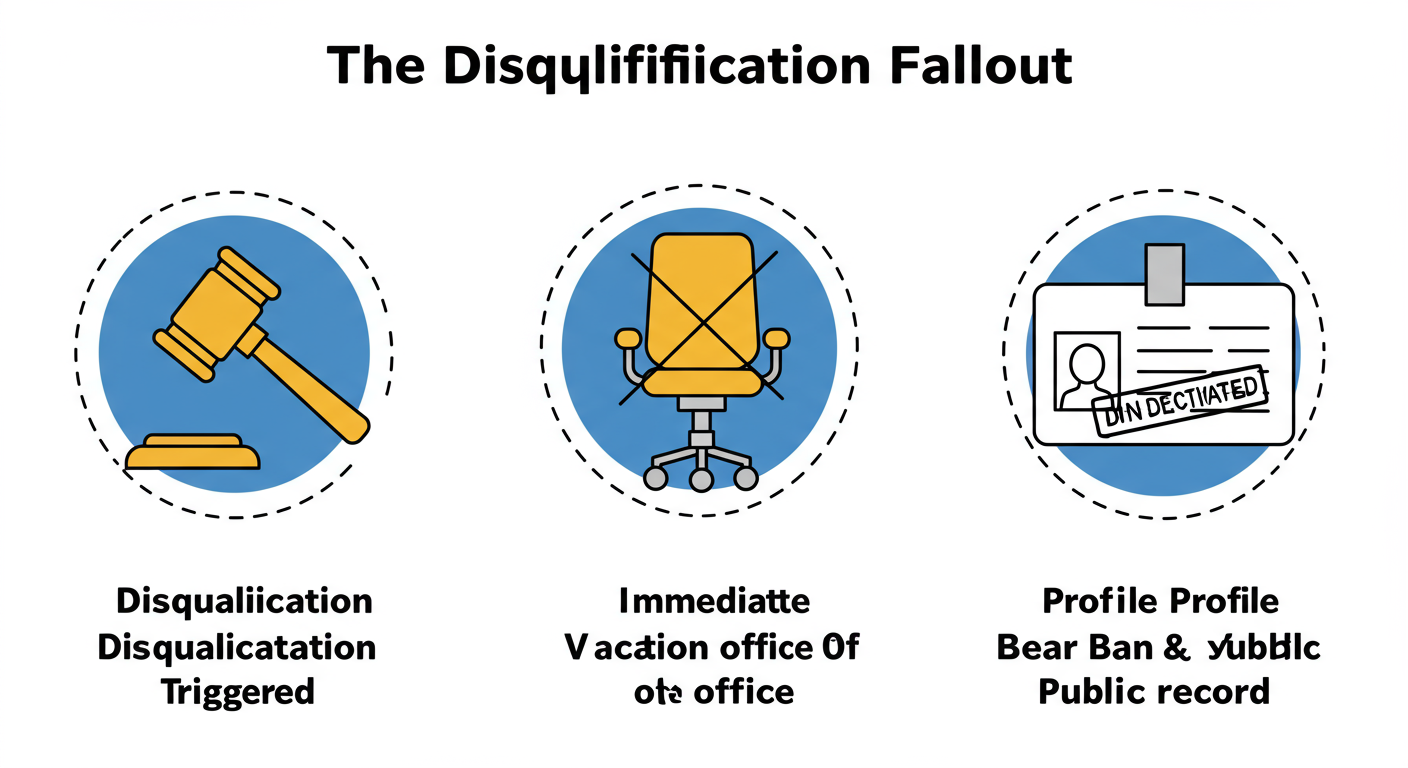
- Automatic Vacation of Office (Section 167): The moment you’re disqualified, you are deemed to have vacated your director’s seat in all companies. For a 164(2) disqualification, this applies to all companies except the one that caused the default. This can throw compliant companies into chaos.
- DIN Deactivation: The Ministry of Corporate Affairs (MCA) will mark your Director Identification Number (DIN) as “Disqualified.” This is a public record. Anyone can look it up. With a deactivated DIN, you cannot file any forms or be appointed anywhere. You are, for all practical purposes, locked out of the system.
- Reputational Damage: Being on the MCA’s public list of disqualified directors is a significant blow to your professional reputation, making it incredibly difficult to regain trust in the corporate world even after the 5-year ban is over.
⚠️ Watch Out
Continuing to act as a director after being disqualified is a serious offense. Under Section 167, it’s punishable with imprisonment for up to one year or a fine that can range from ₹1 lakh to ₹5 lakh, or both. Ignorance of your disqualification is not a valid defense.
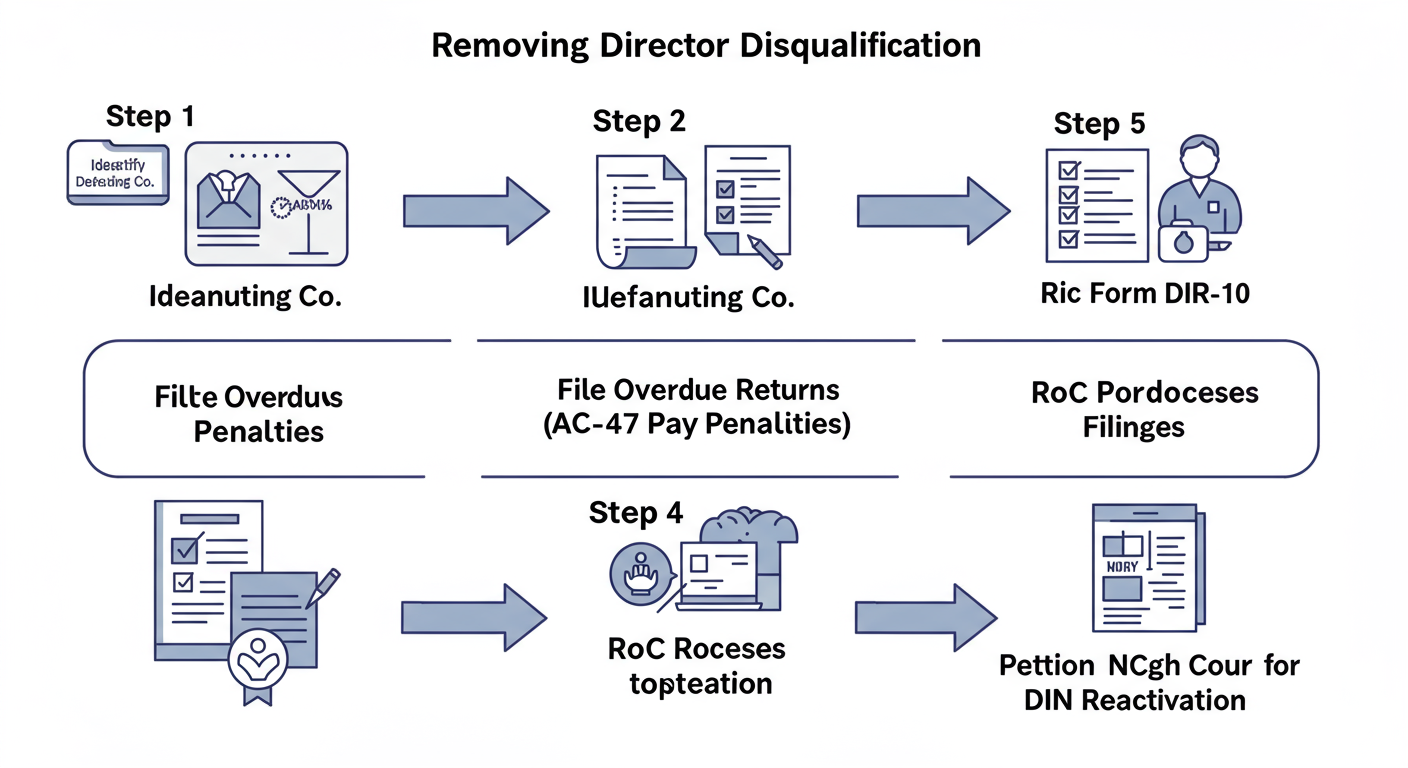
The Road to Recovery: A Step-by-Step Guide to Removing Disqualification
So, the worst has happened. What now? While challenging, it’s sometimes possible to reverse a disqualification, particularly one under Section 164(2). Based on hands-on testing of the process, here’s a practical guide.
Note: This guide primarily addresses disqualification due to non-filing of returns. Other cases may require different legal strategies.
- Step 1: Identify the Defaulting Company. First, pinpoint exactly which company’s non-compliance triggered your disqualification. You can check the MCA portal or engage a professional to identify the source of the default.
- Step 2: Make Good the Default. This is the most critical step. The defaulting company must file all its overdue annual returns (Form AOC-4) and financial statements (Form MGT-7) with the Registrar of Companies (RoC). This will involve paying standard fees plus significant late-filing penalties.
- Step 3: Wait for RoC Processing. Once filed, the RoC will process the forms. After the default is officially “made good” in their records, the disqualification is technically lifted for future appointments. However, your DIN may not be automatically reactivated.
- Step 4: File Form DIR-10 for Removal (If Necessary). While making good the default is the core remedy, you may need to file Form DIR-10 to formally notify the RoC of the removal of disqualification. This is often required to get the process moving.
- Step 5: Approach the NCLT or High Court (For Complex Cases). If your DIN is not reactivated or if you need to challenge the disqualification itself, you may need to file a petition with the National Company Law Tribunal or the relevant High Court. This is a legal process that requires professional representation. They can issue an order directing the RoC to reactivate your DIN.
💡 Pro Tip
Don’t wait. The moment you suspect a company is heading towards a default, act. It’s infinitely easier and cheaper to ensure compliance beforehand than to navigate the complex and expensive process of removing a disqualification after the fact. Trust me on this one, the legal fees for a court petition can be substantial.
❓ Frequently Asked Questions
How can I check my director disqualification status?
The easiest way is to visit the official Ministry of Corporate Affairs (MCA) website. You can use the ‘View Director Master Data’ service by entering your DIN. The status will clearly show as ‘Active’ or ‘Disqualified’. The MCA also periodically publishes lists of disqualified directors.
Does director disqualification apply to private limited companies?
Yes, absolutely. Section 164 applies to directors of all companies registered under the Companies Act, 2013, including private limited, public limited, and one-person companies (OPCs). There is no exemption based on company type.
What is Form DIR-8 and why is it important?
Form DIR-8 is a declaration a person must give to a company before their appointment or re-appointment. In it, they certify that they are not disqualified under Section 164. It places the legal responsibility on the director to be aware of and disclose their status. Submitting a false DIR-8 can lead to penalties for fraud.
If a company makes good its default, is my disqualification automatically removed?
Making good the default is the necessary first step, but it doesn’t always lead to automatic DIN reactivation. While it removes the bar for future appointments, the vacation of office that already occurred is not reversed. Often, you’ll need to follow up with the RoC or even petition a court to get your DIN status changed back to ‘Active’.
What is the difference between ‘moral turpitude’ and other offenses?
The term ‘moral turpitude’ isn’t explicitly defined in the Companies Act, so its meaning comes from legal interpretation. It generally refers to an act of baseness, vileness, or depravity in the private and social duties which a man owes to his fellow men, or to society in general, contrary to the accepted and customary rule of right and wrong. You can find more on this legal concept on platforms like Wikipedia. Other offenses might be purely regulatory, whereas those involving moral turpitude suggest a fundamental lack of integrity.
Your Final Check: Vigilance is the Best Defense
Look, Section 164 of the Companies Act isn’t just a piece of legislation; it’s the rulebook for your career as a director. The law is unforgiving, and the consequences of negligence—whether your own or your company’s—are severe.
The key isn’t to fear this law, but to respect it. Proactive compliance is your only true shield. This means staying on top of your company’s filing deadlines, demanding transparency in board meetings, and being acutely aware of your own legal and financial standing. The full text of the law is available on the India Code website for reference.
Your next step? Don’t just close this tab. Go and check your company’s compliance status on the MCA portal right now. Set a calendar reminder for your annual filing deadlines. Start a conversation at your next board meeting about your company’s Section 164 risk profile. Because in the world of corporate governance, what you don’t know can hurt you.