Introduction to GST Refunds for Excess Tax Payments
Navigating the Goods and Services Tax (GST) landscape can be a daunting task for many business owners and tax practitioners. One of the most common issues encountered is the accidental overpayment of taxes. Whether it is due to an arithmetic error, a duplicate payment, or paying under the wrong head (e.g., paying CGST instead of IGST), understanding the GST refund claim process for excess payment is essential for maintaining healthy business liquidity. For many enterprises, these funds represent significant working capital that should not remain locked in the government’s coffers unnecessarily.
The GST law provides a structured mechanism to claim back these funds. However, the procedure is time-bound and requires meticulous documentation. In this guide, we will break down the complexities of the GST refund claim process for excess payment, providing you with a step-by-step roadmap to successfully recover your money. If you find the technicalities overwhelming, seeking professional GST Refund Services can streamline the entire application and ensure compliance with the latest regulations.
What is the GST Refund Claim Process for Excess Payment?
The GST refund claim process for excess payment refers to the legal procedure through which a taxpayer requests the return of tax amounts paid in excess of their actual liability. Under Section 54 of the CGST Act, 2017, a person can claim a refund of any tax and interest, if any, paid by them by making an application before the expiry of two years from the “relevant date.”
Excess payment usually occurs in two scenarios: first, when a taxpayer pays more tax than what is shown in the returns; second, when tax is paid under the wrong tax head. Unlike an Inverted Duty Structure or Export refunds, a refund of excess payment in the electronic cash ledger is relatively straightforward but still demands accuracy. Staying updated with the compliance calendar ensures you never miss a filing deadline for such claims.
Electronic Cash Ledger
This ledger contains the actual cash deposited for tax payments. Refunds from this ledger are generally processed faster as the money is already yours.
Electronic Credit Ledger
This contains Input Tax Credit (ITC). Refunds here are restricted to specific cases like exports or inverted duty structures, not simple excess payments.
Relevant Date
For excess payments, the relevant date is typically the date of payment. You must file your claim within two years from this date.
Step-by-Step Guide: The GST Refund Claim Process for Excess Payment
The digital-first approach of the GST portal has made the application process more transparent. Here is the detailed GST refund claim process for excess payment using the online portal.
Initiating the GST Refund Claim Process for Excess Payment via RFD-01
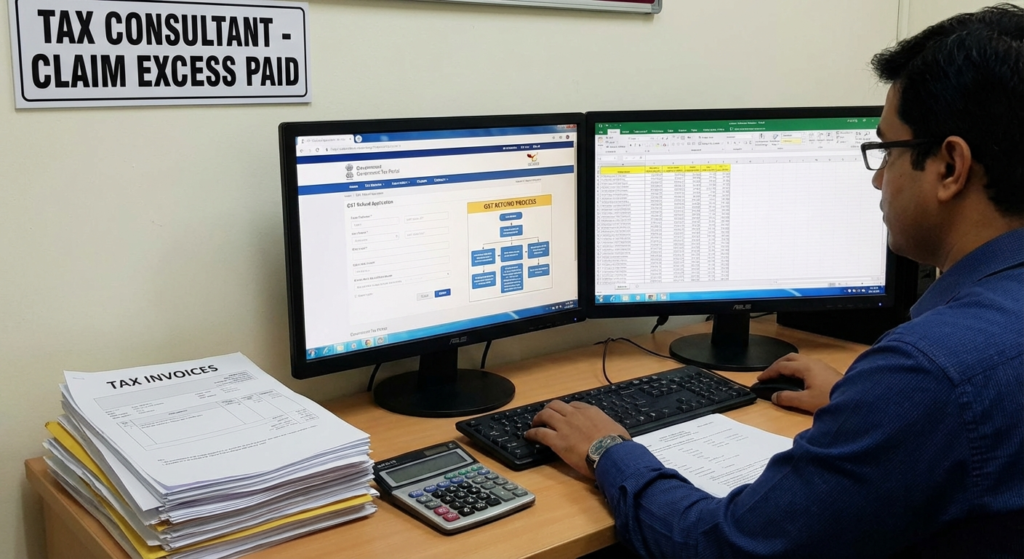
The primary form for any GST refund is Form GST RFD-01. This is an online application that must be filed on the GST Common Portal. Follow these steps:
- Login to the Portal: Access your account on the official GST Portal.
- Navigate to Refunds: Go to ‘Services’ > ‘Refunds’ > ‘Application for Refund’.
- Select Refund Type: Choose ‘Refund of Excess Balance in Electronic Cash Ledger’ or ‘Refund on account of assessment/provisional assessment/appeal/any other order’.
- Fill the Form: Enter the amount you wish to claim. The system will auto-populate the available balance in your cash ledger.
- Bank Account Selection: Choose the bank account where you want the refund credited. Ensure this account is pre-validated.
- Verification: Submit the form using a Digital Signature Certificate (DSC) or Electronic Verification Code (EVC).
Documentation Required for the GST Refund Claim Process for Excess Payment
Documentation is the backbone of a successful refund claim. While a refund of excess balance in the cash ledger requires minimal documentation, other types of excess tax payments (like those paid during an audit) require substantial proof. To satisfy the GST refund claim process for excess payment requirements, you should have the following ready:
- Proof of Payment: Copies of the challans (CIN) used to deposit the tax.
- Statement of Excess Payment: A detailed calculation showing how the excess amount was arrived at.
- Declaration of Unjust Enrichment: A self-declaration (for amounts below Rs. 2 Lakhs) or a CA certificate (for amounts above Rs. 2 Lakhs) stating that the tax burden has not been passed on to the consumer.
- Correspondence: Any notices or orders from the tax department that led to the overpayment.
According to the Central Board of Indirect Taxes and Customs (CBIC), the burden of proof lies with the taxpayer to demonstrate that they are entitled to the refund and have not benefited from “unjust enrichment.” More details can be found on the CBIC official website.
Timelines and Processing Stages
Understanding the timeline of the GST refund claim process for excess payment helps in managing expectations and cash flow. Once the RFD-01 is filed, the following stages occur:
Tracking the GST Refund Claim Process for Excess Payment Status
After filing, an Acknowledgement (RFD-02) is issued within 15 days if the application is complete. If there are deficiencies, a Deficiency Memo (RFD-03) is issued, requiring you to file a fresh application after rectifying errors.
Stage 1: Filing
Submission of RFD-01 on the portal. ARN (Application Reference Number) is generated.
Stage 2: Scrutiny
The proper officer examines the application and supporting documents for accuracy.
Stage 3: Sanction
If satisfied, the officer issues a Sanction Order (RFD-06) within 60 days of the ARN.
Stage 4: Credit
The amount is electronically credited to your linked bank account via RFD-05 (Payment Advice).
Common Pitfalls in the GST Refund Claim Process for Excess Payment
Many taxpayers face delays or rejections due to avoidable mistakes. Being aware of these can help you navigate the GST refund claim process for excess payment more effectively.
- Mismatched Bank Details: If the bank account is not integrated with the NPCI or is not pre-validated, the refund will fail.
- Time Barred Claims: Filing after the two-year window is a guaranteed way to get a rejection.
- Incorrect Tax Heads: Claiming a refund for IGST when the excess was paid in CGST/SGST.
- Unjust Enrichment: Failing to provide a CA certificate when the refund amount exceeds Rs. 2 Lakhs.
“A refund claim is only as strong as its documentation. Even a minor clerical error in the RFD-01 can lead to a deficiency memo, resetting the 60-day clock.” — This is a common sentiment among tax experts regarding the strictness of the GST department.
How to Resolve Rejections and Show Cause Notices
If the tax officer is not satisfied with your application, they will issue a Show Cause Notice (RFD-08). You have 15 days to respond using Form RFD-09. This is a critical juncture in the GST refund claim process for excess payment. You must provide a logical, evidence-based reply to address the officer’s concerns. If the explanation is accepted, the refund is sanctioned; otherwise, it may be rejected in part or full via RFD-06.
Provisional Refund
For certain categories like exporters, 90% of the refund is granted provisionally within 7 days.
Interest on Delay
If the refund is not paid within 60 days, interest at the rate of 6% is payable by the government.
Conclusion: Maximizing Success in Your Refund Claim
The GST refund claim process for excess payment is a vital right for every taxpayer. While the system is designed to be automated, the human element of scrutiny remains significant. By ensuring timely filing, accurate data entry, and robust documentation, businesses can ensure that their excess tax payments are returned promptly. Remember, the key to a hassle-free refund lies in consistency between your books of accounts, your GST returns, and your refund application.
Whether you are a small business owner or a large corporation, staying diligent with your filings and understanding the nuances of the law will safeguard your financial interests. If you encounter complexities, do not hesitate to consult with experts who specialize in the GST refund claim process for excess payment to avoid the pitfalls of litigation and long-term fund blockage.
FAQs
Generally, no. Section 54 of the CGST Act mandates that the refund application must be filed within two years from the relevant date. However, certain exceptions apply in cases of court orders or specific notifications.
A CA certificate is mandatory only if the refund amount exceeds Rs. 2 Lakhs. For amounts below this threshold, a self-declaration regarding unjust enrichment is sufficient.
In such cases, you must pay the correct tax (IGST) first and then apply for a refund of the wrongly paid tax (CGST) using the GST refund claim process for excess payment.
The law mandates that the refund order must be issued within 60 days from the date of the complete application (ARN). Once the order is issued, the credit usually reflects in the bank within a few business days.
Yes, under Section 54(10), the proper officer can deduct any outstanding tax, interest, or penalty from the sanctioned refund amount before crediting it to your account.
A Deficiency Memo (RFD-03) is issued when the officer finds the application incomplete or errors in the documentation. You must file a new application (RFD-01) after correcting the mentioned issues.
Read Also:
- Comprehensive Guide to GST E-Way Bill Generation Rules India (2026) and Associated Penalties
- FCRA Registration for NGOs: Eligibility and Application Process
- Comprehensive Guide to Income Tax Deductions Section 80C to 80U: Complete List 2026
- How to Register for GST Online in India: Step-by-Step Guide 2026
- 7 Critical Rules for Input Tax Credit GST Every Business Must Master in 2025
- Mastering the GST Late Fee Calculation: Rules, Caps, and Compliance Strategies