You’ve just finished a fantastic meal. The conversation was great, the food was divine. Then the bill arrives, and a familiar wave of confusion washes over you. CGST, SGST, Service Charge… what does it all mean? Why is the tax 5% here but was 18% at that hotel last month?
If you’ve ever felt like you need a finance degree to understand your dinner bill, you’re not alone. But it doesn’t have to be this complicated.
This isn’t just another dry tax guide. This is your field manual to confidently understanding every single line item on your restaurant bill. By the end of this 5-minute read, you’ll know exactly what you’re paying for, why you’re paying it, and how to spot a wrongful charge from a mile away. Let’s demystify the GST on restaurant food once and for all.
The 5% Rule: Decoding the Standard GST on Restaurant Food in 2026
Let’s cut straight to the chase. For the vast majority of your dining experiences, the rule is incredibly simple.
As of 2026, the standard GST rate on food services supplied by restaurants is 5%.
That’s it. This single, flat rate applies whether the restaurant is a cozy non-air-conditioned café or a chic, air-conditioned fine-dining establishment. This uniformity was a deliberate move by the GST Council to slash complexity for consumers. Before this change, tax rates could vary based on amenities, leading to widespread confusion. Now, it’s refreshingly straightforward.
But there’s a critical catch that makes this 5% rate possible. It’s a concept called Input Tax Credit, or the lack thereof.
The ITC Twist: The Hidden Reason Your GST is Only 5%
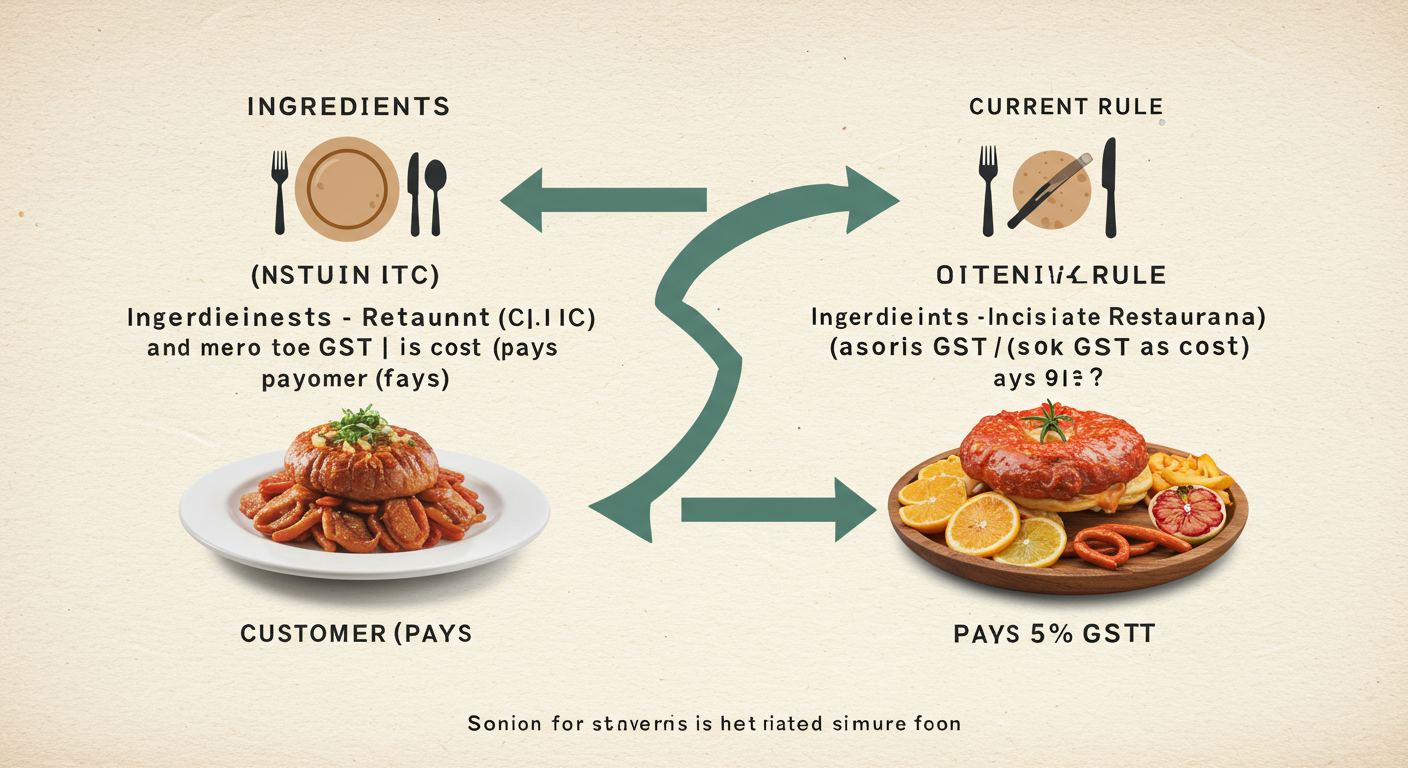
To truly grasp the GST on restaurant food, you have to understand Input Tax Credit (ITC). Think of ITC as a refund. For most businesses, if they pay GST on their raw materials (inputs), they can get a credit for that tax when they sell their final product. This prevents a “tax on tax” situation, where the final price gets inflated by taxes paid at every step of the supply chain.
However, the restaurant industry has a special deal. When the GST council set the rate at a low 5%, they did so with one major condition: restaurants cannot claim Input Tax Credit.
What does this mean in practice? The GST a restaurant pays on its rent, raw ingredients (vegetables, spices, meat), kitchen equipment, and marketing services becomes a direct cost to the business. They can’t get a “refund” for it. This cost is then baked into the menu prices you see.
The government’s logic was clear: a lower, non-creditable tax rate for the consumer is better than a higher 18% rate where the restaurant claims ITC. This forces the benefit of the lower tax to be passed directly to you.
💡 Pro Tip
For restaurant owners, this “no ITC” rule means meticulous cost management is non-negotiable. Since input GST is a hard cost, negotiating better prices with suppliers and optimizing operational expenses are the only ways to protect your margins without unfairly inflating menu prices.
Let’s look at how this impacts the final bill from the restaurant’s perspective.
| Scenario | GST Rate on Food | Can Claim ITC? | Impact on Restaurant’s Costs | Impact on Your Bill |
|---|---|---|---|---|
| Hypothetical 18% GST | 18% | Yes | Lower operational cost, as they get credit for GST paid on rent, ingredients, etc. | Higher tax percentage on the final bill (e.g., ₹180 on a ₹1,000 meal). |
| Current 5% GST (The Rule) | 5% | No | Higher operational cost, as input GST is treated as an expense. This is factored into menu prices. | Lower tax percentage on the final bill (e.g., ₹50 on a ₹1,000 meal). |
When the 5% Rule Bends: Special GST Scenarios You Must Know
While 5% is the norm, the GST on restaurant food isn’t a one-size-fits-all affair. The rate can, and does, change based on one primary factor: the restaurant’s location, specifically if it’s inside a high-end hotel.
Here’s a clear breakdown of the different scenarios you might encounter.
| Type of Establishment | GST Rate on Food | ITC Availability | Who This Applies To |
|---|---|---|---|
| Standalone Restaurants | 5% | No | 99% of places: Cafes, food courts, QSRs, local eateries, fine-dining restaurants (AC or Non-AC). |
| Restaurants in Hotels (Room Tariff < ₹7,500/day) | 5% | No | Restaurants located inside budget or mid-range hotels. The hotel’s room rate determines the restaurant’s GST rate. |
| Restaurants in Hotels (Room Tariff ≥ ₹7,500/day) | 18% | Yes | This is the big exception. Luxury hotel restaurants charge a higher GST but can claim ITC on their expenses. |
| Outdoor & Event Catering | 18% | Yes | Services for weddings, corporate events, and parties. This is considered a different type of service. |
⚠️ Watch Out
Some hotels with room tariffs just under the ₹7,500 threshold might still try to charge 18% GST in their restaurants. Always be aware of the hotel’s category. If it’s not a 5-star or equivalent luxury property, and you’re charged 18% GST on a meal, it’s worth questioning.
What About Zomato & Swiggy Deliveries?
This is a common question in 2026. The rules are simple: the GST rate is determined by the restaurant, not the delivery platform. If you order from a standalone restaurant, the GST is 5%. If you order from a luxury hotel restaurant via Swiggy, the GST will be 18%. The delivery platform is simply the facilitator; the tax liability remains with the restaurant.
Decoding Your Bill: Alcohol, Service Charge, and Other Mysteries
Your bill can still hold a few surprises, even when you know the GST rate. Let’s solve them. 7 Critical Rules for Input Tax Credit GST Every Business Must Master in 2025
The Alcohol Question: Why Is It Taxed Differently?
Ever notice that alcohol is billed separately or has a weird tax rate? That’s because alcoholic liquor for human consumption is outside the GST framework. Instead, it’s subject to state-level taxes like Value Added Tax (VAT) and Excise Duty. These rates vary wildly from state to state. Form 26QB: A Buyer's Guide to TDS on Property Sale (2026)
This is why your bill will always show GST (CGST + SGST) on food and a separate VAT/Excise tax on alcoholic beverages. They can’t be taxed under the same system.
The Service Charge Trap
This is the most contentious item on any restaurant bill. Let’s be crystal clear: Service Charge is NOT a tax. It’s a fee levied by the restaurant, essentially a forced tip.
According to guidelines from the Ministry of Consumer Affairs, restaurants cannot legally add a service charge by default. It is entirely voluntary. You have the right to ask for it to be removed.
⚠️ Watch Out
Some restaurants add the service charge and then calculate GST on the total amount (food + service charge). This is incorrect. GST should only be calculated on the value of the food and beverages supplied, not on the optional service charge.
🎯 Key Takeaway
The standard GST on restaurant food is 5% without ITC. The main exception is an 18% rate with ITC for restaurants in luxury hotels (room tariff ≥ ₹7,500). Remember, alcohol is taxed separately by the state, and service charge is always optional.
Step-by-Step: How to Read Your Restaurant Bill Like a Pro
Armed with this knowledge, let’s put it into practice. Here’s how to audit your bill in 30 seconds.
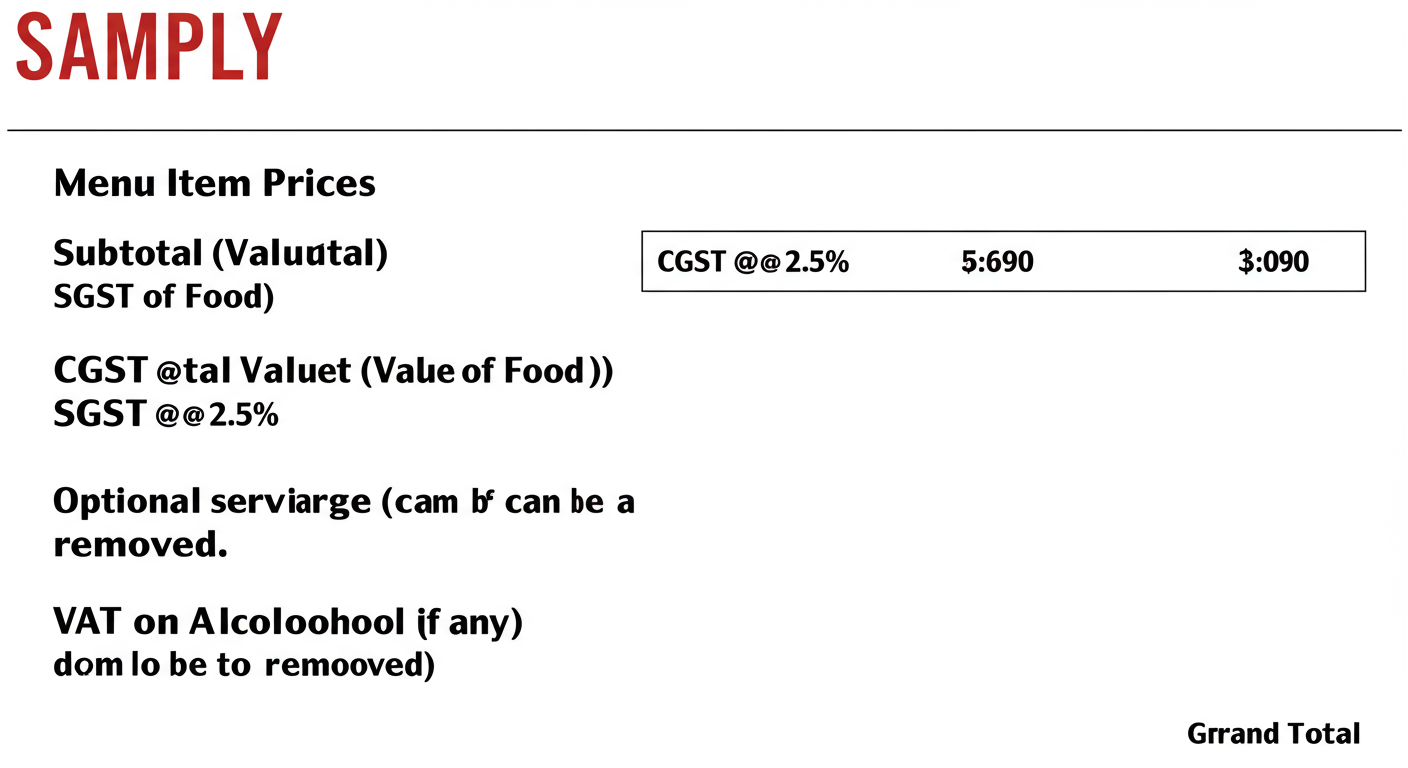
- Check the Food Total: First, ensure the sum of all the dishes you ordered is correct. This is your taxable value.
- Verify the GST Rate: Look at the GST percentages. For most places, you should see two components:
- CGST (Central GST): 2.5%
- SGST (State GST): 2.5%
Together, they make up the 5% GST. If you see 9% CGST and 9% SGST, you’re likely at a luxury hotel restaurant.
- Scrutinize the Service Charge: Is there a service charge? If so, remember it’s optional. If you don’t want to pay it, politely ask your server to have it removed and a new bill generated.
- Check Alcohol Taxes: If you ordered alcoholic drinks, look for a separate line item for VAT or state tax. This is correct. It should not be part of the GST calculation.
- Do the Final Math: The Grand Total should be: (Food Total) + (CGST + SGST) + (VAT on Alcohol, if any) + (Service Charge, if you agree to pay it).
💡 Pro Tip
If you find a discrepancy, don’t be confrontational. Simply and politely ask your server or the manager, “Could you please help me understand the tax calculation here? I was under the impression the GST rate should be 5%.” A calm, informed question gets much better results.
❓ Frequently Asked Questions
Is the GST rate different for takeaways and home deliveries in 2026?
No, the GST rate remains the same. Whether you dine-in, get a takeaway, or order for home delivery, the service is classified as a ‘restaurant service’ and attracts 5% GST (unless it’s from a luxury hotel). The mode of consumption doesn’t change the tax rate.
Why do I see CGST and SGST on my bill instead of just one GST amount?
India uses a dual GST model where the tax collected is split between the central and state governments. For a 5% total GST, the Central Government’s share (CGST) is 2.5%, and the State Government’s share (SGST) is 2.5%. It’s just the two halves of the total GST you pay.
Can a restaurant legally force me to pay a service charge?
Absolutely not. As per the Central Consumer Protection Authority (CCPA) guidelines, a service charge cannot be added automatically to the bill. It is purely voluntary. If a restaurant refuses to remove it, you can file a complaint on the National Consumer Helpline (1915). For more information, you can always refer to the official Central Board of Indirect Taxes and Customs (CBIC) website.
What’s the GST on pre-packaged snacks bought from a restaurant’s counter?
This is a great question. If you buy a pre-packaged and branded item (like a bag of chips or a bottled drink) over the counter, it’s treated as a supply of goods, not a restaurant service. The GST rate will be the MRP rate for that specific product, which could be 12%, 18%, etc., not the restaurant’s 5% rate.
Is there GST on a complimentary meal from a hotel?
As a customer, you don’t pay GST because you aren’t billed for it. However, the business providing the meal does have tax obligations. According to the principles of India’s GST law, they may need to account for GST on the cost of providing that complimentary service, especially in relation to their ITC claims.
Your New Superpower: Dining with Confidence
And there you have it. The complex world of the GST on restaurant food, simplified.
It all boils down to a few core principles: the standard 5% rate without ITC, the 18% exception for luxury hotels, and the clear distinction between mandatory taxes (GST) and optional charges (Service Charge). You no longer need to feel puzzled by your bill. You now have the knowledge to not only understand it but to ensure you’re only paying what’s fair and legally required.
So next time you dine out, take that extra 30 seconds. Glance at the bill with your new, expert eyes. You’ve earned the right to enjoy your meal from the first bite to the final, correctly calculated payment.