
Let’s be honest: The digital marketplace in India is a goldmine right now. Whether you are dropshipping, selling handmade crafts on Etsy, or retailing electronics on Amazon and Flipkart, the potential to scale is massive. But there is a massive hurdle that trips up thousands of new entrepreneurs every single year: GST for ecommerce sellers.
I have consulted with hundreds of online sellers over the last two decades, and I see the same pattern repeat itself. A passionate entrepreneur launches a store, sales start trickling in, and then—bam—they get hit with a compliance notice or realize they have been bleeding money because they didn’t claim their Input Tax Credit correctly. It is heartbreaking, and it is entirely preventable.
If you are planning to sell goods or services online, understanding the nuances of GST isn’t just a legal checkbox—it is the financial backbone of your business. The rules for online sellers are fundamentally different from your local kirana store. They are stricter, more complex, and frankly, a bit more aggressive regarding transparency.
In this comprehensive guide, I am going to walk you through everything you need to know about gst for ecommerce sellers. We will cut through the legal jargon and look at the practical reality: from the new 2024 registration exemptions to the tricky world of TCS and how to actually file your returns without losing your mind.
1. Understanding the Ecosystem: Who is Who?
Before we dive into the tax rates and forms, we need to speak the same language. The GST law treats e-commerce transactions differently because there is a third party involved in the money flow. In a traditional sale, you hand me cash, I give you a product. Simple. In e-commerce, there are three layers:
- The Supplier (You): The person or entity owning the goods or services.
- The Customer (Recipient): The end-user buying the product.
- The E-Commerce Operator (ECO): The platform facilitating the trade (Amazon, Flipkart, Meesho, Myntra, or even your own website if it’s a marketplace model).
Why does this distinction matter? Because the government places a huge compliance burden on the ECO to watch over you. They are essentially deputized tax collectors. This brings us to the most critical question every seller asks me.
2. The Registration Dilemma: Is GST Mandatory for You?
For years, the rule was brutal: If you sold a single rupee worth of goods through an E-Commerce Operator, you needed a GST registration. Section 24(ix) of the CGST Act overrode the standard exemption limit of ₹40 Lakhs/₹20 Lakhs that offline sellers enjoyed. This barrier to entry crushed many micro-businesses before they could even start.
However, the landscape has shifted significantly in late 2023 and moving into 2024. Let’s break down the current rules because there is a lot of confusion here.
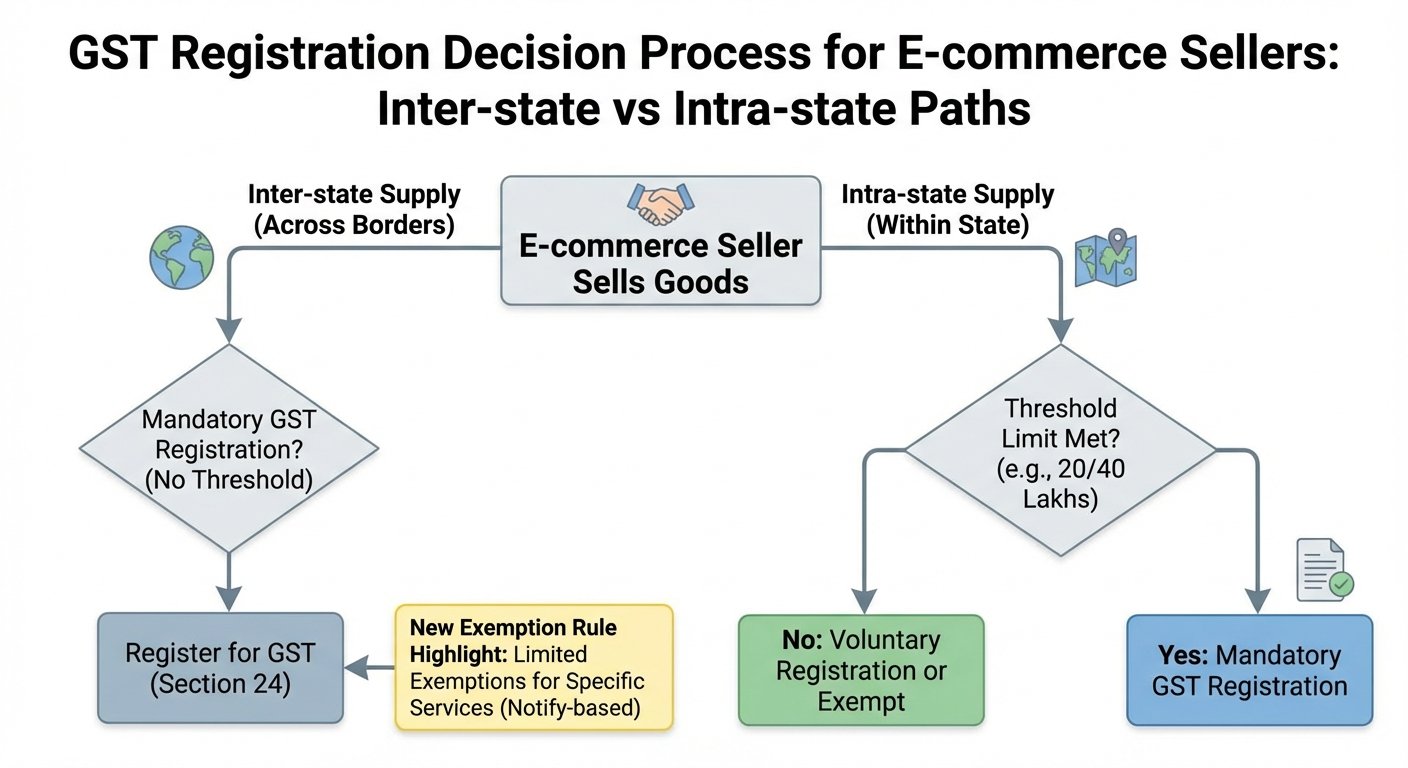
The General Rule (Inter-State Sales)
If you plan to sell goods from one state to another (Inter-State)—for example, you are in Maharashtra and you want to ship to a customer in Karnataka—GST registration is mandatory. There is no threshold limit here. You sell, you register. Period.
The New Exemption: Intra-State Supplies
Recognizing that the old rules were hurting small sellers, the GST Council introduced a relief measure (via Notification No. 34/2023). Unregistered suppliers are now allowed to make intra-state supplies (selling within the same state) through an ECO, provided:
- Your aggregate turnover is less than the threshold limit (₹40 Lakhs for goods in most states, ₹20 Lakhs for services/special category states).
- You do not make any inter-state supply.
- You have an Enrollment Number (validated by the portal).
My Honest Advice? While this exemption exists, it is incredibly limiting for an e-commerce business. The whole point of selling online is to reach a national audience. By restricting yourself to intra-state sales, you are capping your growth potential by 90%. Unless you are a hyper-local bakery or a service provider strictly serving one city, get the GST registration. It builds trust and allows you to scale.
3. Tax Collected at Source (TCS): The Hidden Mechanism
If you are new to gst for ecommerce sellers, you might look at your settlement report from Amazon and wonder, “Why did they deduct 1% of my sales?” This is TCS (Tax Collected at Source), and it is a monitoring mechanism, not an extra cost—if you handle it right.
Here is how it works under Section 52 of the CGST Act:
- The Deduction: When you sell a product for ₹1,000, the ECO (Amazon/Flipkart) is required to deduct 1% (0.5% CGST + 0.5% SGST or 1% IGST) of the net value of taxable supplies.
- The Deposit: The ECO deposits this money with the government by the 10th of the next month.
- The Credit: This amount appears in your GST portal under the ‘TDS and TCS credit received’ tile.
The Reconciliation Nightmare
The biggest challenge with TCS is matching your data with the platform’s data. Sometimes, Amazon might deduct TCS on an order that was returned later. If your books say one thing and the GSTR-8 (filed by Amazon) says another, you will face issues. I recommend doing a reconciliation every single month before you file your GSTR-3B.
4. Return Filing Calendar: Do Not Miss These Dates
Compliance is the heartbeat of your business. In the offline world, you might get away with filing a few days late (with a small late fee). In the online world, if you don’t file, your GST registration can be suspended, and Amazon/Flipkart will instantly block your account. Recovering a suspended account is a nightmare you want to avoid.
Here is the standard filing rhythm for a regular gst for ecommerce sellers registrant:
| Form Name | Purpose | Due Date |
|---|---|---|
| GSTR-1 | Details of Outward Supplies (Sales). This is where you declare every invoice. | 11th of next month (Monthly) or 13th (Quarterly via QRMP). |
| GSTR-3B | Summary Return. Calculation of Tax Liability, Input Tax Credit, and Payment. | 20th, 22nd, or 24th of next month (depending on state/turnover). |
| TCS Return | Accepting the TCS deducted by the ECO. | Any time, but recommended before filing GSTR-3B. |
Handling Sales Returns (The Credit Note Issue)
E-commerce has a high return rate—sometimes 15-30% in fashion categories. When a customer returns a product, you have already paid GST on that sale in the previous month. How do you get it back?
You must issue a Credit Note against the original invoice. You report this Credit Note in your GSTR-1. This reduces your tax liability for the current month. If you fail to issue and report credit notes, you are paying tax on income you never earned. This is the #1 area where I see sellers leaking money.
5. Can E-Commerce Sellers Use the Composition Scheme?
The Composition Scheme is attractive because of its low tax rate (1% for traders) and reduced compliance (quarterly filing). Historically, e-commerce sellers were strictly barred from this scheme. The law stated that if you sell through an ECO that collects TCS, you cannot opt for Composition.
The Change: Recent amendments now allow sellers making intra-state supplies through an ECO to opt for the Composition Scheme.
The Reality Check: Should you do it? Probably not. Here is why:
- Territorial Restriction: You still cannot sell Inter-state. You are stuck selling only within your state.
- No Input Tax Credit: You cannot claim credit on the GST you pay for stock, packaging, ads, or logistics. In e-commerce, your expenses (and the GST on them) are high. Losing ITC often costs you more than the savings from the lower tax rate.
- Bill of Supply: You cannot issue a Tax Invoice, meaning business customers (B2B) won’t buy from you because they can’t claim credit.
For a detailed look at the deadlines for composition dealers, check out our guide on CMP-08 filing due dates, but proceed with caution.
6. Input Tax Credit (ITC): Your Profit Booster
This is where smart sellers make their money. In the traditional retail model, rent and electricity might not have GST. But in e-commerce, almost every expense has GST attached to it.
- Platform Fees: Amazon/Flipkart charge referral fees, closing fees, and shipping fees. All of these attract 18% GST.
- Logistics: Courier services charge 18% GST.
- Advertising: Facebook/Google/Amazon Ads charge 18% GST.
- Packaging: Corrugated boxes, tape, and bubble wrap all have GST.
Under the regular gst for ecommerce sellers rules, you can claim ALL of this as Input Tax Credit.
7. Place of Supply: The Tricky Part of Logistics
One concept that confuses many is the “Place of Supply.” In e-commerce, you might be sitting in Delhi, your warehouse is in Haryana, and your customer is in Tamil Nadu. What tax do you charge?
- Scenario A: You ship from your registered premise in Delhi to a customer in Delhi. -> CGST + SGST.
- Scenario B: You ship from your registered premise in Delhi to a customer in Tamil Nadu. -> IGST.
- Scenario C (The Warehouse Trap): You store goods in an Amazon Fulfillment Center in Karnataka (while you are based in Delhi). You are now making a supply from Karnataka.
Crucial Rule: If you store goods in a warehouse in a different state (like Amazon FBA), that warehouse is considered an “Additional Place of Business.” You MUST get a separate GST registration for that state. You cannot ship from a Karnataka warehouse using a Delhi GST number. This is a common compliance trap that leads to hefty penalties.
If you are exploring new business structures to manage this, you might want to look into startup India tax benefits to see if you can restructure for better efficiency.
8. Common Mistakes to Avoid
After auditing numerous e-commerce accounts, here are the top mistakes I see:
- Ignoring GSTR-2B Reconciliation: You cannot claim ITC just because you have an invoice. The supplier (e.g., the courier company) must file their return for it to appear in your GSTR-2B. If it’s not in 2B, you can’t claim it.
- Wrong HSN Codes: E-commerce platforms are strict. Using a generic HSN code instead of the specific 6-digit or 8-digit code for your product category can lead to account suspension.
- Treating TCS as an Expense: I’ve seen accountants book TCS as a commission expense. It is an asset (cash equivalent). Treat it as such.
- Forgetting E-Way Bills: For consignments strictly exceeding ₹50,000 in value, an E-Way bill is mandatory. While couriers often handle this, the liability ultimately rests on you as the supplier.
Conclusion
Navigating gst for ecommerce sellers is certainly more complex than running a local shop, but it is the price of admission for accessing a global market. The digital trail is permanent—every sale, every return, and every commission fee is recorded. This transparency is good for the ecosystem, but it demands that you stay organized.
My final piece of advice? Don’t try to save money by doing this manually if you have high transaction volumes. Invest in a good GST reconciliation tool or hire a chartered accountant who understands e-commerce specifically. The cost of compliance is always lower than the cost of non-compliance.
Stay compliant, claim your ITC, and focus on growing your brand. The opportunities in 2024 are limitless for those who play by the rules.
Frequently Asked Questions
If you are selling inter-state (shipping to customers outside your home state), yes, GST registration is mandatory regardless of turnover. If you strictly sell intra-state (within your state), you may be exempt under the new notification, but you must obtain an enrollment number.
The TCS deducted by the platform will appear in your GST portal. You need to file the ‘TDS/TCS Credit Received’ return. Once filed, the amount moves to your Electronic Cash Ledger, which you can use to pay your output tax liability or claim as a refund.
Yes, you can use your residential address. You will need to provide proof of address like an electricity bill and, if you are not the owner, a No Objection Certificate (NOC) from the legal owner (e.g., your parents or landlord).
Late filing attracts a late fee (currently up to ₹50 per day depending on the return type) and interest at 18% per annum on the net tax liability. Furthermore, e-commerce platforms integrate with the GSTN API and may block your listing if your GSTIN status turns inactive due to non-filing.
E-Invoicing is currently mandatory for businesses with an aggregate turnover exceeding ₹5 Crores in any preceding financial year from 2017-18 onwards. If you cross this threshold, you must generate IRN (Invoice Reference Number) for B2B and export supplies.