Understanding the Digital Signature Certificate for Company India
In the rapidly evolving business ecosystem of the subcontinent, obtaining a digital signature certificate for company India has transitioned from being a luxury to a mandatory compliance requirement. As the government pushes for a ‘Digital India,’ almost every corporate interaction with regulatory bodies now happens through encrypted electronic channels. A Digital Signature Certificate (DSC) serves as a digital equivalent of a physical signature, offering a high level of security for online transactions by ensuring the authenticity and integrity of the documents filed.
A digital signature certificate for company India is not merely a scanned image of a handwritten signature. It is a secure digital key issued by Certifying Authorities (CAs) that validates the identity of the holder. For companies, this is essential for filing annual returns, incorporating new entities, and signing e-tenders. Without a valid DSC, a company cannot fulfill its statutory obligations under the Companies Act or the Goods and Services Tax (GST) Act. By using asymmetric cryptography, these certificates ensure that the data remains tamper-proof during transmission over the internet.
Legal Authenticity
Under the Information Technology Act, 2000, digital signatures are legally recognized and carry the same weight as physical signatures in a court of law.
Data Integrity
Once a document is digitally signed, any alteration to the data will invalidate the signature, ensuring the information remains unchanged.
Global Reach
Companies can sign cross-border contracts and legal documents instantly, removing the logistical hurdles of physical courier services.
Types of Digital Signature Certificate for Company India
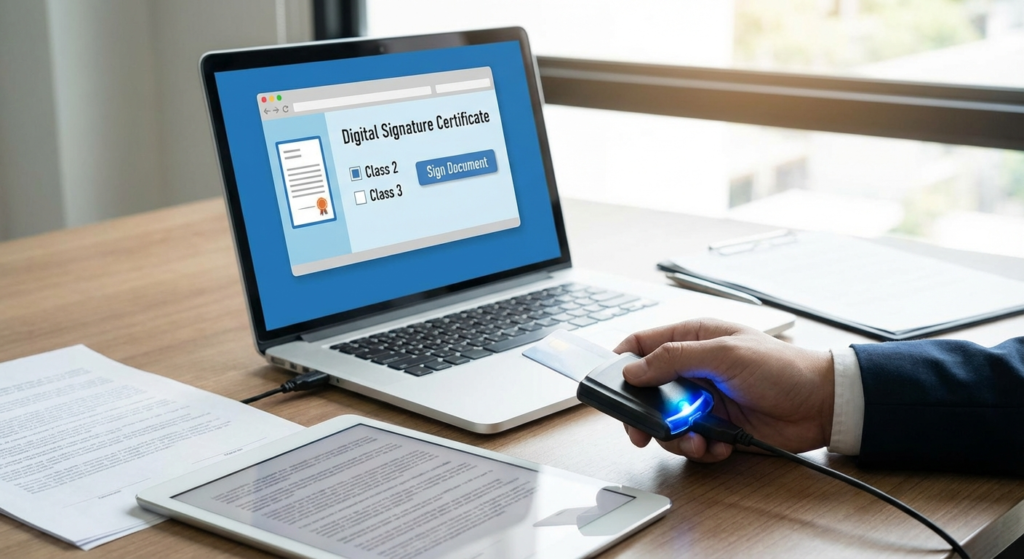
When looking to secure a digital signature certificate for company India, it is crucial to understand that the classification system has undergone significant changes. Previously, Class 2 certificates were widely used for tax filings and company registrations. However, as per the guidelines issued by the Controller of Certifying Authorities (CCA), Class 2 certificates have been discontinued since January 1, 2021. Today, only Class 3 certificates are issued for all purposes.
Class 3 Digital Signature Certificate for Company India
Class 3 is the most secure form of DSC available in the Indian market. It requires the applicant to prove their identity before a registration authority, often involving a video verification process. This type of certificate is used for high-security environments, including e-tendering, e-procurement, and filing documents with the Ministry of Corporate Affairs (MCA). For a business, having a Class 3 DSC ensures that they meet the highest standards of electronic security required by government portals.
The Importance of Digital Signature Certificate for Company India
The transition to paperless governance has made the digital signature certificate for company India a cornerstone of corporate administration. From the moment a business is conceived, the promoters require a DSC to sign the incorporation forms. If you are looking to start a new venture, professional DSC Services can help you navigate the complexities of obtaining these certificates along with your company registration.
Beyond incorporation, the DSC is used for various recurring tasks. Directors use it to sign financial statements, board resolutions, and even for GST registration and monthly return filings. In the context of the Income Tax Department, a DSC is mandatory for companies to e-verify their tax audits and annual income tax returns. It eliminates the need for physical presence and reduces the carbon footprint of the organization by removing the necessity for massive amounts of paperwork.
How to Apply for a Digital Signature Certificate for Company India Online
The application process for a digital signature certificate for company India has become significantly streamlined thanks to paperless KYC (Know Your Customer) methods. Most Certifying Authorities like eMudhra, Capricorn, and VSign offer a completely online journey. Here is a breakdown of the typical application steps:
- Selection of Certificate Type: Choose the Class 3 DSC with a validity of 1, 2, or 3 years. Most companies prefer a 2-year validity for a balance between cost and convenience.
- Mode of Application: You can choose between Aadhaar-based paperless KYC or PAN-based paperless KYC. The Aadhaar method is generally faster as it uses an OTP sent to your registered mobile number.
- Document Upload: You will need to provide a digital copy of your PAN card, an address proof (like a utility bill or bank statement), and a recent passport-size photograph.
- Video Verification: This is a critical security step. The applicant must record a short video (usually 20-30 seconds) through their phone or laptop camera, reading a specific code or statement displayed on the screen.
- Payment and Approval: Once the fee is paid and the video is verified by the CA, the certificate is approved.
- Downloading into USB Token: A DSC cannot be stored on a hard drive for security reasons. It must be downloaded onto a FIPS-compliant cryptographic USB token.
Step 1: Identity Proof
Use your PAN card or Aadhaar for instant identity verification through the CA portal.
Step 2: Video Recording
Complete a quick video call or recorded clip to confirm your physical presence and identity.
Step 3: Token Delivery
Receive your secure USB crypto-token via courier to begin signing documents digitally.
Certifying Authorities and Validity Periods
In India, the CCA has authorized several entities to issue certificates. When you apply for a digital signature certificate for company India, you are essentially purchasing a service from these CAs. Common providers include Sify, NSDL, and eMudhra. While the core technology remains the same across all providers, the service quality, customer support, and ease of the video verification platform may vary.
The validity of a DSC is another important consideration. While you can opt for a 1-year certificate, most corporate professionals recommend a 2-year or 3-year validity. This prevents the frequent hassle of renewal and ensures that your filings are not stalled due to an expired certificate. It is important to note that a DSC must be renewed before its expiry date; otherwise, a fresh application process, including video verification, must be completed from scratch.
Documents Required for Corporate DSC
While an individual DSC only requires personal documents, a ‘Company DSC’ (where the company name is mentioned in the certificate) requires additional proof of the organization’s existence. This is often required for e-tendering where the person signing must prove they represent a specific legal entity. Required documents usually include:
- Copy of the Certificate of Incorporation.
- The company’s PAN Card.
- Board Resolution authorizing the applicant to obtain the DSC.
- The latest bank statement of the company.
- GST registration certificate (if applicable).
Common Use Cases for Companies
The utility of a digital signature certificate for company India spans across multiple government and private portals. For instance, the MCA21 portal requires DSCs for all filings related to Company Law. Similarly, the Directorate General of Foreign Trade (DGFT) requires a specific type of DSC for Import-Export Code (IEC) related transactions. In the banking sector, many institutions now allow corporate accounts to be managed using digital signatures for high-value transfers, adding an extra layer of security beyond traditional passwords.
FAQs
No, Class 2 Digital Signature Certificates have been discontinued by the CCA since 2021. All company-related filings now require a Class 3 DSC, which offers a higher level of security and identity verification.
If the applicant chooses the paperless KYC route and completes the video verification promptly, a DSC can be issued within 30 minutes to 2 hours. However, the physical delivery of the USB token may take 2-3 working days.
Yes, an individual can hold multiple DSCs. For example, a person can have one DSC in their personal capacity and another as an authorized signatory for their company.
If you lose your USB token, you must immediately inform the Certifying Authority to revoke the certificate. You will then need to apply for a new DSC as the private key stored on the token cannot be recovered.
Yes, it is mandatory for all directors of private limited companies to have a DSC for filing annual returns and other statutory forms with the MCA. It is also required for signing income tax returns if the company’s accounts are audited.
Conclusion
The implementation of the digital signature certificate for company India has revolutionized how businesses interact with the government. It has brought transparency, reduced processing times, and significantly enhanced the security of sensitive corporate data. By understanding the shift to Class 3 certificates and following the streamlined online application process, companies can ensure they remain compliant with the latest regulatory standards. Whether you are a startup founder or a seasoned corporate director, having a valid and secure DSC is the first step toward efficient digital governance in the modern Indian economy.
Read Also:
- How to Start a Construction Company in India – Guide 2024-25
- GST Return Filing Due Dates 2026: A Comprehensive Monthly Compliance Calendar
- How to File ITR-1 Online India: A Complete Step-by-Step Guide for Salaried Employees
- ITR Filing Penalties for Late Submission: What You Need to Know 2026 – Avoiding the ITR Filing Late Penalty India
- 7 Critical Aspects of Startup Valuation Tax Every Founder Must Know