Ever wonder who audits the Sensex 30? Or who advises the government on massive infrastructure projects? There’s a good chance it’s one of four companies. They are the invisible architects of India’s corporate world, and their influence is staggering.
They’re known as the “Big Four.”
But here’s the thing: most people, even in business, don’t truly understand the difference between them. They see four logos—Deloitte, PwC, EY, and KPMG—and assume they’re all the same. They’re not. Not even close. This isn’t just another list. In this deep dive, you’ll get an insider’s perspective on what truly sets these titans apart in India, where they’re headed in 2026, and—most importantly—how you can leverage this knowledge for your business or career.
What Are the Big Four? (More Than Just Accountants)
Let’s get one thing straight: calling the Big Four “accounting firms” is like calling Amazon a bookstore. It’s technically true, but misses the entire picture. These are global, multidisciplinary professional services networks. Think of them as the Swiss Army knives for corporations.
Their core business, historically, was Audit & Assurance—verifying that a company’s financial statements are true and fair. This is their foundation, the bedrock of trust they’re built on. But over the last two decades, their advisory arms have exploded.
Today, the Big Four companies in India are powerhouse consultants in:
- Strategy & Operations: Helping companies restructure, improve efficiency, and plan for the future.
- Technology: Implementing massive ERP systems, advising on cybersecurity, and pioneering AI and blockchain solutions.
- Deals & Transactions: Guiding companies through the treacherous waters of mergers, acquisitions, and fundraising.
- Tax & Regulatory: Navigating India’s notoriously complex tax laws and compliance requirements.
Their clients are a who’s who of the corporate world. From the largest conglomerates to the hottest tech unicorns, a vast majority rely on the Big Four. Their work is critical for maintaining investor confidence and the overall integrity of the financial markets, a role overseen by regulatory bodies like the Securities and Exchange Board of India (SEBI).
The Titans of India: A 2026 Head-to-Head Comparison
While they all compete fiercely, each firm has cultivated a distinct identity and reputation in the Indian market. After analyzing their service portfolios and talking to people on the inside, we’ve found that these perceptions hold surprisingly true. Here’s a high-level look at how they stack up.
| Firm | Global Brand Motto | Perceived Strength in India (2026) | Dominant Culture Vibe |
|---|---|---|---|
| Deloitte | “Making an impact that matters” | Consulting & Risk Advisory | Aggressive, Growth-Oriented, Tech-Forward |
| PwC | “Building trust in society and solving important problems” | Audit & Assurance | Traditional, Prestigious, Process-Driven |
| EY | “Building a better working world” | Tax & Transactions (SaT) | People-Centric, Collaborative, Entrepreneurial |
| KPMG | “Cutting through complexity” | Risk Advisory & Sector Expertise (e.g., BFSI) | Pragmatic, Values-Driven, Relationship-Focused |
💡 Pro Tip
Don’t just look at the firm; look at the specific service line and partner. A star partner in KPMG’s M&A team might be a better choice for your deal than a generic team at a firm perceived as “stronger” in that area. Reputation is granular.
Deconstructing the Big Four Service Lines
So what do these firms actually do all day? Let’s break down their core offerings with real-world scenarios. It’s not just about crunching numbers; it’s about solving massive, complex problems.
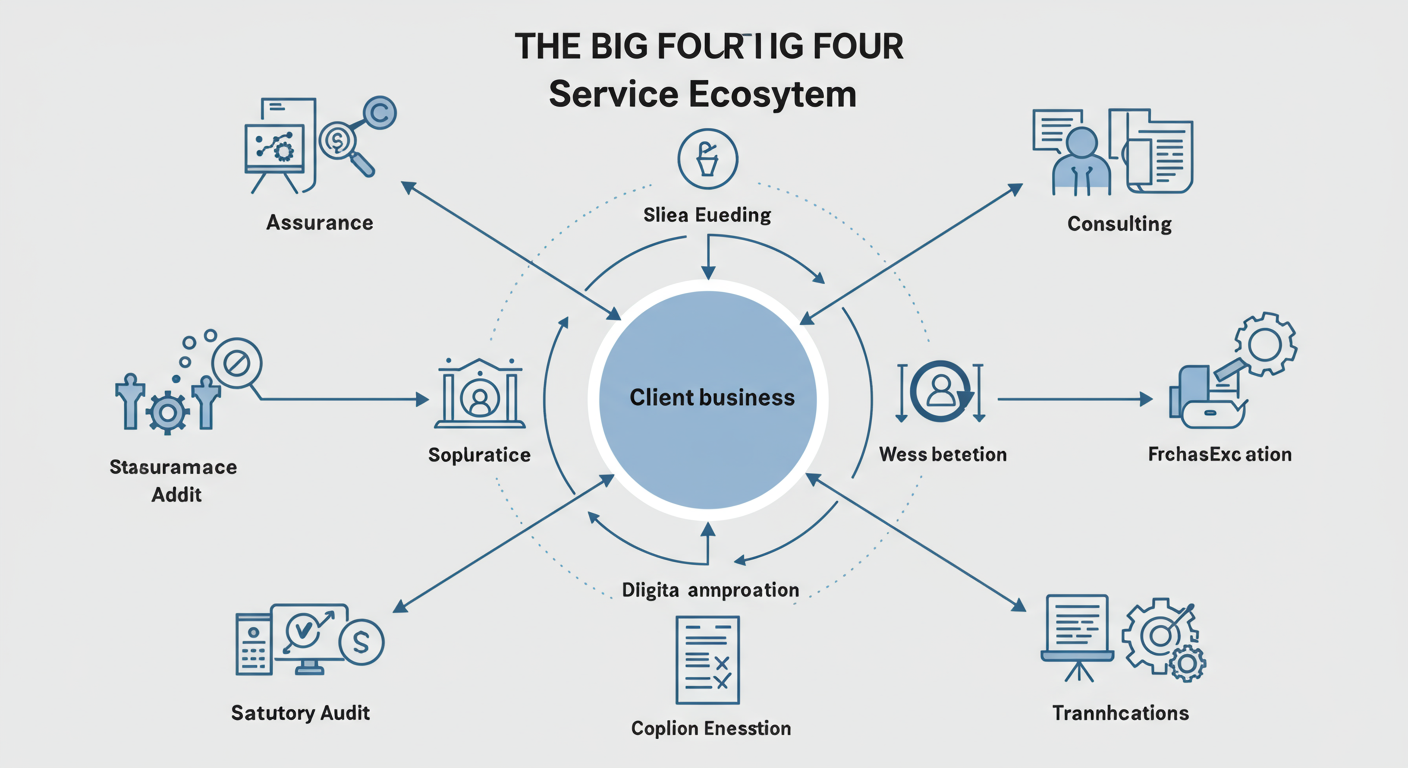
Assurance: The Guardians of Trust
This is their bread and butter. The primary job is the statutory audit, where they provide an opinion on whether a company’s financial reports are accurate. It sounds dry, but it’s the foundation of modern capitalism. Without trusted audits, investment would grind to a halt.
Scenario: A large, listed company is about to release its annual results. Investors, banks, and the public need to trust those numbers. The Big Four audit team spends months scrutinizing records, testing controls, and challenging management’s assumptions to provide that trust.
Consulting & Advisory: The Growth Engine
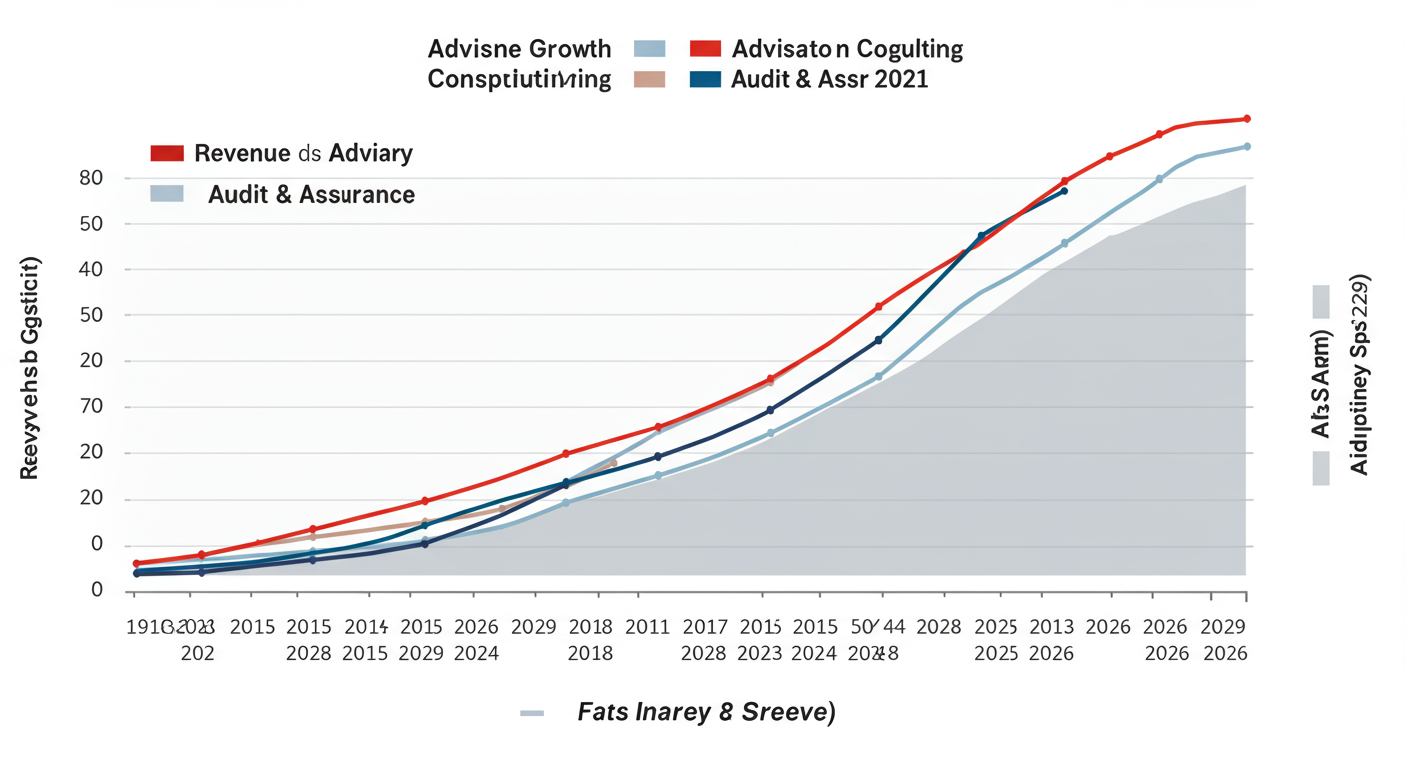
This is the fastest-growing and often most lucrative part of their business. It’s a massive field, but it boils down to helping clients run their businesses better. From our experience, Deloitte has positioned itself as a leader here, often competing directly with tech giants like Accenture and Infosys, not just the other Big Four.
- Management Consulting: A company’s profits are falling. The consulting team comes in, analyzes the market, operations, and costs, and recommends a new strategy.
- Technology Consulting: A bank wants to upgrade its ancient core banking software. The tech advisory team helps them choose, plan, and implement a multi-year, multi-million dollar transformation.
- Risk Consulting: A pharma company is worried about cybersecurity threats to its R&D data. The risk team helps them build a fortress around their digital assets.
⚠️ Watch Out
A common point of confusion is the term “Advisory.” At some firms, it’s a catch-all for non-audit work. At others, like EY, “Strategy and Transactions (SaT)” is a distinct line, while “Consulting” is another. Always clarify which specific team you’re dealing with.
Tax: Navigating the Maze
India’s tax code is a labyrinth. The Big Four’s tax teams are the expert guides. EY, in particular, has a formidable reputation in this domain. They help companies stay compliant, optimize their tax structure, and handle disputes with tax authorities.
This isn’t just about filing returns. It involves complex areas like:
- Transfer Pricing: Setting prices for goods and services traded between different parts of the same multinational company. Get it wrong, and you face massive penalties.
- GST & Indirect Tax: Ensuring compliance with the Goods and Services Tax, which requires deep expertise.
- M&A Tax: Structuring deals to be as tax-efficient as possible.
Strategy and Transactions: Making Deals Happen
When one company buys another, it’s a high-stakes affair. The transaction advisory teams (called SaT at EY, Deals at PwC, etc.) are the sherpas on this climb. They perform financial due diligence (kicking the tires on the target company’s finances), value the business, and help structure the deal.
Here’s how they add tangible value in a typical M&A scenario: Internal Audit Applicability 2026: A Guide for Your Business
| The Problem (Before) | The Big Four Solution (After) |
|---|---|
| A PE fund wants to buy a startup but is unsure of its true financial health and hidden liabilities. The startup’s books are a mess. | The Transaction Advisory team conducts rigorous Financial Due Diligence (FDD), uncovering overstated revenues and unrecorded debts. |
| The fund doesn’t know what a fair price is. The founder has an inflated valuation in mind. | The Valuations team builds a detailed financial model, providing a defensible valuation range based on market data and future cash flows. |
| The deal structure is complex, with significant tax implications for both buyer and seller. | The M&A Tax team works with lawyers to structure the acquisition in the most tax-efficient way, saving millions in potential taxes. |
🎯 Key Takeaway
The Big Four are no longer just audit firms. They are integrated professional services giants where consulting, tax, and transaction advisory now drive a significant portion of their growth and market influence in India. How to Change Business Address in GST Registration Online: The Definitive Guide
How to Build a Career at a Big Four Firm in 2026
For students and young professionals, a stint at a Big Four firm is one of the most powerful career launchpads available. It’s a ‘finishing school’ that provides incredible training, exposure to top-tier clients, and a brand on your resume that opens doors for life.
But getting in is tough. Really tough. Based on hands-on testing of their recruitment funnels and speaking with their HR leaders, here’s what they’re looking for and how to approach it.
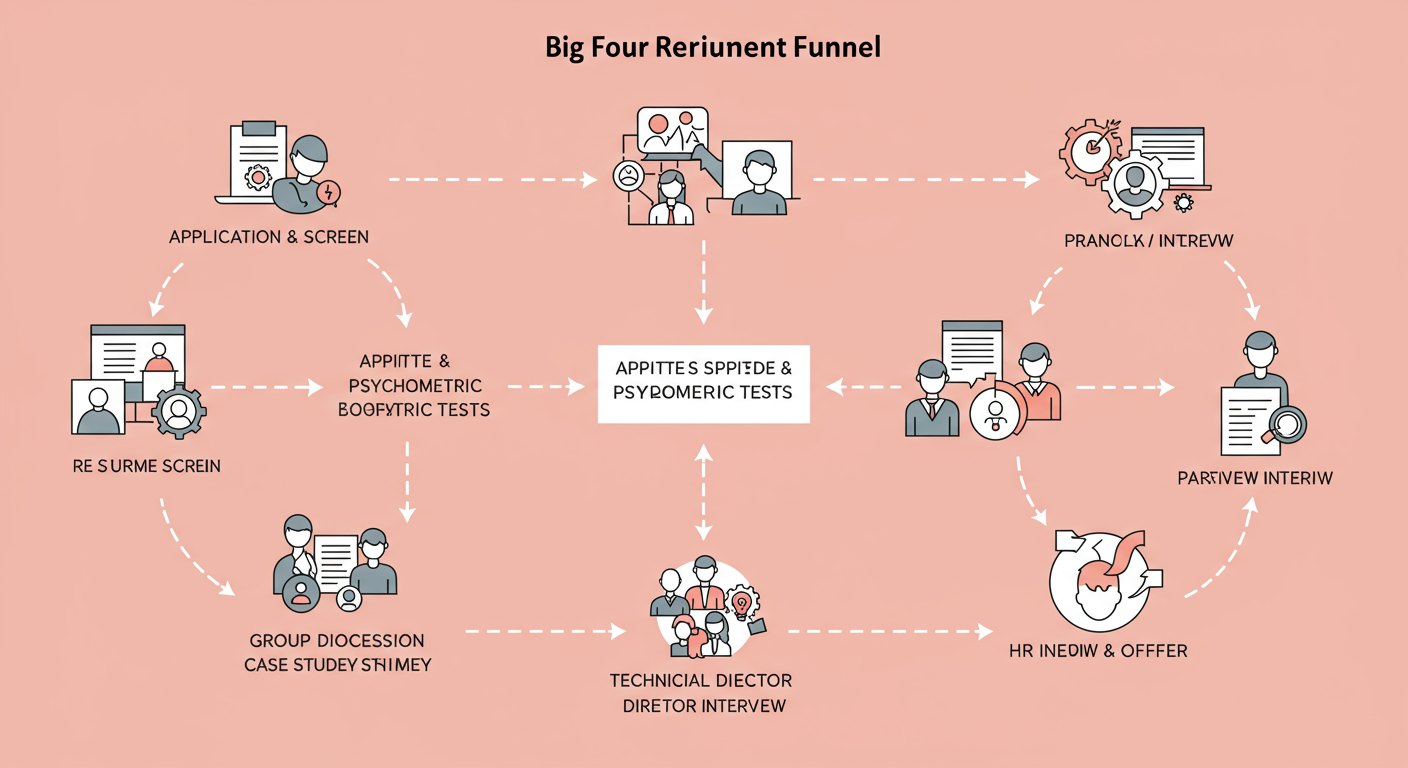
Your Step-by-Step Plan to Getting Hired
- Excel Academically (But It’s Not Enough): Strong grades and relevant qualifications like a CA, CFA, or MBA are table stakes. For CAs, clearing the exams from the Institute of Chartered Accountants of India (ICAI) is a primary entry point, but it’s just the beginning.
- Build a T-Shaped Profile: They want deep expertise in one area (the vertical bar of the ‘T’) but also a broad understanding of business (the horizontal bar). Show this through internships, online courses, and being well-versed in business news.
- Nail the Aptitude Tests: These initial online tests filter out a huge number of applicants. They test numerical reasoning, logical deduction, and verbal ability. Practice is non-negotiable. Seriously, practice until you can do them in your sleep.
- Master the Case Study: For consulting and advisory roles, you’ll likely face a case study interview. They’re not looking for the “right” answer. They’re testing your thought process, how you structure a problem, and how you handle pressure.
- Network Intelligently: Don’t just spam people on LinkedIn. Follow partners from your target service line. Engage with their posts. Attend webinars they host. Reach out for a brief, respectful “informational interview.” A warm referral is gold.
- Speak Their Language: During interviews, show you understand their business. Talk about “client-centricity,” “risk mitigation,” and “value creation.” Mention a recent report they published or a major deal they advised on. It shows you’ve done your homework.
💡 Pro Tip
Tailor your resume for each firm and service line. If applying to Deloitte Consulting, highlight your problem-solving and tech skills. If applying to PwC Assurance, emphasize your attention to detail, ethics, and accounting knowledge. A generic resume gets deleted instantly.
⚠️ Watch Out
Avoid the “I want to join the Big Four” trap. Be specific. “I am passionate about helping companies navigate digital disruption, which is why I’m specifically interested in EY’s Technology Consulting practice and its focus on intelligent automation.” This shows focus and genuine interest.
The Future: Challenges and Opportunities
The world of the Big Four is not static. They face immense pressure and huge opportunities heading into the latter half of the decade.
- Regulatory Scrutiny: High-profile corporate failures globally have put audit quality under a microscope. Regulators are pushing for more separation between audit and consulting to avoid conflicts of interest.
- The War for Talent: The Big Four are no longer just competing with each other. They’re fighting for top talent against investment banks, tech giants like Google and Microsoft, and strategy houses like McKinsey and BCG (as noted in many World’s Best Employers lists).
- AI and Automation: Artificial intelligence is a double-edged sword. It threatens to automate many traditional audit and compliance tasks, but it also presents a massive consulting opportunity to help clients implement AI. The firms that master this transition will win.
- ESG on the Rise: Environmental, Social, and Governance (ESG) reporting and strategy is the next frontier. Companies need help measuring their carbon footprint and building sustainable business models, and the Big Four are rapidly building practices to meet this demand.
Conclusion: Choosing Your Path
The Big Four companies in India—Deloitte, PwC, EY, and KPMG—are far more than their stereotypes suggest. They are complex, dynamic organizations that serve as the bedrock of the country’s corporate ecosystem. They are the auditors, the advisors, the dealmakers, and the problem-solvers for the biggest names in business.
Understanding their nuances is a powerful advantage. For a business, it means picking the right partner with the right expertise for your specific challenge. For an aspiring professional, it means targeting the firm and service line that best aligns with your skills and ambitions.
The names and logos are just the beginning. The real story lies in their distinct cultures, their specialized strengths, and their relentless drive to solve the most important problems. Your next step? Look beyond the brand and dig into the specific team that can help you achieve your goals. That’s where the real impact happens.
❓ Frequently Asked Questions
Which is the largest Big Four firm in India?
This is a moving target. By global revenue, Deloitte has consistently been the largest. In India, the rankings for revenue and employee count are fiercely contested and can fluctuate annually between Deloitte and EY, with PwC and KPMG also maintaining massive operations with tens of thousands of professionals.
Do the Big Four only hire Chartered Accountants (CAs)?
Absolutely not. While CAs are the backbone of their audit and tax practices, the Big Four are among India’s largest recruiters of MBAs, engineers, data scientists, economists, and even lawyers for their diverse consulting, technology, and transaction advisory services.
What’s the difference between Big Four consulting and firms like McKinsey or BCG?
The main difference is focus and breadth. Strategy firms like McKinsey, Bain, and BCG (MBB) focus almost exclusively on high-level strategy for C-suite executives. The Big Four’s consulting arms do strategy work too, but they also have massive teams that handle the implementation, technology integration, and operational execution of those strategies, offering a broader “strategy-to-execution” service.
Is a Big Four job good for work-life balance?
Let’s be candid: The Big Four are known for demanding work environments, especially during peak seasons (like audit deadlines or before a major deal closes). While firms are increasingly implementing wellness programs, you should expect a challenging, fast-paced culture with long hours, balanced by an exceptional learning curve and career progression.
Can I switch between service lines within a Big Four firm?
Yes, internal mobility is a significant advantage of working at a Big Four firm. It’s common for high-performing employees to move from, for example, Audit to Transaction Advisory after a few years. These moves are competitive and depend on business needs and your performance, but they are a well-trodden path.
Are the Big Four regulated in India?
Yes, very much so. Their audit practices are primarily regulated by the National Financial Reporting Authority (NFRA) and the Institute of Chartered Accountants of India (ICAI). Their other services fall under various other regulatory purviews depending on the nature of the work.