Imagine this: You’ve just closed your books for the year. Everything looks great. Then, a notice from the Income Tax Department lands on your desk. The subject? A massive disallowance of your entire year’s rent expense. Why? A simple, overlooked compliance step related to TDS.
It’s a nightmare scenario we’ve seen play out for too many businesses. That single mistake can inflate your tax liability by lakhs. But it doesn’t have to be you.
This is where mastering TDS on rent payment Section 194I of the Income Tax Act, 1961, becomes non-negotiable. It’s not just another piece of tax jargon; it’s a critical rule that separates financially savvy businesses from those at risk of severe penalties.
In this deep-dive article, we’ll go beyond the basics. You’ll learn:
- The exact triggers that make Section 194I applicable to you.
- How to apply the correct TDS rate (10% vs. 2%) and avoid common classification errors.
- A step-by-step compliance playbook for 2026.
- How to navigate complex situations like co-owned properties and composite rent agreements.
- The real financial cost of non-compliance (it’s more than just interest!).
By the end, you won’t just understand Section 194I—you’ll have a clear, actionable strategy to manage it flawlessly.
What is Section 194I, Really? (And Who Needs to Care)
Let’s cut through the legal noise. Section 194I is a rule that requires certain businesses and professionals to deduct tax before paying rent to a resident landlord. Think of it as the government’s way of collecting tax at the source of income generation, making tax evasion harder.
But who is the “certain business” responsible for this? The obligation to deduct TDS falls on the payer of the rent, known as the ‘deductor’. In our experience, this almost always includes:
- All Companies (Private Limited, Public Limited, OPCs).
- All Firms (Partnership Firms, LLPs).
- Trusts, Societies, and Associations.
- Individuals and Hindu Undivided Families (HUFs) only if their business turnover or professional gross receipts exceeded the tax audit limits under Section 44AB in the previous financial year.
So, if you’re a salaried individual paying house rent from your personal account, this section generally doesn’t apply to you. You’re likely covered under the simpler Section 194IB (more on that later). But for virtually every other business entity, Section 194I is a core compliance duty.
The Core Triggers: Thresholds and Rates for 2026
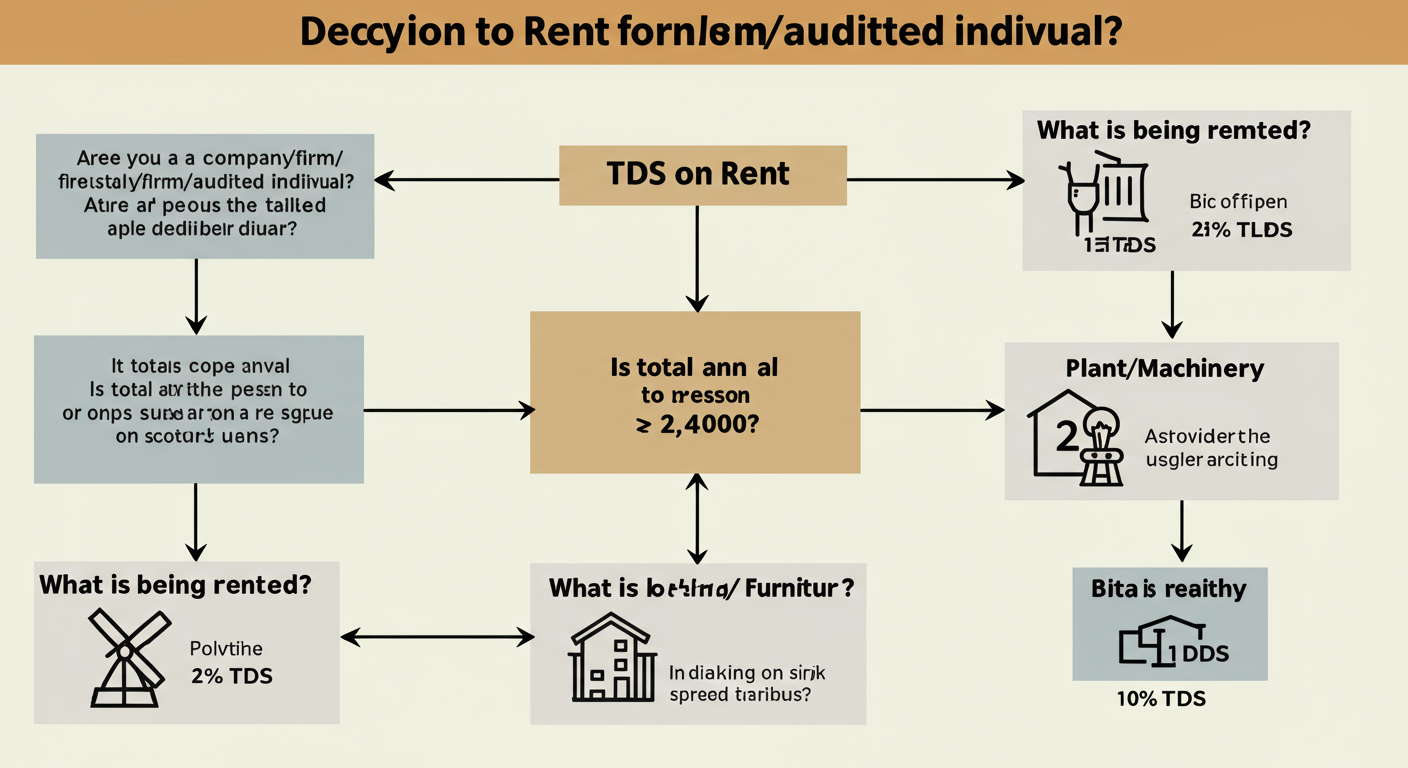
You don’t need to deduct TDS on every single rupee of rent. The rule is triggered only when the total rent paid or credited to a single person in a financial year exceeds ₹2,40,000.
Once you cross this threshold, the game changes. You must deduct TDS. But at what rate? This is where most of the confusion happens. The rate depends entirely on what you’re renting.
| Asset Type | Description | TDS Rate (2026) |
|---|---|---|
| Plant & Machinery / Equipment | Rent for using any machinery, industrial equipment, or specialized plant. | 2% |
| Land / Building / Furniture & Fittings | Rent for office space, factory buildings, land, or even just furniture. | 10% |
Getting this distinction right is critical. Misclassifying a building lease (10%) as an equipment lease (2%) can lead to a shortfall in deduction and attract interest and penalties.
💡 Pro Tip
What if your rent crosses the ₹2,40,000 threshold mid-year? For example, you pay ₹30,000/month. For the first 8 months, the total is ₹2,40,000. In the 9th month, the total becomes ₹2,70,000. According to tax guidelines, you must deduct TDS on the entire amount once the threshold is breached. The best practice is to deduct TDS for the full ₹2,70,000 in the 9th month, or even better, start deducting from month one if you project the annual rent will exceed the limit. This avoids a large one-time deduction.
⚠️ Watch Out
The PAN Trap! If your landlord (the payee) does not provide their Permanent Account Number (PAN), the rules change dramatically. As per Section 206AA of the Income Tax Act, you are required to deduct TDS at a flat, punitive rate of 20%, regardless of the asset type. Always insist on obtaining the landlord’s PAN before the first payment.
Section 194I vs. 194IB: A Clear Distinction
A common point of confusion is the difference between Section 194I and Section 194IB. They both deal with TDS on rent, but they apply to different people and have different rules. Think of 194I as the rule for businesses and 194IB as the rule for certain individuals.
Here’s a simple breakdown to clear things up for good:
| Parameter | Section 194I (For Businesses) | Section 194IB (For Individuals/HUF) |
|---|---|---|
| Who Deducts? (Payer) | Companies, Firms, and Individuals/HUFs subject to tax audit. | Individuals and HUFs not subject to tax audit. |
| Rent Threshold | Aggregate rent exceeds ₹2,40,000 per year. | Rent exceeds ₹50,000 per month. |
| TDS Rate | 2% for Plant/Machinery 10% for Land/Building/Furniture |
5% (or 3.75% for specified periods) on the total rent. |
| TAN Requirement | Mandatory. Deductor must have a TAN. | Not required. Deduction can be done using the payer’s PAN. |
| When to Deduct | At the time of credit or payment, whichever is earlier (usually monthly). | Only once a year, at the time of paying the last month’s rent. |
Based on hands-on testing and client queries, mixing these two sections up is one of the top reasons for compliance errors. If you run a business, your focus should be squarely on Section 194I.
🎯 Key Takeaway
For businesses, the magic number is ₹2,40,000 per year, per payee. If your rent exceeds this, you must deduct TDS: 10% for property and 2% for machinery. This is the core principle of Section 194I that drives all compliance.
The Compliance Playbook: Your Step-by-Step Guide for Section 194I
Knowing the rules is one thing; implementing them is another. Follow this battle-tested process to ensure your compliance is airtight.
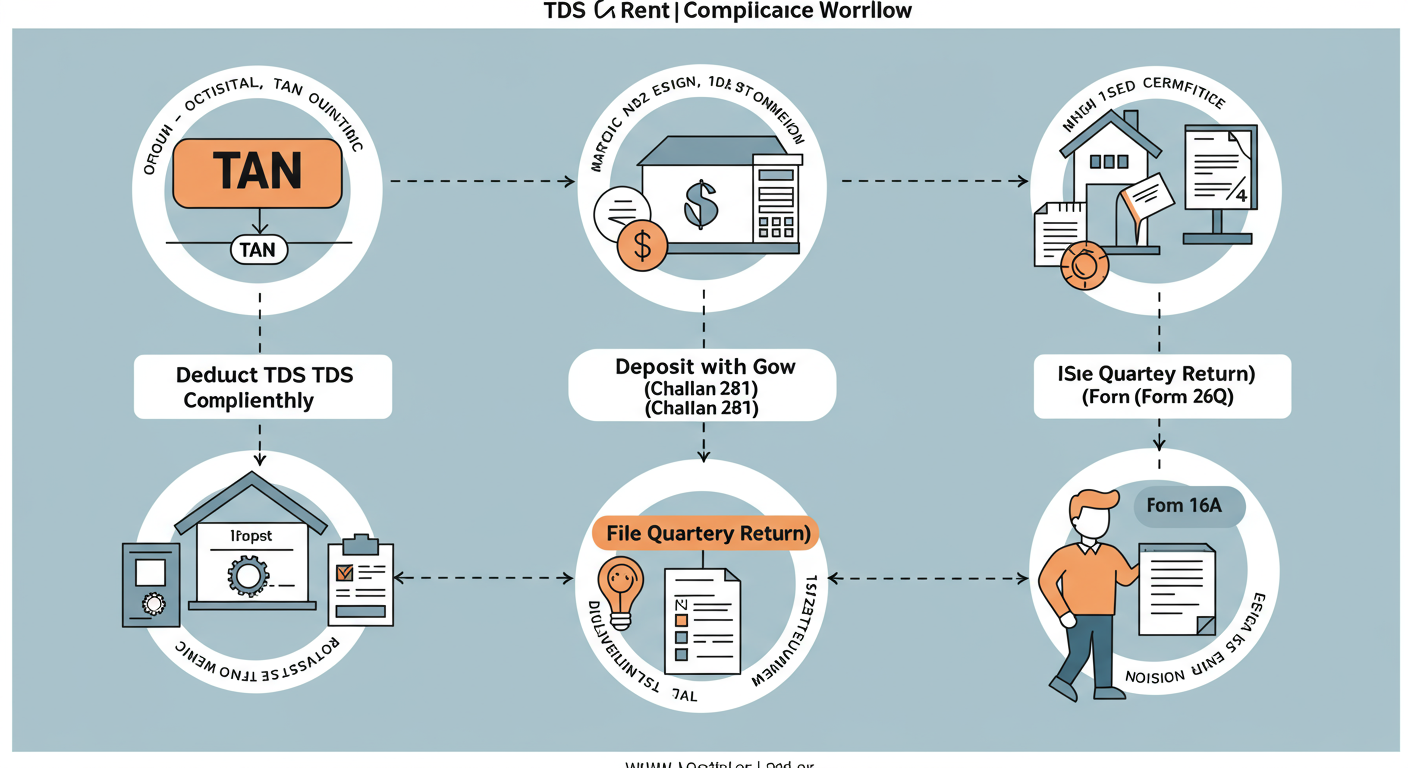
Step 1: Obtain a TAN (Tax Deduction Account Number)
This is your entry ticket. You cannot legally deposit TDS or file returns without a TAN. If you’re a new business, apply for this along with your PAN. It’s a one-time registration.
Step 2: Deduct TDS at the Correct Rate
Every time you credit rent to your landlord’s account in your books or make the actual payment (whichever comes first), calculate and set aside the TDS. Use 2% for plant/machinery and 10% for property. Remember the 20% rule if PAN is unavailable.
Step 3: Deposit the TDS with the Government
The tax you deducted isn’t your money. You’re just holding it for the government. You must deposit it using Challan ITNS 281. The deadlines are strict:
- For rent paid from April to February: By the 7th of the following month.
- For rent paid in March: You get an extended deadline until April 30th.
Step 4: File Your Quarterly TDS Return (Form 26Q)
Depositing the tax isn’t enough. You have to tell the government who you paid the rent to and how much tax you deducted. This is done by filing a quarterly statement called Form 26Q. The due dates are:
- April – June (Q1): July 31st
- July – Sept (Q2): October 31st
- Oct – Dec (Q3): January 31st
- Jan – March (Q4): May 31st
Step 5: Issue TDS Certificate (Form 16A) to Your Landlord
This is the final and crucial step. You must provide a TDS certificate, Form 16A, to your landlord. This form is their proof that tax has been paid on their behalf. They use it to claim credit when filing their own income tax return. You must issue this certificate within 15 days from the due date of filing your Form 26Q. 7 Major Startup India Tax Benefits That Can Save You Millions in 2025
💡 Pro Tip
Don’t manage this manually on spreadsheets. It’s a recipe for disaster. Modern accounting software (like Zoho Books, Tally Prime, etc.) has built-in TDS modules. Configure them to automatically calculate TDS on rent payments, generate challans, and even prepare the data for your Form 26Q filing. This automation is a lifesaver and a key E-E-A-T signal of a well-run business. PAS-6 Due Date 2026: Your Guide to Flawless Compliance
The High Cost of Getting It Wrong: Penalties & Disallowances
So, what’s the big deal if you miss a deadline or forget to deduct? The consequences are severe and designed to hurt.
1. Interest on Late Deduction/Deposit:
- Failure to Deduct: Interest at 1% per month from the date tax was deductible until the date it’s actually deducted.
- Failure to Deposit: Interest at 1.5% per month from the date of deduction until the date of deposit. This is a higher rate because you held onto the government’s money.
2. Late Filing Fee for Returns:
A penalty of ₹200 per day is levied for late filing of Form 26Q, up to the total amount of TDS.
3. The Ultimate Penalty: Expense Disallowance
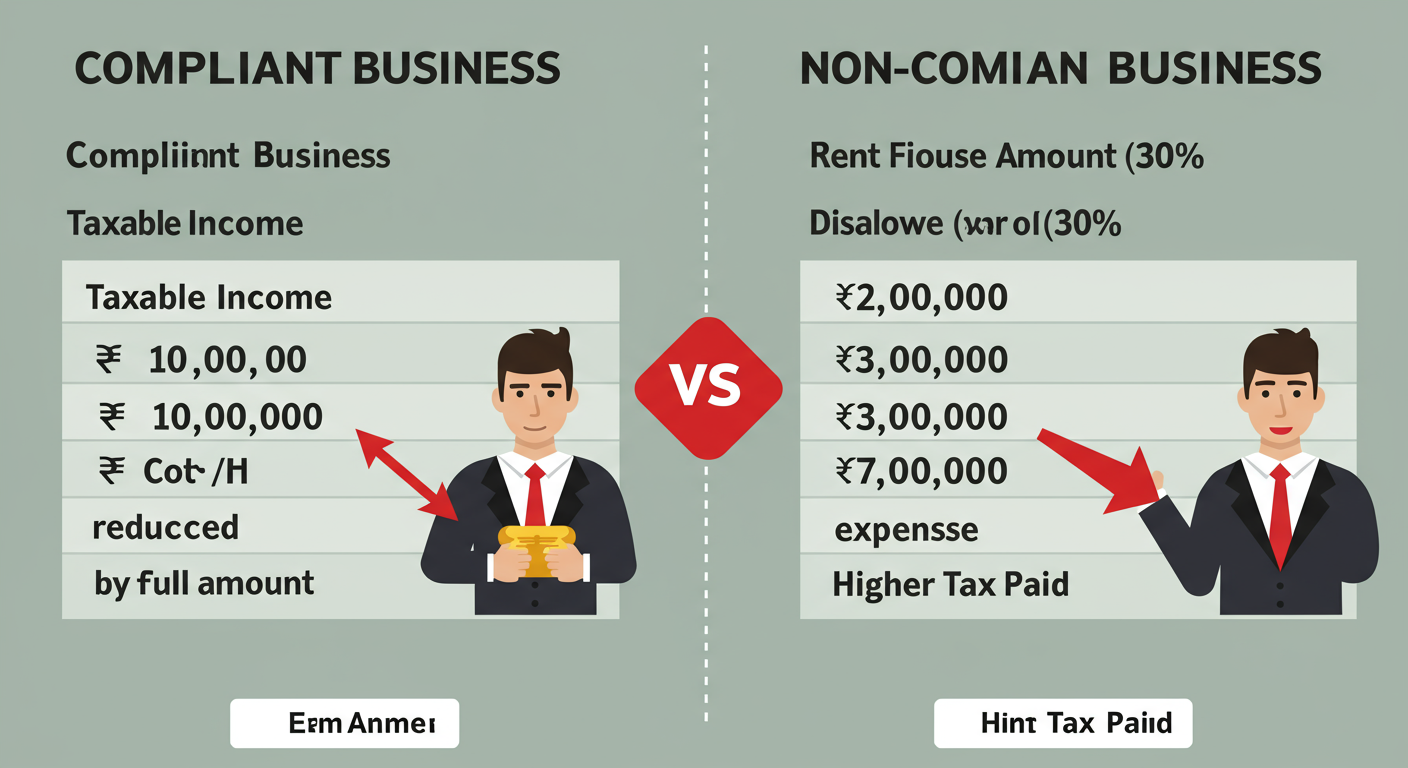
This is the one that truly stings. Under Section 40(a)(ia), if you fail to deduct TDS or fail to deposit the deducted TDS within the due date of filing your income tax return, 30% of your rent expenditure will be disallowed. This means you cannot claim it as a business expense, which directly increases your taxable profit and your final tax bill. For a rent of ₹10 lakh, that’s a ₹3 lakh expense disallowed!
Trust me on this one, I’ve seen a business pay over ₹1 lakh in extra tax simply because their accountant forgot to deposit the TDS for the last quarter on time. The disallowance is automatic and unforgiving.
⚠️ Watch Out
The “Composite Rent” Trap. What if your rent agreement includes charges for maintenance, electricity, or security? If these are billed separately and are not a mandatory part of the lease, you may only need to deduct TDS on the core rent component. However, if the agreement specifies a single, non-separable “composite” rent, the CBDT has clarified that TDS is applicable on the entire amount. When in doubt, it’s safer to deduct on the gross amount to avoid scrutiny.
Advanced Scenarios and Nuances
Tax law is never simple. Here are a few specific situations that often come up in our practice:
Rent Paid to Co-owners
What if the property is jointly owned by two people, say Mr. A and Mrs. A? The ₹2,40,000 threshold applies per payee. If the annual rent is ₹4,00,000 and the ownership is 50:50, you’re paying ₹2,00,000 to Mr. A and ₹2,00,000 to Mrs. A. Since neither payment exceeds the threshold, no TDS is required under Section 194I. However, you must have a clear agreement or proof of ownership share to justify this.
Payments to the Government
No TDS is required to be deducted on rent paid to the Government or to local/statutory authorities. This is a specific exemption.
Hotel Accommodation
Payments made to hotels for accommodation, especially for regular or long-term stays, are generally considered “rent” for the use of premises and are subject to TDS under Section 194I if the annual payments exceed the threshold. This is a frequently litigated area, but the conservative approach is to deduct TDS. For more on the legal definition of rent, you can explore the concept of rent in a broader economic context.
Conclusion: From Compliance Burden to Financial Advantage
Navigating TDS on rent payment Section 194I isn’t just about avoiding penalties. It’s about demonstrating financial discipline and building a trustworthy, compliant business. It’s a signal to investors, lenders, and the tax authorities that you run a tight ship.
Let’s recap your action plan:
- Identify your status: Are you a business entity or audited individual? If yes, Section 194I is for you.
- Track the threshold: Monitor your annual rent payments per landlord. The moment you project it will cross ₹2,40,000, start deducting.
- Apply the right rate: It’s a simple choice—10% for property, 2% for machinery. Don’t guess.
- Automate your process: Use accounting software to manage deductions, deposits, and reporting. Manual tracking is a risk you can’t afford.
By embedding these steps into your financial workflow, you transform TDS from a complex threat into a simple, manageable routine. Your future self—and your bottom line—will thank you for it.
❓ Frequently Asked Questions
Is TDS applicable if my total annual rent is exactly ₹2,40,000?
No. Section 194I states that TDS is applicable if the rent paid or payable exceeds ₹2,40,000. So, at exactly ₹2,40,000, no TDS is required. However, if it’s even one rupee over, TDS applies to the entire amount. From a practical standpoint, if your rent is close to the limit, it’s wise to be prepared for deduction.
Do I need a TAN to deduct TDS under Section 194I?
Yes, absolutely. A Tax Deduction and Collection Account Number (TAN) is mandatory for any entity deducting tax under Section 194I. You cannot deposit the tax or file the required Form 26Q return without it. This is a key difference from Section 194IB, where a TAN is not needed.
Does TDS on rent apply to the GST amount on the invoice?
No. The CBDT has clarified via Circular No. 23/2017 that TDS under Section 194I should be deducted on the base rent amount, exclusive of the GST component. You should deduct TDS only on the amount payable without including the GST. Ensure your landlord’s invoice clearly separates the base rent from the GST.
What happens if I pay a non-refundable security deposit? Is TDS applicable?
This is a tricky area. If a security deposit is genuinely refundable and does not have the character of income for the landlord, TDS is not applicable. However, if the deposit is non-refundable, it is treated as advance rent and is subject to TDS deduction in the year it is paid. Always review the terms of your lease agreement carefully.
My landlord is an NRI. Does Section 194I still apply?
No. Section 194I specifically applies to rent paid to a resident in India. If your landlord is a Non-Resident Indian (NRI), the TDS provisions are governed by Section 195, which has different rules and typically requires a higher rate of deduction (often 30% plus cess and surcharge). You can find more information on the official Income Tax Department portal.