Your startup is finally taking off. The late nights, the endless coffee, the “are we crazy?” moments—it’s all paying off. But now you’ve hit a wall. A big one. A venture capitalist loves your pitch but says, “We only invest in Private Limited companies.” Suddenly, your flexible, easy-to-manage LLP feels less like a launchpad and more like a cage.
Sound familiar? I’ve seen this exact scenario play out dozens of times. The LLP to Private Limited Company conversion isn’t just a bureaucratic chore; it’s a strategic rite of passage for businesses ready to scale. It’s the key that unlocks serious funding, top-tier talent, and global credibility.
Forget the dense legal jargon. This guide is your battle-tested roadmap. We’ll walk you through the entire process, step-by-step, showing you exactly how to navigate the conversion in 2026, avoid common pitfalls, and set your business up for explosive growth.
Why Bother? The Strategic Payoff of Conversion
Let’s be honest: nobody enjoys paperwork. So, why go through the hassle of an LLP to Private Limited Company conversion? The answer is simple: leverage. A Private Limited Company (PLC) structure gives you leverage that an LLP simply can’t offer.
Think of it this way. An LLP is a fantastic vehicle for starting out—it’s low on compliance and high on flexibility. But when you’re ready to hit the accelerator, you need a different kind of engine. A PLC is built for speed and scale. Based on our hands-on testing with numerous clients, the shift unlocks three critical growth levers:
- Access to Equity Funding: This is the big one. VCs, angel investors, and private equity firms overwhelmingly prefer to invest in companies, not LLPs. Why? Because companies can issue shares (equity). This clear ownership structure is non-negotiable for most institutional investors.
- Attracting Elite Talent with ESOPs: Want to hire the best engineers, marketers, and leaders? You need to offer more than just a salary. Employee Stock Option Plans (ESOPs) give your team a real stake in the company’s success. It’s a powerful retention tool, and it’s only available to companies.
- Enhanced Credibility and Trust: A Private Limited Company is subject to stricter disclosure and governance standards under the Companies Act, 2013. This transparency builds immense trust with international clients, lenders, and potential partners. It signals that your business is serious, stable, and professionally managed.
Here’s a direct comparison of the two structures when growth is your primary goal.
| Feature | Limited Liability Partnership (LLP) | Private Limited Company (PLC) |
|---|---|---|
| Equity Funding | Difficult; no concept of share capital. | Easy; can issue shares to investors. |
| Employee Incentives | Profit sharing only. | Can offer ESOPs. |
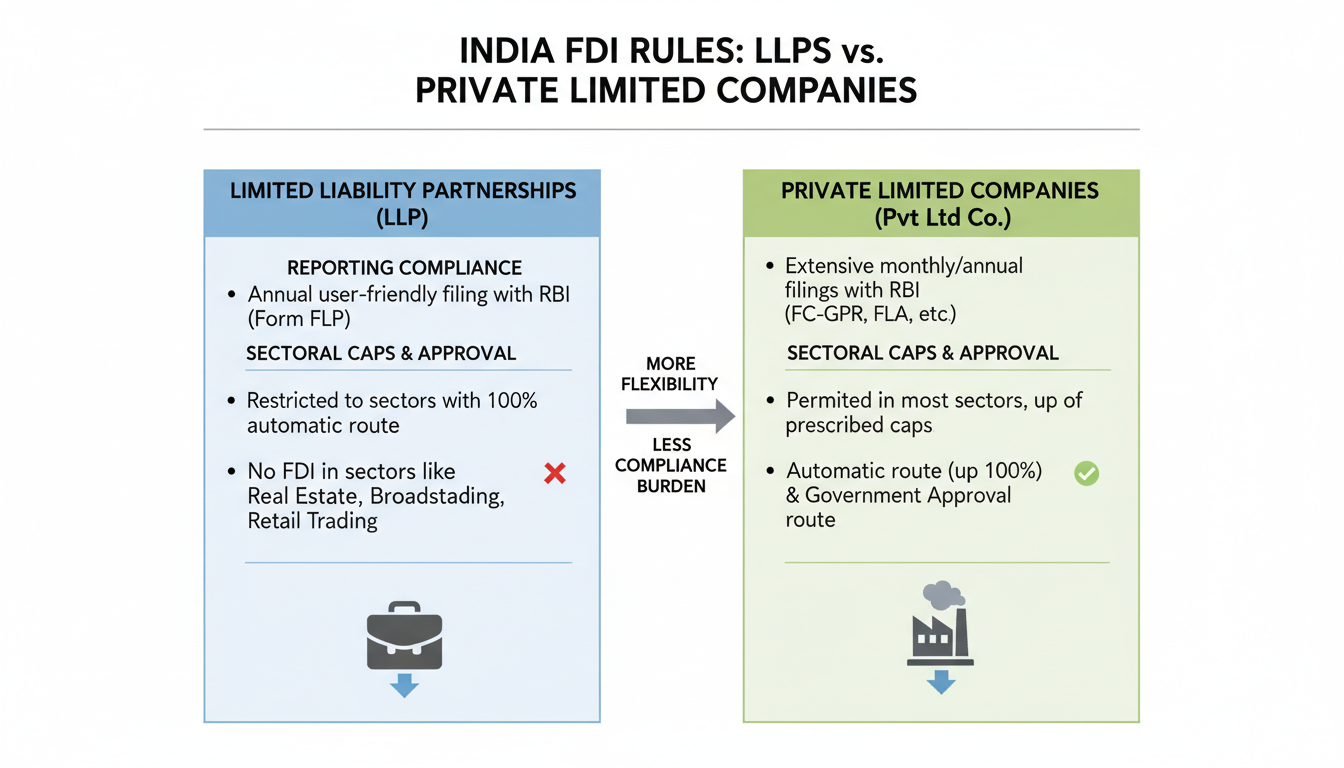
| Foreign Investment (FDI) | Allowed only in 100% automatic route sectors. | More flexible FDI options. |
| Governance & Compliance | Relatively simple and less stringent. | More structured and regulated. |
| Investor Preference | Low. | High. |
💡 Pro Tip
Don’t wait until an investor is at your door to start the conversion. The process takes 45-60 days. From our experience, initiating the conversion before you start actively fundraising shows foresight and preparedness, which seriously impresses potential investors.
Are You Ready? The Eligibility Checklist
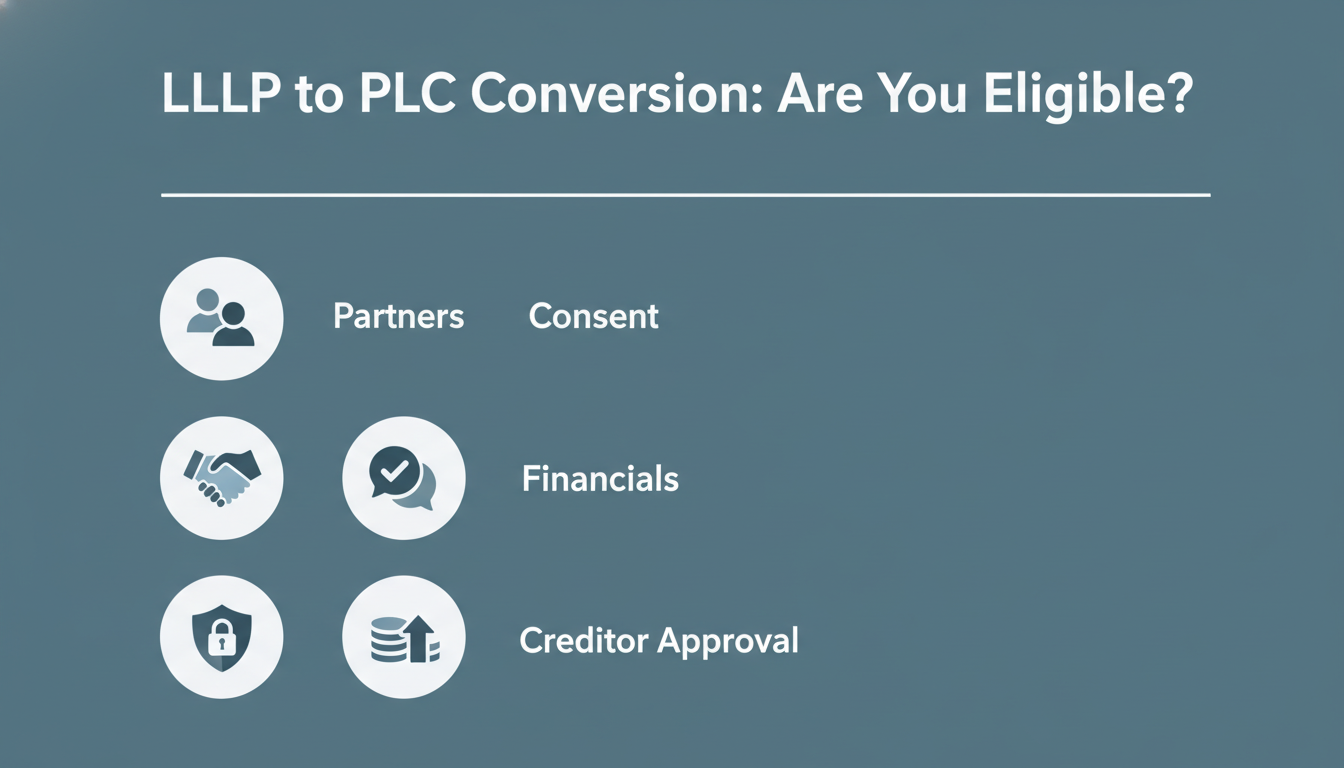
Before you dive in, you need to make sure your LLP is even eligible for conversion. Think of this as a pre-flight check. According to the rules laid out in Section 366 of the Companies Act, 2013, you must meet these core requirements. No exceptions.
- ✅ Minimum Partners: Your LLP must have at least two partners. For the new company, you’ll need a minimum of two shareholders.
- ✅ Partner Consent: This isn’t a solo decision. You need written consent from a majority of the partners, and in practice, it’s best to have unanimous agreement to avoid future disputes.
- ✅ Clean Financials: All required filings for the LLP, like Form 8 (Statement of Account & Solvency) and Form 11 (Annual Return), must be up-to-date with the Registrar of Companies (ROC).
- ✅ Secured Creditors’ Approval: If your LLP has any outstanding secured loans, you absolutely must obtain a ‘No Objection Certificate’ (NOC) from the lender.
⚠️ Watch Out
Unresolved compliance issues are conversion killers. We’ve seen applications get stuck for months because of a single overdue filing or a forgotten notice. Before you even think about converting, conduct a thorough internal audit of your LLP’s compliance history with the MCA. Fix everything first.
The Conversion Blueprint: A Step-by-Step Guide for 2026
Alright, you’ve decided to make the leap and you’ve confirmed your eligibility. Now for the main event. Here is the exact, field-tested process for a smooth LLP to Private Limited Company conversion.
Step 1: Hold a Partners’ Meeting & Pass a Resolution
This is the official starting line. Convene a formal meeting of all partners. The agenda is simple: formally resolve to convert the LLP into a Private Limited Company. In this meeting, you must also authorize two or more partners to handle all the paperwork and filings. Document everything meticulously in the meeting minutes—this is your first piece of evidence for the ROC.
Step 2: Reserve Your Company Name (SPICe+ Part A)
Next, you need a name for your new company. Most businesses simply change the suffix from “LLP” to “Private Limited” to maintain brand continuity. You’ll apply for name reservation through the MCA’s SPICe+ Part A web form. It’s a straightforward process, but the name must comply with the Companies (Incorporation) Rules, 2014.
Step 3: Publish the Newspaper Advertisement
This is a critical step that many people underestimate. You must publish a public notice about the proposed conversion in two newspapers:
- One in an English newspaper circulating in the district of your LLP’s registered office.
- One in a vernacular (local language) newspaper of that same district.
The notice, which is filed in Form URC-2, essentially informs the public and creditors of the change and gives them 21 days to raise objections. Keep the original newspaper clippings—you’ll need them for your application.
Step 4: File the Magic Forms: URC-1 and SPICe+ Part B
Once the 21-day notice period is over and you (hopefully) have no objections, it’s time to file the main application with the ROC. This is a combined submission:
- Form URC-1: This is the primary application for conversion. It contains details of the LLP, partners, and the resolution. You’ll attach a ton of documents to this, including the newspaper ads, creditor NOCs, and a statement of assets and liabilities.
- SPICe+ Part B: This is the integrated incorporation form for the new company. It includes the application for Director Identification Numbers (DINs), PAN, and TAN, and is filed along with the electronic Memorandum of Association (e-MOA) and Articles of Association (e-AOA).
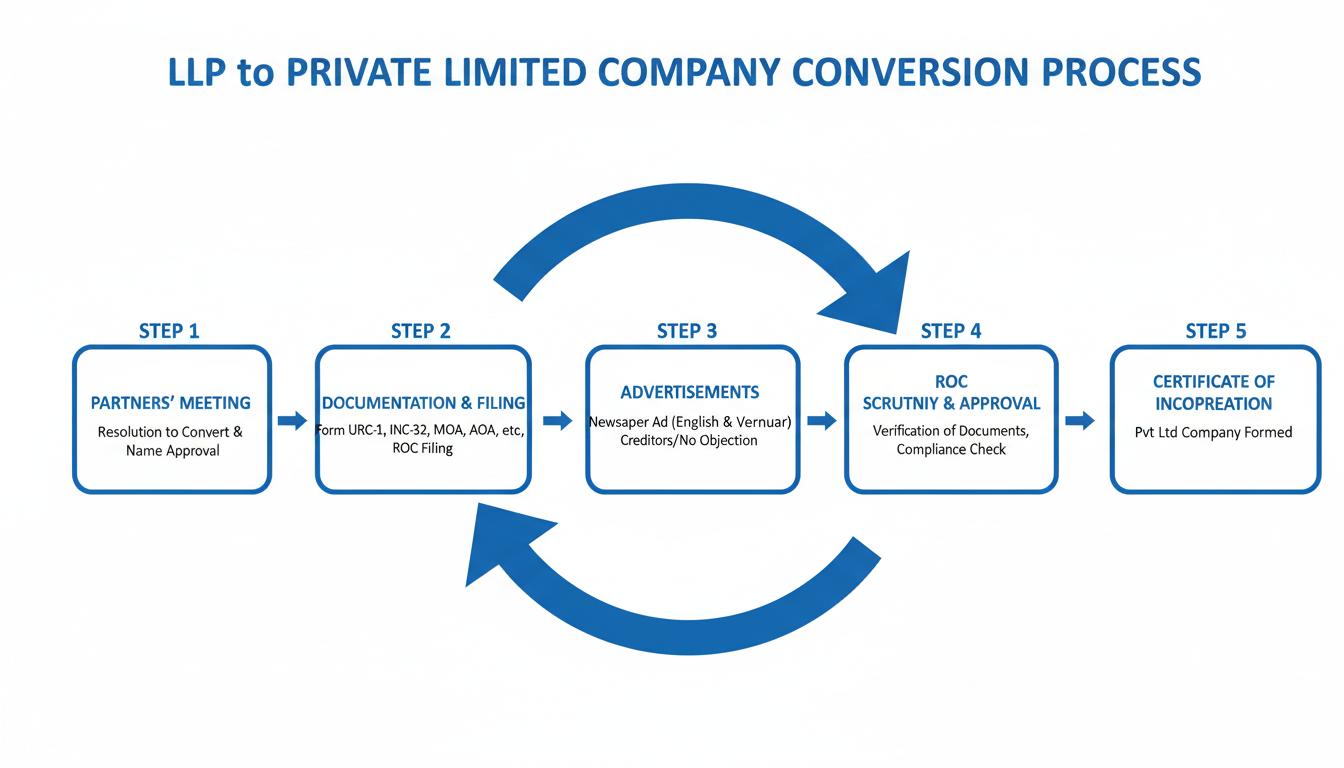
Step 5: Scrutiny by ROC and Certificate of Incorporation
After you submit the forms, an officer at the ROC will scrutinize your application. If everything is in order, they will approve the forms and issue the Certificate of Incorporation for your new Private Limited Company. Congratulations! Your LLP is now legally dissolved, and all its assets, liabilities, rights, and obligations are automatically vested in the new company. There’s no need for a separate transfer deed. It’s a seamless legal transition.
🎯 Key Takeaway
The conversion from an LLP to a Private Limited Company is not just a legal change, but a fundamental business transformation. It’s a strategic move that unlocks access to equity funding and top-tier talent via ESOPs, positioning your company for serious, scalable growth.
Navigating the Paperwork Maze: Your Document Checklist
A successful conversion hinges on meticulous documentation. Missing a single paper can delay your application by weeks. Here’s a summary of what you’ll need to gather. 12 Common Income Tax Filing Mistakes to Avoid This Assessment Year
| Document | Purpose | Who Prepares It? |
|---|---|---|
| LLP Agreement & Incorporation Certificate | Proves the existence and constitution of the LLP. | Partners |
| Statement of Assets & Liabilities | Shows the financial position of the LLP. Must be certified by a CA and not older than 30 days. | Chartered Accountant (CA) |
| List of Partners & Directors | Details of all partners of the LLP and the proposed first directors of the company. | Partners |
| Consent of Proposed Directors (DIR-2) | Formal consent from individuals to act as directors. | Proposed Directors |
| Newspaper Advertisement Clippings | Proof of public notice. | Partners |
| No Objection Certificate (NOC) | Approval from secured creditors, if any. | Lenders/Creditors |
💡 Pro Tip
Create a dedicated cloud folder (like Google Drive or Dropbox) for all your conversion documents. Scan and upload everything as you get it. This creates a single source of truth and makes it incredibly easy to share documents with your CA or legal consultant, preventing last-minute scrambles. Mastering the GST Amendment Online Process: A Comprehensive Step-by-Step Guide
The FDI Factor: When the RBI Gets Involved
Does your LLP have foreign partners or Foreign Direct Investment (FDI)? If so, pay close attention. This adds another layer of compliance to your conversion. How to File ITR-1 Online India: A Complete Step-by-Step Guide for Salaried Employees
Under the Foreign Exchange Management Act (FEMA), the rules for FDI in LLPs are stricter than for companies. While the conversion itself is generally permitted, you must ensure compliance with the guidelines set by the Reserve Bank of India (RBI). After the conversion, the capital held by foreign investors is reclassified from “capital contribution” in an LLP to “equity shares” in a company.
This change must be reported to the RBI. You’ll need to file Form FC-GPR (Foreign Currency – Gross Provisional Return) within 30 days of the allotment of shares in the new company. This is a mandatory reporting requirement.
⚠️ Watch Out
Failing to report the change in foreign investment to the RBI is a serious offense under FEMA and can lead to significant penalties. Don’t assume the ROC’s approval covers your RBI obligations. They are two separate compliances. Always consult with a professional who has experience in FEMA matters.
Life After Conversion: The Critical First 90 Days
Getting the Certificate of Incorporation feels like the finish line, but it’s not. Your work has just begun. The first 90 days are critical for ensuring a smooth operational transition.
“The conversion is the legal event, but the integration is the business reality. How you manage the post-conversion phase determines whether you truly capitalize on the new structure.”
Here’s your immediate to-do list:
- Apply for New PAN and TAN: The legal entity has changed, so you’ll need a new Permanent Account Number (PAN) and Tax Deduction and Collection Account Number (TAN) for the company.
- Update Bank Account Details: Visit your bank with the Certificate of Incorporation and new PAN to convert your LLP’s bank account to a corporate account.
- Modify GST and Other Registrations: Update your GST registration with the new company details. Do the same for all other licenses and registrations (e.g., MSME, Startup India, Professional Tax).
- Inform Everyone: Proactively communicate the change in legal status to your clients, vendors, employees, and other stakeholders. Update your letterheads, website, and contracts.
Your Next Move
An LLP to Private Limited Company conversion is a powerful, strategic pivot. It’s your declaration to the world—and to investors—that you’re no longer just playing the game; you’re playing to win.
Yes, it involves legal steps and careful paperwork. But the rewards—access to capital, the ability to attract world-class talent, and the credibility to operate on a global stage—are immense. You’ve built your business from the ground up. Now it’s time to give it the corporate structure it needs to fly.
Your immediate next step? Don’t just jump into filing forms. Start with a simple internal audit. Review your LLP’s compliance status and partner agreements. A clean foundation makes for a smooth and successful conversion.
❓ Frequently Asked Questions
Can a 2-partner LLP convert into a Private Limited Company?
Absolutely. An LLP with a minimum of two partners can convert into a Private Limited Company with a minimum of two shareholders. The existing partners can become the initial shareholders and directors of the new company.
What happens to the LLP’s existing contracts and debts after conversion?
They are automatically transferred to the new Private Limited Company. By operation of law under the Companies Act, 2013, all assets, liabilities, rights, and obligations of the LLP are vested in the newly formed company. Your contracts remain valid.
Will the PAN of the business change after conversion?
Yes, in almost all cases. The conversion creates a new legal entity in the eyes of the Income Tax Department. You will need to apply for a new PAN and TAN for the Private Limited Company immediately after receiving the Certificate of Incorporation.
How long does the entire LLP to Private Limited Company conversion process take in 2026?
From our experience, a realistic timeline is between 45 to 60 days. This includes the mandatory 21-day newspaper advertisement period, name approval, form processing by the ROC, and potential queries. Starting with all documents in order is the best way to speed up the process.
Is it better to start a new company instead of converting the LLP?
It depends. Conversion offers the major advantage of continuity—all assets, liabilities, brand recognition, and history are transferred seamlessly. Starting a new company means you have to manually transfer assets, renegotiate contracts, and you lose the business’s operational history, which can be a significant drawback.
Read Also:
- India Startup Guide 2026: Pvt Ltd Secrets
- Avoid Tax Penalties: Your 2026 194Q Guide
- Pvt Ltd Company Registration in India: The 2026 Founder’s Playbook
- Form 3 LLP Filing in 2026: A Guide to Avoid Costly Penalties
- Form ADT 1 Filing: The Ultimate 2026 Guide to Compliance – Visual Story
- Form 11 LLP Filing 2026: A Complete Guide to Annual Returns
- MGT-7 Due Date 2026: A Guide to Filing & Avoiding Penalties