Navigating the TDS Rate Chart FY 2025-26 India: Why Compliance Matters
For small and medium-sized enterprises (SMEs) operating in India, managing finances goes beyond profit and loss; it involves strict adherence to tax regulations. One of the most critical compliance areas is Tax Deducted at Source (TDS). TDS is not merely a formality; it’s a mandatory obligation where the deductor (your business) must withhold tax at specified rates before making certain payments to the deductee (recipient).
The Financial Year (FY) 2025-26, which covers the period from April 1, 2024, to March 31, 2025, requires meticulous attention to the updated rates and thresholds. Failing to correctly implement the TDS rate chart FY 2025-26 India can result in significant penalties, interest charges, and legal complications. This comprehensive guide breaks down the essential rates and rules, ensuring your business stays compliant and avoids unnecessary financial risk.
What is TDS and Who Needs to Deduct It?
TDS is an advance tax mechanism designed to collect tax at the source of income. It applies to various payments, including salaries, interest, commission, professional fees, rent, and payments to contractors. If your business falls under the purview of tax audit requirements or exceeds specific turnover thresholds, you are generally required to deduct TDS.
Crucial Insight: While the rates themselves have remained largely stable across the last few budgets for standard sections, understanding the ever-changing threshold limits is the biggest challenge for small businesses. A minor change in a threshold can shift an entire payment category from non-TDS to mandatory deduction.
The Role of the Deductor
The deductor is the person or entity making the payment (your business). They are legally responsible for deducting the correct tax rate, depositing it with the government, and issuing Form 16/16A.
The Role of the Deductee
The deductee is the recipient of the payment. The amount deducted as TDS is credited against their final income tax liability when they file their annual return.
Importance of TAN
Every person required to deduct TDS must obtain a Tax Deduction and Collection Account Number (TAN). This 10-digit alpha-numeric number is mandatory for all TDS compliance activities.
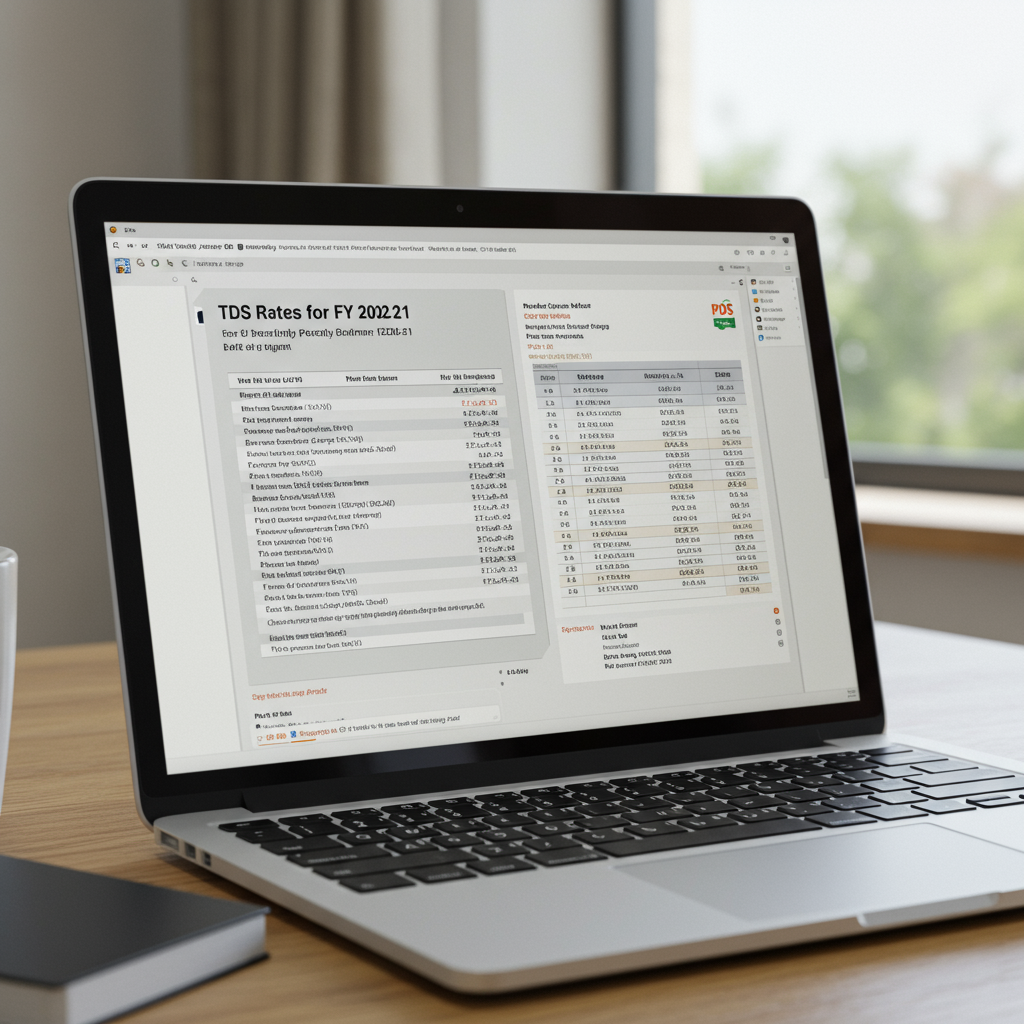
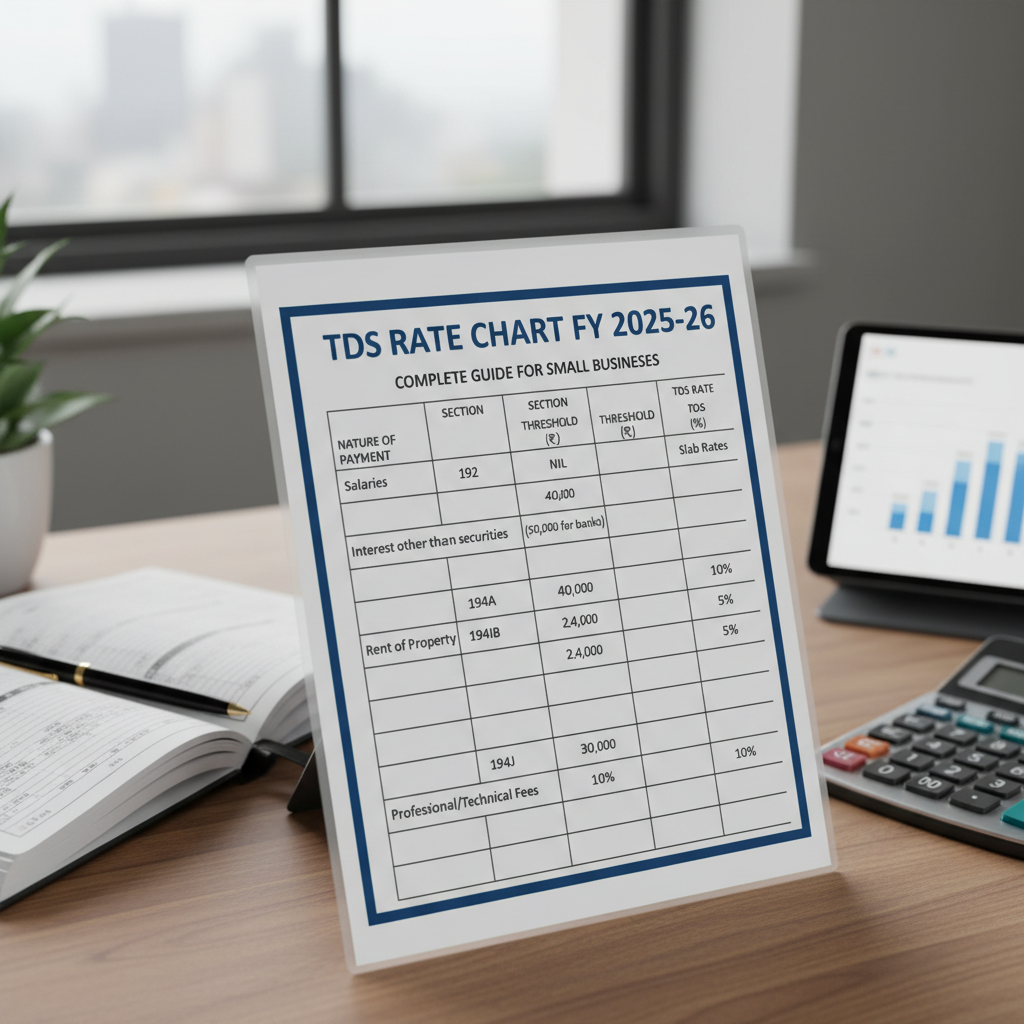
The Essential TDS Rate Chart FY 2025-26 India (Key Sections)
The following table outlines the most frequently used sections of the Income Tax Act for TDS deduction, along with their respective rates and applicable thresholds for the TDS rate chart FY 2025-26 India. Note that these rates apply when the deductee furnishes a valid PAN. If PAN is not provided, the rate defaults to 20% (or the applicable rate, whichever is higher), as mandated under Section 206AA.
Note: Unless otherwise specified, the rates mentioned below do not include Health and Education Cess or Surcharge, which are generally applicable only when the payment exceeds specified high limits.
Section 194A: Interest (Other than Securities)
- Rate: 10%
- Threshold: ₹40,000 (for banks, cooperative societies, and post offices) or ₹5,000 (in other cases).
- Applicability: Interest paid on loans, fixed deposits (FDs), or other advances.
Section 194C: Payment to Contractors
- Rate: 1% (if paid to an individual/HUF) or 2% (if paid to a company/firm).
- Threshold: ₹30,000 (single transaction) or ₹1,00,000 (aggregate during the FY).
- Applicability: Payments for work contracts, advertising, broadcasting, catering, manufacturing/supplying a product using materials purchased by the customer.
Section 194H: Commission or Brokerage
- Rate: 5%
- Threshold: ₹15,000
- Applicability: Payments made as commission (excluding insurance commission) or brokerage.
Section 194I: Rent
- Rate: 2% (Rent for plant, machinery, or equipment) or 10% (Rent for land, building, or furniture).
- Threshold: ₹2,40,000 per annum.
- Applicability: Rent paid by the business to the landlord.
Section 194J: Professional or Technical Services
- Rate: 10% (General professional fees, director fees, royalty, non-compete fees).
- Rate: 2% (Fees for technical services, royalty in the nature of computer software, payments to call centers).
- Threshold: ₹30,000 (aggregate during the FY).
Section 194M: Payments to Resident Professionals/Contractors (Non-Audit Cases)
- Rate: 5%
- Threshold: ₹50,00,000 (₹50 Lakh)
- Applicability: Payments made by individuals or HUFs (not subject to Section 194C, 194H, or 194J) for contractual work or professional fees, where the payment exceeds ₹50 Lakh.
Understanding the Impact of Non-PAN Compliance
One of the most stringent provisions in the Income Tax Act is related to the failure to quote or furnish PAN. Section 206AA mandates that if the recipient (deductee) fails to provide their PAN, the tax must be deducted at the higher of the following rates:
- The rate specified in the relevant provision of the Act.
- The rate or rates in force.
- 20%.
For most payments covered under the TDS rate chart FY 2025-26 India, this effectively means a default rate of 20%. This high rate acts as a strong incentive for businesses to ensure that all vendors, contractors, and service providers furnish their correct PAN details before any payment is processed.
Practical Examples for Small Business Owners
Example 1: Payment to an Individual Contractor (Section 194C)
A small business hires Mr. Sharma (an individual) for a one-time renovation project costing ₹45,000. Since this single payment exceeds the ₹30,000 threshold, TDS is applicable.
- Payment Amount: ₹45,000
- Applicable Rate (Individual): 1%
- TDS Amount Deducted: ₹45,000 * 1% = ₹450
- Net Payment to Mr. Sharma: ₹44,550
If the business had paid Mr. Sharma ₹25,000 in April and then another ₹25,000 in June (total ₹50,000), TDS would apply to the second payment, as the aggregate crosses the ₹30,000 limit.
Example 2: Rent Payment for Office Space (Section 194I)
Your business pays ₹25,000 per month for office rent (a building). The annual rent totals ₹3,00,000, which exceeds the ₹2,40,000 threshold.
- Monthly Rent: ₹25,000
- Applicable Rate (Building Rent): 10%
- Monthly TDS Deducted: ₹25,000 * 10% = ₹2,500
- Net Monthly Payment to Landlord: ₹22,500
Other Important Sections in the TDS Rate Chart FY 2025-26 India
While Sections 194A, C, H, I, and J cover the majority of SME transactions, businesses must also be aware of other specialized sections, particularly those related to digital commerce and property.
Section 194O: E-commerce Operator
- Rate: 1%
- Applicability: TDS on sales or services facilitated by an e-commerce operator. This is mandatory for the operator when making payments to the e-commerce participant.
Section 194Q: Purchase of Goods
- Rate: 0.1%
- Applicability: Applies if the buyer’s turnover exceeds ₹10 crore and the total purchases from a single seller exceed ₹50 Lakh during the FY. This is a crucial section for large traders and manufacturers.
Section 194IA: TDS on Sale of Property
- Rate: 1%
- Applicability: Applicable when the consideration for the transfer of immovable property (excluding agricultural land) exceeds ₹50 Lakh. The buyer must deduct TDS. For detailed guidance, you might refer to resources on Form 26QB TDS on Sale of Property.
Compliance Checklist: Ensuring Timely Deduction and Deposit
The duty of the deductor does not end with merely deducting the tax. Timely deposit and accurate filing are equally important. Failure in any step attracts interest and penalties.
TDS Deposit Deadlines
TDS deducted must be deposited with the Central Government within the following deadlines:
- Non-Government Deductors: By the 7th of the following month in which the deduction was made.
- March Deduction: For tax deducted in March, the deadline is extended to April 30th.
Quarterly TDS Return Filing
Businesses must file quarterly TDS returns (Form 24Q for salaries and Form 26Q for non-salary payments). These returns summarize the tax deducted, the PANs of the deductees, and the deposit challan details. Ensure timely filing using professional TDS Return Filing Services to avoid penalties under Section 234E.
As the Income Tax Department states, “Tax compliance is built on the principle of self-assessment and timely contribution. Accurate TDS deduction is the first line of defense against future tax demands.”
Leveraging Lower Deduction Certificates (LDC)
Sometimes, the statutory rate prescribed in the TDS rate chart FY 2025-26 India might be too high for the recipient, potentially leading to a large refund claim later. To address this, the deductee can apply to the Assessing Officer for a Lower Deduction Certificate (LDC) under Section 197.
What is an LDC?
An LDC permits the deductor to deduct TDS at a lower rate (even zero percent) than the standard rate, based on the recipient’s estimated low tax liability for the financial year.
Deductor’s Responsibility
If a deductee provides a valid LDC, the deductor must verify its authenticity and apply the specified lower rate. The certificate details must be accurately recorded during TDS return filing.
Non-Availability of LDC
If an LDC expires or is not furnished, the deductor must revert to the standard statutory rates applicable for FY 2025-26.
Avoiding Penalties and Interest: A Critical Overview
Small businesses often face penalties due to errors in calculation or delay in deposit. Understanding these consequences is paramount to maintaining good standing with the tax authorities.
- Failure to Deduct or Short Deduction: If TDS is not deducted, or deducted at a lower rate than required by the Income Tax Act, the business is liable to pay interest at 1% per month from the date the tax was deductible until the date of actual deduction.
- Failure to Deposit after Deduction: If the tax is deducted but not deposited on time, the interest rate jumps to 1.5% per month from the date of deduction until the actual date of deposit.
- Late Filing of TDS Returns: Late filing attracts a fee of ₹200 per day until the return is filed, though the total penalty cannot exceed the amount of TDS deductible.
- Incorrect PAN: Errors in PAN can lead to non-credit of TDS to the deductee and potential penalties for the deductor.
For more official guidance on the statutory rates and provisions, businesses should regularly consult the official Income Tax Department of India website.
Conclusion: Mastering the TDS Rate Chart FY 2025-26 India
For small businesses, tax compliance is often perceived as complex, but accurate TDS management simplifies year-end filing for both the business and its vendors. By diligently applying the correct rates from the TDS rate chart FY 2025-26 India, adhering to the specified thresholds, and ensuring timely deposit and return filing, you can safeguard your business against financial penalties and contribute effectively to the nation’s tax framework. Regular internal audits and the use of specialized Income Tax resources are highly recommended to ensure continuous compliance throughout the financial year.
FAQs
The primary consequence is that your business will be liable to pay interest at 1% per month from the date the tax was deductible until the date of actual deduction. Furthermore, the entire expenditure related to that payment may be disallowed as a business expense under Section 40(a)(ia), leading to a higher taxable income.
Generally, TDS is not required to be deducted on the Goods and Services Tax (GST) component of an invoice, provided the GST component is shown separately in the bill or invoice. TDS should only be calculated on the base value of the goods or services supplied (excluding GST).
Yes, if the aggregate rent paid to a resident individual or entity exceeds the threshold of ₹2,40,000 during the financial year (FY 2025-26), you must deduct TDS under Section 194I at 10% (for building/land). There is a separate provision (Section 194IB) for individuals/HUFs not subject to tax audit, but most businesses follow 194I.
If the deductee fails to provide a PAN, you must deduct TDS at the higher of the statutory rate or 20%, as per Section 206AA. It is crucial to enforce PAN submission, as deducting at 20% can cause significant friction with vendors.
Section 192 (TDS on Salary) does not have a fixed rate chart; instead, the employer must deduct tax based on the employee’s applicable income tax slab rates (either the old regime or the new, default regime), taking into account declarations, investments, and exemptions. The rates are the standard income tax slab rates defined in the Finance Act.
The deductee can check the credit of the TDS deducted by your business in their Form 26AS, which is accessible through the income tax e-filing portal. This form reflects all tax credits associated with their PAN, provided you filed your quarterly TDS return (26Q or 24Q) correctly and on time.
Read Also:
- How to Change Business Address in GST Registration Online: The Definitive Guide
- ROC Annual Filing 2026: AOC-4 and MGT-7 Due Dates and Penalties
- Trade License Registration: State-wise Requirements and Process in India
- FCRA Registration for NGOs: Eligibility and Application Process
- 10 Crucial Facts About NRI Taxation in India: The 2025 Comprehensive Guide
- 11 Best Tax Saving Investments India: The Ultimate 2025 Guide to Wealth Creation
- Is Your 2026 Valuation a Tax Bomb?
- Form 16B Password 2026: Unlock Your TDS Certificate Instantly
- Beat Crippling ROC Fines in 2026
- ITR-2 Form Guide for 2026: Who MUST File It (And Why)