From 1 April 2026, the Income-tax Act, 2025 replaced the Income-tax Act, 1961. Familiar TDS sections such as 194C, 194H, 194J and 194Q now sit inside two consolidated provisions, and the return forms have new numbers. This guide maps old to new so you can deduct, deposit and report TDS correctly in tax year 2026-27.
Quick answer
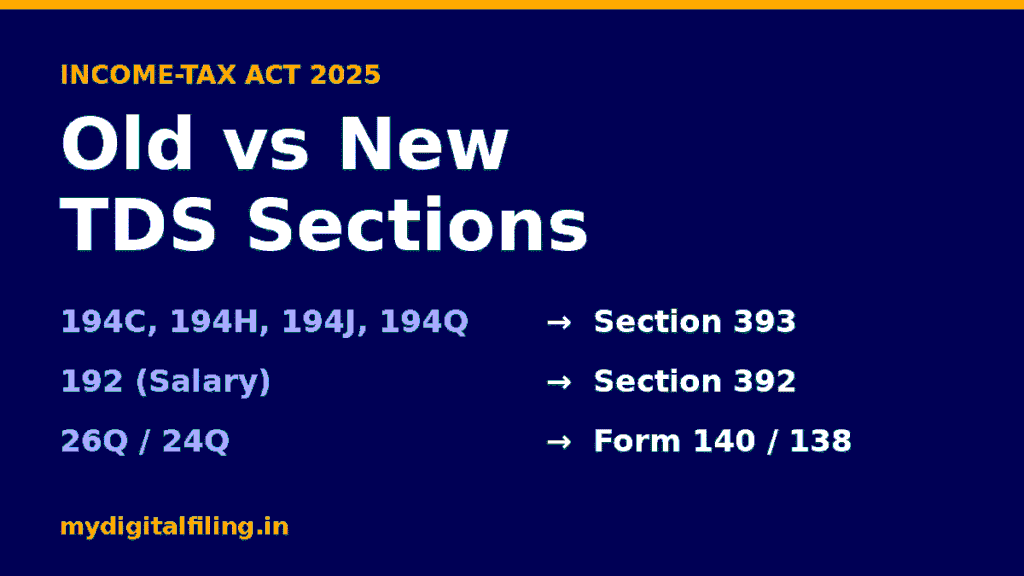
Under the Income-tax Act, 2025, TDS on salary is in section 392 and most other TDS provisions are in section 393, arranged in tables. Old 194Q (purchase of goods) is now section 393(1), Table Sl. No. 8(ii); old 194H (commission) is section 393(1), Table Sl. No. 1(ii). Returns 24Q, 26Q and 27Q are now Forms 138, 140 and 144, and Form 16/16A are now Forms 130/131.
Key takeaways
- The Income-tax Act, 2025 applies from 1 April 2026. “Tax year” replaces “previous year” and “assessment year”.
- For payments from 1 April 2026, quote the new provision, e.g. “section 393(1) [Table: Sl. No. 6(i)]” instead of 194C.
- Amounts paid or credited on or before 31 March 2026 stay under the 1961 Act, including the Q4 FY 2025-26 returns in the old forms.
- Rates and thresholds from the Budget 2025 changes carry over, such as ₹20,000 for commission and ₹50,000 for professional fees.
What changed under the Income-tax Act, 2025
The Income Tax Department’s FAQs on the transition to the Income-tax Act, 2025 say that the TDS sections from 192 to 194T are now consolidated under two sections: section 392 for salary and section 393 for other payments. Section 393 is split by type of payee:
- Section 393(1): payments to residents (commission, rent, interest, contractors, fees, goods).
- Section 393(2): payments to non-residents (old section 195 and related provisions).
- Section 393(3): payments to any person, such as lottery winnings, cash withdrawals and partner remuneration.
Each item is identified by its table serial number, so “194J” becomes “section 393(1) [Table: Sl. No. 6(iii)]”. Quoting old section numbers for payments after 1 April 2026 can cause processing errors.
“Tax year” replaces previous year and assessment year
Income earned from 1 April 2026 to 31 March 2027 is “Tax Year 2026-27”, the term used on challans, returns and certificates.
Old TDS sections vs new provisions: mapping table (tax year 2026-27)
Based on section 393 published on the Income Tax Department website. Rates are basic rates; a higher rate applies where the payee has no PAN.
| Old section (1961 Act) | New provision (2025 Act) | Nature of payment | Threshold | Rate (TY 2026-27) |
|---|---|---|---|---|
| 192 | Section 392 | Salary | Income above the basic exemption limit | Slab rates |
| 194A | 393(1) Sl. No. 5(ii) and 5(iii) | Interest other than on securities | ₹50,000 from banks, co-operative banks and post office (₹1,00,000 for senior citizens); ₹10,000 in other cases | 10% |
| 194C | 393(1) Sl. No. 6(i) | Payments to contractors and sub-contractors | ₹30,000 single payment or ₹1,00,000 in aggregate | 1% (individual/HUF), 2% (others) |
| 194H | 393(1) Sl. No. 1(ii) | Commission or brokerage (other than insurance commission) | ₹20,000 | 2% |
| 194-I | 393(1) Sl. No. 2(ii) | Rent: plant and machinery / land, building, furniture | ₹50,000 per month or part of a month | 2% / 10% |
| 194-IB | 393(1) Sl. No. 2(i) | Rent paid by individuals/HUFs not covered above | ₹50,000 per month or part of a month | 2% |
| 194-IA | 393(1) Sl. No. 3(i) | Transfer of immovable property (not agricultural land) | ₹50 lakh | 1% of consideration or stamp duty value, whichever is higher |
| 194J | 393(1) Sl. No. 6(iii) | Fees for professional or technical services, royalty, director’s fees | ₹50,000 (nil for director’s remuneration) | 2% (technical services, call centre, film royalty), 10% (others) |
| 194M | 393(1) Sl. No. 6(ii) | Contract work, commission or professional fees paid by individuals/HUFs | ₹50 lakh | 2% |
| 194Q | 393(1) Sl. No. 8(ii) | Purchase of goods by a buyer | ₹50 lakh from one seller in the tax year | 0.1% on the amount above ₹50 lakh |
| 194R | 393(1) Sl. No. 8(iv) | Benefit or perquisite arising from business or profession | ₹20,000 | 10% of value |
| 194S | 393(1) Sl. No. 8(vi) | Transfer of virtual digital assets | As per the table and notes | 1% |
| 195 | 393(2) Sl. No. 17 | Other sums payable to non-residents (not salary) | No threshold | Rates in force or DTAA rate |
About payment codes: Some software and websites show a four-digit “payment code” for each table item. We have not found an official CBDT list of these codes, so none are printed here. Pick the nature of payment from the drop-down on the e-Pay Tax challan and the return utility, and check the official mapping table before relying on any third-party code list.
194Q under the new Act
Old 194Q is now section 393(1), Table Sl. No. 8(ii). A buyer whose business turnover exceeded ₹10 crore in the preceding year deducts 0.1% on purchases from a resident seller above ₹50 lakh in the year, at credit or payment, whichever is earlier. It does not apply where tax is deductible or collectible under another provision. For a detailed explanation of the conditions, read our Section 194Q guide.
194H under the new Act
Old 194H is now section 393(1), Table Sl. No. 1(ii). TDS is 2% on commission or brokerage once the total paid to a person crosses ₹20,000 in the tax year. Insurance commission is a separate item, Sl. No. 1(i).
Old TDS return forms vs new form numbers
The Income-tax Rules, 2026 renumbered all TDS and TCS forms. The mapping below is taken from the Department’s FAQs on forms under the Income-tax Rules, 2026.
| Old form | New form | Purpose | Due date |
|---|---|---|---|
| 24Q | Form 138 | Quarterly TDS statement for salary | 31 July, 31 October, 31 January, 31 May |
| 26Q | Form 140 | Quarterly TDS statement for non-salary payments to residents | 31 July, 31 October, 31 January, 31 May |
| 27Q | Form 144 | Quarterly TDS statement for payments to non-residents | Check the official FAQs |
| 27EQ | Form 143 | Quarterly TCS statement | Check the official FAQs |
| 16 | Form 130 | TDS certificate for salary | By 15 June after the tax year |
| 16A | Form 131 | TDS certificate for non-salary payments | Within 15 days of the quarterly statement due date |
| 26QB, 26QC, 26QD, 26QE | Form 141 | Challan-cum-statement (property, rent by individuals, 194M, VDA) | Within 30 days from the end of the month of deduction |
| 15G / 15H | Form 121 | Declaration for no deduction of tax | Before the payment |
The Q4 FY 2025-26 return (January to March 2026) was filed in the old forms, and corrections for FY 2025-26 or earlier stay under the 1961 Act.
Illustration: TDS on purchase of goods and commission
Illustration. Sharma Traders had a turnover of ₹14 crore in tax year 2025-26, so it counts as a buyer for tax year 2026-27. It buys goods worth ₹80 lakh from one resident supplier between April and December 2026.
- Purchases up to ₹50 lakh: no TDS.
- Purchases above ₹50 lakh: ₹80,00,000 − ₹50,00,000 = ₹30,00,000.
- TDS at 0.1%: ₹30,00,000 × 0.1% = ₹3,000, under section 393(1), Table Sl. No. 8(ii) (old 194Q).
It also pays ₹45,000 commission to a sales agent. As this exceeds ₹20,000, it deducts 2% = ₹900 under section 393(1), Table Sl. No. 1(ii) (old 194H). Both go into Form 140.
Common mistakes to avoid
- Quoting old section numbers for payments after 1 April 2026.
- Filing the old form (26Q instead of Form 140) for quarters of tax year 2026-27.
- Applying the new Act to March 2026 credits, which stay under the 1961 Act even if paid later.
- Using old thresholds, such as ₹15,000 for commission.
- Missing the ₹50 lakh calculation for 194Q: TDS applies only to the excess, and it is tracked per seller.
Step-by-step: how to deduct, deposit and file TDS under the new Act
- Identify the payment and its section 392/393 item from the table above.
- Check the threshold and rate, and collect the payee’s PAN (a higher rate applies without it).
- Deduct TDS at the time of credit or payment, whichever is earlier.
- Deposit the tax through e-Pay Tax using your TAN. Under rule 218 of the Income-tax Rules, 2026, non-government deductors pay within seven days from the end of the month of deduction, and by 30 April for March deductions. Form 141 cases have 30 days from the end of the month.
- File the quarterly statement in Form 138, 140 or 144 by the due date, quoting the correct new provision.
- Issue certificates: Form 130 to employees by 15 June, and Form 131 to other payees within 15 days of the return due date.
- Correct errors in a challan, PAN or section through a correction statement.
Prefer to hand this over? Our TDS return filing service covers challan checks, returns and certificates each quarter.
File your TDS returns under the new Act without errors
Our expert team maps every payment to the right section 392/393 provision and files Forms 138, 140 and 144 for you. TDS return filing at ₹499 + GST per return. Trusted by 10,000+ clients, with a money-back guarantee on our professional fee.
Clean books make TDS easier; see our accounting and bookkeeping services (from ₹2,000 + GST per month). For your own return, our income tax filing service starts at ₹699 + GST.
Frequently asked questions
What is the new section for 194Q from 2026?
Section 393(1), Table Sl. No. 8(ii) of the Income-tax Act, 2025: 0.1% on purchases from a seller above ₹50 lakh in the tax year.
What is the new section for 194H?
Section 393(1), Table Sl. No. 1(ii): 2% on commission or brokerage above ₹20,000 in a tax year.
What replaced Form 24Q, 26Q and 27Q?
Form 24Q is now Form 138, Form 26Q is now Form 140 and Form 27Q is now Form 144. Form 27EQ for TCS is now Form 143.
What are the due dates for quarterly TDS returns in tax year 2026-27?
For Forms 138 and 140, the due dates are 31 July (Q1), 31 October (Q2), 31 January (Q3) and 31 May after the tax year (Q4).
Which Act applies to a bill credited in March 2026 but paid in April 2026?
The 1961 Act. TDS was due at credit in March 2026; no further deduction is needed on payment.
Sources and references
- Income Tax Department: FAQs on the transition to the Income-tax Act, 2025
- Income-tax Act, 2025: Section 393
- FAQs and guidance notes on forms under the Income-tax Rules, 2026
- Form No. 140 (earlier Form 26Q): FAQs
- Forms 130, 131, 132 and 133 (earlier Forms 16, 16A, 16B–16E, 27D)
- Income-tax Rules, 2026: Rule 218 (time for payment of TDS)
- Income Tax Department: TDS on purchase of goods
This guide reflects the position as of October 2026. Tax law, rates and forms change; check the latest notifications on incometax.gov.in or speak to a professional before acting.