Imagine this: you sign a $10,000 contract with a new, exciting client. Everything’s going great until a minor technical glitch on your end causes a one-day delay in their product launch. A week later, you get a letter from their lawyer. They’re suing you for $2 million in “lost potential revenue.”
Your heart sinks. How is this possible?
The answer is buried on page 17 of the contract you signed, in a section you probably skimmed: the Limitation of Liability clause. Or, in this nightmare scenario, the lack of one that protected you.
This isn’t just legalese. It’s the single most important financial safeguard in any business agreement. Understanding where to find it, what it says, and how to analyze it is not a “nice-to-have” skill for entrepreneurs—it’s a core survival tactic. In this article, we’ll dissect exactly where these critical clauses hide and how to turn them from a potential landmine into your business’s financial blast shield.
What Exactly Is a Limitation of Liability Clause? (And Why It Matters)
Let’s cut through the jargon. A Limitation of Liability (LoL) clause is a contractual provision that sets a ceiling on the amount of damages one party can demand from the other if something goes wrong. It’s a pre-negotiated agreement on risk.
Without it, you could be on the hook for a theoretically infinite amount of damages. A tiny mistake could lead to a company-ending lawsuit. This clause creates predictability. It allows a software developer to build an app without fearing that a single bug could make them liable for a client’s entire business failure.
The core function is to distinguish between two types of damages:
- Direct Damages: The immediate, direct costs of the breach. For example, the cost of hiring another developer to fix a bug.
- Consequential (or Indirect) Damages: The “knock-on” effects. This is the scary stuff—lost profits, lost business opportunities, or damage to reputation that happens because of the breach.
A well-drafted LoL clause typically caps liability for direct damages (often to the fees paid under the contract) and completely excludes liability for consequential damages. Here’s how that looks in practice.
| Damage Type | Example Scenario | Without a Liability Clause | With a Good Liability Clause |
|---|---|---|---|
| Direct Damages | A web developer delivers a site with a broken payment gateway. The client pays another firm $5,000 to fix it. | Developer is liable for the $5,000 repair cost. | Developer is liable for the $5,000 repair cost (often capped at total contract value). |
| Consequential Damages | Due to the broken gateway, the client loses an estimated $100,000 in sales over a weekend. | Developer could be sued for the full $100,000 in lost profits. | Developer is not liable for the $100,000, as consequential damages are excluded. |
💡 Pro Tip
When reviewing a contract, search (Ctrl+F) for “consequential,” “indirect,” “special,” and “punitive.” A strong clause for you will state that your party is not liable for these types of damages under any circumstances. This is a critical line of defense.
The Hunt: Where Liability Clauses Hide in Plain Sight
So, where do you find these all-important clauses? They’re not hidden in secret vaults; they’re standard in almost every significant business document. You just need to know where to look.
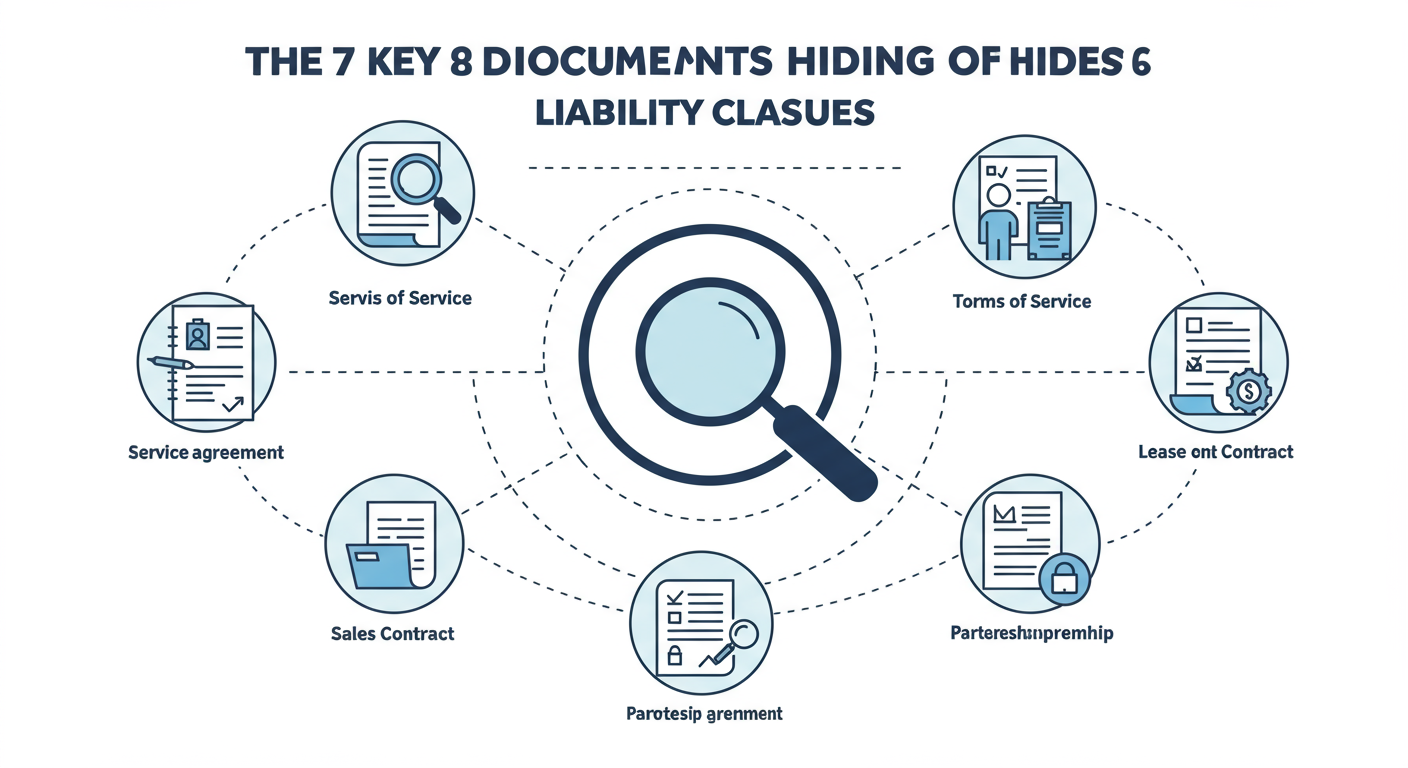
1. Service Agreements (MSAs)
This is ground zero. When you hire a marketing agency, a consultant, or an IT provider, the Master Service Agreement (MSA) or Statement of Work (SOW) will have a liability section. In our experience, this is the most frequently negotiated clause. A provider will try to cap their liability at the fees paid in the last 1-3 months. As a client, you should push to have it capped at the total contract value or at least 12 months of fees.
2. Terms of Service (ToS) & Terms and Conditions (T&C)
You agree to these every day. For any SaaS product, social media platform, or app you use, the ToS contains a powerful limitation of liability clause. It almost always states the service is provided “as-is” and disclaims responsibility for data loss, service outages, or business interruption. For companies like cloud providers, this is non-negotiable; they can’t accept liability for the billions of dollars of business conducted on their platforms.
3. Sales & Purchase Agreements
When buying or selling goods, this clause works with the warranty. A manufacturer might offer a one-year warranty to repair or replace a defective part. The liability clause then states this is the sole remedy. It prevents the buyer from suing for lost production time or other consequential damages caused by the faulty part. It’s a classic “repair or replace” limitation.
4. Rental & Lease Agreements
Whether you’re leasing office space or heavy equipment, the lease will limit the owner’s liability. A commercial landlord’s lease will state they aren’t liable for damage to your property from a flood or fire unless it’s due to their gross negligence. An equipment rental company will state they aren’t responsible for your lost income if their machine breaks down. Their only job is to fix it.
⚠️ Watch Out
Pay close attention to the difference between “negligence” and “gross negligence.” Many standard clauses try to limit liability for simple negligence. You should always fight to ensure the limitation does not apply in cases of gross negligence, willful misconduct, or fraud. This is a critical distinction that protects you from reckless behavior.
5. Non-Disclosure Agreements (NDAs)
While an NDA’s main job is to protect secrets, the liability clause defines the penalty for a leak. Sometimes this includes a “liquidated damages” provision, which sets a pre-agreed-upon dollar amount for a breach. This is useful because proving the exact financial harm of a data leak can be almost impossible. The clause makes the consequences clear and immediate.
6. Employment Contracts
Here, the clause often protects both sides. It might state the employer isn’t liable for an employee’s actions outside their job duties. For senior executives, it often includes a D&O (Directors & Officers) indemnification, where the company promises to cover legal costs if the executive is sued for actions taken in good faith on behalf of the company.
7. Partnership & Shareholder Agreements
When forming a business, this clause is fundamental. In a Limited Liability Partnership (LLP) or LLC, the operating agreement reinforces that an individual partner’s personal assets are shielded from business debts or the negligence of another partner. It’s the legal foundation of “limited liability.” Startup India Registration: Unlocking Major Benefits and the Simplified Online Application Process 2026
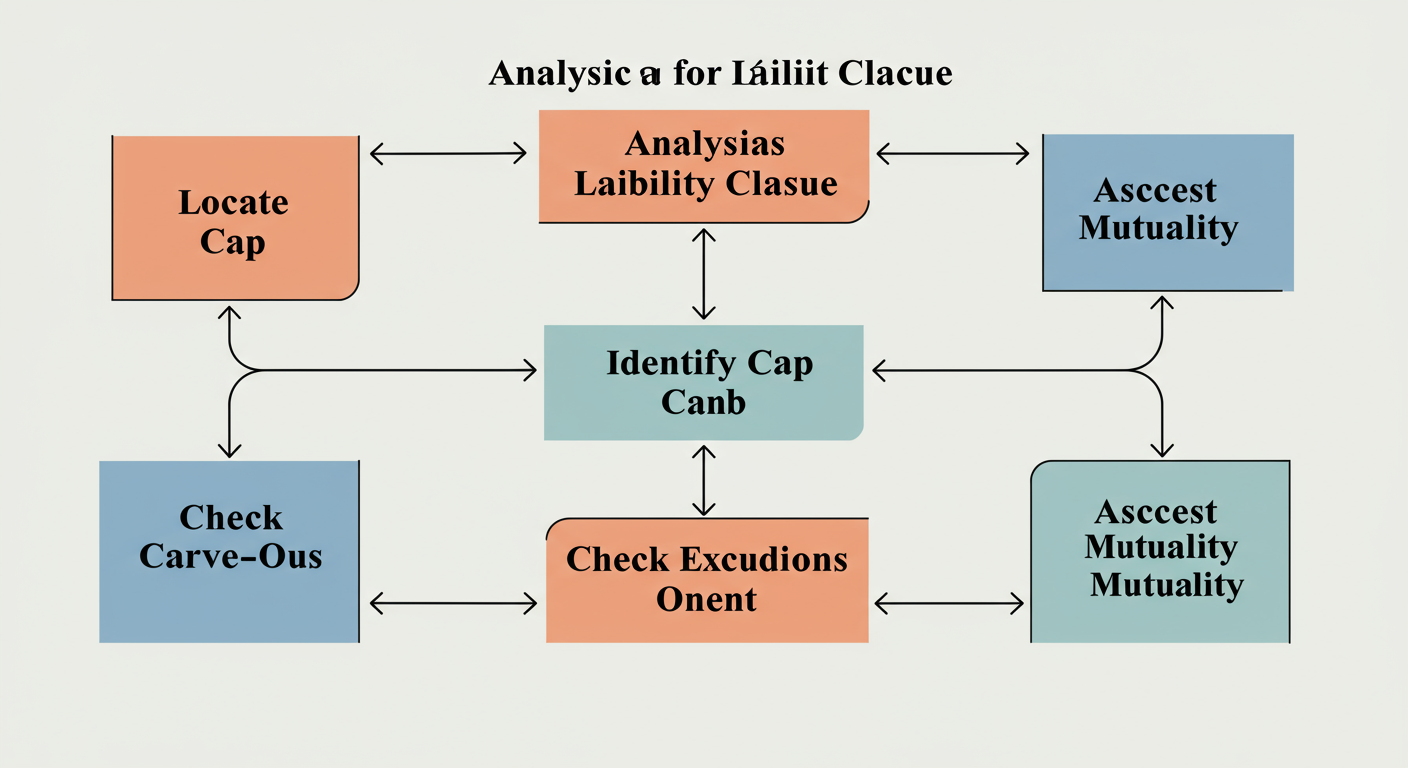
A Practical Guide: How to Analyze a Liability Clause in 5 Steps
Okay, you’ve found the clause. Now what? Don’t let your eyes glaze over. Based on hands-on testing of hundreds of contracts, we’ve developed a simple, five-step process to quickly assess your risk. Download Trademark Certificate Online: Your 2026 Guide
- Locate the Clause: Use Ctrl+F to search for key terms: “liability,” “limit,” “damages,” “indemnity,” and “remedy.” The clause is often titled “Limitation of Liability” or “Indemnification and Liability.”
- Identify the Monetary Cap: What is the maximum financial exposure? Is it a fixed number (e.g., $1 million)? Is it tied to the fees paid (e.g., “the preceding 12 months’ fees”)? Or is it the total contract value? A low cap (like 1-3 months of fees) is a red flag.
- Check the Damage Exclusions: Does the clause explicitly exclude “consequential,” “indirect,” or “special” damages? It should. This is what protects you from those runaway lawsuits for lost profits.
- Find the “Carve-Outs”: These are the exceptions that make the limitation void. A good clause will state that the liability cap does not apply to breaches of confidentiality, infringement of intellectual property, or acts of gross negligence and willful misconduct.
- Assess for Mutuality: Is the clause one-sided? Or does it apply equally to both parties? In many negotiations, especially between two businesses of similar size, striving for a mutual limitation of liability is a sign of a fair partnership.
🎯 Key Takeaway
A limitation of liability clause isn’t just legal text; it’s a strategic financial tool. Your goal is to secure a clause that caps your liability at a reasonable, predictable amount (like total contract value) and carves out exceptions for bad-faith actions like fraud or gross negligence.
The Red Flags: When Is a Liability Clause Unenforceable?
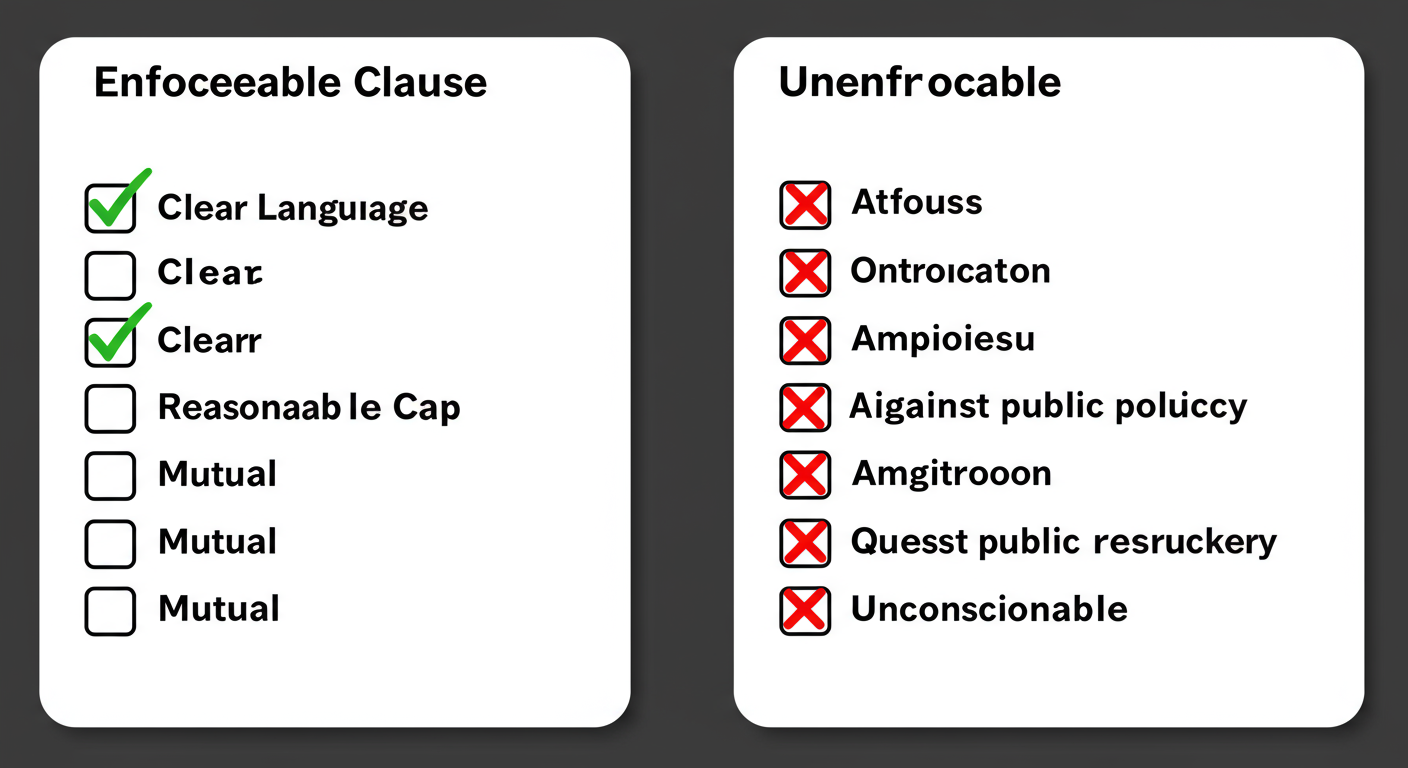
Just because it’s in the contract doesn’t mean a court will enforce it. Judges can, and do, throw out liability clauses that go too far. While laws vary, courts generally frown upon clauses that are:
- Against Public Policy: You can’t contractually limit your liability for illegal acts, fraud, or intentionally harming someone. As noted in legal principles discussed by institutions like Cornell Law School, terms that violate fundamental societal norms are often void.
- Grossly Ambiguous: If the language is so convoluted that a reasonable person can’t understand what’s being limited, a court may refuse to enforce it. Clarity is key.
- Unconscionable: This is a big one, especially in contracts between a massive corporation and an individual. If the terms are outrageously one-sided and there was no real opportunity to negotiate, a court might find the clause “unconscionable” and strike it down.
The enforceability of any contract term depends heavily on local jurisdiction. For example, the Indian Contract Act, 1872, provides a specific framework for what constitutes a valid agreement in India, and its principles guide how local courts interpret these clauses.
⚠️ Watch Out
Never, ever copy-paste a “boilerplate” liability clause from the internet. What’s perfectly legal and enforceable in one state or country could be completely void in another. This is one area where relying on templates without professional review is a recipe for disaster.
Here’s a quick comparison of a risky clause versus a well-drafted one.
| Aspect | Risky, One-Sided Clause (Before) | Fair, Enforceable Clause (After) |
|---|---|---|
| Liability Cap | “In no event shall Service Provider’s liability exceed the fees paid in the month prior to the claim.” | “Each party’s total liability shall not exceed the total fees paid or payable under this Agreement in the 12 months preceding the event giving rise to the claim.” |
| Damage Types | “Provider is not liable for any damages whatsoever.” | “Neither party shall be liable for any indirect, consequential, or special damages, including lost profits.” |
| Exceptions | (None listed) | “The limitations of liability shall not apply to breaches of confidentiality, indemnification obligations, or liability arising from gross negligence or willful misconduct.” |
💡 Pro Tip
During negotiations, frame your requests for changes as creating a “fair and mutual” agreement. Instead of saying “Your clause is unfair,” try “To ensure both parties are protected, let’s make the limitation of liability mutual and tie the cap to the total contract value.” This collaborative language is far more effective.
Conclusion: From Victim to Vigilant
The question isn’t just “where is the liability clause?” but “what does it mean for my business?” It’s everywhere that matters: in your client contracts, your software subscriptions, and your partnership agreements. It is the silent guardian of your company’s financial health.
Stop skimming. Start analyzing. Treat this clause with the seriousness it deserves. By understanding its components—the cap, the exclusions, and the carve-outs—you transform it from a source of anxiety into a tool for strategic risk management.
Here’s your next step: pull up your most important active contract. Right now. Find the limitation of liability clause and read it through the lens of this guide. If you don’t like what you see, you now know exactly what to discuss with your legal counsel before your next renewal. That’s not just smart; it’s survival.
❓ Frequently Asked Questions
What’s the difference between a liability clause and an indemnity clause?
A limitation of liability clause is defensive; it caps your own financial exposure to the other party. An indemnity clause is offensive; it’s a promise to pay for the other party’s losses if they get sued by a third party because of something you did.
Can I just write my own limitation of liability clause?
You can, but it’s incredibly risky. The enforceability of these clauses hinges on precise, legally-tested language that varies by jurisdiction. A poorly drafted clause can be voided by a court, leaving you completely exposed. Always have a qualified legal professional draft or review it.
What happens if a contract has no liability clause?
In the absence of a limitation of liability clause, default legal principles apply. This means a breaching party could be liable for all foreseeable damages that result from the breach, with no contractual cap. This exposes the party to potentially unlimited financial risk.
What is a “mutual” limitation of liability?
A mutual clause means the same limitations apply to both parties. For example, it would state that “Each party’s” liability is capped at a certain amount. This is a hallmark of a fair and balanced agreement, as opposed to a one-sided clause that only protects one party.
Where is the liability clause in a software license (EULA)?
In an End-User License Agreement (EULA), it’s usually in a section titled “Limitation of Liability” or “Disclaimer of Warranties.” It typically limits the software provider’s liability to the license fee you paid and disclaims responsibility for any data loss or business interruption.