Imagine this: a single 21-digit code that acts as your company’s birth certificate, passport, and background check all rolled into one. A code so powerful that forgetting to print it on an invoice could land you a ₹1,00,000 fine. That’s not a hypothetical scenario; it’s the reality of the Corporate Identity Number (CIN) in India.
Most entrepreneurs see it as just another piece of bureaucratic jargon. A string of letters and numbers on a certificate. But that’s a massive mistake. Your CIN is a story—the story of your company’s identity, industry, and legal standing, all encoded in a single line.
In this deep dive, we’re not just going to tell you what a CIN number is. We’re going to show you how to read it like an expert, use it as a strategic tool for due diligence, and avoid the simple compliance mistakes that trip up even seasoned business owners. Let’s decode it.
What is a CIN Number? Your Company’s Digital Fingerprint
A Corporate Identity Number (or CIN) is a unique 21-character alphanumeric code assigned by the Registrar of Companies (RoC) to every company officially registered in India. Think of it as your company’s Aadhaar number. It’s the single, irrefutable identifier used by the Ministry of Corporate Affairs (MCA) and other regulatory bodies to track and manage every aspect of your company’s existence.
From the moment your company is incorporated, this number becomes its primary identity. It’s not just a random sequence; it’s a smart code. It instantly reveals critical details about your business to anyone who knows how to read it.
It’s crucial to understand who gets a CIN and who doesn’t. This number is exclusively for companies registered under the Companies Act. This includes:
- Private Limited Companies (Pvt Ltd)
- Public Limited Companies (Ltd)
- One Person Companies (OPC)
- Section 8 Companies (non-profits)
- Government-owned companies
Business structures like Sole Proprietorships, Partnership Firms, and even Limited Liability Partnerships (LLPs) do not get a CIN. LLPs have their own unique identifier called an LLPIN (LLP Identification Number), which serves a similar purpose but follows a different format.
🎯 Key Takeaway
Your CIN is not just a registration number; it’s your company’s official identity in the eyes of the law. Every part of the 21-digit code tells a specific story about your business, from its listing status to its location and age. Treating it as a mere formality is a direct path to compliance issues.
The Anatomy of a CIN: Decoding the 21-Digit DNA
That 21-character string might look like a jumble of nonsense, but it’s pure logic. Each segment provides a specific piece of information. Let’s break down a real-world example: L26940MH2007PLC173479.
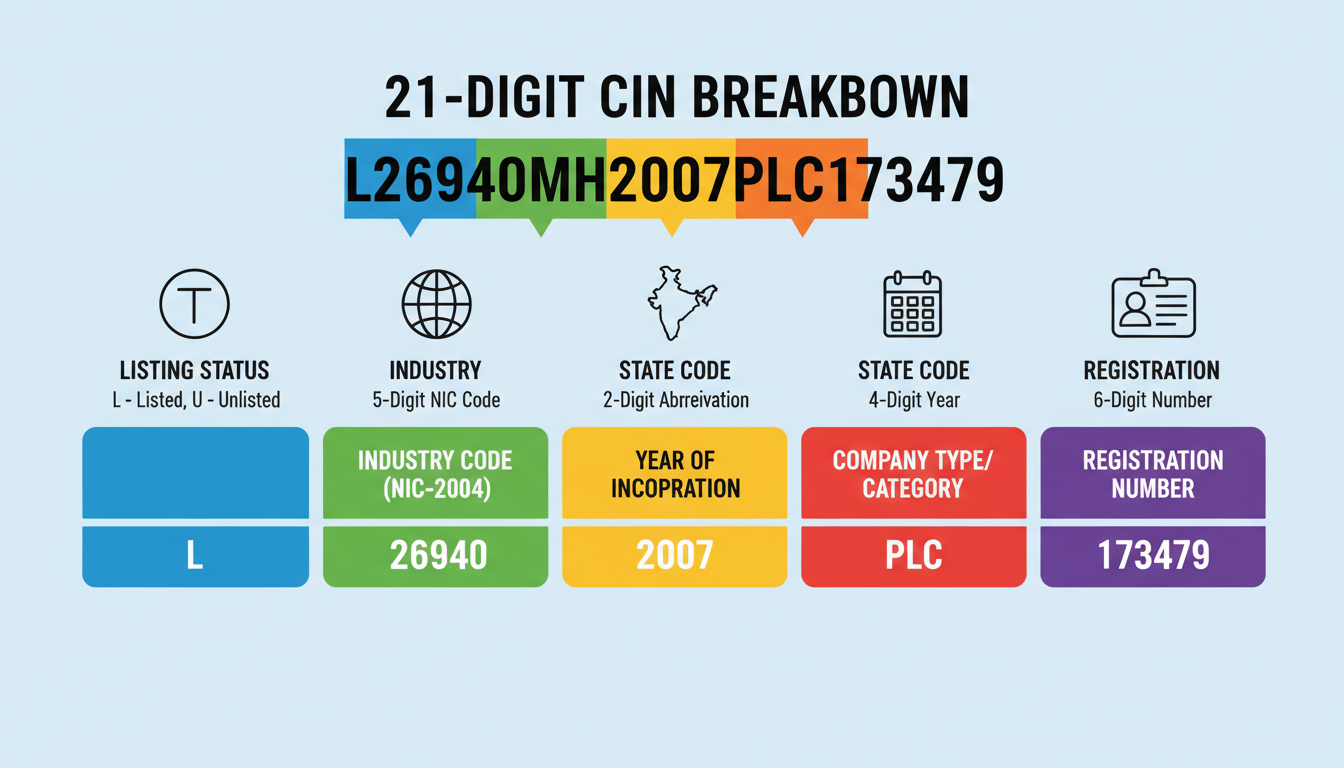
Here’s how the code breaks down, piece by piece:
| Segment | Example | What It Means |
|---|---|---|
| 1. Listing Status (1st Character) | L | Indicates if the company is listed on a stock exchange. ‘L’ for Listed, ‘U’ for Unlisted. This is the first clue about the company’s scale and public accountability. |
| 2. Industry Code (Next 5 Digits) | 26940 | This 5-digit number corresponds to the company’s primary business activity, based on the National Industrial Classification (NIC) codes. These codes are maintained by India’s Central Statistical Organisation. |
| 3. State Code (Next 2 Letters) | MH | Represents the state where the company’s registered office is located. ‘MH’ is Maharashtra, ‘DL’ is Delhi, ‘KA’ is Karnataka, etc. |
| 4. Year of Incorporation (Next 4 Digits) | 2007 | The year the company was officially incorporated. This gives you an instant read on the company’s age. |
| 5. Ownership/Type (Next 3 Letters) | PLC | Specifies the type of company. ‘PLC’ stands for Public Limited Company. Other common codes are ‘PTC’ (Private Limited Company) and ‘OPC’ (One Person Company). |
| 6. RoC Registration No. (Last 6 Digits) | 173479 | The unique, sequential registration number assigned by the specific Registrar of Companies (e.g., RoC-Mumbai). This ensures no two companies can ever have the same CIN. |
💡 Pro Tip
You can use the CIN for quick competitor analysis. By looking at a competitor’s CIN, you can instantly determine their age (Year of Incorporation), their official industry classification (which might differ from their marketing), and their corporate structure (Public vs. Private). It’s a small but powerful piece of competitive intelligence.
Why Your CIN is Non-Negotiable for Business Operations
So, it’s a smart code. But why should you really care? Because in the world of Indian business, the CIN is the master key to compliance, credibility, and transparency. Ignoring its importance is like trying to drive without a license plate.
1. The Bedrock of Legal Compliance
This isn’t optional. The Companies Act, 2013, mandates that your CIN must be printed on a whole host of official documents. We’re talking about:
- All business letterheads
- Invoices, bills, and receipts
- Official notices and publications
- Annual and director’s reports
- Any other official company communication
Failure to comply isn’t just a slap on the wrist. It’s a direct violation that can trigger serious penalties.
⚠️ Watch Out
Under Section 12(8) of the Companies Act, 2013, the penalty for not quoting the CIN is ₹1,000 for each day the default continues, for both the company and every officer in default. This can cap out at a painful ₹1,00,000. It’s one of the easiest—and most expensive—compliance mistakes to make.
2. The Ultimate Stamp of Authenticity
In a market filled with uncertainty, your CIN is proof of your existence. It tells potential investors, clients, banks, and partners that you are a legitimate entity registered with and recognized by the Government of India. When someone wants to verify your company’s details, they don’t search for your brand name; they search for your CIN on the official MCA portal. It’s the fastest way to build trust.
3. The Gateway to Public Information
The CIN is the key that unlocks a treasure trove of public data about any registered company in India. With just this one number, anyone can perform due diligence and access information like: Mastering DRC 03: The 2026 Guide to Voluntary GST Payments
- Company’s registration date and status (Active/Inactive)
- Authorized and paid-up capital
- Address of the registered office
- Names and details of all directors
- History of charges (loans and mortgages)
- Status of annual filings and balance sheets
This level of transparency is fundamental to the Indian corporate ecosystem, and the CIN makes it all possible. 7 Critical Steps in the GST Cancellation Process India: A 2025 Guide
How to Find Any Company’s CIN in Under 60 Seconds
Need to find your own CIN or look up another company’s? It’s incredibly simple and free. The official MCA portal is your best friend here. Based on our hands-on testing, this is the most reliable method. LLP Annual Compliance 2026: The Definitive Guide to Form 8 and Form 11 Filing
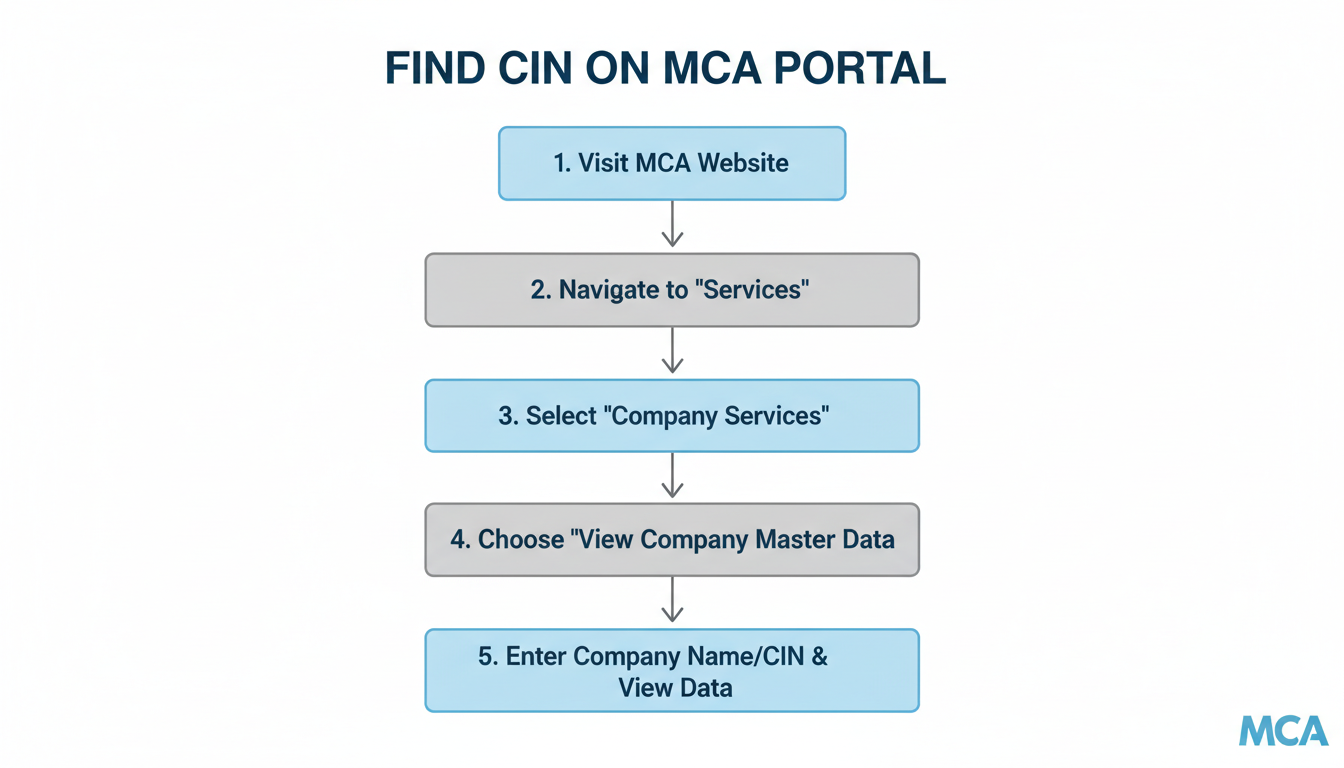
Step-by-Step Guide to Using the MCA Portal
- Go to the MCA Website: Open your browser and navigate to
www.mca.gov.in. - Find ‘MCA Services’: On the main menu, locate and hover over the “MCA Services” tab.
- Select ‘View Company/LLP Master Data’: In the dropdown menu, click on this option. It’s usually under the ‘Master Data’ or a similar heading.
- Search for the Company: You’ll see a search box. Start typing the company’s name. As you type, a list of suggestions will appear. Click the magnifying glass icon and select the exact company you’re looking for from the list. This will auto-fill the CIN if the name is an exact match.
- Enter CAPTCHA and Submit: Fill in the CAPTCHA code displayed on the screen and hit the ‘Submit’ button.
Boom. The next page will display the complete master data for the company, with the CIN listed right at the top. You can also find the CIN on your company’s Certificate of Incorporation and, as required by law, on all official letterheads and invoices.
⚠️ Watch Out
While many third-party business data websites exist, their information can sometimes be outdated. For any legal, financial, or official due diligence, always use the official MCA portal as the single source of truth. Relying on unverified data is a risk you don’t want to take.
CIN vs. The Alphabet Soup: PAN, GSTIN, and LLPIN Explained
It’s easy to get lost in the sea of business identification numbers. CIN, PAN, GSTIN… what’s the difference? They are not interchangeable. Each serves a distinct and legally mandated purpose.
| Identifier | Full Form | Issuing Authority | Purpose & Key Difference |
|---|---|---|---|
| CIN | Corporate Identity Number | Registrar of Companies (MCA) | Corporate Identity: A 21-digit code to identify a registered company. It’s about legal existence and corporate structure. Mandatory for all companies. |
| PAN | Permanent Account Number | Income Tax Department | Tax Identity: A 10-digit code for all tax-related activities. Every legal entity, including companies, needs one. It’s your tax fingerprint. |
| GSTIN | Goods & Services Tax ID Number | GST Network (GSTN) | Indirect Tax Identity: A 15-digit, state-specific, PAN-based number for GST compliance. Not all companies need one—only those crossing the GST turnover threshold. |
| LLPIN | Limited Liability Partnership ID Number | Registrar of Companies (MCA) | LLP Identity: The direct equivalent of a CIN, but specifically for LLPs. It has a different format and signifies a different legal structure governed by the LLP Act, 2008. |
💡 Pro Tip
A simple way to remember the difference: Your CIN proves you’re a company. Your PAN proves you’re a taxpayer. Your GSTIN proves you’re a GST-registered supplier. Each number unlocks a different part of the regulatory system.
Conclusion: Your CIN is Your Corporate DNA
So, what is a CIN number? It’s far more than a 21-digit code. It’s your company’s DNA—a unique, information-rich identifier that is central to your business’s legal and financial life in India.
From our experience working with hundreds of businesses, the ones that thrive are those that master the fundamentals. Understanding your CIN isn’t just about avoiding penalties; it’s about embracing the transparency and credibility that underpin the entire corporate framework. It’s a symbol of your legitimacy and a tool for building trust.
Your next step is simple. Go find your company’s CIN right now. Check if it’s correctly printed on your letterhead and latest invoice. If it’s not, fix it today. This small act of compliance is a powerful step toward building a resilient, trustworthy, and legally sound business for 2026 and beyond.
❓ Frequently Asked Questions
Do all businesses in India have a CIN number?
No, they don’t. A CIN is exclusively for companies registered under the Companies Act (like Private Limited or Public Limited companies). Other business types like Sole Proprietorships, Partnership Firms, and LLPs do not have a CIN. LLPs have their own identifier, the LLPIN.
Can a company’s CIN number ever change?
It’s rare, but yes. A company’s CIN is mostly permanent, but it can be updated in specific situations. For example, if you move your registered office to a new state (the state code changes), convert from an unlisted to a listed company (the first letter changes from ‘U’ to ‘L’), or significantly change your core industry.
What’s the real penalty for not mentioning the CIN on documents?
The penalty, as per the Companies Act, 2013, is not trivial. It’s ₹1,000 per day of default for the company and for every officer involved, with a maximum penalty of ₹1,00,000. It’s a costly and easily avoidable mistake.
Is the CIN the same as a company registration number?
Essentially, yes. The 21-digit CIN is the official, comprehensive registration number for a company in India. While some people might casually refer to the last six digits as the “registration number,” the full CIN is what’s required for all legal and regulatory purposes.
Where exactly is the CIN on the Certificate of Incorporation?
It’s impossible to miss. The CIN is prominently displayed right at the top of the Certificate of Incorporation issued by the MCA. It’s clearly labeled “Corporate Identity Number (CIN)” and is one of the most important details on the entire document.