The Strategic Choice: Why Voluntary GST Registration Matters
In India, the Goods and Services Tax (GST) framework mandates registration only when a business crosses a specified annual aggregate turnover threshold (which varies based on state and supply type). However, many proactive small and medium enterprises (SMEs) choose to register even before they hit this compulsory limit. This strategic decision, known as voluntary GST registration, is far more than just a bureaucratic step; it is a powerful tool for scaling operations and building market trust.
For businesses looking to establish themselves quickly, understanding the core voluntary GST registration benefits is essential. This choice instantly formalizes operations, allowing seamless integration into the organized supply chain. Within the first 100 words, it is critical to grasp that the primary advantages center around financial recovery (Input Tax Credit) and market access.
Understanding the Mandate vs. Voluntary Choice
Before diving into the advantages, let’s clarify the difference. Mandatory registration is triggered by hitting the turnover threshold (typically Rs 20 lakhs or Rs 40 lakhs, or Rs 10 lakhs for specific states/services). Voluntary registration, conversely, is undertaken proactively by any entity that intends to start a business, irrespective of their current turnover. Many businesses start the process by reviewing the mandatory requirements of GST Registration.
Who Can Opt for Voluntary Registration?
- Any person carrying on business, or who intends to carry on business.
- Sole proprietorships, partnerships, LLPs, private limited companies, etc.
- E-commerce sellers who are usually mandated to register regardless of turnover, but may choose to register voluntarily early on.
Why Opting for Voluntary GST Registration Benefits Your Business Growth
The decision to register voluntarily opens up several avenues for business expansion and financial optimization that are otherwise inaccessible to unregistered entities. These advantages often outweigh the perceived burden of compliance for ambitious entrepreneurs.
Benefit 1: Seamless Interstate Trade
Unregistered sellers are legally prohibited from making interstate outward taxable supplies. By opting for voluntary GST registration, your business gains the immediate legal authority to sell goods or provide services across state borders without restrictions, dramatically expanding your potential market reach.
Benefit 2: Enhanced Business Credibility
A registered GSTIN number signals formality and compliance. Large corporations and government agencies often prefer to deal exclusively with GST-registered suppliers, viewing it as a mark of professionalism. This credibility can be crucial when attempting to secure major contracts or utilizing platforms like the Government e-Marketplace (GeM).
Benefit 3: Access to Input Tax Credit (ITC)
This is arguably the most significant financial advantage. Registered entities can claim ITC on the GST paid on their purchases (raw materials, services, machinery). This reduces the effective cost of inputs, leading to better profit margins. Unregistered businesses cannot claim this refund.
Benefit 4: Competitive Advantage
Being registered allows you to issue proper tax invoices. For B2B customers, receiving a tax invoice enables them to claim ITC, making your offerings financially more attractive than those of an unregistered competitor.
Maximizing Financial Returns: Voluntary GST Registration Benefits Through Input Tax Credit
Input Tax Credit (ITC) is the backbone of the GST structure, preventing the cascading effect of taxes (tax on tax). When a business registers voluntarily, they immediately gain access to this system, which can significantly impact cash flow and profitability. If a small manufacturer purchases raw materials worth Rs 1,00,000 and pays 18% GST (Rs 18,000), they can utilize that Rs 18,000 to offset the GST liability on their outward sales.
"The ability to claim Input Tax Credit transforms GST compliance from a cost center into a cash flow mechanism, especially for businesses with high input costs," notes a common sentiment among financial advisors. This is the cornerstone of voluntary GST registration benefits.
Impact on Working Capital
Without voluntary registration, the GST paid on inputs is an outright expense added to the cost of goods sold. With registration, this input tax is recovered, freeing up working capital that would otherwise be locked up in unrecoverable taxes. This is a critical factor for startups and small firms managing tight budgets.
Furthermore, businesses often invest in capital goods (machinery, computers) early on. Voluntary registration allows them to claim ITC on these capital expenditures immediately, providing substantial relief during the initial high-investment phase of the business cycle. This benefit is particularly compelling for entities undergoing private company registration or setting up new manufacturing units.
Weighing the Costs Against the Voluntary GST Registration Benefits
While the advantages are clear, voluntary registration does introduce certain mandatory obligations. It is crucial to assess the compliance burden before making the decision.
The Obligations of a Registered Dealer
Once registered, whether voluntarily or mandatorily, the business is subject to the full spectrum of GST compliance requirements. These include:
- Mandatory Invoicing: Issuing tax invoices that comply with GST rules.
- Filing Returns: Regular filing of GSTR-1 (outward supplies) and GSTR-3B (summary return), often monthly or quarterly, depending on turnover.
- Payment Liability: Once registered, the business must charge and remit GST on all taxable supplies, even if their turnover remains below the compulsory threshold.
If a business fails to comply with the filing requirements, even if it has zero liability, it faces significant late fees and penalties. Therefore, the commitment to regular compliance is a non-negotiable aspect of voluntary registration.
The Drawback: Increased Compliance Cost
For micro-businesses with extremely low turnover, the cost associated with hiring an accountant or consultant to manage monthly filings might exceed the value of the ITC claimed. This increased administrative burden must be calculated carefully.
The Commitment: No Easy Exit
Unlike mandatory registration, which ceases if turnover drops below the threshold, a voluntary registration cannot be easily surrendered. Generally, cancellation is only permitted if the business completely ceases operations or if there is no commencement of business within six months of registration. This is a long-term commitment.
Who Should Seriously Consider Voluntary GST Registration?
The strategic value of voluntary registration is highest for specific types of businesses:
1. Businesses Dealing in Interstate Supplies
If your business model inherently requires selling goods or services to customers in different states, voluntary registration is mandatory for legal compliance, regardless of turnover. This is non-negotiable.
2. Suppliers to Large Corporations (B2B Focus)
If your primary customers are other GST-registered businesses, they will demand tax invoices to claim their own ITC. Being unregistered makes you a less desirable supplier. Registering voluntarily enhances your B2B appeal.
3. E-commerce Sellers
Most e-commerce platforms require sellers to have GST registration even if their turnover is low. If you plan to sell through Amazon, Flipkart, or similar marketplaces, voluntary registration is a prerequisite for listing and operating effectively.
4. Businesses with Significant Capital or Input Purchases
Firms making heavy investments in machinery or inventory before generating substantial sales should register voluntarily to recover the GST paid on these purchases immediately through ITC.
According to the Central Board of Indirect Taxes and Customs (CBIC), adherence to compliance norms is critical. Businesses should leverage technology to manage filings efficiently, thereby minimizing the administrative burden associated with the GST framework.
The Process: How to Secure Voluntary Registration
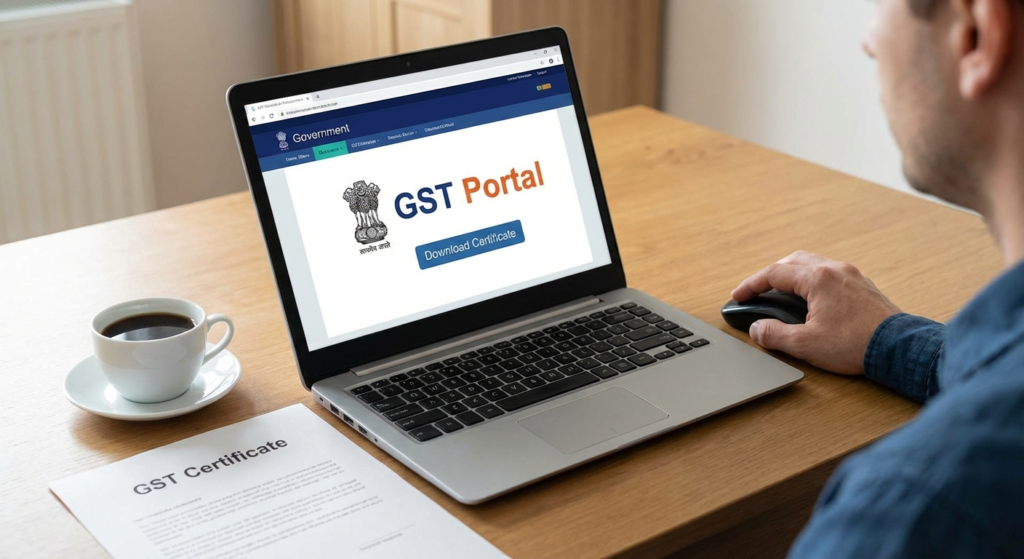
The application for voluntary GST registration is conducted online via the GST portal (www.gst.gov.in). The process is largely similar to mandatory registration, requiring submission of identity proofs, address proofs, bank details, and business constitution documents.
- Part A Application: Submission of PAN, mobile number, and email ID for initial verification.
- Part B Application: Filling out detailed business information, including HSN/SAC codes, bank account details, and details of promoters/directors.
- Document Upload: Attaching necessary documents (e.g., proof of business address, incorporation certificate, or MSME registration details if applicable).
- Verification and Grant: The application is verified by the tax officer. Upon satisfaction, the GSTIN is granted.
It is important to remember that once the application is submitted, compliance requirements begin immediately upon grant of the GSTIN, not just when the turnover threshold is reached. Therefore, readiness for filing returns is paramount.
Registered vs. Unregistered: A Comparative Snapshot
Making an informed decision requires a clear comparison of the tradeoffs. While unregistered status offers simplicity, it restricts growth potential.
Registered Seller (Voluntary)
- Credibility: High. Can secure B2B contracts.
- Tax Recovery: Full access to ITC on all inputs.
- Market Reach: Can conduct interstate sales legally.
- Compliance: High administrative burden (monthly/quarterly returns).
- Cost to Customer: Must charge GST, potentially increasing price for final consumers (B2C).
Unregistered Seller (Below Threshold)
- Credibility: Limited. Cannot deal with large corporations seeking ITC.
- Tax Recovery: No ITC benefit; GST on purchases is a direct expense.
- Market Reach: Restricted to intra-state sales.
- Compliance: Zero administrative burden related to GST filing.
- Cost to Customer: Does not charge GST, potentially lower price for final consumers (B2C).
Ultimately, the decision hinges on the business’s trajectory. If the goal is rapid expansion, dealing with institutional clients, or selling nationally, the voluntary GST registration benefits far outweigh the compliance costs.
Conclusion: Leveraging Formalization for Growth
Voluntary GST registration is a forward-thinking decision for any small business aiming for long-term stability and growth. While it necessitates regular compliance and potentially professional assistance, the advantages—chiefly the ability to claim Input Tax Credit, expand into interstate markets, and establish robust B2B credibility—provide a substantial competitive advantage. By formalizing early, businesses position themselves for success within the organized economy, ensuring they are ready to scale when the turnover surge inevitably arrives. Always consult a tax professional to ensure adherence to the latest rules and procedures governing GST compliance and filing.
FAQs
No, cancellation of a voluntary GST registration is restricted. Unlike mandatory registration, which can be canceled if turnover drops below the threshold, voluntary registration can generally only be surrendered if the business ceases operation or if no business has been commenced within six months of registration. This commitment should be taken seriously.
The primary financial benefit is access to the Input Tax Credit (ITC). This allows the business to recover the GST paid on purchases (inputs, capital goods, and services), significantly reducing the overall cost of operations and improving cash flow.
Yes. Once a GSTIN is issued, whether mandatory or voluntary, the business is legally required to file all mandated GST returns (GSTR-1 and GSTR-3B) by their respective due dates. Failure to file, even if liability is zero, attracts significant late fees and penalties.
No. If your turnover remains within the limits specified for the Composition Scheme (which are lower than the standard threshold), you can opt into the Composition Scheme after voluntary registration, provided you meet all other eligibility criteria (e.g., not engaged in interstate supply of goods, etc.).
It depends on their client base. If the service provider primarily serves B2B clients who require ITC (e.g., consultants, agencies), voluntary registration is highly beneficial for securing contracts and enhancing credibility. If they only serve final consumers (B2C) and have very low input costs, the administrative burden might outweigh the voluntary GST registration benefits.
Read Also:
- Comprehensive Summary of Budget 2026: Key Highlights and Financial Impact
- Mastering the NGO Darpan Registration Steps: A Comprehensive Guide to NITI Aayog Compliance
- The Essential Guide to NITI Aayog NGO Darpan Registration Steps: Compliance and Accessing Government Grants
- Unveiling the Budget 2026 Highlights: A Complete Guide to Tax Reforms and Economic Growth
- Union Budget 2026 Highlights: A Comprehensive Guide to Tax Reforms and Economic Policies
- Unlock Your 2026 Startup Tax Breaks
- India’s 2026 Tax Audit Rules Explained
- Your 2026 India Business Structure Guide
- Nail Your 2026 GST Returns