Introduction to Voluntary GST Registration and Compliance Thresholds
The Goods and Services Tax (GST) regime in India mandates registration for businesses exceeding specific aggregate turnover thresholds. Currently, these limits generally stand at ₹40 lakhs for suppliers of goods (in most states) and ₹20 lakhs for service providers, with lower thresholds applicable in special category states. However, what happens when a budding entrepreneur or a smaller service provider, operating well below these mandated limits, decides to register? This strategic move is known as voluntary GST registration.
While mandatory registration is driven by legal obligation, voluntary registration is driven by strategic business foresight. Opting for voluntary registration opens up a crucial suite of advantages that are otherwise inaccessible to unregistered businesses, making the voluntary GST registration benefits a significant factor in scaling operations. This decision often shifts a business from being a local entity to a professional, scalable enterprise ready for B2B engagement.
As one financial expert noted, “In today’s digitized economy, compliance is often the cornerstone of credibility. Choosing voluntary registration signals reliability to larger clients and suppliers alike.” Understanding these benefits is key to making an informed choice for your business growth trajectory.
The Core Voluntary GST Registration Benefits for Small Businesses
For many small and medium enterprises (SMEs), the immediate costs associated with compliance—such as hiring an accountant and filing monthly returns—can seem daunting. Yet, these costs are often dwarfed by the long-term, tangible financial advantages and market opportunities that GST registration provides.
Enhanced Business Credibility
A GSTIN (GST Identification Number) acts as a proof of legitimate business operations. When dealing with clients, especially corporate entities or government bodies, having a GST number significantly boosts your professional image and trustworthiness.
Access to B2B Markets
Large corporations and established businesses prefer to deal only with GST-registered suppliers. Why? Because they need to claim Input Tax Credit (ITC) on purchases. Without GST registration, you are effectively locked out of most significant business-to-business opportunities.
Inter-State Trade Freedom
If you wish to supply goods or services across state lines, GST registration is mandatory, regardless of turnover. Voluntary registration immediately removes this barrier, allowing you to expand your geographical market reach without restriction.
Leveraging Input Tax Credit (ITC) – The Most Significant Financial Benefit
The single most powerful reason for opting for voluntary GST registration benefits is the ability to claim Input Tax Credit (ITC). ITC is the mechanism that prevents the cascading effect of taxes.
Imagine you are a small manufacturer who buys raw materials worth ₹1,00,000, paying ₹18,000 in GST (18%). If you are unregistered, that ₹18,000 becomes a sunk cost, added directly to your product cost, making you less competitive.
If you are registered, however, that ₹18,000 is claimed back from the government when you file your returns. This allows you to set off the tax paid on inputs against the tax collected on sales (outputs). This mechanism drastically reduces your operating costs and improves profit margins. For any business with significant expenditure on inputs, capital goods, or services, the lack of ITC claimability is often a heavier financial burden than the cost of compliance.
Furthermore, registering voluntarily allows you to legally pass on the GST burden to your consumer, ensuring that your business acts merely as a tax collector, not a tax bearer.
Strategic Advantages: Expanding Market Reach with Voluntary GST Registration
Beyond immediate financial gains, the strategic advantage derived from voluntary registration focuses on long-term scalability and market penetration.
Dealing with E-commerce Operators
For businesses looking to sell through major e-commerce platforms (like Amazon or Flipkart), GST registration is compulsory, even if the turnover is below the threshold. E-commerce platforms are classified as Tax Collectors at Source (TCS) and require their sellers to be registered. Therefore, if your growth strategy involves digital sales channels, voluntary registration is a prerequisite.
Formalizing the Supply Chain
When you register for GST, you enter the formal economy. This formalization often makes it easier to secure loans, attract investors, and integrate with organized logistics and supply chains. Financial institutions view GST filings as credible proof of turnover and business stability, which is essential for working capital financing.
For small contractors or service providers, such as those involved in the construction sector, being registered often dictates eligibility for larger projects. For instance, a small business looking to engage with larger firms, perhaps following guidelines on how to start a construction company in India, will find that clients demand GST invoices for compliance purposes.
Understanding Compliance Costs Versus Voluntary GST Registration Benefits
While the advantages are compelling, it is critical to approach voluntary registration with eyes wide open regarding the associated responsibilities. Voluntary registration comes with mandatory compliance requirements that cannot be ignored.
The primary responsibilities include:
- Mandatory Filing: You must file periodic GST returns (GSTR-1, GSTR-3B) even if there is zero turnover. Failure to file results in steep late fees and penalties.
- Liability for Tax: Once registered, you are obligated to collect and remit GST on your taxable supplies.
- Documentation: You must maintain meticulous records, issue proper tax invoices, and comply with all GST regulations, which can be complex.
It is crucial for businesses evaluating the voluntary GST registration benefits to perform a cost-benefit analysis. Is the potential ITC claim and market expansion opportunity worth the quarterly or monthly effort and cost of compliance? For most growing businesses targeting B2B clients, the answer is a resounding yes.
Pros of Voluntary GST Registration
- Ability to claim Input Tax Credit (ITC).
- Increased market visibility and access to larger contracts.
- Legally permitted inter-state supply of goods/services.
- Easier access to bank financing and formal credit.
Cons of Voluntary GST Registration
- Mandatory periodic return filing (even if turnover is zero).
- Risk of penalties for non-compliance or delayed filing.
- Increased administrative burden and cost of compliance.
- Cannot easily surrender registration (lock-in period).
Special Consideration: Impact on Composition Scheme Eligibility
For micro and small enterprises, an alternative scheme exists: the GST Composition Scheme. This scheme offers simplified compliance and lower tax rates, but it comes with restrictions, most notably the inability to issue tax invoices or claim ITC.
If you register voluntarily, you generally have two options: operate as a regular taxpayer, or, if eligible, opt into the Composition Scheme. However, if your primary motivation for voluntary registration is to claim ITC (which is the main draw for many), then the Composition Scheme is unsuitable. It is important to understand the detailed eligibility and restrictions of both regimes before deciding. You can learn more about the specifics of this simplified regime by examining the GST Composition Scheme eligibility and benefits.
Choosing the regular scheme provides the full range of voluntary GST registration benefits, particularly the ability to issue tax invoices and claim ITC, which is essential for businesses that purchase inputs from registered dealers.
Step-by-Step Guide to Voluntary GST Registration
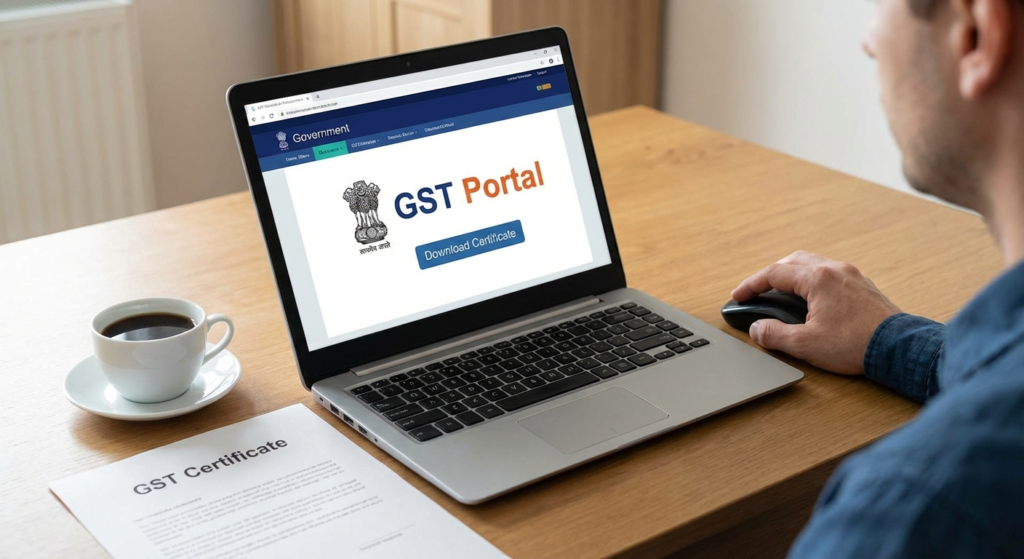
The process for voluntary registration mirrors that of mandatory GST Registration. It is primarily conducted through the official GST portal and involves several key stages:
- Part A Submission: Provide basic details like PAN, mobile number, and email ID to generate a Temporary Reference Number (TRN).
- Part B Submission: Use the TRN to fill out the detailed application form (REG-01). This includes providing details about your business constitution, principal place of business, bank account information, and details of promoters/partners.
- Document Upload: Upload necessary documents, such as proof of constitution, address proof of business premises, bank statements, and photographs of directors/partners.
- Verification and ARN: Once submitted, the application is verified by the GST officer. An Application Reference Number (ARN) is generated.
- Grant of Registration: If the application is satisfactory, the GST officer grants the GSTIN within a specified time frame.
It is vital to ensure all details are accurate, as discrepancies can lead to delays or rejection. Consulting with a professional can streamline this process significantly, ensuring compliance from day one.
A Note on Cancellation
Once you voluntarily register, you cannot simply cancel the registration immediately if you change your mind. The law stipulates that a voluntarily registered taxpayer must generally wait for a minimum period (often one year) before they can apply for cancellation, provided their turnover remains below the threshold and they meet other specific criteria. This ‘lock-in’ period emphasizes that voluntary registration is a commitment to the formal tax structure. For further detailed information on the legal framework, you should consult the guidelines provided by the Central Board of Indirect Taxes and Customs (CBIC). The CBIC official website provides comprehensive circulars and FAQs regarding GST compliance.
Conclusion: Making the Strategic Decision
The decision to undertake voluntary GST registration should be viewed not as an added burden of tax compliance, but as a strategic investment in future growth. The availability of ITC, coupled with the enhanced credibility needed to engage with larger B2B clients and e-commerce platforms, provides a powerful trajectory for business expansion that far outweighs the administrative effort.
For any ambitious small business aiming to transcend local boundaries and secure a competitive edge, understanding and utilizing the voluntary GST registration benefits is indispensable. By formalizing your operations today, you position your business for scalability and success tomorrow, ensuring you remain competitive in an increasingly organized market, as highlighted by various reports on SME growth in India published by authoritative sources like The Economic Times.
FAQs
While there is no explicit official “lock-in period” defined in months, taxpayers who register voluntarily must typically remain registered for a reasonable period and demonstrate genuine compliance before applying for cancellation. Cancellation can only be sought if the taxpayer’s turnover remains below the mandatory threshold and they are not liable for registration under any other mandatory criteria. Tax officers often scrutinize cancellation requests from voluntary registrants closely.
Yes, one of the primary voluntary GST registration benefits is the ability to claim ITC. You can claim ITC on inputs held in stock, inputs contained in semi-finished or finished goods held in stock, and capital goods, as on the day immediately preceding the date from which you become liable to pay tax. This claim must be detailed in the required forms (like GSTR-2A and GSTR-3B) and reconciled properly.
Yes. Once you obtain a GSTIN, whether mandatory or voluntary, filing periodic returns (usually GSTR-1 and GSTR-3B monthly or quarterly, depending on turnover and scheme) is compulsory. Failure to file ‘Nil’ returns results in automatic late fees and potential penalties, which is a major compliance risk associated with voluntary registration.
No, the act of voluntary registration does not change the statutory turnover threshold (e.g., ₹40 lakh or ₹20 lakh). However, once you are registered, you must comply with all GST regulations, regardless of whether you cross that threshold. The threshold determines when registration becomes mandatory, not whether a voluntarily registered person must comply.
The required documents are similar to mandatory registration: PAN card, Aadhaar card, proof of business premises (rent agreement or utility bill), bank account details (first page of passbook or cancelled cheque), and proof of business constitution (e.g., partnership deed, incorporation certificate).
Read Also:
- Mastering TDS Return Filing Online: A Comprehensive Guide for Deductors
- The Ultimate LLP Annual Compliance Checklist for Indian Businesses 2024-2025
- Decoding the Costs: A Comprehensive Guide to GST Registration Fees India
- NGO Darpan Registration: Essential Guide for NGOs
- 7 Steps to Master the GST Return Filing Process in India (2025 Guide)