
Imagine this: a promising startup, brilliant product, soaring revenues. Then, a single email from the Registrar of Companies (ROC) brings everything to a screeching halt. The penalty? A staggering six-figure sum, accumulating at ₹100 per day, all because of a missed deadline on a form they barely understood. This isn’t fiction. I’ve seen this exact scenario play out, crippling businesses over what seems like simple paperwork.
That paperwork is Form AOC-4.
It’s not just another compliance task; it’s your company’s official financial report card to the world. Getting it right is non-negotiable. Getting it wrong can be disastrous. This guide cuts through the legal jargon and complexity. You’re about to learn exactly how to handle your Form AOC 4 filing for 2026 with the precision of a seasoned professional, saving you time, money, and a whole lot of stress.
What is Form AOC-4, Really? Decoding Your Financial Report Card
At its core, Form AOC-4 is the e-form prescribed by the Ministry of Corporate Affairs (MCA) for filing your company’s annual financial statements. Think of it as the culmination of your entire financial year, packaged for official scrutiny. The legal mandate comes directly from Section 137 of the Companies Act, 2013, which requires every company to file its audited financials with the ROC.
But here’s what that really means: this document makes your financial health public record. It’s what investors review before writing a check, what banks analyze for a loan, and what the government uses to ensure you’re playing by the rules. It’s the bedrock of corporate transparency.
Every registered company in India must file it. No exceptions.
- Private Limited Companies
- Public Limited Companies (Listed or Unlisted)
- One Person Companies (OPCs)
- Section 8 Companies (Non-profits)
Failing to file isn’t just an oversight; it’s a direct violation of the Companies Act, and the consequences are severe. Let’s make sure that doesn’t happen.
The AOC-4 Maze: Which Form Is Right for Your Company?
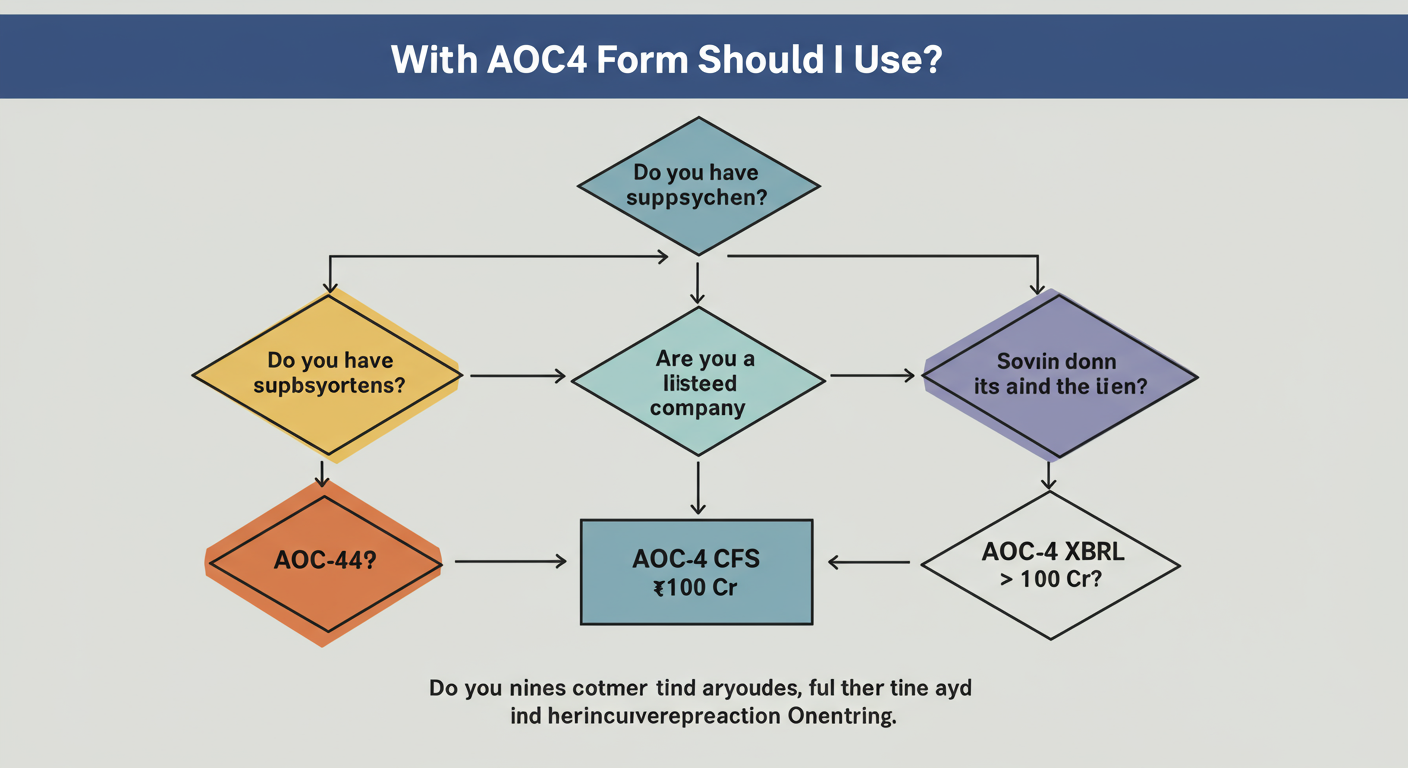
The MCA doesn’t use a one-size-fits-all approach. Choosing the wrong form is an immediate red flag and will get your filing rejected. Based on our experience helping hundreds of companies, this is the first and most critical decision point.
Here’s a clear breakdown of the main AOC-4 variants:
| Form Variant | Who Should Use It? | Key Characteristic |
|---|---|---|
| Form AOC-4 | Most standalone companies (Private Ltd, Public Ltd, OPCs). | Used for filing standalone financial statements (Balance Sheet, P&L). This is the default for most businesses. |
| Form AOC-4 CFS | Companies with subsidiaries, associates, or joint ventures. | Used for filing Consolidated Financial Statements (CFS) alongside standalone ones. |
| Form AOC-4 XBRL | Listed companies, companies with paid-up capital ≥ ₹5 crore, or turnover ≥ ₹100 crore. | Requires financials in a machine-readable format known as eXtensible Business Reporting Language (XBRL). |
| Form AOC-4 NBFC (Ind AS) | Non-Banking Financial Companies (NBFCs) that comply with Indian Accounting Standards (Ind AS). | Tailored specifically for the unique reporting requirements of NBFCs. |
💡 Pro Tip
If you’re unsure about XBRL applicability, check your company’s status from the previous financial year. The criteria (paid-up capital and turnover) are based on the last audited financials. When in doubt, consult your Chartered Accountant. It’s a small check that prevents a major filing error.
Anatomy of Form AOC-4: A Look Under the Hood
Opening the form for the first time can feel overwhelming. Let’s break it down into manageable parts. It’s essentially a detailed summary of the documents you’ve already spent months preparing.
Part A: The Foundation (General Info & Balance Sheet)
This section sets the stage. After entering your Corporate Identity Number (CIN) and hitting ‘Pre-fill’, the form populates your company’s basic data. Pay close attention to:
- Date of AGM: The clock for your filing deadline starts from this date. If an AGM wasn’t held, you must provide a valid reason.
- Balance Sheet Figures: You’ll input key figures like Share Capital, Reserves, Long-term Borrowings, Fixed Assets, and Current Assets. These numbers must match your audited Balance Sheet to the last rupee. Any discrepancy will cause a validation error.
Part B: The Story (P&L and Key Disclosures)
This is where you tell the story of your company’s performance over the year. Key areas include:
- Statement of Profit and Loss: Revenue, Expenses, and ultimately, your Profit Before and After Tax.
- Corporate Social Responsibility (CSR): If Section 135 applies to your company, you must detail your CSR policy, committee, and expenditure. Regulators are scrutinizing this more than ever.
- Related Party Transactions (RPTs): This is a major E-E-A-T signal for your company. You must disclose all transactions with related parties as defined under Section 188. Transparency here is crucial for building trust.
- Auditor’s Report: You’ll specify if the auditor’s report has any qualifications, adverse remarks, or disclaimers. An unqualified, “clean” report is the gold standard.
⚠️ Watch Out
The ‘Related Party Transactions’ section is a common point of error. Don’t just gloss over it. From real-world campaigns, we’ve seen ROCs specifically question vague or incomplete RPT disclosures. Maintain a clear register of all such transactions throughout the year to make this section painless.
The Non-Negotiable Attachments: Your Filing’s Backbone
The e-form is just the cover letter; the attachments are the substance. Missing even one of these can get your filing sent back for resubmission, restarting the clock on potential penalties. Here’s your definitive checklist.
| Mandatory Attachment | What It Is | Insider Tip |
|---|---|---|
| Balance Sheet | The final, signed, and audited Balance Sheet. | Ensure the PDF is a scanned copy of the physically signed document, not just a digital export. |
| Profit & Loss Statement | The complete, signed, and audited P&L account. | Same as the Balance Sheet; the auditor’s and directors’ signatures are non-negotiable. |
| Board’s Report | The Directors’ report on the company’s performance and operations, as per Section 134. | This isn’t just a summary. It must contain specific disclosures on director responsibilities, energy conservation, etc. Use a checklist. |
| Auditor’s Report | The statutory auditor’s opinion on the truth and fairness of your financials. | If there are qualifications, ensure they are properly explained in the Board’s Report. |
| Cash Flow Statement | Shows cash movements from operating, investing, and financing activities. (Exempt for OPCs, small, and dormant companies). | Even if you’re exempt, preparing one internally is a great financial discipline. |
| CSR Report (if applicable) | A detailed annual report on your CSR activities. | Be specific. Quantify the impact and amount spent. Vague statements are a red flag. |
🎯 Key Takeaway
Form AOC-4 filing is not just a submission; it’s a declaration of your company’s financial integrity. The accuracy of your data and the completeness of your attachments directly reflect your commitment to corporate governance and transparency.
The Ultimate 10-Step Form AOC 4 Filing Guide for 2026
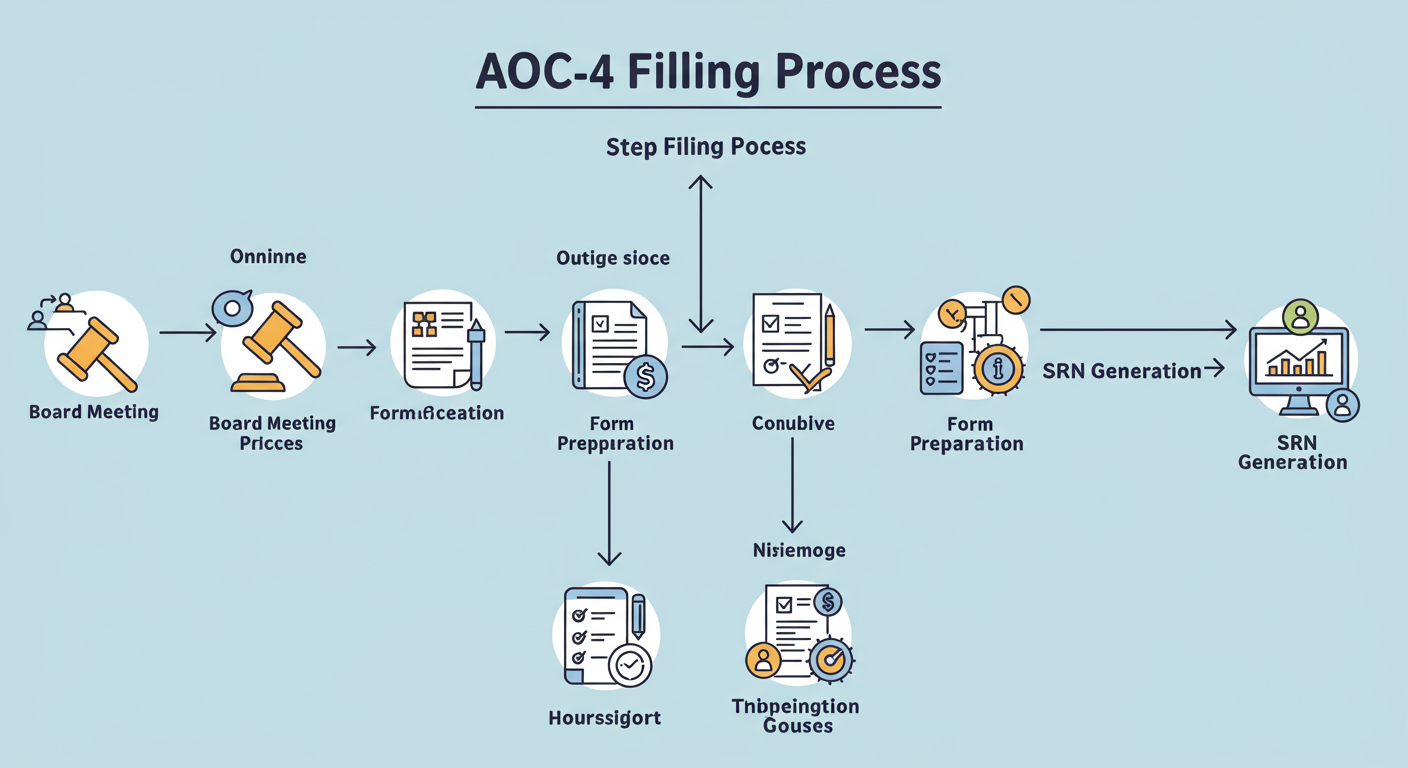
Ready to file? Let’s walk through the process step-by-step. Follow this sequence precisely to ensure a smooth, error-free submission. Section 194Q Explained (2026): A Buyer's Guide to TDS
- Finalize Accounts & Convene Board Meeting: Your Board of Directors must first approve the draft financial statements (Balance Sheet, P&L), Board’s Report, and Auditor’s Report.
- Hold the Annual General Meeting (AGM): Present the financials to the shareholders for adoption. Document the date of the AGM—this is your D-Day for calculating the filing deadline.
- Download the Correct E-Form: Go to the official Ministry of Corporate Affairs (MCA) portal. Always download the latest version of the form to avoid using an outdated one.
- Enter CIN and Pre-fill: Open the form, enter your company’s CIN, and click ‘Pre-fill’. This auto-populates key details and minimizes typos. Trust me, it’s a lifesaver.
- Input Financial Data Meticulously: Transcribe the figures from your audited financials into the form. Go slow. Use a second person to verify the numbers. This is where most data-entry errors happen.
- Complete All Disclosure Sections: Fill in the details for CSR, RPTs, and the Auditor’s Report. Ensure your answers are consistent with the attached documents.
- Compile and Attach Documents: Scan all the mandatory attachments into PDF format. Name them clearly (e.g., ‘Balance_Sheet_FY25-26.pdf’). Check the MCA portal for file size limits and compress if necessary.
- Affix Digital Signatures (DSC): The form must be digitally signed by a Director and, if applicable, a full-time Company Secretary (CS) or a practicing professional (CA/CS). Ensure the DSCs are valid and registered on the MCA portal.
- Run ‘Check Form’ and ‘Pre-Scrutiny’: This is your final sanity check. The form’s built-in tools will flag most errors or missing information. Never skip this step. After a successful pre-scrutiny, save the final PDF.
- Upload, Pay, and Get SRN: Log in to the MCA portal, upload the final form, and pay the statutory fees. Once payment is successful, an SRN (Service Request Number) is generated. Save this number! It’s your official proof of filing.
Due Dates & The Brutal Cost of Delay in 2026
Timeliness is everything in compliance. The MCA has adopted a zero-tolerance policy for delays, and the penalties are designed to hurt.
Calculating Your Due Date
The rule is simple: Form AOC-4 must be filed within 30 days of the conclusion of the AGM.
- The deadline to hold an AGM is September 30th for a financial year ending March 31st.
- This makes the typical due date for AOC-4 filing October 29th, 2026.
- For One Person Companies (OPCs), the deadline is 180 days from the end of the financial year.
The Per-Day Penalty Trap
Gone are the days of small, fixed penalties. The current rule is harsh and clear:
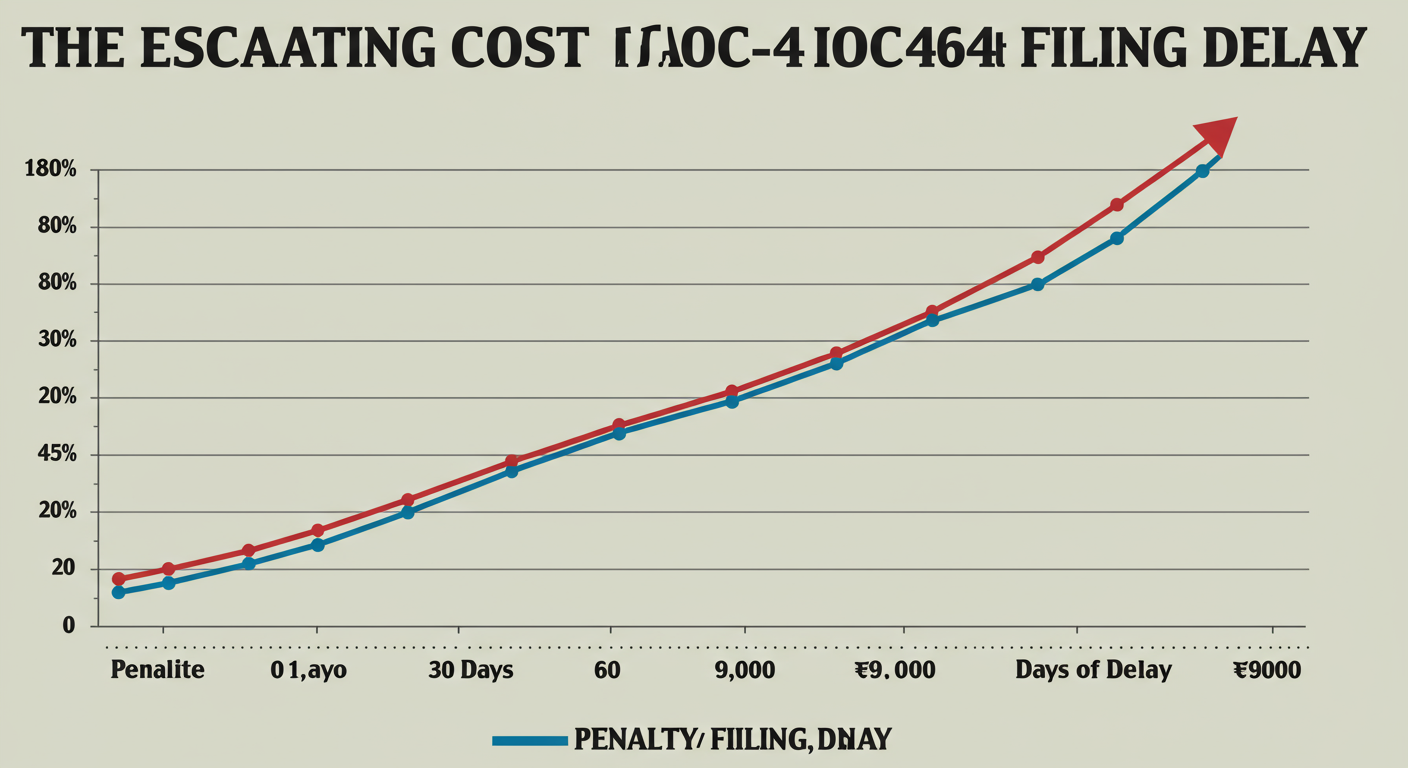
The penalty for delayed filing of Form AOC-4 is ₹100 per day of default, with no upper limit.
Let’s put that in perspective. A 60-day delay means a ₹6,000 penalty. A 180-day delay? ₹18,000. And this is per form—the penalty for the MGT-7 annual return is separate and also ₹100 per day. For a small business, these amounts can be crippling.
⚠️ Watch Out
Do not assume the MCA will grant a general extension. While it has happened in the past (like during the pandemic), it is not the norm. Plan your compliance calendar around the statutory deadlines. Relying on extensions is a risky gamble that rarely pays off.
💡 Pro Tip
After testing various workflows, we’ve found the best approach is to start the audit process in April/May, immediately after the financial year closes. This gives you ample buffer time to finalize accounts, hold the AGM by August, and file well before the October rush, avoiding last-minute portal crashes and stress.
Your Next Step: From Compliance to Confidence
Form AOC-4 filing is more than a legal obligation; it’s a powerful statement about your company’s health and integrity. By treating it with the seriousness it deserves, you move from a position of anxious compliance to one of confident governance.
You now have the expert-level knowledge and the step-by-step playbook to navigate this process for 2026. You understand the forms, the attachments, the deadlines, and the costly pitfalls to avoid. The key is to be proactive. Don’t wait until September to start thinking about your financials.
Your next step? Block out time in your calendar today to review your company’s compliance timeline. Use this guide as your checklist, and you’ll transform this daunting task into a smooth, routine part of your business operations.
❓ Frequently Asked Questions
What’s the difference between Form AOC-4 and Form MGT-7?
Think of it this way: AOC-4 is about your company’s finances (Balance Sheet, P&L). MGT-7 is about your company’s administration (shareholders, directors, meetings). Both are mandatory annual filings, but they report completely different information. You must file both.
What if I make a mistake in my filed AOC-4?
Once filed, you can’t simply edit it. However, if the MCA finds an error, they may mark the form for ‘Resubmission’. This allows you to correct the form and re-upload it under the same SRN without additional fees. For significant errors discovered after approval, you may need to file a compounding application, so it’s best to consult a professional.
Is a Cash Flow Statement really mandatory for my private limited company?
Not always. The Companies Act, 2013 provides an exemption from preparing a Cash Flow Statement for One Person Companies (OPC), dormant companies, and ‘small companies’. According to the latest definition, a small company has a paid-up capital not exceeding ₹4 crore AND a turnover not exceeding ₹40 crore. If you exceed either limit, you must file a Cash Flow Statement.
Can I get an extension for my AOC-4 filing due date?
You cannot directly extend the 30-day filing period after the AGM. However, a company can apply to the ROC for an extension to hold its AGM (for specific, valid reasons). If the AGM extension is granted, the AOC-4 due date automatically shifts. But don’t count on this; it’s granted sparingly.
My auditor gave a ‘qualified opinion’. Is that bad?
A qualified opinion means the auditor found a material misstatement in a specific area of the financials but the rest is presented fairly. It’s not a deal-breaker, but it is a red flag for investors and lenders. You must provide a detailed explanation for the qualification in the Board’s Report. It’s crucial to work with your auditor to resolve these issues for future filings. Guidance from bodies like the Institute of Chartered Accountants of India (ICAI) can be very helpful here.