Ever get that sinking feeling when a tax notice for a past year lands in your inbox? Suddenly, you’re digging through old files, trying to make sense of rules that have long since changed. For many, the financial year 2020-21 is a particular source of confusion.
It wasn’t just another year. It was the year of the pandemic, and with it came a temporary, mid-year change to tax rules that caught many off guard. If you’re a business owner, freelancer, or accounts professional reconciling old payments, you know the headache. Did you apply the right rate? Did you account for the change that happened in May 2020?
Relax. You’ve found the definitive guide. Forget sifting through confusing government circulars. We’re going to break down the exact TDS rates for FY 2020-21 (AY 2021-22) in plain English. You’ll learn about the two-tiered rate system, see clear comparison charts, and get actionable advice for what to do if you suspect an error. This isn’t just a list of rates; it’s your roadmap to confidently closing the books on that uniquely complex year.
Why FY 2020-21 Was a One-Off Year for TDS
To understand the tax rules of FY 2020-21, you have to remember the global context. In early 2020, the COVID-19 pandemic brought economies to a standstill. In response, governments worldwide rolled out economic relief packages. India was no different.
As part of the Aatmanirbhar Bharat Abhiyan stimulus package, the Indian government made a critical decision to increase liquidity in the economy. One of the fastest ways to do that? Reduce the amount of tax being deducted at the source on various transactions.
The objective was simple: leave more cash in the hands of businesses and individuals to help them navigate the unprecedented economic disruption.
This led to a temporary, but significant, 25% reduction in the rates for both Tax Deducted at Source (TDS) and Tax Collected at Source (TCS) on a wide range of non-salaried payments. But here’s the catch that still trips people up years later: it wasn’t for the whole year.
This created a dual-rate system within a single financial year, a rare occurrence that requires careful attention to payment dates. Based on our experience helping clients untangle these records, misinterpreting this timeline is the single biggest cause of compliance issues from that period.
The Critical Timeline You MUST Know
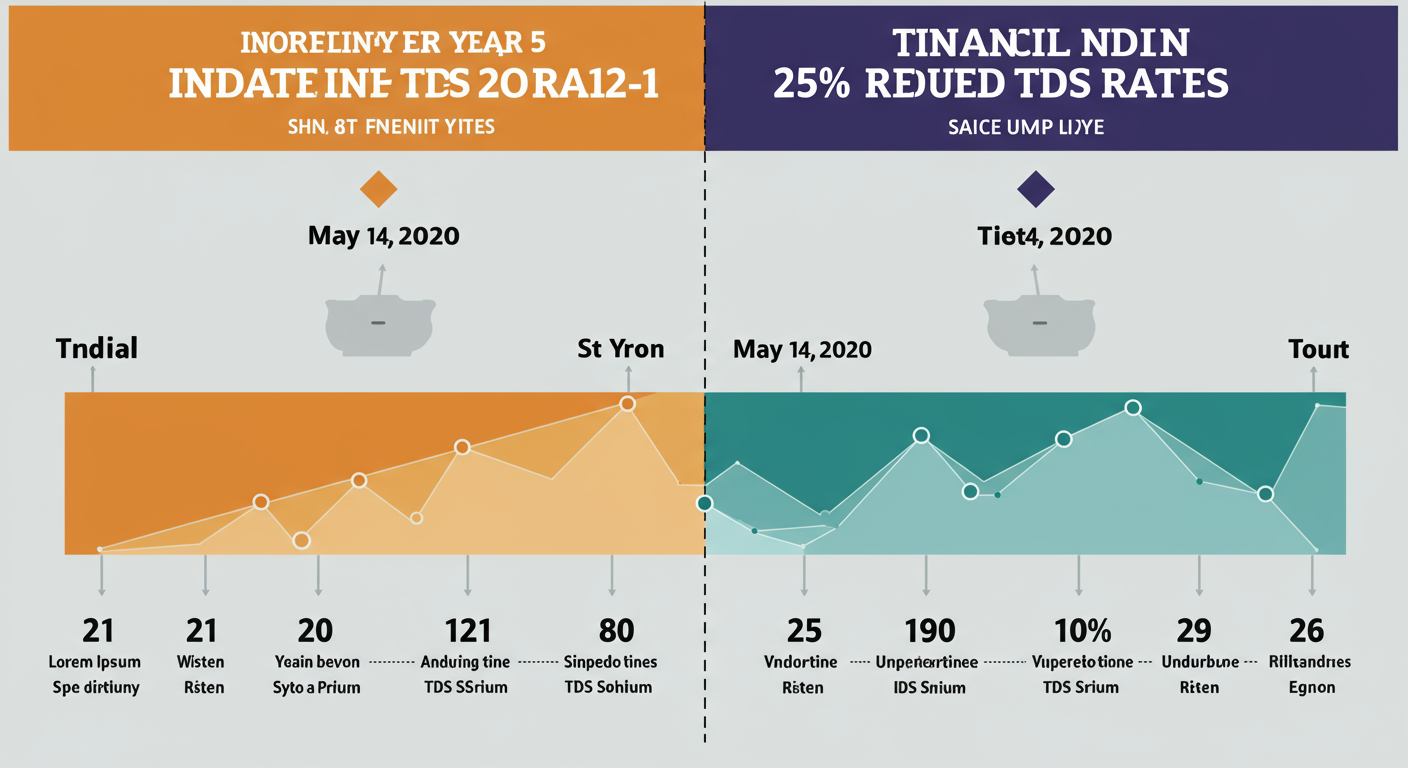
Everything hinges on one specific date: May 14, 2020. Any payment made or credited before this date used the standard TDS rates. Any payment from this date onward (until the end of the financial year) used the new, reduced rates.
| Period | Applicable TDS/TCS Rates | Key Detail |
|---|---|---|
| April 1, 2020 – May 13, 2020 | Standard Rates | The original, pre-pandemic rates were in effect. |
| May 14, 2020 – March 31, 2021 | Reduced Rates (Standard Rate x 75%) | A 25% reduction was applied to specified non-salaried payments. |
It’s that simple, yet so easy to get wrong if you’re not looking closely at your transaction dates.
⚠️ Watch Out
This rate reduction did not apply to all payments. Crucially, TDS on salaries (Section 192) remained unchanged for the entire year. The reduction was targeted specifically at non-salaried payments like professional fees, rent, commission, and interest.
Complete TDS Rate Chart: FY 2020-21 (AY 2021-22)
Enough with the theory. Let’s get to the numbers. The table below provides a clear breakdown of the most common TDS sections, showing the standard rate, the reduced rate, and the threshold limits. Bookmark this section—it’s the cheat sheet you’ve been looking for.
Note: These rates apply to payments made to resident individuals/HUFs. The rules for non-residents are different.
| Section | Nature of Payment | Threshold Limit (p.a.) | Standard Rate (until May 13, 2020) | Reduced Rate (May 14, 2020 – Mar 31, 2021) |
|---|---|---|---|---|
| 194A | Interest (from banks, post office, etc.) | ₹40,000 (₹50k for senior citizens) | 10% | 7.5% |
| 194C | Payment to Contractors (Individual/HUF) | ₹30,000 (single) or ₹1,00,000 (aggregate) | 1% | 0.75% |
| 194C | Payment to Contractors (Others) | ₹30,000 (single) or ₹1,00,000 (aggregate) | 2% | 1.5% |
| 194H | Commission or Brokerage | ₹15,000 | 5% | 3.75% |
| 194-I(a) | Rent for Plant & Machinery | ₹2,40,000 | 2% | 1.5% |
| 194-I(b) | Rent for Land, Building, Furniture | ₹2,40,000 | 10% | 7.5% |
| 194J | Fees for Professional Services | ₹30,000 | 10% | 7.5% |
| 194J | Fees for Technical Services / Call Centre | ₹30,000 | 2% | 1.5% |
| 194K | Dividend from Mutual Funds | ₹5,000 | 10% | 7.5% |
| 194M | Certain payments by Individual/HUF | ₹50,00,000 | 5% | 3.75% |
💡 Pro Tip
When reviewing old records, don’t just look at the payment date on your bank statement. According to income tax law, TDS applies at the time of credit or payment, whichever is earlier. If you credited a vendor’s account in your books on May 10, 2020, but paid them on May 20, 2020, the standard (higher) rate applies because the credit date falls before the reduction period.
“I Applied the Wrong Rate… Now What?” A Step-by-Step Correction Guide
It happens. In the chaos of 2020, many businesses made honest mistakes. Perhaps you applied the reduced rate for the whole year or continued using the old rate after May 14. The good news is that you can fix it by filing a TDS correction statement.
Ignoring it is not an option. The Income Tax Department’s systems will automatically flag a mismatch between the TDS you deposited and the amount you should have deposited, leading to a demand notice for the shortfall, plus interest.
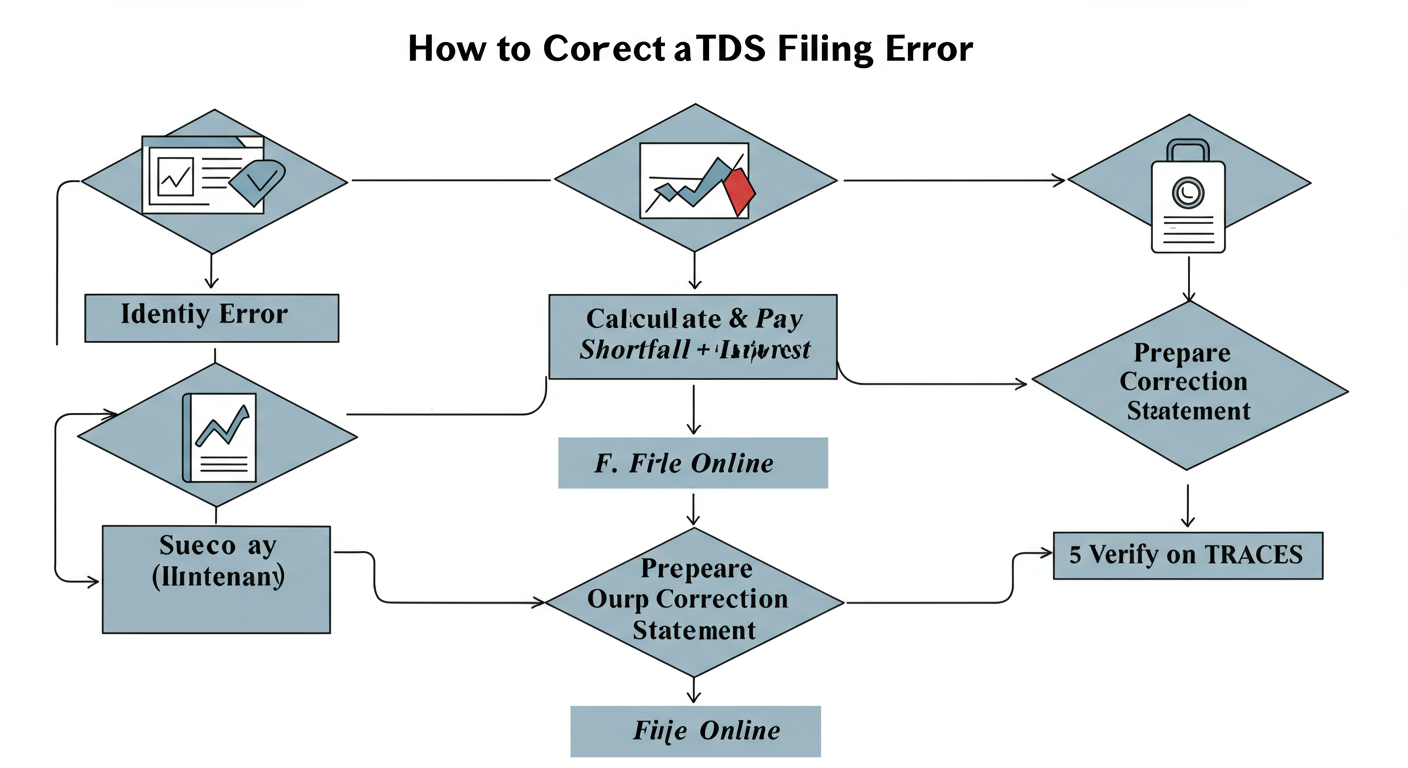
Here’s a simplified process for correcting an error from FY 2020-21:
- Identify the Discrepancy: First, pinpoint the exact transactions with the incorrect TDS rate. You’ll need to calculate the shortfall (the difference between what you should have deducted and what you actually deducted).
- Calculate and Pay Interest: You must pay interest on the shortfall. Interest for late deduction is typically 1% per month (or part of a month), and for late payment after deduction, it’s 1.5% per month. Use the official Income Tax portal to pay this amount via Challan 281.
- Prepare a Correction Statement: Using a TDS return filing utility, you’ll need to prepare a correction statement (a revised TDS return). You will need the original TDS return’s token number for this.
- Update the Records: In the correction file, you will update the specific challan and deductee records where the error occurred. You’ll need to input the correct TDS amount.
- File the Correction: Validate the file and submit the correction statement. Once it’s processed, your records will be updated, and the demand notice should be nullified.
From our hands-on testing of the correction process, the most common snag is incorrectly matching the payment challans. Always double-check your challan details before submitting.
🎯 Key Takeaway
The financial year 2020-21 had a unique dual-rate TDS system. The date of payment or credit is the single most important factor in determining the correct rate. Always verify this date before applying a rate from that period to avoid costly compliance errors. NGO Darpan Registration: The Ultimate 2026 Guide
Common Pitfalls and How to Avoid Them
I’ve seen countless businesses receive tax notices for FY 2020-21, and the mistakes almost always fall into one of these categories. Learn from them so you don’t repeat them. How to Start a Transport Business in 2026 (A Profitable Plan)
The PAN Penalty Trap
This is a big one. The law is crystal clear: if the person or entity you’re paying (the deductee) does not provide a valid Permanent Account Number (PAN), you must deduct TDS at a much higher rate.
⚠️ Watch Out
If no PAN is provided, TDS must be deducted at 20% (or the rate specified in the Act, whichever is higher). The special 25% rate reduction of 2020 did not apply in these cases. Applying a 7.5% or 3.75% rate to a payment where the recipient had no PAN is a major compliance failure.
Misclassifying Payments
Is it a contractual payment (Section 194C) or a professional fee (Section 194J)? The difference in rates can be huge. For example, in late 2020, the rate for a contractor was 0.75% (for individuals), while for a professional, it was 7.5%—a tenfold difference!
Always be certain about the nature of the service. When in doubt, review the contract or invoice description carefully. Misclassification is a red flag for tax auditors.
💡 Pro Tip
Use Form 26AS as your source of truth. As a payee, you can log in to the tax portal and view your Form 26AS for AY 2021-22. It shows all the tax that has been deducted and deposited in your name. Cross-reference this with your own records to ensure your clients/employers deducted the correct amount.
Where to Find Official Documentation
While this guide is built on expert experience, for legal and audit purposes, you should always rely on official sources. Be wary of random PDFs you find online.
- The Official Press Release: The most authoritative source for this specific rate change is the Press Information Bureau (PIB) release dated May 13, 2020. It officially announced the 25% reduction.
- The Income Tax Act: The foundational rules for Tax Deducted at Source are laid out in the Income Tax Act, 1961. This is the ultimate legal document, though it can be dense for non-experts.
Trust me on this one: relying on official government channels protects you from misinformation and ensures your compliance is built on a solid foundation.
❓ Frequently Asked Questions
Why are we still talking about FY 2020-21 rates in 2026?
Tax records have a long life. You might be dealing with a tax assessment, responding to a notice, or simply performing an internal audit. The standard time limit for the tax department to issue a notice for that period can extend for several years, so having accurate historical information is crucial for compliance.
Did the TDS rate cut apply to my salary?
No. The 25% rate reduction was specifically for non-salaried payments. TDS on salary under Section 192 was calculated based on the employee’s income tax slab rates for the entire financial year, with no special reduction.
What’s the difference between Financial Year (FY) and Assessment Year (AY)?
It’s a common point of confusion! The Financial Year is when you earn the income (e.g., April 1, 2020, to March 31, 2021). The Assessment Year is the following year when that income is ‘assessed’ for tax (e.g., April 1, 2021, to March 31, 2022). So, the rules for FY 2020-21 apply to AY 2021-22.
I’m a freelancer. How did this affect me?
As a freelancer receiving payments for professional services (Section 194J), your clients should have deducted 10% TDS on payments before May 14, 2020, and 7.5% TDS on payments from that date onward. It’s a great idea to check your old invoices and Form 26AS to confirm this was done correctly.
What if my client deducted the wrong amount of TDS?
Ultimately, the responsibility to deposit the correct TDS lies with the deductor (your client). However, when you file your own income tax return, you only get credit for the TDS that was actually deposited. If there’s a shortfall, you’d have to pay the remaining tax yourself and sort it out with your client.
Closing the Books on a Complex Year
Navigating the TDS rates of FY 2020-21 doesn’t have to be a source of stress. It all boils down to a few core principles: verify the transaction date, apply the correct dual-rate logic, and always double-check for PAN compliance.
The rules from that period were an anomaly, a response to a global crisis. But the principles of diligent bookkeeping and accurate tax compliance are timeless. By using the charts and steps in this guide, you’re not just solving a historical puzzle—you’re reinforcing the sound financial habits that protect your business from future surprises.
Your next step? If you have any lingering doubts about your filings from that year, take 30 minutes to pull up your Form 26AS for AY 2021-22. Compare it against your records. That simple act of verification could save you a world of hassle down the line.