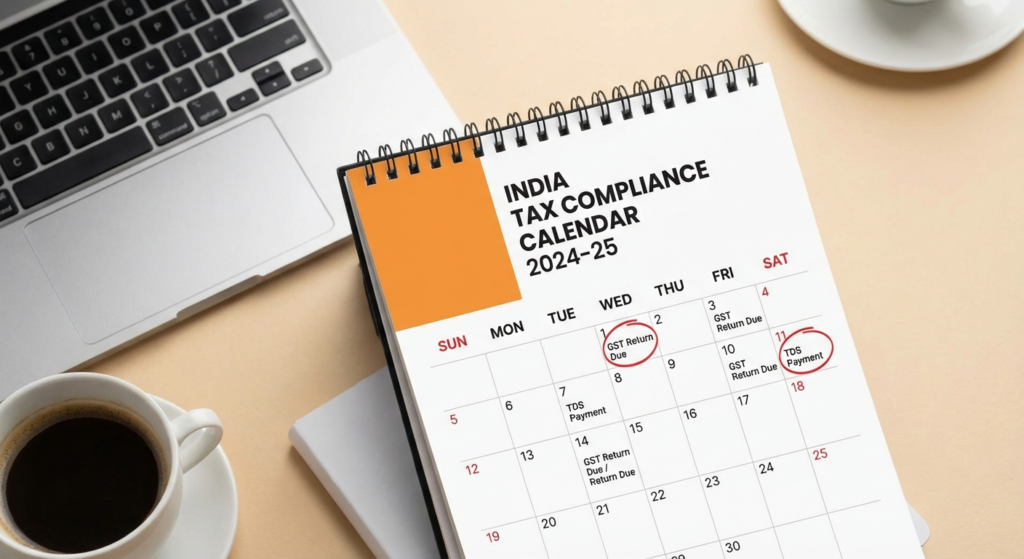
Running a business in India is an exhilarating journey of growth and innovation, but it comes with a significant responsibility: adherence to regulatory norms. For entrepreneurs, CFOs, and tax professionals, the tax compliance calendar India is not just a schedule; it is the backbone of financial discipline. Missing a single deadline can trigger a cascade of penalties, interest payments, and legal notices that distract from your core business goals.
Navigating the labyrinth of GST, Income Tax, TDS, and ROC filings requires foresight. Whether you are a startup founder or a seasoned director, understanding the nuances of the tax compliance calendar India is essential for maintaining a clean compliance track record. In this comprehensive guide, we will break down the month-by-month obligations, helping you stay organized and audit-ready throughout the fiscal year.

Why Following the Tax Compliance Calendar India Matters
In the dynamic Indian regulatory environment, the government has streamlined many processes through digitization, but this also means that non-compliance is detected faster than ever. The tax compliance calendar India serves as your early warning system. It allows businesses to allocate funds for tax payments, organize necessary documentation, and coordinate with chartered accountants well in advance.
Strict adherence to these timelines boosts your business creditworthiness. Banks and investors scrutinize statutory compliance before extending credit or funding. Furthermore, consistent filing avoids the compound effect of late fees. For instance, failing to file GST returns on time not only attracts late fees but can also block the generation of E-way bills, effectively halting your logistics.
Avoid Penalties
Late filing fees and penal interest can severely impact profit margins. A calendar keeps you alert to deadlines like GSTR-3B and TDS payments.
Better Cash Flow
Knowing when Advance Tax is due allows for better liquidity management, preventing last-minute cash crunches.
Audit Readiness
Timely compliance ensures that your books are always ready for scrutiny, reducing stress during the end-of-year financial closing.
GST Deadlines in the Tax Compliance Calendar India
The Goods and Services Tax (GST) is a transaction-based tax, making it one of the most frequent recurring elements in the tax compliance calendar India. Depending on your turnover and the scheme you have opted for (Regular or QRMP), your deadlines will vary. Ignoring these dates is often the primary cause of working capital blockage due to penalties.
For most regular taxpayers, the compliance cycle is monthly. You must file GSTR-1 (Sales return) and GSTR-3B (Summary return) sequentially. If you are a smaller business opting for the Quarterly Return Filing and Monthly Payment of Taxes (QRMP) scheme, your calendar looks slightly different but still requires monthly attention for tax payments via PMT-06.
It is vital to note that GST compliance is not just about filing; it is about accurate reconciliation between your books and the GST portal. For a deeper dive into the repercussions of missing these dates, you can read about GST penalty and interest consequences.
Standard GST Due Dates
- GSTR-1 (Monthly): 11th of the following month.
- GSTR-1 (Quarterly/QRMP): 13th of the month following the quarter.
- GSTR-3B (Monthly): 20th of the following month.
- GSTR-3B (Quarterly): 22nd or 24th of the month following the quarter (state-dependent).
Income Tax & TDS: Pillars of the Tax Compliance Calendar India
While GST handles indirect taxes, the Direct Tax component of the tax compliance calendar India is equally critical. This includes the payment of Advance Tax, filing of Income Tax Returns (ITR), and Tax Deducted at Source (TDS) compliance. These obligations ensure that the government receives revenue throughout the year rather than just at the end.

Advance Tax is particularly important for businesses and individuals whose estimated tax liability exceeds INR 10,000 in a financial year. Failing to pay these installments results in interest under sections 234B and 234C. Similarly, TDS returns must be filed quarterly. If you manage a small business and are struggling with organizing these records, effective bookkeeping for small business is your first step toward compliance.
Advance Tax Schedule
June 15: 15% of liability
Sept 15: 45% of liability
Dec 15: 75% of liability
Mar 15: 100% of liability
TDS Return Deadlines
Q1 (Apr-Jun): July 31st
Q2 (Jul-Sep): Oct 31st
Q3 (Oct-Dec): Jan 31st
Q4 (Jan-Mar): May 31st
Strategic Planning with Your Tax Compliance Calendar India
Merely knowing the dates is not enough; integrating the tax compliance calendar India into your operational workflow is what separates successful businesses from struggling ones. Strategic planning involves setting internal deadlines that are at least 3-5 days prior to the statutory deadlines. This buffer accommodates technical glitches on government portals, bank holidays, or unexpected staff unavailability.
For example, March is typically the busiest month in the financial year. It requires finalizing accounts, paying the last installment of advance tax, and ensuring all GST reconciliations for the fiscal year are complete. By visualizing the entire year through the lens of the compliance calendar, CFOs can plan major expenditures and investments without disrupting the tax payment cash flow.
How the Tax Compliance Calendar India Impacts MSMEs
Micro, Small, and Medium Enterprises (MSMEs) often operate with limited manpower. For them, missing a date on the tax compliance calendar India can lead to penalties that eat into their thin margins. The government has introduced schemes to ease this burden, but the onus remains on the business owner to stay informed.
MSMEs must pay special attention to the “45-day payment rule” under the MSME Act, which is also linked to tax deductibility in the buyer’s audit. Aligning your payment cycles with your compliance calendar ensures you don’t face disallowances during tax assessments. Staying updated on budget impacts on the MSME sector is also advisable to foresee changes in compliance norms.
Detailed Compliance Breakdown by Category
To provide a clear picture, let’s categorize the compliance requirements. This structured approach helps in delegating tasks to your accounts team or external consultants effectively.
Payroll Compliance (PF & ESI)
Due Date: 15th of every month.
Employers must deduct and deposit Provident Fund (PF) and Employee State Insurance (ESI) contributions. Late payments result in damages and loss of income tax deduction benefits.
Professional Tax (PT)
Due Date: State-specific (usually 15th or end of month).
Applicable in states like Maharashtra, Karnataka, and West Bengal. It is a tax on employment and professions levied by the state government.
ROC Compliance (MCA)
AOC-4: 30 days from AGM.
MGT-7: 60 days from AGM.
Companies must file annual financial statements and annual returns with the Registrar of Companies to maintain active status.
Important External Resources
For the most accurate and real-time updates, always refer to the official government portals. You can verify Income Tax deadlines at the Income Tax e-Filing Portal and check GST notifications at the GST Common Portal. These sources are the final authority on any changes to the calendar.

Consequences of Ignoring the Calendar
The cost of ignorance is high. Beyond the immediate monetary penalties, non-compliance leads to a “Compliance Rating” downgrade on public portals. In the GST regime, a low compliance score can deter potential clients from doing business with you, as they may fear the loss of Input Tax Credit (ITC). Furthermore, repeated offenses can lead to the cancellation of registration, effectively shutting down your business operations.
Additionally, directors of non-compliant companies can face disqualification under the Companies Act. Therefore, treating the tax compliance calendar India as a critical business document rather than a mere administrative list is imperative for long-term sustainability.
Conclusion
Mastering the tax compliance calendar India is about shifting from a reactive mindset to a proactive one. It empowers you to take control of your business finances, avoid unnecessary litigation, and build a reputation as a trustworthy corporate citizen. By marking these critical dates for GST, TDS, Advance Tax, and ROC filings, you safeguard your business against volatility.
Remember, tax laws in India evolve constantly. While this guide provides a solid foundation for 2025, always consult with a qualified Chartered Accountant to tailor this calendar to your specific business model. Stay compliant, stay profitable, and let your business grow without the shackles of regulatory penalties.
FAQs
For most small businesses, the 20th of every month is critical as it is the due date for filing GSTR-3B (unless opted for QRMP). Missing this impacts the ability to generate E-way bills and attracts immediate late fees.
The core structure usually remains the same, but specific dates can be extended by government notifications due to festivals, technical glitches, or pandemics. Always check for official circulars for the current fiscal year.
If you miss the Advance Tax deadlines (June 15, Sept 15, Dec 15, Mar 15), you are liable to pay interest under Section 234C of the Income Tax Act at 1% per month on the shortfall amount.
Yes. While tax dates (GST, Income Tax) are largely similar, corporate law compliances differ. Private Limited companies have to file forms like AOC-4 and MGT-7 with the ROC, whereas LLPs file Form 8 and Form 11.
Yes, many cloud-based accounting software and compliance platforms offer automated reminders and dashboards that track your specific liabilities against the tax compliance calendar India, reducing the risk of human error.