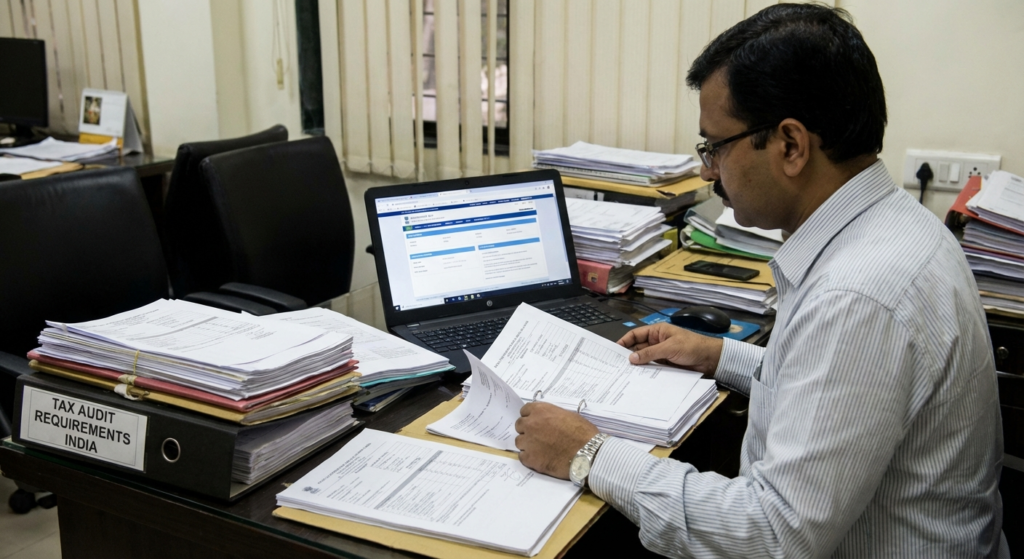
Picture this: Your business just had its best year ever. Revenue is up, clients are happy, and you’re finally scaling. But then, an email from the Income Tax Department lands in your inbox. The subject line? “Scrutiny Notice.” Suddenly, that celebration feels a long way off.
This scenario is a real fear for many Indian entrepreneurs. And often, it stems from one area of confusion: the tax audit. It’s a mandatory check-up for your business’s financial health, and getting it wrong can lead to crippling penalties and endless headaches.
But it doesn’t have to be that way. This isn’t just another dry legal breakdown. We’ve guided hundreds of businesses through the complexities of Indian tax law. In this article, we’ll give you the straight talk on tax audit requirements India has for 2026. You’ll learn exactly who needs an audit, how to prepare without the stress, and the critical mistakes to avoid. Let’s make sure your best year ever stays that way.
What *Really* is a Tax Audit? (Beyond the Jargon)
At its core, a tax audit is an independent verification of your company’s financial records. Think of it like a doctor’s second opinion for your business’s finances. The Income Tax Act, 1961, under the pivotal Section 44AB, mandates this process to ensure you’ve reported your income, deductions, and taxes accurately.
A practicing Chartered Accountant (CA) performs the audit. Their job isn’t to find fault; it’s to certify that your books of accounts are clean and compliant with tax laws. The final output is an audit report, filed in specific forms (which we’ll cover later), that essentially gives the tax department a green flag on your return.
This process builds trust. It tells the authorities that your filed Income Tax Return (ITR) is backed by professionally verified data, reducing the chances of a dreaded scrutiny notice. It’s a mandatory compliance step that, when done right, becomes a powerful shield.
The Big Question: Do YOU Need a Tax Audit in 2026?
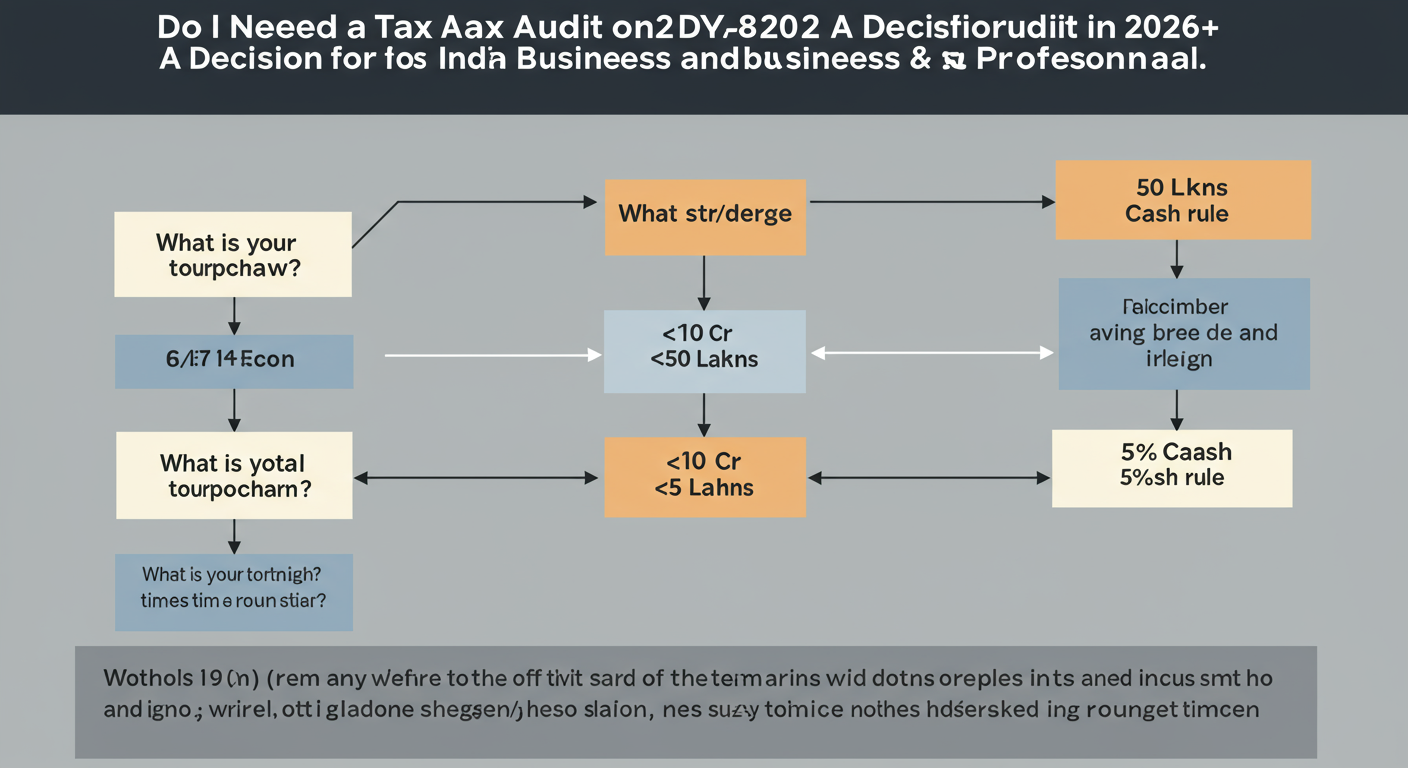
This is where most people get stuck. The rules, known as turnover limits, are different for businesses and professionals. For the Financial Year 2025-26 (Assessment Year 2026-27), the thresholds are clear, but with one major exception that rewards digital payments.
Let’s break it down. Your requirement to get an audit depends on two things: the nature of your work (business or profession) and your total annual turnover or gross receipts.
| Category | Turnover / Gross Receipts Limit | Key Conditions & Nuances |
|---|---|---|
| Business | Exceeds ₹1 Crore | This is the standard limit for any business, from trading to manufacturing. |
| Business (Digital Focus) | Exceeds ₹10 Crore | This higher limit applies ONLY if your cash receipts AND cash payments are less than 5% of the total. It’s a major incentive to go digital. |
| Profession | Exceeds ₹50 Lakhs | This applies to specified professionals like doctors, lawyers, engineers, architects, and IT consultants. |
| Presumptive Tax (Business – Sec 44AD) | Turnover up to ₹2 Crore | Audit is NOT required if you declare ≥8% (or 6% for digital) of turnover as profit. An audit is triggered if you declare lower profits AND your total income is above the basic exemption limit. |
| Presumptive Tax (Profession – Sec 44ADA) | Gross Receipts up to ₹50 Lakhs | Audit is NOT required if you declare ≥50% of receipts as profit. An audit is triggered if you declare lower profits AND your total income is above the basic exemption limit. |
⚠️ Watch Out
The most common trap we see is with the Presumptive Taxation Scheme. Business owners think they are exempt from audits under Section 44AD. But if you declare profits lower than the prescribed 8%/6% to save tax, you immediately fall under the tax audit requirements India mandates, forcing you to maintain full books and get them audited. It’s a classic case of a shortcut leading to a much longer road.
The ₹10 Crore “Digital” Lifeline: Are You Eligible?
The jump from a ₹1 Crore to a ₹10 Crore audit threshold is massive. It’s a clear signal from the government to encourage a less-cash economy. But qualifying for it requires meticulous record-keeping.
Here’s the rule, plain and simple:
- Your total cash receipts (money coming in) must be 5% or less of your total receipts for the year.
- Your total cash payments (money going out) must be 5% or less of your total payments for the year.
You must satisfy both conditions. If even one of them is breached—say, your cash payments are 6%—you fall back to the ₹1 Crore limit. This includes all payments, from supplier invoices to petty cash expenses.
💡 Pro Tip
From day one of the financial year, maintain a simple spreadsheet tracking your total receipts/payments versus your cash receipts/payments. Update it monthly. This simple habit, which takes maybe 30 minutes a month, can save you from an unexpected and costly audit requirement at the end of the year. Don’t wait until it’s too late to check.
Your Pre-Audit Battle Plan: A Step-by-Step Guide
So, an audit is mandatory for you. Don’t panic. Preparation is everything. A smooth audit is a fast audit. Based on our experience handling countless cases, here’s your checklist for a stress-free process.
- Gather Your Core Financials: This is non-negotiable. Your CA will need your complete books of accounts, including the cash book, bank book, general ledger, and journals.
- Organize All Invoices & Vouchers: Collect every single sales invoice and purchase bill. For expenses, ensure you have supporting vouchers. No voucher, no expense—it’s that simple in an audit.
- Compile All Bank Statements: Download the statements for the entire financial year (April 1 to March 31) for ALL bank accounts linked to the business, including any you barely use.
- Prepare Your Asset Register: Create a list of all fixed assets (like laptops, machinery, furniture) purchased or sold during the year. Include dates and values. This is crucial for calculating depreciation correctly.
- Finalize Stock Valuation: If you deal in goods, you need a detailed valuation of your opening and closing stock. The valuation method should be consistent with previous years.
- Consolidate Statutory Records: Have all your GST returns (GSTR-1, GSTR-3B), TDS/TCS returns, and payment challans ready. The auditor will cross-verify these with your books.
🎯 Key Takeaway
The tax audit requirement hinges on specific turnover limits: ₹1 Crore for most businesses, ₹10 Crore for businesses with under 5% cash transactions, and ₹50 Lakhs for professionals. Understanding which bracket you fall into early in the year is the single most important step to ensure compliance and avoid penalties.
Decoding the Audit Report: Forms 3CA, 3CB, and 3CD
Once your CA completes the audit, they don’t just send you a simple “OK” report. They file specific forms on the Income Tax portal. Knowing which form applies to you provides clarity on the process.
| Form Name | Who Is It For? | What Is It? |
|---|---|---|
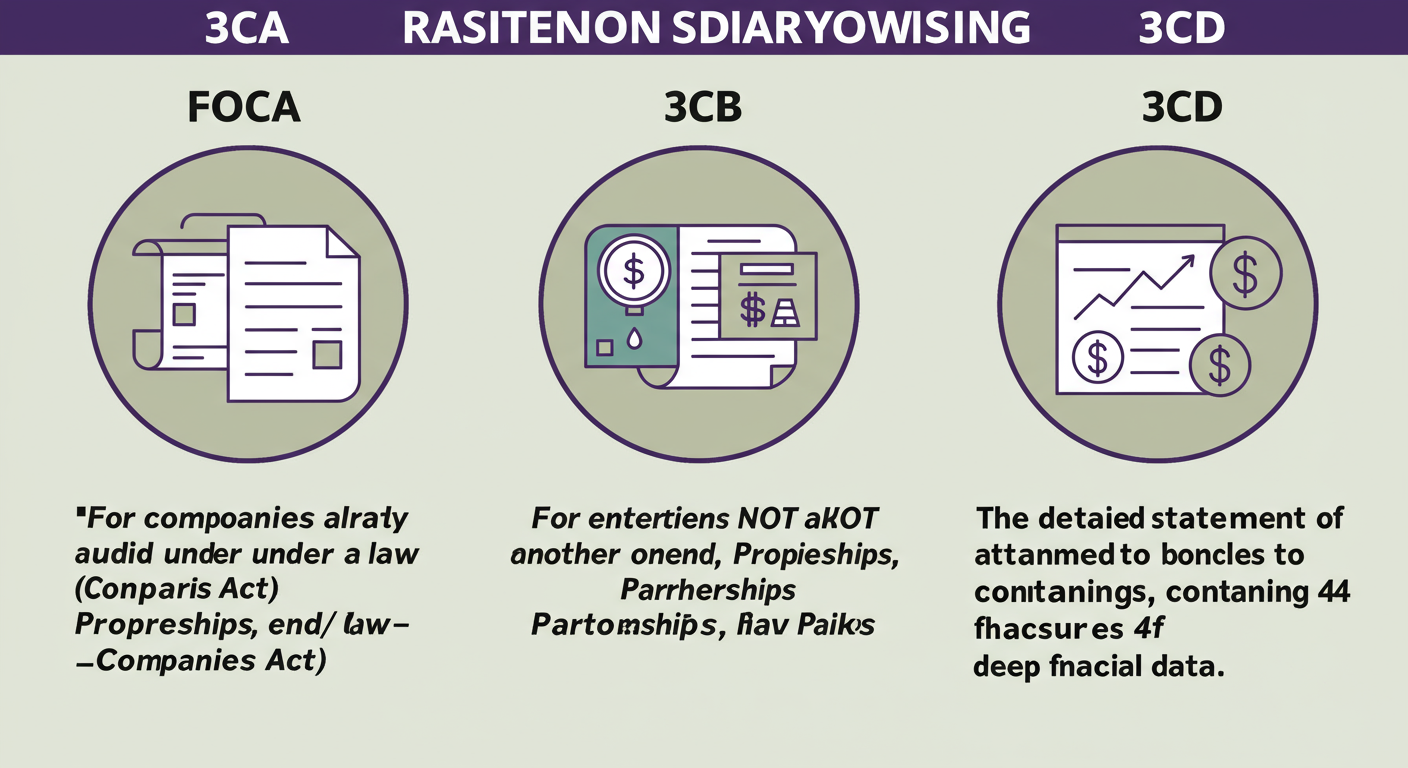
| Form 3CA | Companies or LLPs whose accounts are already required to be audited under another law (like the Companies Act, 2013). | A simple audit report stating that a separate audit has been performed and referencing that report. |
| Form 3CB | Proprietorships, Partnerships, and any other entity not required to be audited under any other law. | This is the primary audit report where the CA certifies the balance sheet and profit & loss account. |
| Form 3CD | Everyone undergoing a tax audit. | This is the real meat of the audit. It’s a detailed statement with 44 clauses where the auditor must report specific information on everything from loans and depreciation to TDS compliance and related party transactions. |
Essentially, you’ll either get Form 3CA or 3CB, but everyone gets Form 3CD. This detailed statement is what the tax department scrutinizes closely.
💡 Pro Tip
Ask your CA for a draft of Form 3CD before they file it. Reviewing it gives you incredible insight into the financial health and compliance level of your own business. It can highlight areas for improvement in the next financial year. Don’t just wait for the final submission; be an active participant.
The High Cost of Non-Compliance: Penalties Under Section 271B
What happens if you were supposed to get an audit but didn’t? The consequences are straightforward and costly.
According to Section 271B of the Income Tax Act, failure to get your accounts audited or file the audit report by the due date (typically October 31st of the assessment year) attracts a penalty.
The penalty is the lower of:
- 0.5% of your total sales, turnover, or gross receipts.
- A flat ₹1,50,000.
For a business with a ₹2 Crore turnover, that’s a ₹1 Lakh penalty. For a turnover of ₹4 Crores, it hits the maximum of ₹1.5 Lakhs. It’s a significant, and entirely avoidable, expense.
⚠️ Watch Out
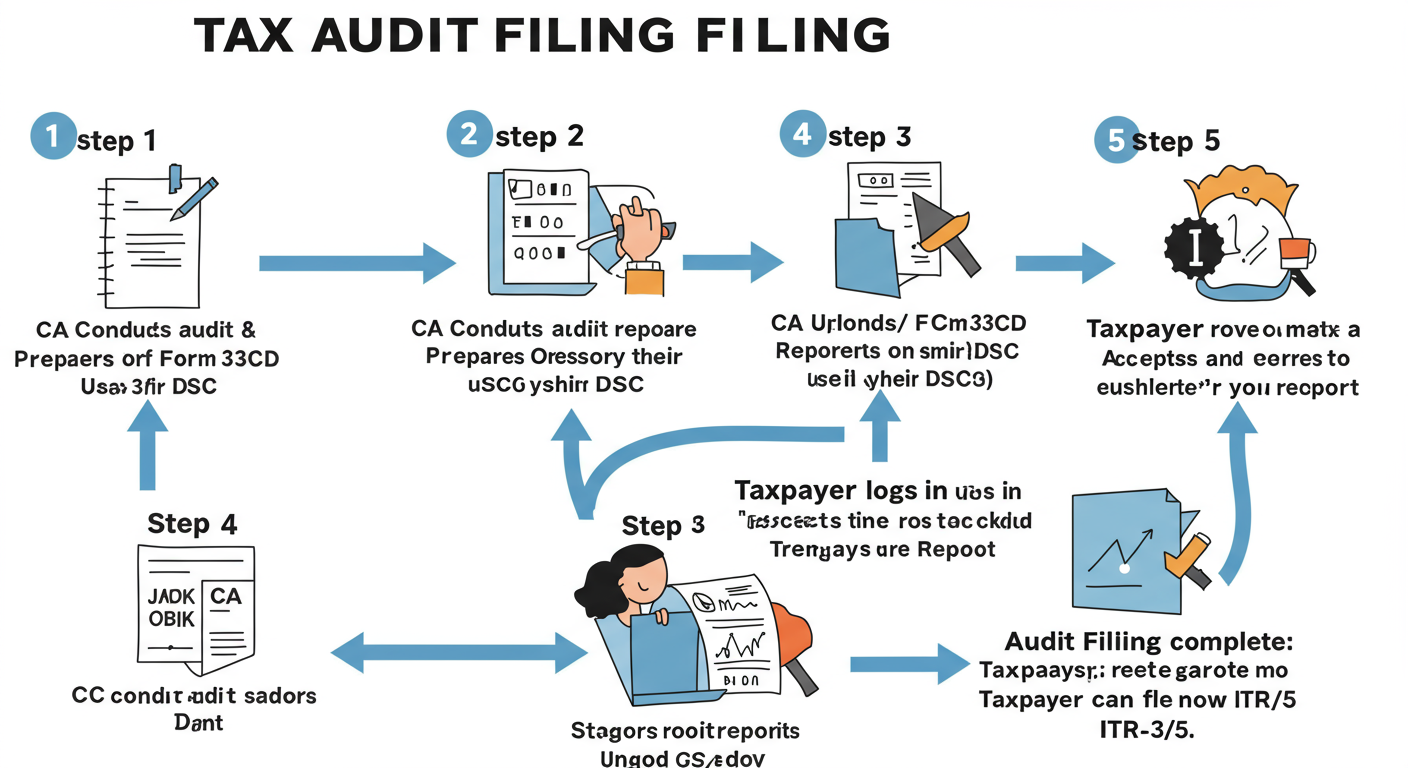
The due date for filing the tax audit report is separate from your ITR filing due date. The audit report must be filed by the CA first. Only then can you file your ITR. Missing the audit deadline often leads to missing the ITR deadline, potentially creating a cascade of penalties and interest charges. Always check the official due dates on the Income Tax Department portal.
Your Next Step: From Compliant to Confident
Navigating the tax audit requirements India sets out is a critical part of scaling a business responsibly. It’s not just about avoiding penalties; it’s about building a transparent, trustworthy enterprise that’s ready for growth, loans, and investment.
You now have the framework: understand your turnover limit, leverage the digital transaction benefit if you can, and prepare your documents methodically. The key is to be proactive, not reactive. Don’t wait until the last quarter of the financial year to think about this.
Your immediate next step? If you’re even close to these thresholds, have a conversation with a qualified Chartered Accountant today. A 30-minute consultation now can save you months of stress and thousands of rupees later. Take control of your compliance, and build your business on a foundation of confidence.
❓ Frequently Asked Questions
What is the due date for a tax audit report for FY 2025-26?
For the Financial Year 2025-26 (which corresponds to the Assessment Year 2026-27), the due date for filing the tax audit report is typically October 31, 2026. This is one month before the ITR filing due date for audit cases. Always verify dates on the official income tax portal as they can be extended by the government.
Is a tax audit required if my business made a loss?
Yes, absolutely. The requirement for a tax audit is based on your turnover, not your profit or loss. If your turnover exceeds the ₹1 Crore (or ₹10 Crore) threshold, you must get an audit, even if you’ve incurred a substantial loss. In fact, an audited loss is more easily accepted by the tax department for carry-forward to future years.
Can I revise a tax audit report after filing?
Yes, a tax audit report can be revised, but only under specific circumstances. According to guidance from the Institute of Chartered Accountants of India (ICAI), a report can be revised if there was a change in law, a discovery of a significant error, or a change in the underlying financial statements after the initial audit. It cannot be revised for minor corrections or on a whim.
How is “turnover” calculated for a tax audit? Does it include GST?
This is a critical point. “Turnover” or “Gross Receipts” refers to the total value of your sales or services rendered. As a general rule, if you are collecting GST from your customers and it is shown separately in your invoices, it should be excluded from the turnover calculation for Section 44AB. However, if you follow an inclusive pricing model, the treatment can get complex. It’s vital to discuss this with your CA to ensure an accurate calculation.
I’m a freelancer earning 60 lakhs. Do I need an audit?
Yes. As a professional, your gross receipts have exceeded the ₹50 Lakhs threshold. Therefore, a tax audit under Section 44AB is mandatory for you. You could have avoided this by opting for the Presumptive Scheme under Section 44ADA if your receipts were below ₹50 Lakhs and you declared at least 50% as profit, but at ₹60 Lakhs, the audit is unavoidable.