
What if you could legally sidestep a mandatory tax audit, even with a turnover of ₹9 crore? It’s not a loophole; it’s a specific provision in India’s tax code designed for modern businesses. Yet, every year, thousands of entrepreneurs and professionals stumble into a mandatory audit—and the risk of heavy penalties—simply because they misunderstand one simple rule.
This isn’t another dry summary of tax law. This is your strategic playbook. We’re going to break down the exact tax audit limit for AY 2026-27 (for the financial year 2025-26). You’ll learn the critical thresholds, how to leverage the “digital transaction” incentive, and how to avoid the common traps hidden within the popular presumptive tax schemes.
By the end of this article, you’ll have the clarity and confidence to structure your finances, stay compliant, and keep your hard-earned money away from the taxman’s penalty box.
What is a Tax Audit, Really? (And Why You Should Care)
Let’s cut through the jargon. A tax audit, under Section 44AB of the Income Tax Act, is a formal inspection of your business’s financial records by a practicing Chartered Accountant (CA). Think of it less as an interrogation and more as a high-stakes financial health check-up.
The CA’s job is to verify that your books of account are accurate and that you’ve followed all the tax laws. They then submit a report (in Form 3CA/3CB and 3CD) to the Income Tax Department. It’s a stamp of approval that says, “Yes, these numbers are clean.”
Why does this matter so much? Because it’s about more than just compliance. It’s about:
- Credibility: Audited financial statements are the gold standard. Banks, investors, and government agencies take them far more seriously when you’re applying for a loan or a tender.
- Error Detection: A good auditor acts as a second pair of expert eyes, catching costly mistakes you might have missed. In our experience, this process often saves businesses more money than the audit costs.
- Penalty Prevention: This is the big one. Failing to get a mandatory audit done can trigger a painful penalty. More on that later.
Understanding the thresholds isn’t just a box-ticking exercise. It’s a fundamental part of smart financial strategy for any growing business in India.
The Core Audit Thresholds for AY 2026-27: Business vs. Profession
For the Assessment Year 2026-27, the government has continued its push to reward digital transactions. This creates a two-tiered system for both businesses and professionals. Your audit liability depends entirely on your turnover/receipts and your reliance on cash.
Here’s how it breaks down. It’s simpler than you think.
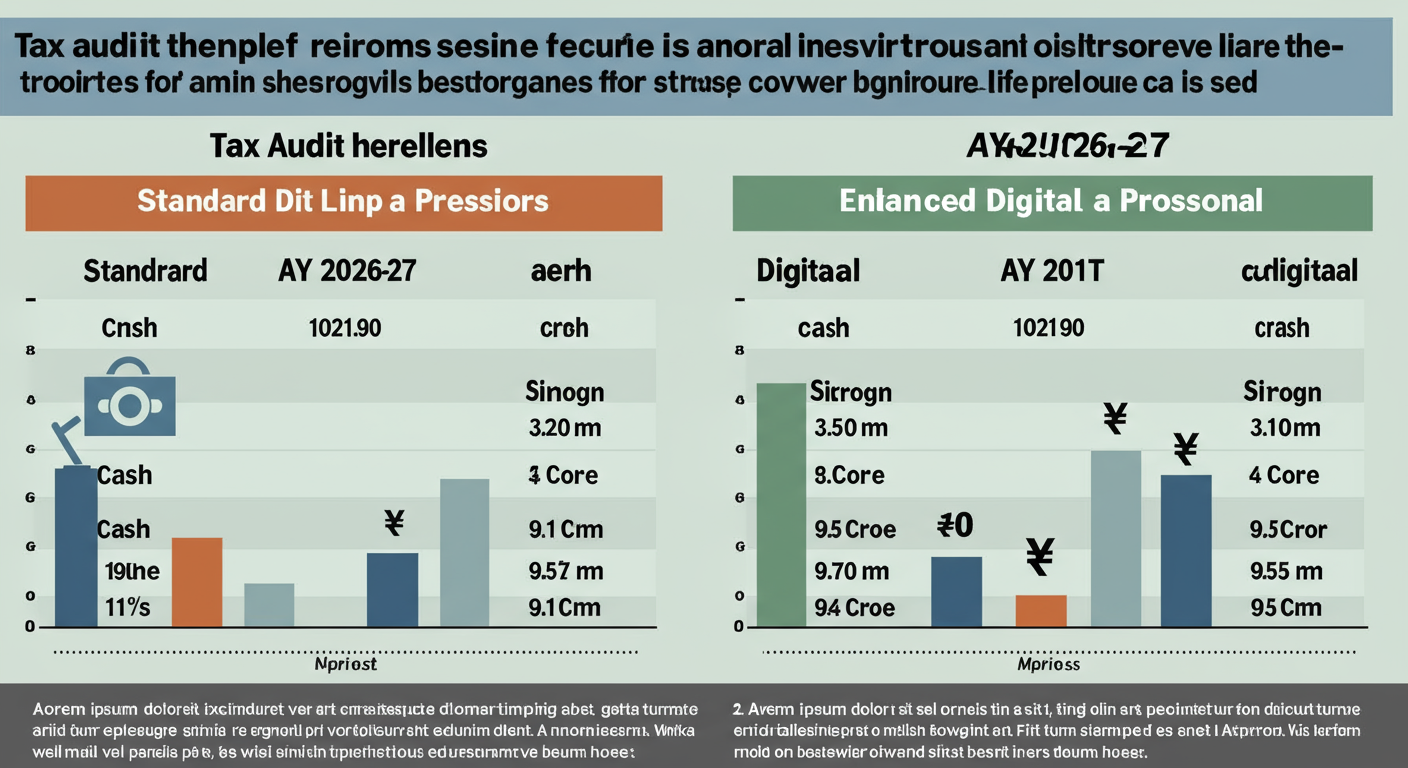
| Taxpayer Category | Standard Audit Limit | Enhanced Audit Limit (If Digital Conditions Met) |
|---|---|---|
| Business | Turnover > ₹1 Crore | Turnover > ₹10 Crore |
| Profession | Gross Receipts > ₹50 Lakh | Gross Receipts > ₹75 Lakh (under Presumptive Scheme) |
The “Enhanced Limit” is where the magic happens. But it comes with a critical condition.
💡 Pro Tip
The 5% cash rule is your golden ticket. To qualify for the higher ₹10 crore (business) or ₹75 lakh (professional) limits, your cash transactions must be minimal. Specifically, both your total cash receipts and your total cash payments for the year must be 5% or less of their respective totals. It’s not one or the other—it’s both.
Business Audit Limits (Section 44AB) Explained
For businesses, it’s all about turnover. Let’s see this in action.
- Scenario A (High Cash): “Kiran Retailers” has a turnover of ₹1.5 crore in FY 2025-26. A significant portion of their sales is in cash, making up 15% of total receipts. Result: Tax audit is mandatory because their turnover exceeds ₹1 crore and they don’t meet the digital condition.
- Scenario B (Low Cash): “Digital Solutions Pvt. Ltd.” has a turnover of ₹8 crore. They meticulously ensure all client payments are received via bank transfer and vendor payments are made through NEFT/RTGS. Their cash receipts are 1% and cash payments are 2% of the totals. Result: No tax audit required. Their turnover is below the ₹10 crore enhanced limit, and they easily satisfy the <5% cash rule.
Professional Audit Limits (Section 44AB) Explained
For professionals—doctors, lawyers, architects, consultants, etc.—the logic is similar but the numbers are different. The standard limit is a gross receipt of ₹50 lakh.
The enhanced limit of ₹75 lakh was introduced for professionals eligible for the presumptive taxation scheme under Section 44ADA, provided their cash receipts are 5% or less of total gross receipts. This was a significant relief, but the cash condition is strict.
⚠️ Watch Out
For professionals, the ₹75 lakh limit isn’t a general exemption. It’s tied to the presumptive scheme (Section 44ADA). If your gross receipts are ₹70 lakh but your cash receipts are 10% of the total, you can’t use the presumptive scheme with the enhanced limit. You’ll fall back to the standard ₹50 lakh threshold, making an audit mandatory.
🎯 Key Takeaway
The government’s message is crystal clear: go digital. By ensuring your cash receipts and payments are below 5% of totals, you unlock a 10x higher audit threshold (from ₹1 Cr to ₹10 Cr) for your business. This is the single most powerful compliance-saving strategy for most SMEs today.
The Presumptive Taxation Trap: When “Simple” Gets Complicated
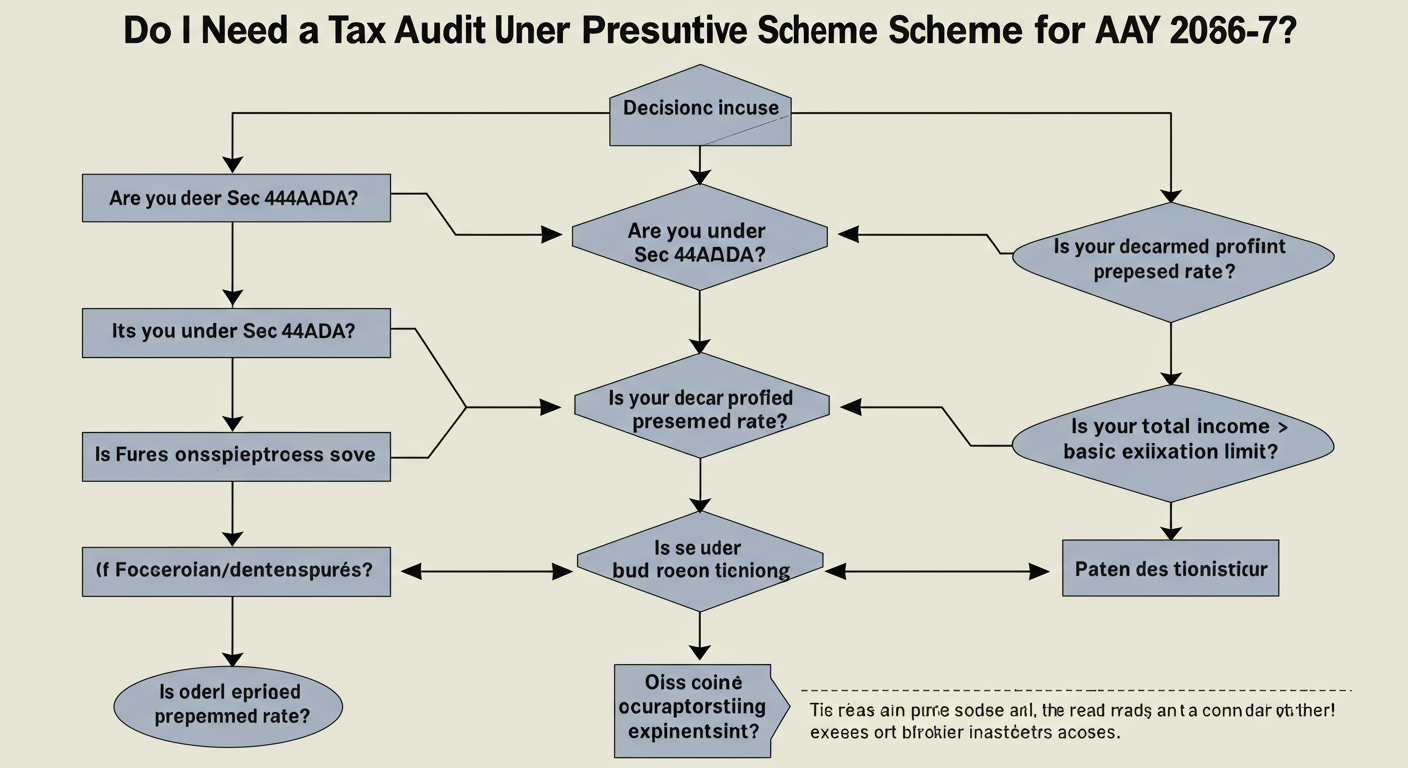
The presumptive tax schemes—Section 44AD for businesses and Section 44ADA for professionals—are fantastic. They allow you to declare income as a fixed percentage of your turnover/receipts, freeing you from maintaining detailed account books.
Simple, right? Not always.
Here’s the trap I’ve seen countless taxpayers fall into: thinking “presumptive” means “no audit, ever.” That’s dangerously false. An audit becomes mandatory under these schemes if you do two things: The Comprehensive Guide to Income Tax Return Filing: Step-by-Step E-Filing Process and Essential Checklist
- You declare profits LOWER than the presumed rate (8%/6% for business, 50% for profession).
- AND your total taxable income is MORE than the basic exemption limit (e.g., ₹2.5 lakh/₹3 lakh depending on the tax regime).
Let’s break this down with a scenario-based table. Incorporating a Private Company: Step-by-Step Guide
| Scenario | Turnover / Receipts | Profit Declared | Total Income | Audit Required? |
|---|---|---|---|---|
| Business (44AD) | ₹90 Lakh (all digital) | ₹4.5 Lakh (5%) | > ₹3 Lakh | Yes. Profit (5%) is below the presumed 6% rate. |
| Business (44AD) | ₹90 Lakh (all digital) | ₹7.2 Lakh (8%) | > ₹3 Lakh | No. Profit is above the presumed 6% rate. |
| Professional (44ADA) | ₹60 Lakh | ₹25 Lakh (41.6%) | > ₹3 Lakh | Yes. Profit (41.6%) is below the presumed 50% rate. |
| Professional (44ADA) | ₹60 Lakh | ₹30 Lakh (50%) | > ₹3 Lakh | No. Profit is exactly at the presumed 50% rate. |
⚠️ Watch Out
The eligibility turnover limit for the presumptive scheme for businesses (Section 44AD) was increased to ₹3 crore. However, this is only if your cash receipts are 5% or less. If your turnover is ₹2.5 crore but your cash receipts are 10%, you are not eligible for the presumptive scheme at all, and the general audit limit of ₹1 crore applies.
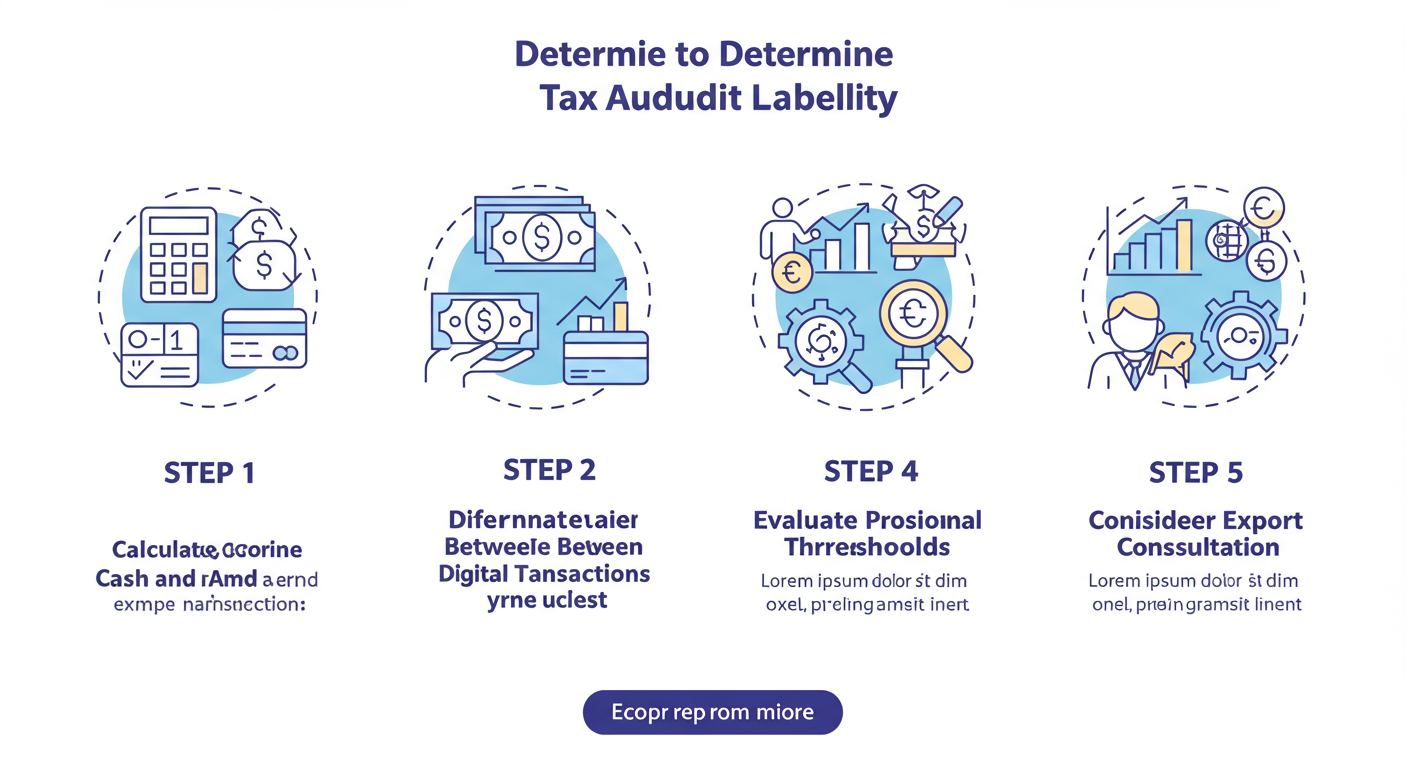
Step-by-Step: How to Determine Your Audit Liability in 5 Minutes
Feeling overwhelmed? Don’t be. Follow this simple, step-by-step process at the end of the financial year (after March 31, 2026).
- Calculate Your Total Turnover/Gross Receipts: Sum up all your sales or professional receipts for the financial year (April 1, 2025, to March 31, 2026). According to guidance from the Institute of Chartered Accountants of India (ICAI), whether to include GST depends on your accounting method, but consistency is key.
- Calculate Your Cash Percentages:
- Sum up all receipts in cash. Divide by total receipts. Is it ≤ 5%?
- Sum up all payments in cash. Divide by total payments. Is it ≤ 5%?
- Apply the Business Threshold: Is your turnover over ₹1 crore? If yes, did you pass the 5% cash test in step 2? If you passed the cash test, is your turnover over ₹10 crore? An audit is only needed if you fail the cash test and are over ₹1 crore, OR if you pass the cash test but are over ₹10 crore.
- Apply the Professional Threshold: Are your gross receipts over ₹50 lakh? If yes, an audit is likely needed unless you qualify for the presumptive scheme’s enhanced limit (under ₹75 lakh with <5% cash receipts).
- Check for Presumptive Scheme Triggers: If you plan to use a presumptive scheme (44AD/44ADA) but want to declare lower profits, check the conditions in the table above. This is a common tripwire.
When in doubt, the final step is always to consult a qualified CA. It’s a small investment to prevent a massive headache.
The Cost of Getting it Wrong: Penalties for Non-Compliance
Ignoring a mandatory tax audit is not an option. The Income Tax Department enforces this rule strictly via Section 271B.
If you fail to get your accounts audited, the penalty is the lower of:
- 0.5% of your total turnover or gross receipts.
- A flat ₹1,50,000.
Imagine your turnover is ₹2 crore. A 0.5% penalty is ₹1,00,000. If your turnover is ₹4 crore, the penalty hits the maximum cap of ₹1,50,000. While you can plead ‘reasonable cause’ for the failure, it’s a difficult and uncertain process. It’s far cheaper and safer to just comply.
💡 Pro Tip
Based on hands-on testing of compliance workflows, we recommend setting up separate bank accounts for business and personal use. This makes tracking digital vs. cash transactions incredibly simple. Use accounting software that automatically categorizes transactions. This documentation will be your best defense if your calculations are ever questioned.
❓ Frequently Asked Questions
What is the due date for the tax audit report for AY 2026-27?
For taxpayers who require an audit, the due date to furnish the tax audit report is 30th September 2026. The corresponding due date for filing your Income Tax Return (ITR) is then extended to 31st October 2026.
My business turnover is ₹7 crore and 99% of my transactions are digital. Do I need a tax audit?
No, you don’t. Since your cash receipts and payments are well under the 5% threshold, you qualify for the enhanced turnover limit of ₹10 crore. As your ₹7 crore turnover is below this limit, a tax audit under Section 44AB is not mandatory for you for AY 2026-27.
I’m a consultant with gross receipts of ₹68 lakh. My cash receipts are ₹5 lakh (about 7.3%). Is an audit required?
Yes, an audit is absolutely required. Your gross receipts of ₹68 lakh are above the standard professional limit of ₹50 lakh. You cannot use the presumptive scheme’s enhanced ₹75 lakh limit because your cash receipts (7.3%) exceed the 5% cap. This is a classic case where the audit becomes mandatory.
What exactly is “turnover” for a tax audit?
Turnover, or sales, generally refers to the aggregate value realized from the sale of goods or provision of services. It typically excludes things like GST (if accounted for separately), interest income, or sale of fixed assets. For a precise definition applicable to your industry, it’s best to consult the official guidance on tax audits or a CA.
What if I run a business AND a profession? How are the limits applied?
You must check the limits for each activity separately. If your business turnover exceeds its applicable limit (e.g., ₹1 crore) OR your professional receipts exceed their limit (₹50 lakh), you must get your accounts audited. An audit is triggered even if only one of the two crosses its threshold. The audit would then cover both your business and professional accounts.
Your Next Step: From Information to Action
Navigating the tax audit limit for AY 2026-27 isn’t about memorizing numbers. It’s about adopting a modern, digital-first mindset for your finances. The path to simpler compliance is clear: minimize cash, understand the real rules of presumptive schemes, and document everything.
From real-world campaigns we’ve managed, the businesses that thrive are those that treat compliance not as a burden, but as a system to be optimized. By leveraging the ₹10 crore digital limit, you’re not just avoiding an audit; you’re building a more transparent, efficient, and credible business.
Your next step? Don’t wait until September. Take 30 minutes this week to review your transaction patterns from the current financial year. Are you on track to stay below the 5% cash threshold? A little course correction now can save you a world of hassle later. For the most definitive rules, always refer back to the source, the Income Tax Act, 1961, or seek professional advice.