
India is officially the world’s third-largest startup ecosystem. That’s huge. From Bengaluru’s tech hubs to Delhi’s fintech corridors, the energy is palpable. But here’s the reality check: a brilliant idea doesn’t legally exist until you handle the paperwork. That’s where startup company registration India comes in.
I’ve been advising founders for over 15 years, and I’ve seen too many treat registration as a boring afterthought. Big mistake. Navigating the legal landscape might feel overwhelming, but it’s actually the bedrock of your business. Whether you want to raise venture capital, protect your personal assets, or just ensure nobody steals your brand name, getting your startup company registration India right is non-negotiable.
In this guide, I’m going to cut through the jargon and walk you through exactly how to register your startup in 2024 without losing your mind.
Why Startup Company Registration India Matters
You might be tempted to start as a sole proprietorship to save money. I get it—bootstrapping is tough. But if you’re building something scalable, that approach is risky. Formalizing your business via proper startup company registration India does more than just keep the government happy.
When you register, specifically as a Private Limited Company, your business becomes a separate legal entity. This is crucial because it protects you. If the business goes bust (and let’s be honest, startups are risky), your personal car, house, and savings are generally safe.
The Core Benefits
- Limited Liability: Keeps your personal assets distinct from business debts.
- Fundraising: VCs need equity in exchange for cash. You can’t give equity if you haven’t completed your startup company registration India process.
- Tax Holidays: Recognized startups can get 3-year income tax exemptions.
Choosing the Right Structure
Before filling out forms, you need to pick a lane. In India, you generally have three options for formal registration:
- Private Limited Company (Pvt Ltd): The gold standard for startups. It allows for external funding and offers limited liability.
- Limited Liability Partnership (LLP): Great for service-based businesses or small teams not looking for VC money. It has lower compliance costs.
- One Person Company (OPC): For the solo founder who wants liability protection but isn’t ready to share equity yet.
For most of you reading this, the Private Limited route is the way to go for startup company registration India under the Startup India scheme.
Prerequisites: Get Your Documents Ready
The Ministry of Corporate Affairs (MCA) has digitized everything, which is a blessing. But the system is unforgiving if you make typos or miss documents. Before you log in to handle your startup company registration India application, have these ready:
- Identity Proof: PAN Card (mandatory for Indians) and Aadhaar/Passport.
- Address Proof: Latest bank statement or electricity bill (not older than 2 months).
- Office Address: You need a registered office. This can be your home, but you’ll need a utility bill and an NOC from the owner.
Also, don’t ignore the money side. Incorporation costs money, and you’ll need to subscribe to shares. I highly recommend reading up on effective cash flow strategies to manage these early expenses.
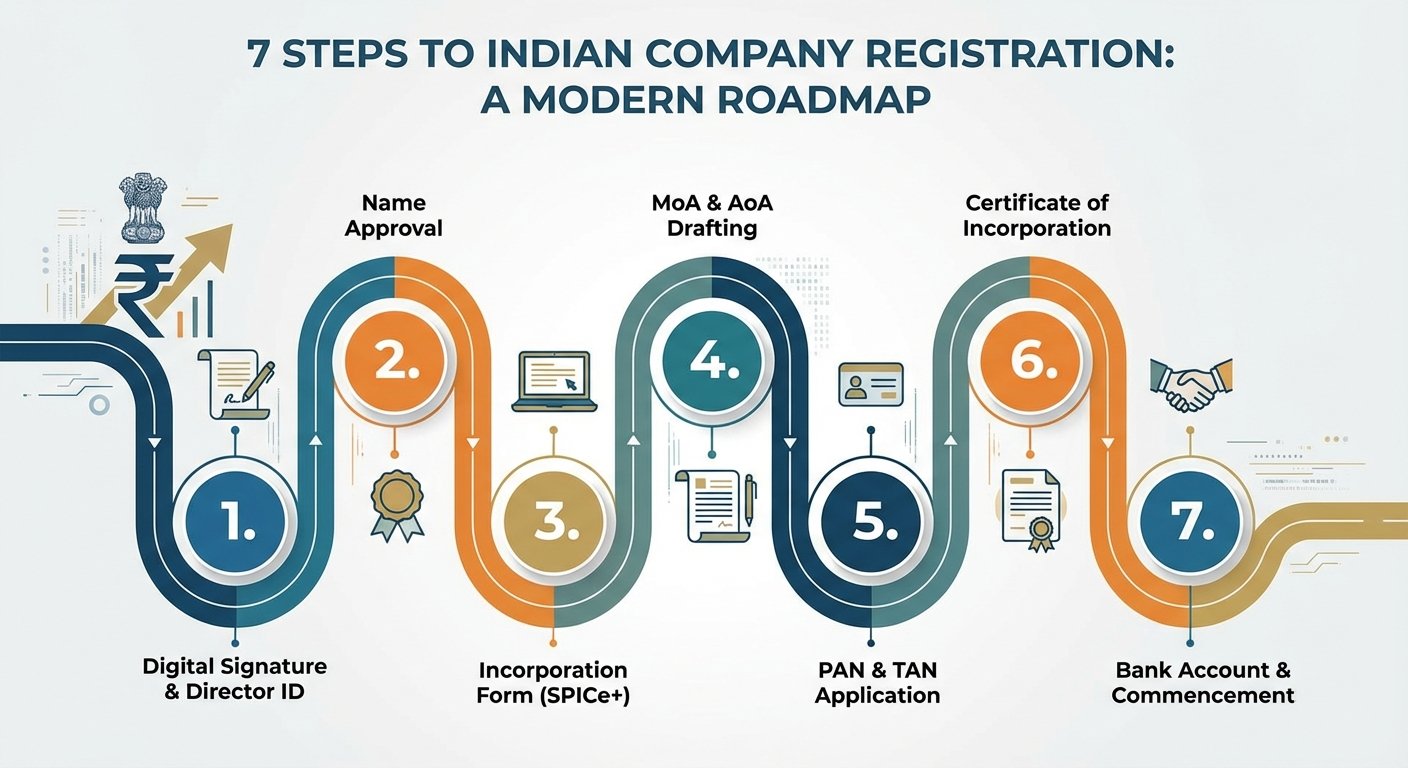
The 7-Step Process for Startup Company Registration India
We use the SPICe+ (Simplified Proforma for Incorporating Company Electronically Plus) form now. It integrates multiple steps into one web-based form. Here is the workflow to get your startup company registration India done smoothly:
Step 1: Digital Signature Certificates (DSC)
Since you can’t physically sign digital forms, all directors need a Class 3 DSC. It’s basically a secure USB token that acts as your signature.
Step 2: Director Identification Number (DIN)
You don’t need to apply for this separately anymore. You can apply for DIN for up to three directors directly inside the SPICe+ form.
Step 3: Name Reservation
This is where many get stuck during startup company registration India. Your name must be unique. If it conflicts with an existing trademark, it gets rejected. You can use the ‘RUN’ service to check availability or apply directly in Part A of SPICe+.
Step 4: The Incorporation Application (Part B)
This is the big one. You’ll input details about your registered office, directors, and share capital. You’ll also attach your Memorandum of Association (MOA) and Articles of Association (AOA).
Step 5: PAN and TAN
The system automatically generates your company’s PAN and TAN during incorporation. No separate application is needed.
Step 6: GST and Bank Account
While optional at the exact moment of incorporation, the SPICe+ form allows you to apply for GSTIN and open a bank account simultaneously. I recommend doing this to save time later. For more on tax, check out our guide on GST registration online.
Step 7: Certificate of Incorporation
Once the Registrar of Companies (ROC) approves your forms, you receive the Certificate of Incorporation (COI) via email. Congratulations, your startup company registration India journey has officially begun!
Beyond Incorporation: DPIIT and Compliance
Getting your COI is just the start. To actually be a “Startup” in the government’s eyes, you must apply for DPIIT recognition. This unlocks the tax holidays and self-certification benefits associated with startup company registration India.
You also need to stay compliant. Missed deadlines lead to heavy penalties. For example, if you’re paying salaries or contractors, you must handle TDS returns filing on time.
Cost Analysis
How much does this actually cost? If your authorized capital is small (under ₹15 Lakhs), the government waives the incorporation fee. However, the total cost for startup company registration India usually includes:
- Stamp Duty: Varies by state (e.g., Maharashtra is higher than Delhi).
- DSC Fees: Roughly ₹1,500 – ₹2,000 per director.
- Professional Fees: You will likely need a CA or CS to draft your MOA/AOA and file the forms.
Common Mistakes to Avoid
I’ve seen applications rejected for simple reasons. The most common? Name infringement. Always check the MCA database and trademark registry before falling in love with a brand name. If you need to protect your own brand, consider trademark registration early on. Another error is rushing the startup company registration India paperwork without verifying address proofs—this causes unnecessary delays.
Conclusion
Completing your startup company registration India is a milestone. It transforms your side hustle into a legitimate entity ready for the market. It might seem like a lot of hoops to jump through, but the credibility and protection it offers are worth every penny.
Don’t let the paperwork scare you off. Get your documents in order, follow the steps, and build that legal foundation. The market is waiting for you.
FAQs
If your documents are perfect and the name is available, it usually takes 7-10 working days. However, government processing times can vary.
Yes! Many founders start from home. You just need a utility bill in the owner’s name and a No Objection Certificate (NOC) from them.
Not immediately. A residential address works for incorporation. However, for GST registration later, physical verification might be required depending on your state.
For a Private Limited Company, yes, you need at least two directors. If you are a solo founder, consider an OPC or ask a family member to be a non-executive director.
MCA incorporation creates your company (the legal entity). Startup India is a government scheme that gives that entity special benefits like tax breaks. You need to do MCA incorporation first.
Read Also:
- 7-Step Guide to Partnership Firm Registration India: Process, Documents & Fees (2024) – Visual Story
- Freelancer Tax Guide for India 2026
- PAS-6 Due Date 2026: Your Guide to Flawless Compliance
- Salary Structure Explained 2026: A Guide to CTC & Take-Home Pay
- Proprietorship Firm Registration in 2026: A 5-Minute Guide
- Form 3 LLP Filing in 2026: A Guide to Avoid Costly Penalties – Visual Story
- Avoid This Costly 2026 Director Filing Mistake
- How to Register DSC on MCA Portal (2026 V3 Guide)