Imagine this: You’ve just closed a record quarter, thanks to a network of high-performing sales agents. You pay out their commissions, everyone is happy, and you move on. Three months later, a notice from the Income Tax Department lands on your desk. The subject? Failure to deduct TDS on commission payments. Suddenly, your profit margins are threatened by interest and penalties you never saw coming.
This isn’t just a scare story; it’s a reality for thousands of businesses every year. The rules around Tax Deducted at Source (TDS) can feel like a minefield, and Section 194H, which governs TDS on commission and brokerage, is a frequent tripwire.
But it doesn’t have to be this way. The rules have actually become simpler and more business-friendly in recent years. In this in-depth guide, we’ll cut through the jargon and give you the battle-tested knowledge you need to handle TDS on commission flawlessly in 2026. You’ll learn the current rates, who needs to comply, and how to build a bulletproof process that keeps you safe and your agents happy.
What Exactly is Section 194H? (And Why It Matters in 2026)
Let’s start with the basics. Section 194H of the Income Tax Act, 1961, is a specific rule that mandates the deduction of tax at source on payments of commission or brokerage. In simple terms, if you’re a business paying someone for acting as your agent, you’re required to hold back a small percentage of that payment as tax and deposit it with the government on their behalf.
The government’s goal here is to track these transactions and collect tax revenue at the point of income generation, rather than waiting for the agent to file their tax return. It’s a crucial part of India’s tax collection mechanism.
But what counts as “commission or brokerage”? The definition is broad. According to the Act, it includes any payment received or receivable, directly or indirectly, by a person acting on behalf of another for:
- Services rendered (not being professional services)
- Any service in the course of buying or selling of goods
- Any transaction relating to an asset, valuable article, or thing (excluding securities)
This covers a huge range of common business payments, from sales commissions and real estate brokerage to advertising agency fees and payments to freelance business development reps.
🎯 Key Takeaway
Section 194H requires you to deduct tax (TDS) when you pay commission or brokerage exceeding ₹20,000 in a financial year. The current TDS rate is a flat 2%, making compliance simpler and improving cash flow for agents compared to the old rules.
The Big Shift: Section 194H Then vs. Now
Here’s where things get interesting. If you’ve been in business for a while, you might remember the old rules for Section 194H, which were a bit more demanding. A major change implemented on April 1, 2025, fundamentally altered the landscape for TDS on commission.
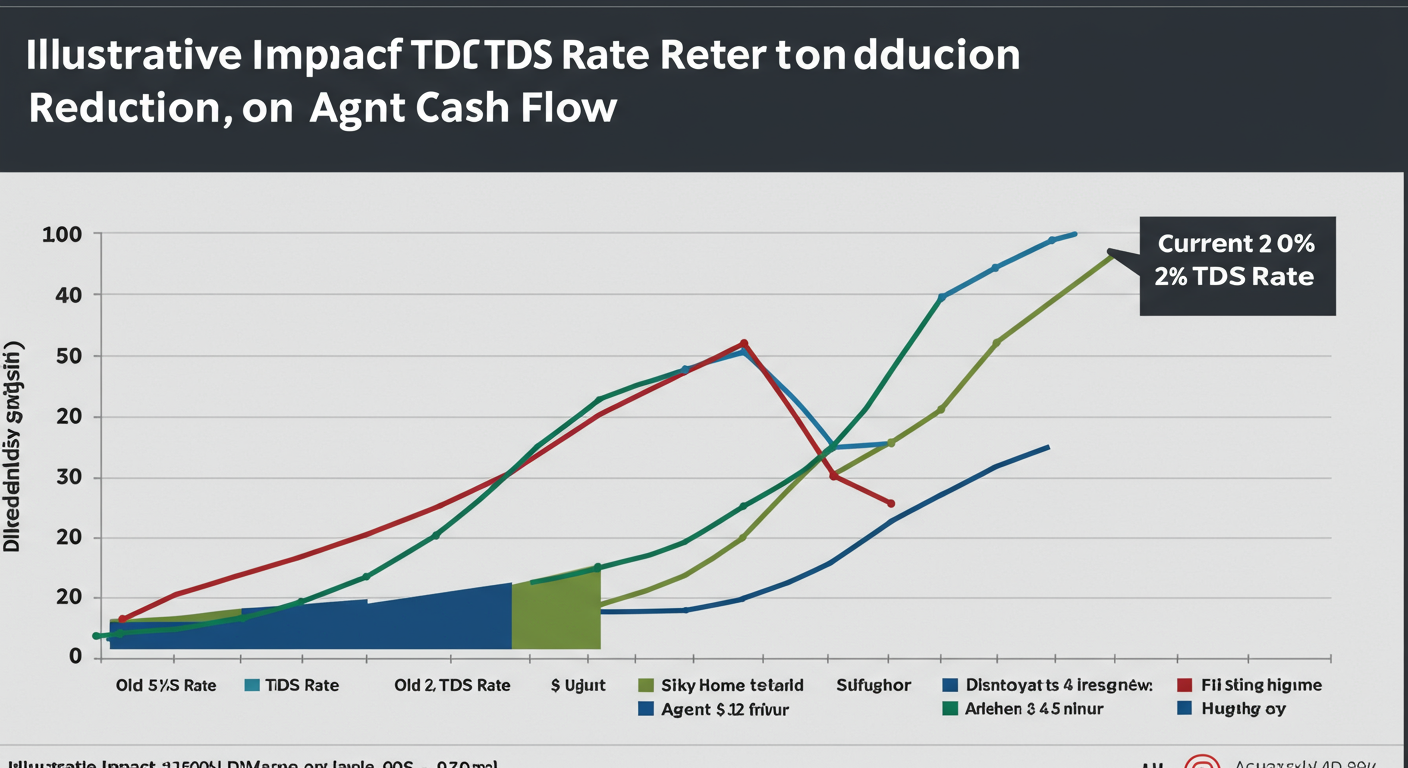
For years, the standard rate was 5%. But recognizing the burden this placed on small businesses and agents, the government made a significant, business-friendly change. Understanding this “then vs. now” context is key to appreciating the current, simpler system.
Based on our hands-on experience helping businesses adapt, this change has been a massive relief, unlocking cash flow and reducing administrative headaches. Here’s a clear breakdown:
| Parameter | Old Rules (Before April 1, 2025) | Current Rules (For FY 2025-26 & 2026-27) |
|---|---|---|
| TDS Rate | 5% (or 3.75% during specific COVID-19 relief periods) | 2% |
| Threshold Limit | ₹15,000 per financial year | ₹20,000 per financial year |
| Impact on Agent | Higher tax deduction, lower initial cash flow. | Lower tax deduction, more immediate take-home pay. |
| Administrative Burden | Higher, as the lower threshold caught more small payments. | Lower, as fewer small-ticket vendors fall under the TDS net. |
💡 Pro Tip
If your accounting software still has “5%” hard-coded as the TDS rate for commission, you’re at risk of over-deducting and creating reconciliation nightmares. Audit your vendor payment and accounting systems immediately to ensure they reflect the current 2% rate for Section 194H.
Who is Responsible for Deducting TDS on Commission?
This is a critical question. Not everyone who pays a commission needs to worry about TDS. The liability falls on specific “persons” as defined by the Income Tax Act.
You are required to deduct TDS under Section 194H if you are:
- Any person, other than an Individual or a Hindu Undivided Family (HUF). This includes Companies, Partnership Firms, LLPs, Co-operative Societies, and Trusts.
- An Individual or a HUF whose accounts were required to be audited in the immediately preceding financial year.
That second point is the one that often trips people up. Let’s break it down. If you’re a proprietor or run a HUF, you need to check your last year’s financials. If your total sales, turnover, or gross receipts from your business exceeded ₹1 crore (or your gross receipts from a profession exceeded ₹50 lakh), you were subject to a tax audit. Therefore, you must deduct TDS on all applicable payments in the current year.
⚠️ Watch Out
Never assume that just because you are an “individual,” you are exempt. The tax audit rule is the great equalizer. We’ve seen many successful sole proprietors and consultants get hit with non-compliance notices because they overlooked this specific clause. Always check last year’s audit status!
Commission vs. Professional Fees: Don’t Get Them Mixed Up
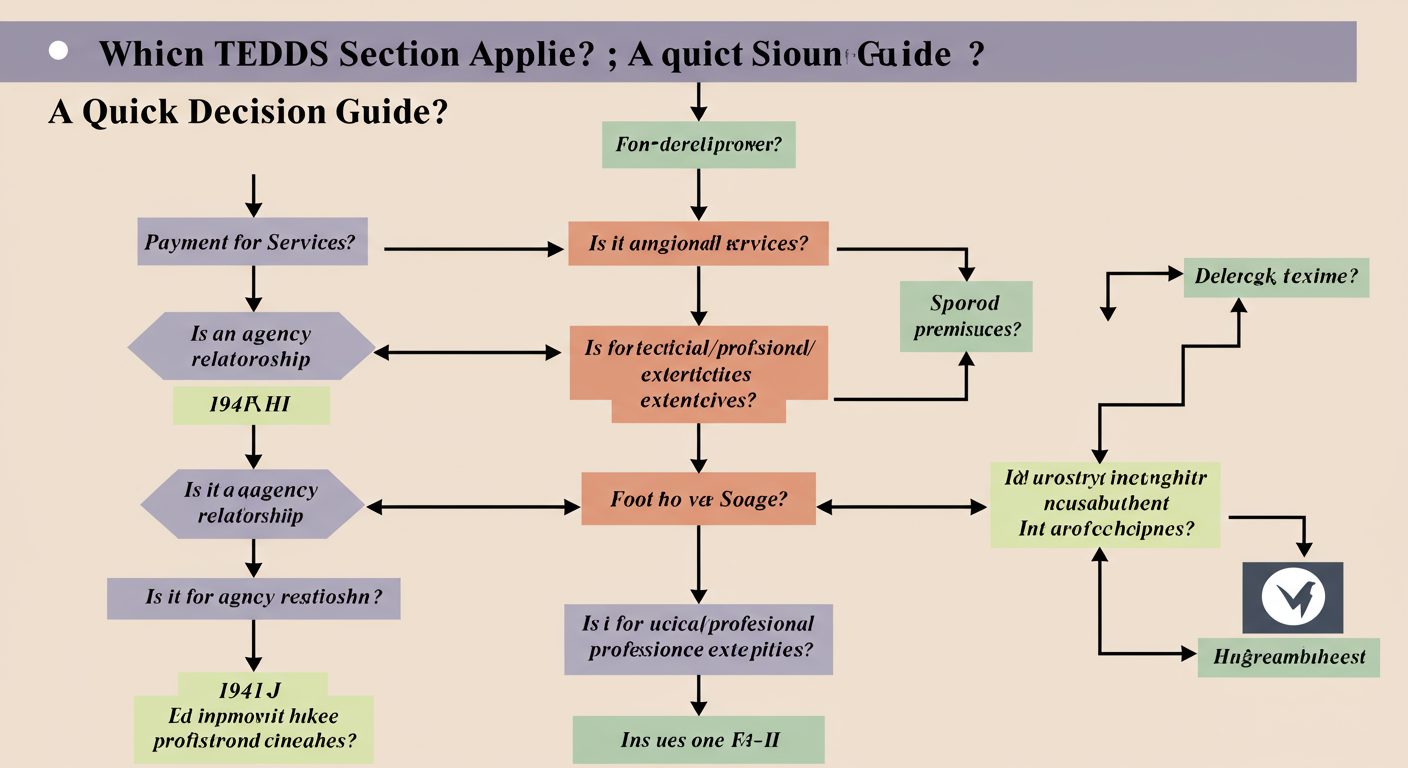
One of the most common—and costly—mistakes we see in our client work is misclassifying payments. Paying a marketing consultant is not the same as paying a sales agent, and the tax department cares deeply about the difference.
Applying the wrong TDS section can lead to a “short deduction” notice, even if you deducted *some* tax. It’s crucial to know the difference.
| TDS Section | Type of Payment | Current TDS Rate (2026) | Typical Example |
|---|---|---|---|
| Section 194H | Commission or Brokerage | 2% | Paying a real estate broker or a sales agent. |
| Section 194J | Fees for Professional or Technical Services | 10% (2% for some technical services) | Paying a lawyer, a digital marketing consultant, or a software developer. |
| Section 194-I | Rent | 2% (Plant & Machinery) / 10% (Land, Building, Furniture) | Paying office rent. |
The key distinction for 194H is the agency relationship. The person is acting on your behalf to facilitate a transaction. For 194J, you’re paying for their specialized knowledge or expertise directly. 7 Steps to Master the GST Return Filing Process in India (2025 Guide)
Your Step-by-Step Guide to 194H Compliance
Alright, let’s get practical. Here is a clear, repeatable process you can implement today to ensure you never miss a beat with Section 194H. GST Notice Reply Process: 7 Steps to Master It (2025 Guide)
- Verify Applicability & Threshold: Before making any commission payment, check if the total amount paid or credited to that specific agent in the current financial year will exceed ₹20,000. Keep a running tally for each vendor.
- Check the Payee’s PAN: This is non-negotiable. Request the agent’s Permanent Account Number (PAN). If they fail to provide it, you are required by law to deduct TDS at a much higher rate of 20%.
- Calculate the TDS Amount: Apply the 2% rate to the total invoice amount (before GST). For example, on a commission of ₹50,000, the TDS is ₹1,000 (2% of 50,000).
- Deduct and Pay the Net Amount: Pay the agent the net amount after deduction. In our example, you would pay them ₹49,000 (₹50,000 – ₹1,000).
- Deposit TDS with the Government: You must deposit the deducted TDS amount (₹1,000) with the government using Challan ITNS 281. The deadline is the 7th of the next month. (For March deductions, the deadline is April 30th).
- File Quarterly TDS Return (Form 26Q): Every quarter, you must file a statement in Form 26Q, detailing all the commission payments made and TDS deducted. This informs the tax department who the credit belongs to.
- Issue TDS Certificate (Form 16A): After filing your return, you must provide a TDS certificate (Form 16A) to the agent. This is their proof that tax has been deducted and deposited on their behalf, which they can claim as a credit when filing their own income tax return.
💡 Pro Tip
Regularly cross-check your TDS records with the payee’s Form 26AS on the TRACES portal. This ensures the TDS credit is correctly reflecting in their account. Proactively resolving discrepancies here prevents future headaches for both you and your agents, building trust and a smooth working relationship.
When You *Don’t* Need to Deduct TDS Under 194H
Knowing when not to deduct is just as important. You are exempt from deducting TDS on commission in the following scenarios:
- Below Threshold: The total commission paid to a single person during the financial year does not exceed ₹20,000.
- Personal Payments: An individual or HUF paying a commission for purely personal purposes (e.g., brokerage on the sale of a personal home), provided they are not liable for a tax audit.
- Specific Exemptions: Payments made by the RBI, commission on securities transactions on a stock exchange, and certain payments to government bodies are exempt. For more on government policy, you can check releases from the Press Information Bureau.
- NIL Rate Certificate: If the agent provides you with a valid certificate under Section 197 from their Assessing Officer, authorizing a lower or NIL rate of TDS.
⚠️ Watch Out
Just because you don’t deduct TDS (e.g., because the amount is below the threshold) doesn’t mean the income isn’t taxable for the agent. They are still responsible for declaring that commission as income on their tax return. Your obligation is only to deduct and report; their obligation is to pay the final tax.
The High Cost of Getting It Wrong: Penalties for Non-Compliance
The Income Tax Department does not take TDS compliance lightly. The consequences of failing to deduct or deposit TDS are severe and can significantly impact your bottom line.
- Interest: You’ll be liable to pay interest. 1% per month if you fail to deduct, and 1.5% per month if you deduct but fail to deposit on time.
- Late Filing Fee: A fee of ₹200 per day is levied for late filing of TDS returns (Form 26Q), up to the total TDS amount.
- Penalty: The Assessing Officer can levy a penalty equal to the amount of tax you failed to deduct or pay.
But here’s the real killer blow for businesses:
Under Section 40(a)(ia) of the Income Tax Act, if you fail to deduct TDS on an expense, 30% of that entire expense will be disallowed. This means you cannot claim it as a business expense, which directly increases your taxable profit and your final tax bill.
Think about it. On a ₹1,00,000 commission payment, failing to deduct ₹2,000 in TDS could lead to ₹30,000 of that expense being disallowed. If your company is in the 30% tax bracket, that’s an extra ₹9,000 in tax, plus interest and penalties. It’s a costly mistake.
❓ Frequently Asked Questions
What is the current TDS on commission rate for 2026?
As of 2026, the TDS rate on commission and brokerage under Section 194H is 2%. This rate has been effective since April 1, 2025, a reduction from the previous 5% rate.
Does TDS on commission apply if the agent doesn’t have a PAN?
Yes, and it’s much higher. If the payee does not provide a valid PAN, you must deduct TDS at a flat rate of 20%, as per Section 206AA. The 2% rate is only applicable if you have their PAN on record.
Is GST included when calculating TDS on commission?
No. According to CBDT Circular No. 23/2017, TDS under Section 194H should be deducted on the base amount of the commission, excluding the GST component, provided the GST is shown separately on the invoice. This is a common point of confusion, so always check the invoice structure.
What’s the difference between Section 194H and 194D (Insurance Commission)?
Section 194H is for general commission and brokerage. Section 194D specifically covers income by way of insurance commission. Thankfully, to simplify things, the TDS rate for Section 194D was also aligned and is now generally 2% for payments to residents, similar to 194H.
What if the commission is paid in kind, not cash?
The law covers payments “in cash or in kind.” If you pay commission in the form of a gift, a trip, or a product, you are still liable to deduct TDS on its market value. The deductor must ensure that tax has been paid on this value before releasing the benefit to the agent.
Conclusion: From Compliance Burden to Business Advantage
Navigating TDS on commission doesn’t have to feel like walking a tightrope. With the current 2% rate and a higher ₹20,000 threshold, the rules under Section 194H are more straightforward than ever before. The key is to move from a reactive to a proactive mindset.
By understanding the nuances, setting up a clear step-by-step process, and using the insights from this guide, you can transform TDS compliance from a source of anxiety into a smooth, automated part of your financial operations. This not only protects your business from costly penalties but also builds trust and transparency with the valuable agents and partners who drive your growth.
Your next step? Take five minutes to review your vendor list. Identify everyone you pay a commission to and check if your accounting system is correctly set up for the 2% TDS rate. That small action today could save you a massive headache tomorrow.
For the most definitive and up-to-date regulations, always refer to the official Income Tax Department website or consult with a qualified tax professional. For a general understanding of the concept, the Wikipedia page on TDS provides a good overview.