
Let’s be honest for a second. When most people think about the role of chartered accountant (CA), they picture someone buried under a mountain of receipts, fiercely punching numbers into a calculator as the tax deadline looms. While that stereotype might have held water twenty years ago, it couldn’t be further from the truth today.
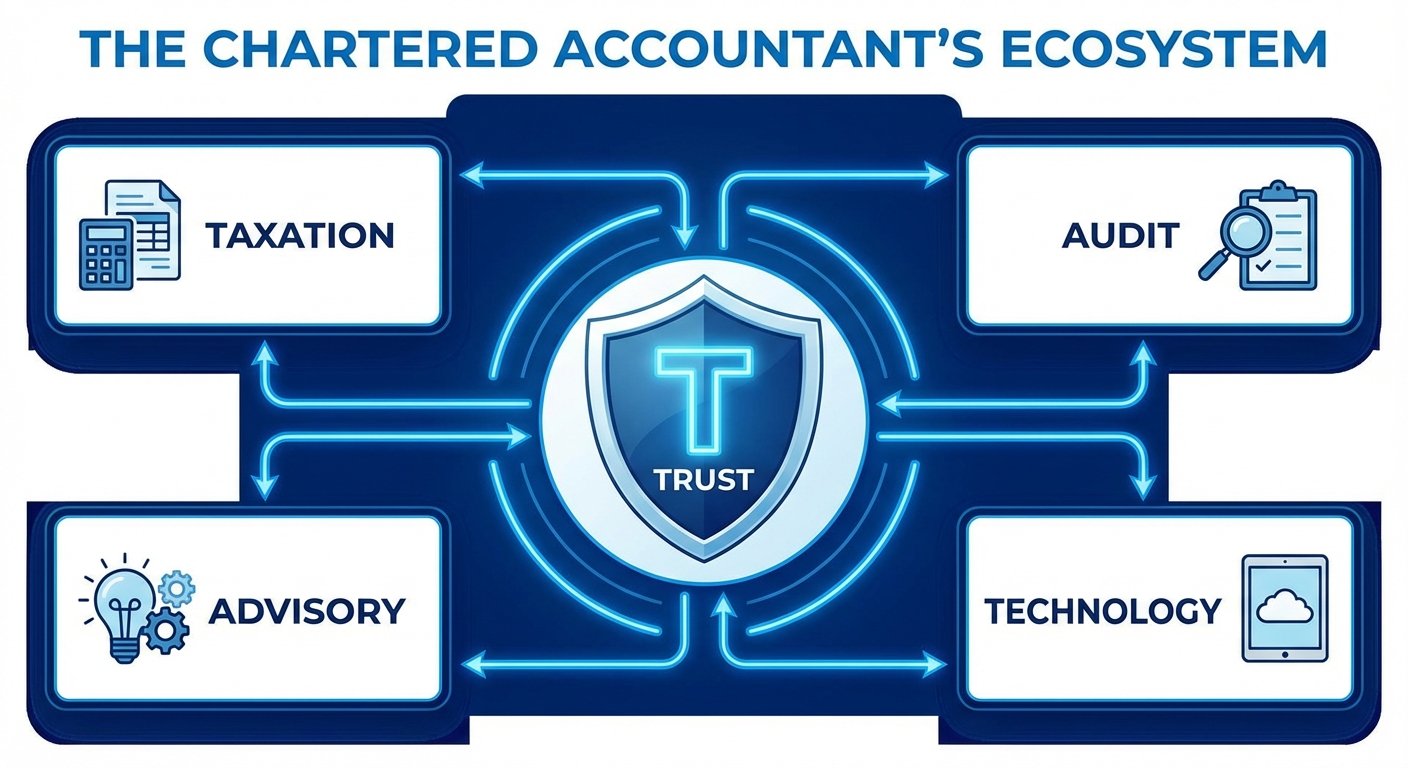
In my two decades of working alongside business leaders and financial experts, I’ve seen firsthand that a skilled CA is often the difference between a business that barely survives and one that dominates its market. They aren’t just tax filers; they are the financial architects of your company. They are the ones who tell you not just what happened with your money, but why it happened and how to make more of it.
Whether you’re a startup founder trying to extend your runway or a director managing a multinational portfolio, understanding the true depth of the role of chartered accountant is critical. In this guide, I’m going to pull back the curtain on what CAs actually do, why their signature carries so much weight, and how you can leverage their expertise to safeguard your financial future.
Figure 1: Modern CAs use data to drive strategy, not just record history.
1. Financial Reporting: Translating Chaos into Clarity
Financial reporting is often dismissed as a boring compliance task. But here’s the thing: financial statements are the report card of your business. If you don’t understand them, you’re flying blind.
The fundamental role of chartered accountant here isn’t just data entry—it’s translation. A CA takes the chaotic daily transactions of your business and organizes them into a structured narrative that investors, banks, and the government can understand. This involves preparing:
- Balance Sheets: A snapshot of what you own vs. what you owe.
- Profit & Loss Accounts: The story of your operational efficiency over a period.
- Cash Flow Statements: The reality check—because profit on paper doesn’t mean cash in the bank.
I cannot stress this enough: Profit is opinion, cash is fact. A good CA ensures your reporting adheres to Generally Accepted Accounting Principles (GAAP) and International Financial Reporting Standards (IFRS). This standardization is what allows an investor in New York to trust the numbers of a company in Mumbai.
2. Taxation and Compliance: Your Shield Against Legal Trouble
If there is one area where the role of chartered accountant is non-negotiable, it’s taxation. Tax laws in India are notoriously complex and fluid. One missed deadline or incorrect filing can lead to a cascade of notices, penalties, and interest that can cripple a small business.
Direct Taxation (Income Tax)
It’s not just about filing returns. It’s about strategic tax planning. A CA analyzes your income structure to maximize deductions under sections like 80C or 80D, and ensures corporate tax liabilities are optimized without crossing legal lines. They handle Tax Audits (required if turnover exceeds certain limits) and represent you before tax authorities if disputes arise.
Indirect Taxation (GST)
Since the rollout of GST, the compliance burden has shifted significantly. Monthly returns, reconciliation of Input Tax Credit (ITC), and annual filings are mandatory. A mismatch between your books and the GST portal can block your working capital.
If you’ve ever received a scary notice from the department, you know the panic it induces. This is where a CA steps in. Handling the GST notice reply process requires a mix of legal knowledge and diplomatic drafting. A professional reply can often resolve issues without a single rupee in penalties.
3. Audit and Assurance: The Guardian Role
Auditing is the function most synonymous with the CA profession. But what does it actually mean? An audit is essentially a “stress test” of your financial reality.
Statutory Audit
Under the Companies Act, 2013, every private limited company must undergo an audit, regardless of whether they made a profit or a loss. The CA examines your books to certify that they present a “true and fair view.” This phrase is the gold standard in accounting. It tells the world that your numbers aren’t cooked.
Internal Audit
While statutory audits are for outsiders (shareholders, government), internal audits are for you. The role of chartered accountant here is to act as a detective within your own company. They look for:
- Leakages: Is inventory disappearing?
- Inefficiencies: Are you paying too much for raw materials?
- Process Gaps: Is the person approving payments also the one signing the checks? (A major fraud risk).
Figure 2: Internal audits often reveal cost-saving opportunities that management missed.
4. Strategic Business Advisory: The “Virtual CFO”
This is where the modern role of chartered accountant gets exciting. Many small to mid-sized businesses (SMBs) cannot afford a full-time Chief Financial Officer (CFO). A CA often bridges this gap, acting as a Virtual CFO.
They move beyond historical data to help you shape the future. This includes:
- Budgeting & Forecasting: Helping you set realistic revenue targets based on market trends, not just gut feeling.
- Pricing Strategy: Calculating your exact break-even point so you don’t sell your products at a loss without realizing it.
- Cash Flow Management: Advising on when to expand and when to conserve cash.
For example, if you are planning the incorporation of a private company, a CA will advise you on the capital structure. Should you take debt? Should you give up equity? These are high-stakes decisions where expert advice is invaluable.
5. Company Law and Secretarial Compliance
You might think, “I have a Company Secretary for this,” but CAs play a massive role in Ministry of Corporate Affairs (MCA) compliance. The regulatory environment in India is becoming stricter by the day. The introduction of the MCA V3 portal has made compliance more digital but also more rigorous.
The role of chartered accountant involves certifying forms regarding:
- Allocation of shares.
- Appointment and resignation of directors.
- Creation of charges (when you take a bank loan against assets).
Why this matters: Non-compliance can lead to the disqualification of directors. I’ve seen directors of thriving companies get their DIN (Director Identification Number) blocked simply because they missed filing an annual return for a dormant company they forgot about. A diligent CA ensures this never happens.
6. Forensic Accounting: The Financial Detectives
In an era where digital transactions are the norm, white-collar crime is becoming increasingly sophisticated. Forensic accounting is a specialized branch where the role of chartered accountant intersects with law enforcement.
Forensic CAs are hired to investigate:
- Embezzlement: When an employee siphons off funds.
- Insurance Claims: Verifying the actual loss after a fire or disaster.
- Dispute Resolution: calculating precise damages in a lawsuit between partners.
They dig deep into the metadata of accounting software to find deleted entries or altered timestamps. If you suspect foul play in your accounts, a standard audit might miss it, but a forensic audit will find it.
7. The Digital Transformation: CAs and Technology
There is a fear that AI and automation will replace accountants. I disagree. Technology hasn’t replaced the role of chartered accountant; it has elevated it.
In the past, a CA spent 80% of their time on data entry and 20% on analysis. Today, tools like Zoho Books, Tally Prime, and Quickbooks automate the entry. This flips the ratio: CAs now spend 80% of their time analyzing data to find insights.
Data Analytics & AI
Modern CAs use data analytics to spot trends. For instance, they might notice that your shipping costs have spiked by 15% in Q3 compared to last year, prompting a renegotiation with your logistics provider. This proactive advice pays for their fees ten times over.
8. The Startup Ecosystem: Valuation and Fundraising
Startups operate in a high-pressure, high-burn environment. The role of chartered accountant here is vital for survival. When a startup goes to raise funds, investors demand a “Due Diligence” report. They want to know if the user metrics translate to financial reality.
CAs assist startups with:
- Valuation: Using methods like Discounted Cash Flow (DCF) to put a price tag on the company for equity dilution.
- ESOPs: Structuring Employee Stock Option Plans to attract talent without burning cash.
- Cap Table Management: ensuring that the ownership structure remains clean as new investors come on board.
A startup with messy books is a red flag for VCs. A CA ensures your financial house is in order so you can focus on the pitch.
9. Ethics and Trust: The Signature that Matters
At the end of the day, the profession is built on trust. The Institute of Chartered Accountants of India (ICAI) enforces a strict code of ethics. When a CA signs a document, they are putting their license and reputation on the line.
This ethical gatekeeping is crucial for the economy. It prevents companies from inflating profits to boost stock prices (remember Satyam?). The role of chartered accountant is to be the conscience of the business world, often having to say “no” to management when they want to cut corners.
Figure 3: A partnership built on trust and expertise.
10. How to Choose the Right CA for Your Business
Not all CAs are created equal. Some specialize in bank audits, others in international taxation, and some in startup advisory. Finding the right fit is essential.
Checklist for hiring a CA:
- Industry Experience: Do they understand your specific sector (e.g., e-commerce vs. manufacturing)?
- Tech Adoption: Do they use modern tools or are they stuck with manual ledgers?
- Proactivity: Do they only call you when a deadline is near, or do they call you with ideas to save money?
- Communication: Can they explain complex tax laws in plain English?
Conclusion: The Indispensable Partner
The role of chartered accountant has transformed from a back-office necessity to a boardroom strategic asset. In a world of complex compliance and fierce competition, they are the navigators who keep your ship off the rocks.
Whether you are navigating the Ministry of Corporate Affairs portal or planning a multi-crore expansion, a competent CA is the best investment you can make. Don’t just hire a CA to keep the taxman away—hire one to help you build a legacy.
Frequently Asked Questions (FAQs)
A CA ensures accurate GST return filing, reconciles Input Tax Credit (ITC) to prevent losses, and handles all communication with tax authorities, including replying to notices and managing audits.
Absolutely. CAs prepare the Projected Financial Statements and Project Reports that banks require to assess your creditworthiness. Their certification adds the necessary credibility to your loan application.
A statutory audit is required by law to certify the accuracy of financial statements for external stakeholders. An internal audit is optional (but recommended) and focuses on improving internal operations, preventing fraud, and increasing efficiency.
Yes. Mistakes made in the early stages—like wrong equity structure or missing compliance filings—can be incredibly expensive to fix later. A CA helps set up a scalable financial foundation from day one.
Technology has automated manual data entry, allowing CAs to focus on high-value tasks like financial analysis, strategic planning, and fraud detection. It has shifted their role from “bookkeeper” to “strategic advisor.”