
Picture this: a single, overlooked deadline costs your company ₹100 per day, per form, with no upper limit. A few months of neglect, and you’re staring at a six-figure penalty. This isn’t a scare tactic. It’s the reality of late ROC filing in India.
But here’s the thing. Viewing ROC compliance as just bureaucratic red tape is a massive strategic error. It’s the bedrock of your company’s credibility, the key to unlocking investment, and the shield that protects you from devastating legal trouble.
Forget the dense legal jargon and confusing government portals. In this guide, we’re cutting through the noise. You’ll get a battle-tested, step-by-step roadmap to master your annual and event-based filings for 2026. You’ll learn not just *what* to file, but *why* it matters and *how* to do it right the first time. Let’s turn this mandatory chore into a strategic advantage.
What is ROC Filing? (And Why It’s Your Company’s Annual Health Check)
Think of the Registrar of Companies (ROC) as the official record-keeper for every company operating in India. It’s an office under the Ministry of Corporate Affairs (MCA), and its job is to ensure businesses are transparent and accountable. ROC filing is simply the process of submitting your company’s annual financial and operational report card to this authority.
It’s not just about paperwork. It’s a public declaration that your company is healthy, well-governed, and playing by the rules. Every document you file—from financial statements to lists of directors—is a signal to the world. A signal to investors, banks, customers, and even potential top-tier employees.
A clean filing history says, “We’re a serious, trustworthy business.” A messy one? It screams risk.
The Brutal Cost of Neglect vs. The Strategic Gain of Compliance
Many founders, especially in the early days, push compliance to the bottom of the to-do list. Big mistake. The principle is simple: the cost of compliance is *always* less than the cost of non-compliance. And the gap isn’t even close.
Let’s break down the real-world consequences. We’re not just talking about late fees.
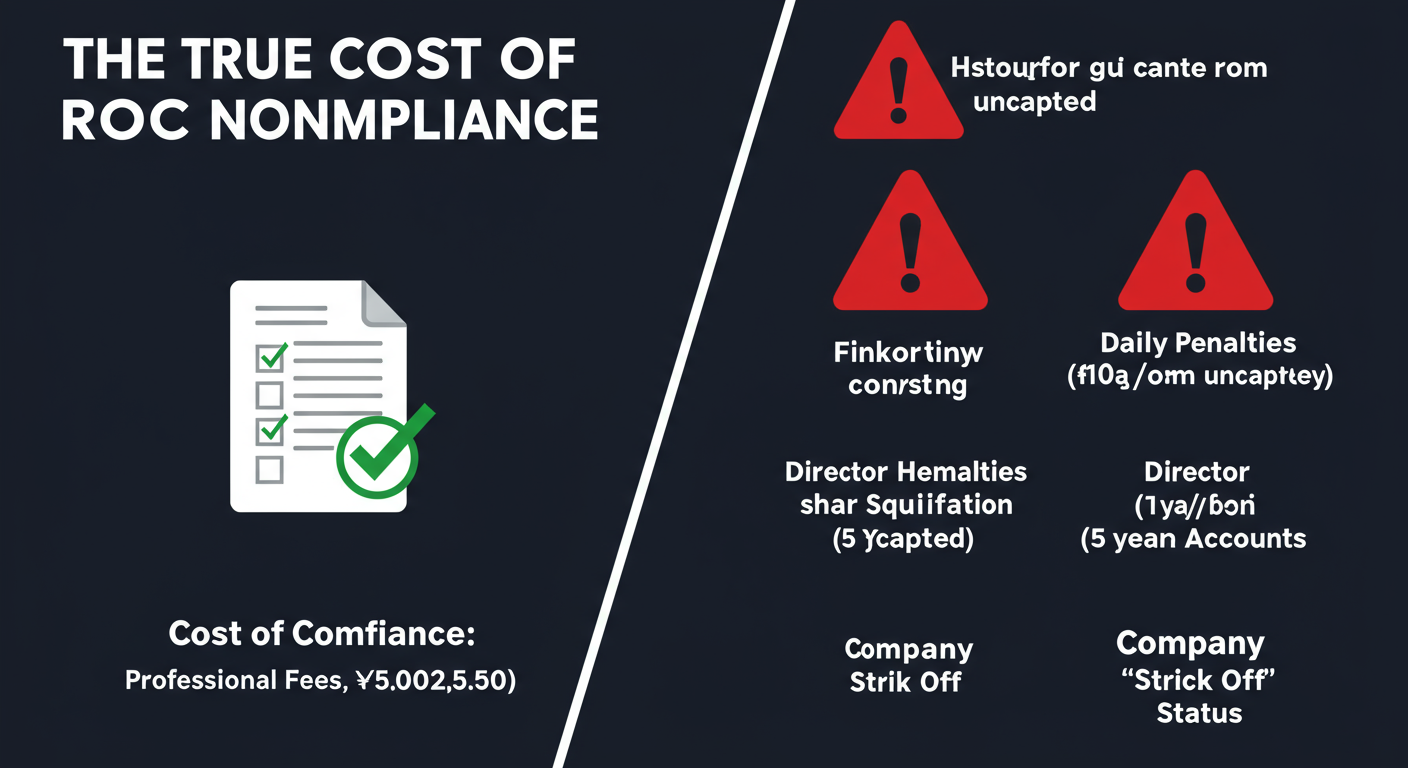
Based on our experience with hundreds of businesses, the fallout from ignoring ROC filing is predictable and severe. Investors conduct due diligence by pulling your MCA records. If they see defaults, the conversation is often over before it begins. Banks will deny loans. Your company could even be legally dissolved by the ROC.
| Aspect | Proactive Compliance | Costly Non-Compliance |
|---|---|---|
| Financial Cost | Predictable professional fees (e.g., CA/CS services). | Uncapped daily penalties (₹100/day/form) that can run into lakhs. Plus, high fees for company revival. |
| Investor Perception | Builds trust. Signals good governance and low risk. A major green flag. | Massive red flag. Kills funding deals instantly. Shows poor management. |
| Legal Status | Maintains ‘Active’ status. Full legal protection and operational freedom. | Risk of ‘Struck Off’ status, freezing of bank accounts, and legal dissolution. |
| Director Liability | Directors are protected and maintain a clean record. | Disqualification from being a director in ANY company for 5 years. Potential for prosecution. |
⚠️ Watch Out
The “₹100 per day” penalty is per form. If you’re late on both Form AOC-4 and Form MGT-7, you’re accumulating a ₹200 penalty every single day. This adds up incredibly fast and there is no upper limit. We’ve seen penalties exceed the entire cost of incorporation in just a few months.
The Core Annual Filings: Your 2026 ROC Checklist
For most private limited companies, annual compliance boils down to two primary forms and one key event: the Annual General Meeting (AGM). Your entire filing calendar revolves around the date of your AGM.
Let’s get into the specifics of what you need to file.
Form AOC-4: Your Company’s Financial X-Ray
This is where you file your company’s complete financial statements for the year. It’s the proof of your financial health (or lack thereof).
- What it includes: Balance Sheet, Profit & Loss Account, Cash Flow Statement, and the Board’s Report.
- Who signs it: At least one Director and, if required, a professional (CA/CS/CWA).
- The Deadline: Within 30 days of your company’s AGM.
Form MGT-7 / MGT-7A: Your Company’s Annual Report Card
This form is a comprehensive summary of your company’s non-financial information. Think of it as the “State of the Union” for your business.
- What it includes: Details of shareholders, directors, share transfers, company structure, and meetings held during the year.
- Who signs it: A Director and, for most companies, a practicing Company Secretary.
- The Deadline: Within 60 days of your company’s AGM.
💡 Pro Tip
If your business qualifies as a “Small Company” or is a “One Person Company (OPC),” you can file the much simpler Form MGT-7A. It requires less information and doesn’t need certification from a practicing professional, saving you time and money. Check the latest thresholds under the Companies Act, 2013 to see if you qualify—it’s a huge win if you do.
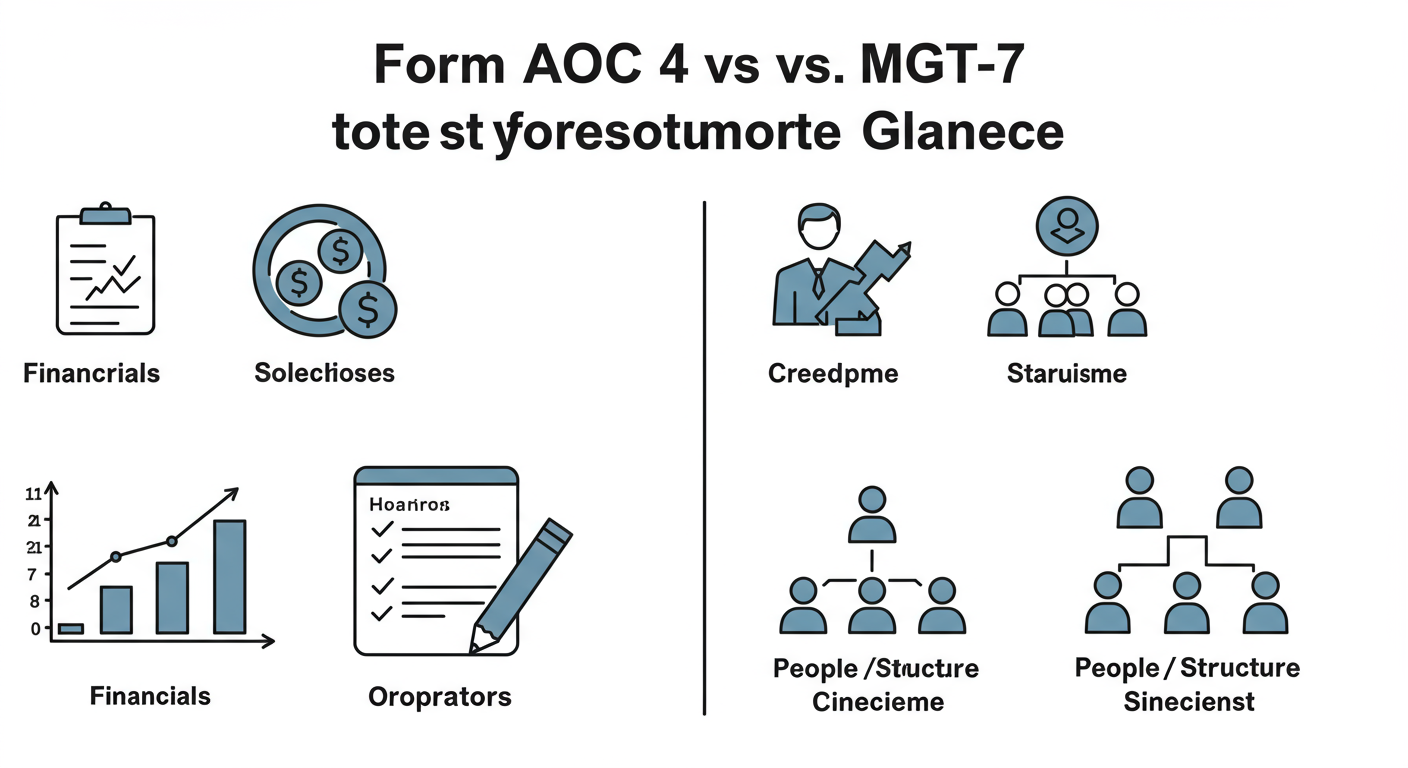
Here’s a clearer look at how these two critical forms differ:
| Feature | Form AOC-4 (Financials) | Form MGT-7/7A (Annual Return) |
|---|---|---|
| Primary Purpose | To report the company’s financial performance and position. | To report on the company’s structure, management, and shareholding. |
| Key Contents | Balance Sheet, P&L Account, Board’s Report, Auditor’s Report. | Shareholder list, Director details, Share capital structure, Meeting details. |
| Due Date (Post-AGM) | Within 30 days. | Within 60 days. |
| Common Mistake | Mismatch between figures in the financial statements and the form. | Incorrectly reporting the list of shareholders as of the financial year-end. |
🎯 Key Takeaway
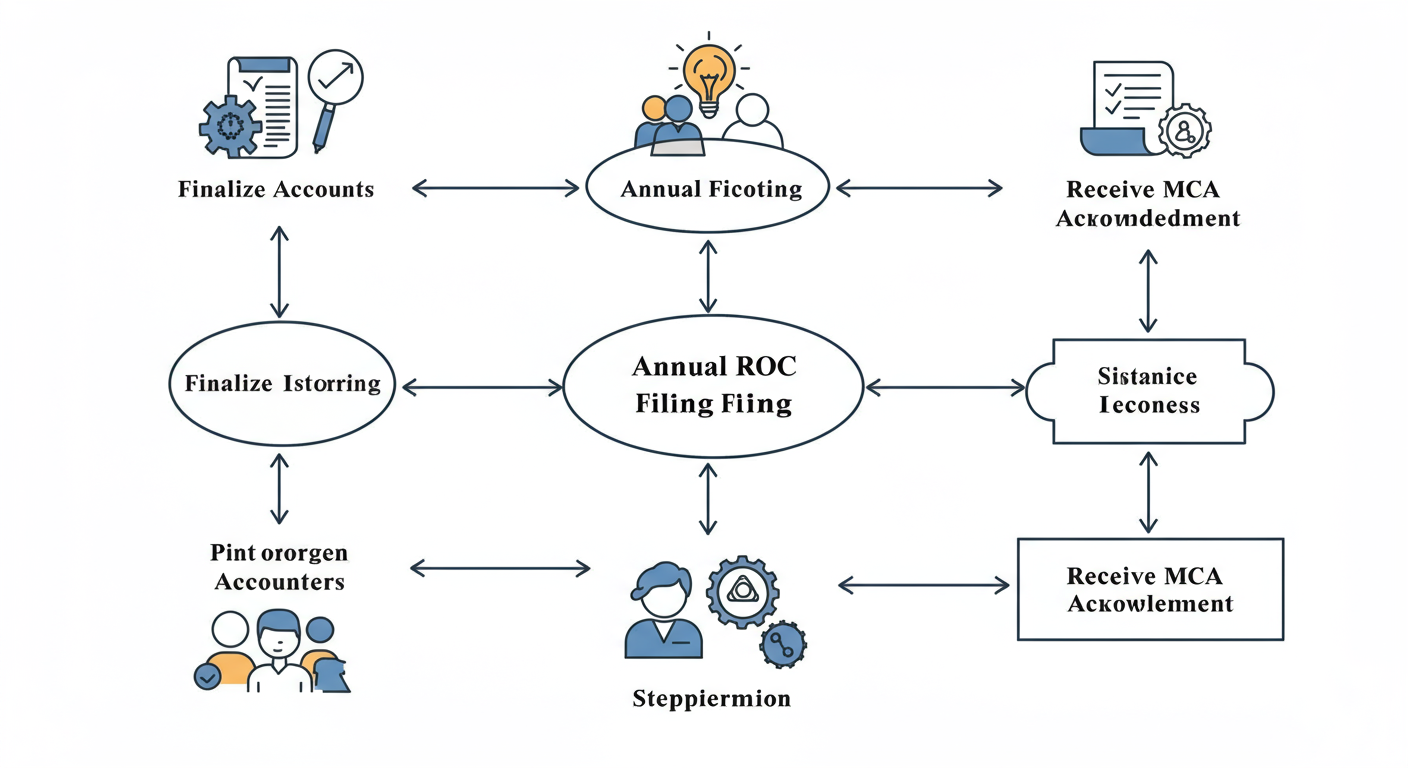
ROC filing is not an isolated task but the final step in a sequence: 1) Finalize accounts, 2) Hold Board Meeting, 3) Hold AGM, 4) File forms. Your AGM date (which must be by Sept 30th, 2026, for the FY 2025-26) is the anchor for all your filing deadlines.
Your Step-by-Step ROC Filing Workflow
Feeling overwhelmed? Don’t be. After guiding countless companies through this, we’ve refined the process into a clear, manageable workflow. Follow these steps, and you’ll be golden. Unlocking Competitive Edge: Comprehensive Voluntary GST Registration Benefits for Small Businesses
- Step 1: Finalize Your Books (By July/August 2026)
Your accountant finalizes the company’s financial statements for the fiscal year that ended on March 31, 2026. Get this done early. The audit process can take time. - Step 2: Hold a Board Meeting (By early September 2026)
The Board of Directors must formally meet to approve the audited financial statements, the Board’s Report, and the notice for the Annual General Meeting (AGM). Document this with proper meeting minutes. - Step 3: Conduct the Annual General Meeting (AGM) (By September 30, 2026)
This is the formal meeting where the company’s members (shareholders) adopt the financial statements. This is a legal requirement and the date is critical—it starts the clock for your filing deadlines. - Step 4: Appoint/Re-appoint an Auditor & File ADT-1
If you’re appointing a new auditor at the AGM, you must file Form ADT-1 to notify the ROC. Deadline: Within 15 days of the AGM. This is a commonly missed step! - Step 5: Prepare and File Form AOC-4
With the AGM complete, you now have 30 days to file your financial statements using Form AOC-4. A director must digitally sign it. Ensure the data you enter in the e-form perfectly matches your audited financials. - Step 6: Prepare and File Form MGT-7/7A
You have 60 days from the AGM to file your annual return. This form requires meticulous detail about your shareholding pattern and director changes throughout the year. For most companies, a practicing Company Secretary must also certify it. - Step 7: Pay Fees and Get Acknowledgment
Once the forms are uploaded to the MCA portal, you pay the statutory fees. The system will generate a Service Request Number (SRN) and a challan. Save these. They are your proof of filing.
Event-Based Filings: The Compliance You Can’t Forget
Compliance isn’t just an annual affair. Certain business events trigger an immediate filing requirement. Ignoring these is just as dangerous as missing your annual filings. Deadlines are short, and penalties are just as strict. MOA and AOA Meaning: Understanding the MOA and AOA Difference and Importance for Companies
Here are the most common triggers:
- You change your registered office: File Form INC-22 within 30 days.
- You appoint, remove, or a director resigns: File Form DIR-12 within 30 days.
- You increase your company’s authorized capital: File Form SH-7 within 30 days of the shareholder resolution.
- You allot new shares to investors: File Form PAS-3 within 30 days of allotment.
- You take an unsecured loan from directors: You need a declaration and a board resolution.
- You pass a special resolution (e.g., to change the company name or objects): File Form MGT-14 within 30 days.
⚠️ Watch Out
Event-based filings are easy to miss in the heat of running your business. A new director joins, everyone’s excited, and the paperwork is forgotten. The 30-day clock is unforgiving. From our hands-on testing, the MCA system is automated to apply penalties the moment the deadline is breached.
Other Critical Compliances for 2026
Beyond the big annual and event-based filings, a couple of other key compliances apply to almost every company.
Form DIR-3 KYC (Director KYC): Every person holding a Director Identification Number (DIN) must complete their KYC annually. The deadline is typically September 30th. If a director misses this, their DIN is deactivated, and a flat penalty of ₹5,000 is levied to reactivate it. A deactivated DIN means they can’t sign any ROC forms, paralyzing your compliance.
Form DPT-3 (Return of Deposits): Does your company have outstanding loans or advances from anyone other than banks or certain financial institutions? This includes loans from other companies or even advances from customers. If so, you must file Form DPT-3 by June 30th each year, reporting these amounts. It’s a declaration that you haven’t accepted illegal deposits. According to industry research, this is one of the most frequently missed compliances.
💡 Pro Tip
Create a simple “Compliance Calendar” in Google Sheets or your project management tool. List every single deadline: DPT-3 (June 30), Director KYC (Sept 30), AGM (Sept 30), AOC-4 (Oct 30), MGT-7 (Nov 29). Assign an owner for each. This simple act of tracking transforms compliance from a chaotic scramble into a predictable process.
Conclusion: Compliance Is Your Competitive Edge
Look, ROC filing can seem complex. But it doesn’t have to be a source of stress. By understanding the core requirements, respecting the deadlines, and following a clear process, you can handle it smoothly.
Remember the key takeaways:
- It’s not a cost, it’s an investment. Good compliance builds trust and opens doors to funding and growth.
- Deadlines are sacred. The AGM date (by Sept 30th) sets your filing clock. Daily penalties are real and uncapped.
- It’s more than just annual filings. Keep track of event-based changes like new directors or office moves.
Your next step? Don’t wait until September. Start the conversation with your CA or CS now. Get your accounts in order and map out your compliance calendar for 2026. Taking control of your ROC filing today is one of the smartest, safest moves you can make for your business’s future.
❓ Frequently Asked Questions
What is the difference between Form MGT-7 and MGT-7A?
Form MGT-7 is the standard, detailed annual return for most private and public companies. Form MGT-7A is a much simpler, abridged version created specifically for One Person Companies (OPCs) and “Small Companies.” Using MGT-7A if you’re eligible saves significant time and doesn’t require certification by a professional, reducing costs.
Can I file ROC returns myself without a professional?
While technically possible, it’s strongly discouraged. The MCA portal is complex, and forms like MGT-7 and AOC-4 for most companies require certification by a practicing Chartered Accountant (CA) or Company Secretary (CS). A professional ensures accuracy, avoids costly errors, and provides strategic advice on corporate governance, which is a key part of demonstrating good corporate governance.
What happens if my company has no business activity? Do I still need to file?
Yes, absolutely. A company with zero revenue or operations is still legally required to complete its annual ROC filing (AOC-4 with nil statements and MGT-7). The only way to reduce this burden is to formally apply for ‘Dormant Company’ status with the ROC, which has much lighter compliance needs.
What is the absolute last date to hold an AGM for the 2025-26 financial year?
For the financial year ending March 31, 2026, your company must hold its Annual General Meeting (AGM) within six months. This means the absolute latest date is September 30, 2026. All your annual filing deadlines are calculated from the actual date your AGM was held.
My director missed his DIR-3 KYC. What do I do?
First, the director’s DIN will be marked as ‘Deactivated due to non-filing of DIR-3 KYC’. To fix this, you must file the e-form DIR-3 KYC on the MCA portal and pay a flat penalty of ₹5,000. Only after the payment is processed and the form is approved will the DIN be reactivated. Until then, that director cannot sign any ROC forms.