You’ve got the million-dollar idea, the relentless drive, and you’re ready to be your own boss. But then comes the paralyzing question: how do you protect yourself? For years, solo entrepreneurs in India faced a tough choice: operate as a sole proprietor and risk their personal assets, or navigate the complexities of a multi-director company. It felt like a compromise either way.
That all changed with the One Person Company (OPC). It’s the corporate structure built from the ground up for the solo founder.
This isn’t just another dry legal guide. We’re going to break down the entire OPC company registration process into a clear, actionable roadmap. You’ll learn not just the steps, but the why behind them. We’ll cover the critical advantages, the documents you actually need, the compliance you can’t ignore, and the common pitfalls that trip up 90% of new founders. Let’s build your business on a rock-solid foundation.
What is an OPC, Really? (And Is It Right for You?)
Think of a One Person Company as a powerful hybrid. It takes the best part of being a sole proprietor—total control—and fuses it with the single most important benefit of a private limited company: a separate legal identity. This isn’t just legal jargon. It’s a shield.
Introduced by the Companies Act, 2013, an OPC is a private company that can be formed with just one member and one director (who can be the same person). This means the company itself can own property, sign contracts, and incur debt. If the business faces financial trouble, your personal assets—your home, your car, your savings—are protected. That’s the limited liability promise, and for a solo founder, it’s everything.
But who is it actually for? Based on our experience helping hundreds of entrepreneurs, an OPC is a perfect fit for:
- Freelancers and Consultants: Web developers, writers, designers, and business consultants who want to project a more professional image and protect their personal wealth.
- Creative Professionals: Photographers, artists, and performers who need a formal structure to manage contracts and earnings.
- E-commerce Entrepreneurs: Solo sellers on platforms like Amazon or Shopify who are scaling up and need a legitimate business entity for payment gateways and GST.
- Early-Stage Founders: Entrepreneurs testing a business idea who want a formal structure without the immediate need for a co-founder.
The Unbeatable Case for an OPC: Why It’s a Solo Founder’s Best Friend
Choosing a business structure isn’t just a box to tick; it defines your company’s future. While a sole proprietorship is easy to start, it leaves you dangerously exposed. An OPC, on the other hand, provides a robust framework for growth and security. Let’s be blunt: the advantages are massive.
Here’s a direct comparison that makes the choice crystal clear.
| Feature | ✅ One Person Company (OPC) | ❌ Sole Proprietorship |
|---|---|---|
| Liability | Limited. Your personal assets are safe from business debts. | Unlimited. Your personal assets can be seized to pay business debts. |
| Legal Status | Separate Legal Entity. The company is a distinct “person” in the eyes of the law. | No separate identity. You and the business are legally the same. |
| Business Continuity | Perpetual Succession. The business continues even after the owner’s death via a nominee. | Ends with the owner. The business dissolves upon the owner’s death. |
| Credibility & Trust | High. Seen as a more professional and stable entity by banks, clients, and investors. | Low. Often perceived as a small, informal operation. |
| Access to Funding | Easier. Can raise funds from angel investors, VCs, and banks. Can issue shares. | Extremely difficult. Limited to personal loans or small business loans. |
💡 Pro Tip
The “separate legal entity” status is more than just a legal concept. It allows you to open a dedicated business bank account, secure business loans in the company’s name, and sign contracts as a corporate entity. This instantly boosts your credibility with clients and partners.
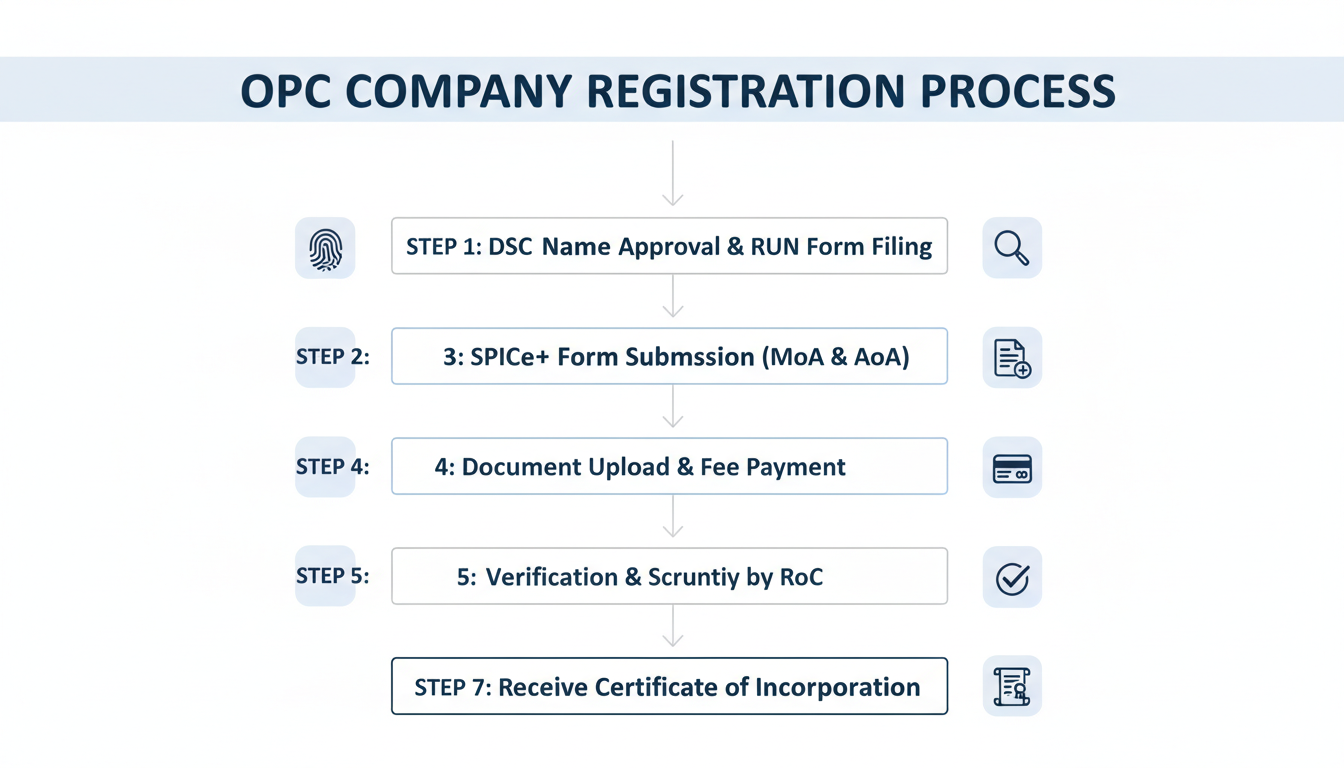
The Complete OPC Company Registration Process (2026)
The Ministry of Corporate Affairs (MCA) has digitized the entire incorporation process, making it more efficient than ever. But streamlined doesn’t mean simple. One small error can lead to delays and rejections. Follow these steps meticulously for a smooth launch.
Step 1: Obtain a Digital Signature Certificate (DSC)
First things first. You can’t file anything on the MCA portal without a DSC. This is your electronic signature, and it’s mandatory for the proposed director. You’ll need a Class 3 DSC, which offers the highest level of security. You can get this from any government-approved Certifying Authority.
Step 2: Reserve Your Unique Company Name
Your company name is your identity. It must be unique and end with the suffix “(OPC) Private Limited”. The name reservation is done through a web form called SPICe+ Part A. You can submit two name options. The MCA will check if they are too similar to existing companies or registered trademarks.
⚠️ Watch Out
Don’t get too attached to your first name choice. Generic names like “India Web Solutions (OPC) Private Limited” are almost always rejected. Be creative and check the MCA’s company name database and the public trademark search before applying to save time.
Step 3: Gather and Prepare Your Documents
This is where most people get stuck. Organization is key. You’ll need digital copies (scans) of the following:
- Director & Nominee Documents:
- PAN Card
- Aadhaar Card
- Proof of Identity (Voter ID, Passport, or Driver’s License)
- Proof of Address (Latest bank statement, utility bill – not older than 2 months)
- Passport-sized photograph
- Registered Office Documents:
- Proof of Address (Latest utility bill – electricity or gas)
- No Objection Certificate (NOC) from the property owner if it’s a rented or leased space.
- Rental Agreement (if applicable).
- Key Incorporation Documents (usually drafted by a professional):
- Memorandum of Association (MoA): Defines the company’s objectives.
- Articles of Association (AoA): Outlines the internal rules of the company.
- Form INC-3: Consent from the nominee, signed and attached with their PAN and Aadhaar.
Step 4: File the SPICe+ Part B Form
This is the main event. The SPICe+ Part B is the integrated incorporation form. It’s a smart form that combines applications for:
- Company Incorporation
- Director Identification Number (DIN) allotment
- PAN and TAN for the new company
- GSTIN, EPFO, and ESIC registration (if applicable)
You’ll fill in all the details of your company, director, and nominee, and attach all the documents prepared in Step 3. The form must be digitally signed with your DSC.
Step 5: Scrutiny and Approval
Once you submit the form, an officer at the Central Registration Centre (CRC) will review your application. They’ll check every detail. If everything is perfect, they’ll approve it. If there’s a minor issue, they might send it for “resubmission,” giving you a chance to correct the errors. A major error could lead to outright rejection.
Step 6: Receive Your Certificate of Incorporation
Success! Upon approval, the Registrar of Companies (RoC) will email you the Certificate of Incorporation. This digital certificate is conclusive proof that your company legally exists. It will also contain your company’s Corporate Identity Number (CIN), PAN, and TAN. Your OPC is now officially open for business!
🎯 Key Takeaway
OPC company registration is a document-intensive, step-by-step process. The key to a fast, successful incorporation is meticulous preparation of your documents and choosing a unique, compliant name from the very beginning. Rushing these early stages almost always leads to costly delays. Taxation of Charitable Trust: What You Need to Know
Life After Incorporation: Your OPC Compliance Checklist
Congratulations, you’re incorporated! But the work isn’t over. Running an OPC means staying compliant with the law to avoid heavy penalties and maintain your active status. While the compliance burden is lighter than for a private limited company, it’s not zero. Here’s what you absolutely must do every year. 7 Best Options for Business Structure India: The Ultimate Selection Guide (2025)
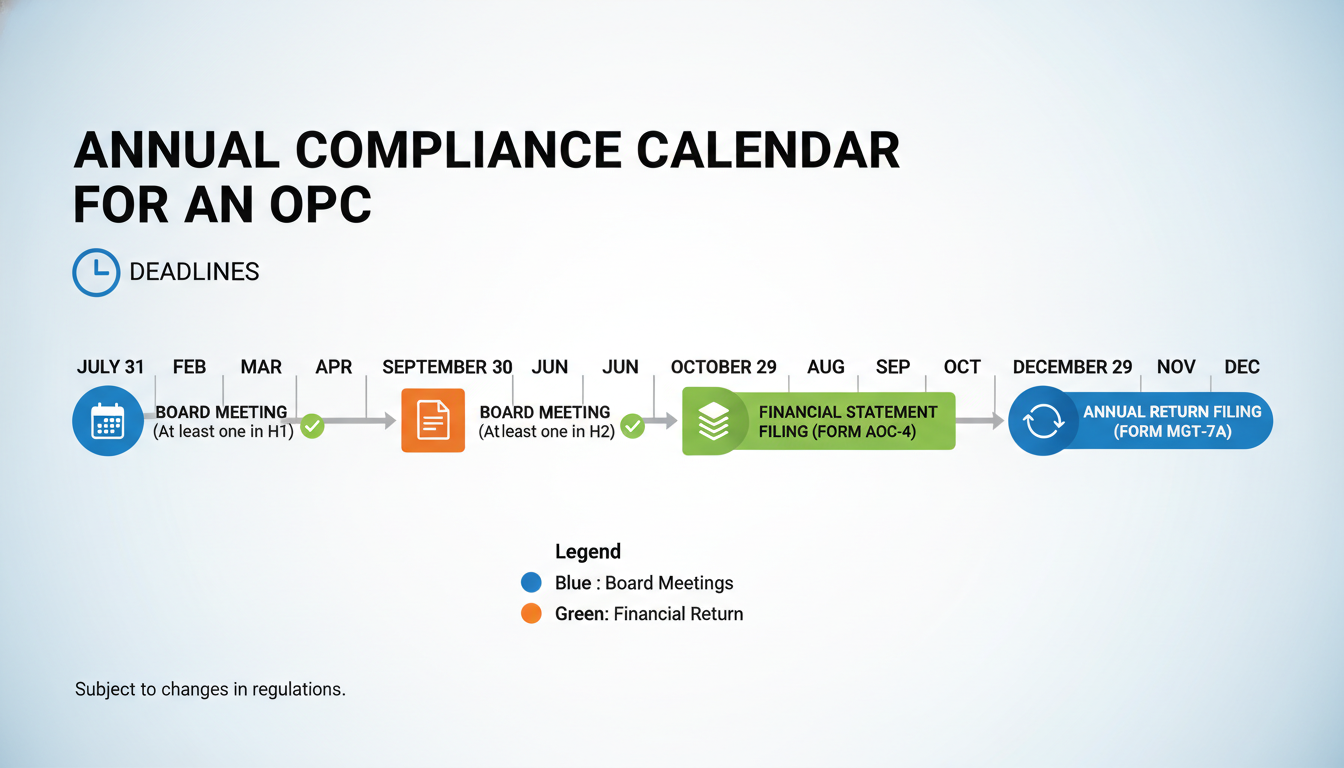
We’ve seen many new founders get overwhelmed by this, so we’ve broken it down into a simple table.
| Compliance Task | Required Form | Due Date | Why It Matters |
|---|---|---|---|
| Board Meetings | N/A (Minutes must be recorded) | At least one meeting in each half of the calendar year (min. 90-day gap). | For making key business decisions and maintaining corporate governance. |
| Statutory Audit | Auditor’s Report | Before filing financial statements. | An independent audit of your financial records is mandatory. |
| File Financial Statements | Form AOC-4 | Within 180 days from the end of the financial year (by Sep 27th). | Submits your Balance Sheet and P&L account to the RoC. |
| File Annual Return | Form MGT-7A | Within 60 days of the AGM (by Nov 29th). | Provides a yearly snapshot of the company’s details, director, etc. |
| File Income Tax Return | ITR-6 | October 31st of the assessment year. | Mandatory tax filing for all corporate entities. |
💡 Pro Tip
Open a separate business bank account the day you get your Certificate of Incorporation. Do not mix personal and business finances. This single habit will make your accounting, auditing, and tax filing 10x easier and is a critical sign of a professionally run business.
The Growth Path: When to Convert Your OPC
An OPC is a fantastic launchpad, but it has its limits. The law recognizes that as a business grows, its structure needs to evolve. There are two scenarios where your OPC must convert into a Private Limited Company.
According to the Companies (Incorporation) Rules, mandatory conversion is triggered when your OPC’s paid-up share capital exceeds ₹50 Lakhs OR its average annual turnover of the three immediately preceding consecutive financial years is ₹2 Crores or more.
Once you cross either of these thresholds, you have six months to convert to a private limited company, which requires adding at least one more director and member.
You can also choose to voluntarily convert at any time. This is a common strategic move when you’re ready to:
- Bring on a co-founder.
- Raise equity funding from investors (investors can’t invest in an OPC).
- Offer Employee Stock Ownership Plans (ESOPs) to attract talent.
⚠️ Watch Out
Ignoring the mandatory conversion thresholds is a serious compliance failure. The penalties can be significant, and it can create major legal headaches down the line. Keep a close eye on your capital and turnover figures as your business scales.
❓ Frequently Asked Questions
Who is eligible to start an OPC in India?
Only a natural person who is an Indian citizen and resident in India can form an OPC. A person is considered ‘resident’ if they have stayed in India for at least 120 days during the immediately preceding financial year. Non-resident Indians (NRIs) and foreigners are not eligible to start an OPC.
What is the role of the nominee in an OPC?
The nominee is your safety net. Their legal role is to take over the company in the event of the sole member’s death or incapacitation. This ensures the business continues to exist and operate, a concept known as ‘perpetual succession’. The nominee’s written consent is a mandatory part of the registration process.
Are there any special tax benefits for an OPC?
No, an OPC does not have any special tax benefits. It is taxed at the same corporate tax rates as a private limited company. You can find the current rates on the official Income Tax Department website. However, structuring director’s remuneration and other expenses correctly can help in tax planning.
How long does the OPC registration process take in 2026?
If your documents are in order and your proposed name is available, the entire process is quite fast. From applying for the DSC to receiving the Certificate of Incorporation, it typically takes between 7 to 15 working days. Delays are almost always caused by incorrect documents or name rejections.
Can I have more than one director in an OPC?
Yes, an OPC can have more than one director (up to a maximum of 15), but it can only have one member/shareholder. This is the defining feature of an OPC. The directors manage the company, but the single member holds all the shares and ultimate ownership.
Your Next Step: From Solo Dream to Legal Reality
The journey from a solo idea to a thriving business is a marathon, not a sprint. Choosing the right legal structure is your first, most critical step. The One Person Company offers an unparalleled combination of control, protection, and credibility, specifically designed for the ambitious solo entrepreneur in India.
You’re no longer just a freelancer; you’re the director of your own company. You’re protected. You’re credible. You’re ready to scale.
By following this guide, you’ve demystified the process. You understand the steps, the documents, and the ongoing responsibilities. Your next step is to take action. Begin by organizing your documents and brainstorming that perfect, unique company name. The foundation for your empire awaits.