
You’re a successful freelancer. A talented consultant. A solo founder with a brilliant idea. You’re making good money, but a nagging fear keeps you up at night: what if one client dispute, one business debt, wipes out your personal savings? Your car? Your home?
For years, this was the harsh reality for solo entrepreneurs in India, trapped between the unlimited personal liability of a sole proprietorship and the complexity of finding a partner for a private limited company. It felt like a choice between risk and compromise.
Not anymore.
The One Person Company (OPC) is the modern legal structure designed specifically for you. It’s a powerful hybrid that gives you the total control of a proprietorship with the iron-clad liability protection of a corporation. In this in-depth guide, we’ll break down exactly what an OPC is, who it’s for, and the precise steps to register one in 2026. You’ll learn how to build a credible, scalable, and legally secure business—all on your own terms.
What is a One Person Company, Really? (Beyond the Textbook Definition)
Think of a One Person Company as a legal shield. It’s a revolutionary concept introduced by The Companies Act, 2013, that creates a separate legal entity for your business, even though you are the sole owner. This distinction is everything.
Imagine you and your business are two separate people. Your business can own assets, sign contracts, and incur debts all under its own name. If the business faces a financial crisis or a lawsuit, creditors and courts can only go after the business’s assets. Your personal wealth—your house, your savings, your investments—remains untouched. It’s the ultimate financial firewall for a solo entrepreneur.
This structure is a direct response to the needs of the modern gig economy and solo-founder startup culture. It acknowledges that you don’t need a co-founder to build a serious, legitimate enterprise.
OPC vs. Proprietorship vs. Private Limited: Which is Right for You?
Choosing your business structure is one of the most critical decisions you’ll make. It impacts your liability, taxes, compliance burden, and ability to raise funds. Let’s be honest, the options can be confusing. Based on our experience helping hundreds of founders, the choice usually boils down to your immediate needs and long-term vision.
Here’s a no-fluff comparison to help you decide.
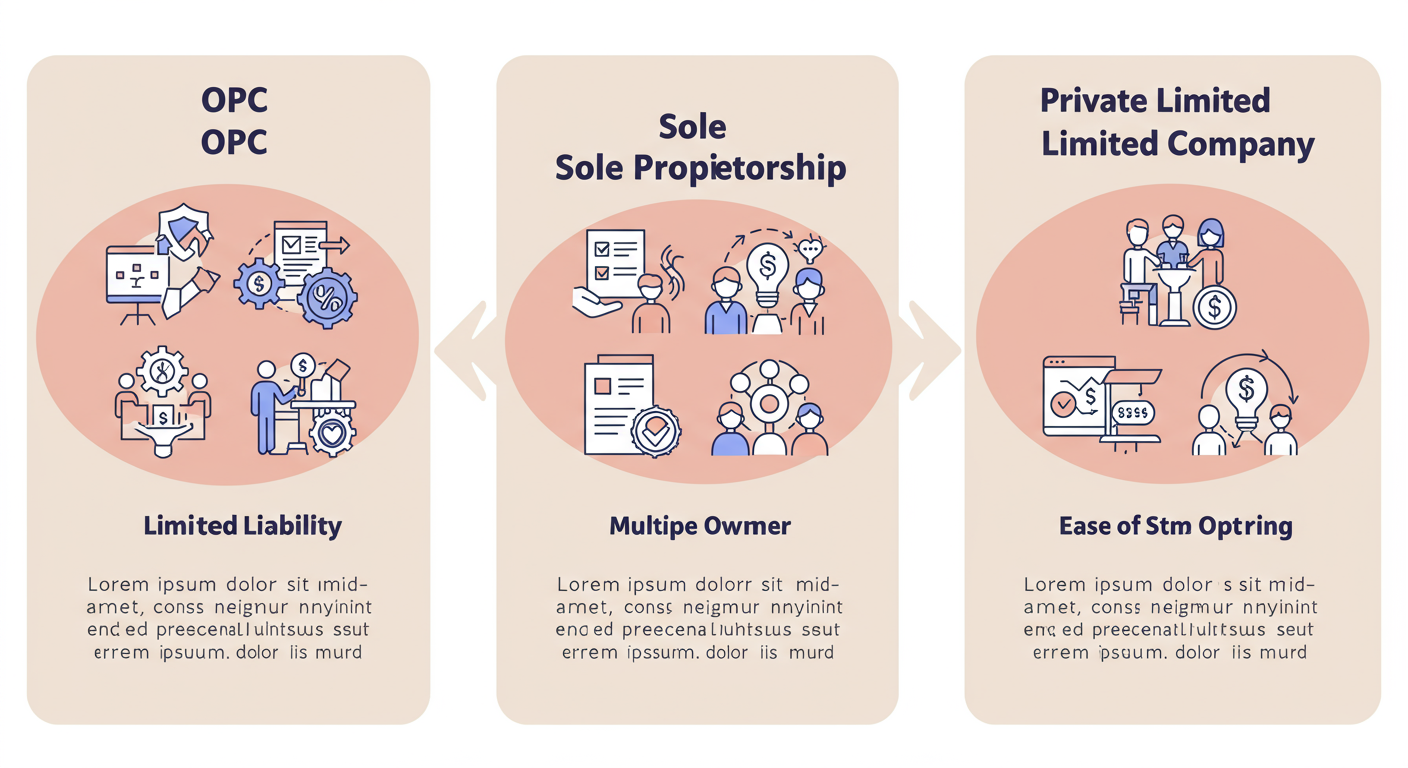
| Feature | One Person Company (OPC) | Sole Proprietorship | Private Limited Company (PLC) |
|---|---|---|---|
| Liability | Limited: Your personal assets are protected. This is the biggest win. | Unlimited: You and the business are one. Your personal assets are at risk. | Limited: Shareholders’ personal assets are protected. |
| Ownership | 1 Member (Shareholder) | 1 Owner | Min. 2, Max. 200 Shareholders |
| Credibility | High (Registered as ‘Pvt. Ltd.’) | Low (Unregistered entity) | Very High (The standard for startups) |
| Fundraising | Possible (Angel, VC, Banks) | Extremely Difficult (Only debt) | Ideal for Equity Fundraising |
| Compliance | Moderate (Annual filings, one board meeting per half-year) | Minimal (Mainly income tax) | High (More meetings, resolutions, and filings) |
| Best For | Solo founders wanting liability protection and a professional brand. | Freelancers and small traders just starting with low risk. | Startups with co-founders aiming for rapid scaling and VC funding. |
🎯 Key Takeaway
An OPC offers the best of both worlds for a solo founder: the complete control of a proprietorship and the limited liability and credibility of a private limited company. It’s the ideal middle ground for serious solo ventures.
The Step-by-Step OPC Registration Process (2026 Edition)
The registration process has become significantly more streamlined thanks to the Ministry of Corporate Affairs (MCA) portal. While it’s straightforward, every step needs to be executed perfectly to avoid delays. Trust me on this one, a small mistake in a form can set you back weeks.
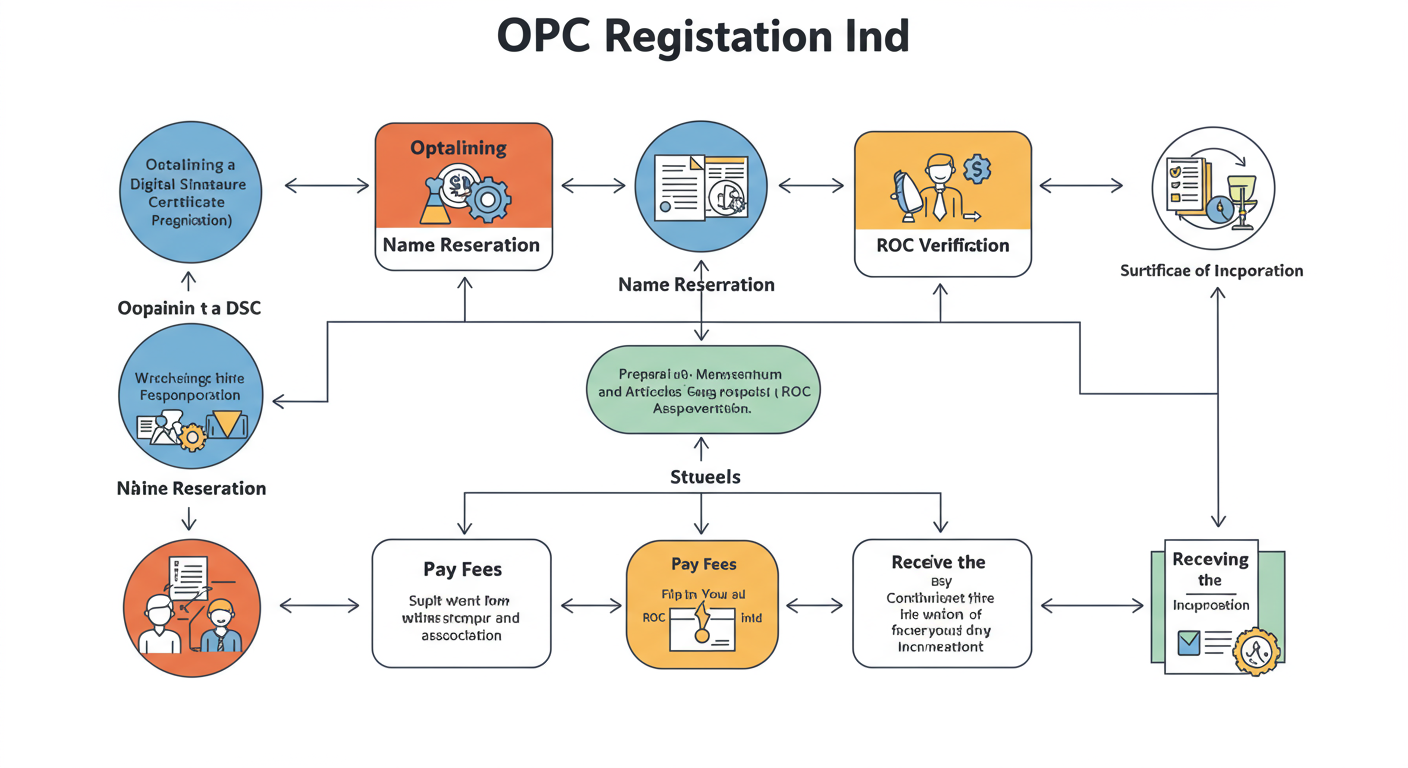
Here’s the exact process we follow for a smooth incorporation:
- Obtain a Digital Signature Certificate (DSC): This is your electronic signature for all official documents. You’ll need a Class 3 DSC. Don’t skip this; it’s the very first key to the entire process.
- Reserve Your Company Name (SPICe+ Part A): This is a critical step. You need to propose a unique name for your company that isn’t already taken or trademarked. The name must end with the suffix “(OPC) Private Limited”. You can check for name availability on the MCA portal.
- Apply for Director Identification Number (DIN): Every director needs a unique DIN. This is now integrated into the main incorporation form, so you don’t need to file a separate application.
- Gather and Prepare All Documents: This is where most delays happen. Get everything in order before you start filing. You’ll need PAN cards, address proofs, identity proofs for both yourself (the member) and your chosen nominee. We’ll cover the full checklist in the next section.
- Draft the e-MoA and e-AoA: The Memorandum of Association (MoA) defines your company’s business objectives, and the Articles of Association (AoA) lay out its internal operating rules. These are now filed electronically with the main form. Be precise here—what you write in the MoA legally defines what your business can and cannot do.
- File the SPICe+ Form (Part B): This is the main event. The SPICe+ (Simplified Proforma for Incorporating Company Electronically Plus) is an integrated web form that combines applications for DIN, PAN, and TAN. You’ll attach your DSC, the e-MoA, e-AoA, and all other supporting documents here.
- Receive Your Certificate of Incorporation: Once the Registrar of Companies (RoC) verifies everything, they will issue the Certificate of Incorporation. This is your company’s birth certificate. Congratulations! You’ll also receive the company’s PAN and TAN automatically. You can always find the latest forms and procedures on the official Ministry of Corporate Affairs website.
💡 Pro Tip
When reserving your company name, submit two options in order of preference. The first should be your ideal name, and the second a solid backup. This simple step can prevent a complete restart of the name reservation process if your first choice is rejected.
The Ultimate Document Checklist for OPC Registration
Being disorganized with documents is the #1 reason for registration delays. Use this checklist to ensure you have everything ready for a seamless process. Note the separate requirements for the Member (you) and the Nominee.
| Document | Required for Member (Owner) | Required for Nominee |
|---|---|---|
| PAN Card | ✅ Mandatory | ✅ Mandatory |
| Aadhaar Card | ✅ Mandatory | ✅ Mandatory |
| Identity Proof (Voter ID, Passport, or Driver’s License) | ✅ Any one | ✅ Any one |
| Address Proof (Latest Bank Statement or Utility Bill) | ✅ Not older than 2 months | ✅ Not older than 2 months |
| Passport-sized Photograph | ✅ Digital copy | ✅ Digital copy |
| Nominee Consent Form (INC-3) | ❌ Not applicable | ✅ Mandatory, signed |
| Proof of Registered Office (Rental Agreement/Utility Bill + NOC from owner) | ✅ Mandatory for the company | ❌ Not applicable |
⚠️ Watch Out
Ensure the name and address on your proof documents (like Aadhaar and bank statements) match exactly. Even a small discrepancy, like a missing initial, can lead to rejection by the RoC. Double-check everything before uploading.
Life After Incorporation: Your Annual Compliance Checklist
Getting incorporated is just the beginning. To keep your OPC active and avoid hefty penalties, you must follow a set of annual compliances. The good news? It’s far less burdensome than for a full private limited company. Small Company Definition in India (2026 Criteria): A Guide
Here’s what you need to do every year: Understand Key Difference between Private and Public Company
- Conduct Board Meetings: You must hold at least one meeting of the Board of Directors in each half of the calendar year. The gap between these two meetings must be at least 90 days.
- Appoint a Statutory Auditor: Within 30 days of incorporation, you must appoint a practicing Chartered Accountant to audit your financial statements.
- File Financial Statements (AOC-4): Your audited balance sheet and profit & loss statement must be filed with the RoC within 180 days of the end of the financial year (by September 27th).
- File Annual Return (MGT-7A): This form contains details about the company, its member, and director. It must be filed with the RoC within 60 days from the conclusion of the AGM.
- File Income Tax Return: Just like any other company, your OPC must file its income tax return (Form ITR-6) by the due date.
⚠️ Watch Out
Ignoring annual compliances is a costly mistake. The MCA imposes significant daily penalties for late filings, which can quickly accumulate into thousands or even lakhs of rupees. Set calendar reminders and treat these deadlines as non-negotiable.
The Fine Print: OPC Limitations and Common Myths
An OPC is powerful, but it’s not without its rules. It’s crucial to understand the limitations to ensure it’s the right fit and to avoid any compliance issues down the road.
Key Limitations:
- One Person, One OPC: An individual can only be a member of one OPC at a time.
- Nominee is a Must: You must designate a nominee who will take over the company in the event of your death or incapacitation. This is a key feature for business continuity.
- Restricted Activities: An OPC cannot be a Section 8 company (non-profit) or engage in Non-Banking Financial Investment (NBFI) activities.
One of the biggest myths, which was once a reality, was the mandatory conversion rule. Previously, if an OPC crossed a certain turnover or paid-up capital threshold, it had to convert into a private limited company. However, a 2021 rule change completely removed this requirement, allowing OPCs to grow indefinitely without being forced to change their structure. This was a massive win for solo entrepreneurs.
💡 Pro Tip
Your nominee must be an Indian citizen and resident. Treat the nominee selection seriously. It shouldn’t just be a name on a form. Have a frank conversation with your chosen nominee about their role and responsibilities should they ever need to step in. This ensures a smooth transition and protects the future of your business.
❓ Frequently Asked Questions
Can a foreigner or NRI start an OPC in India?
No. As of 2026, the law requires the sole member and the nominee of an OPC to be natural persons who are Indian citizens and resident in India. A person is considered ‘resident’ if they have stayed in India for at least 120 days in the preceding financial year.
Is there a minimum capital requirement for an OPC?
No, there is no minimum paid-up share capital requirement. You can start an OPC with as little as ₹1,000 or any amount you feel is necessary for your business operations. This makes it incredibly accessible.
Can an OPC have more than one director?
Yes. While an OPC can only have one member (shareholder), it can have up to 15 directors. The sole member can also be the sole director, which is the most common setup. Having additional directors can be useful if you want to bring in expert advisors to your board.
Is GST registration mandatory for an OPC?
GST registration is not automatically required. It becomes mandatory only when your annual turnover exceeds the threshold limit (currently ₹40 lakhs for goods and ₹20 lakhs for services in most states). However, you can always register for GST voluntarily to claim input tax credits. For more on how corporate taxes and liabilities work, understanding concepts like limited liability is fundamental.
What happens if my nominee withdraws their consent?
If your nominee withdraws their consent, you must nominate a new person within 15 days. You then need to inform the Registrar of Companies (RoC) by filing the appropriate form (INC-4) to update the company’s records. It’s a straightforward process, but one that must be done promptly.
Your Next Move: From Solo Founder to CEO
The One Person Company has fundamentally changed the game for solo entrepreneurs in India. It’s no longer necessary to expose your personal assets to risk or to find a co-founder just for the sake of legal structure. The OPC provides the perfect launchpad: a professional identity, a corporate shield for your wealth, and a scalable foundation for growth.
It’s the legal recognition that a one-person army can build an empire.
If you’re a single founder serious about building a lasting, credible business, the question isn’t if you should formalize your operations, but how. For most, the OPC is the smartest, most strategic answer. Your next step is to start the name reservation process and gather your documents. It’s time to stop thinking like a freelancer and start acting like the CEO you are.