
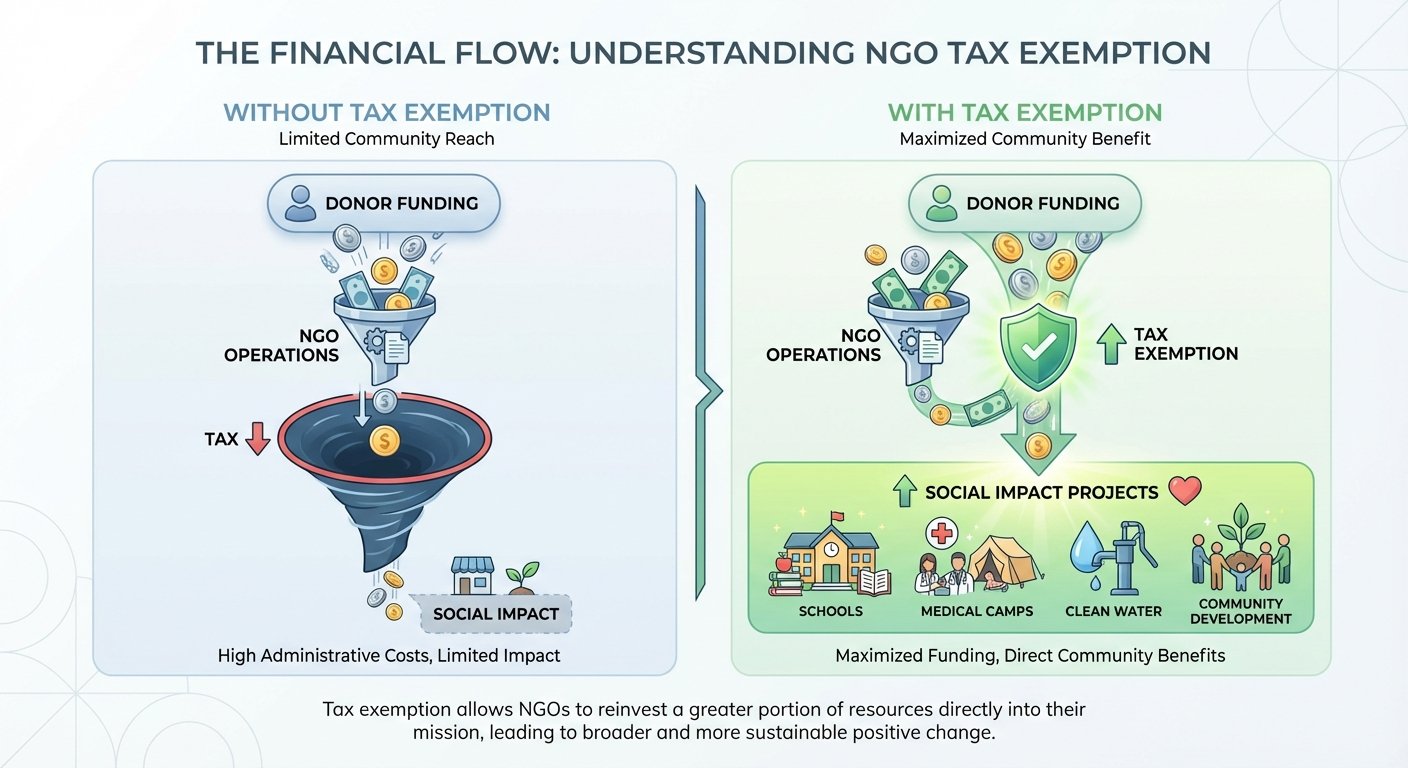
Running a non-profit isn’t just about passion; it’s about stretching every rupee to make a real difference. But here’s the hard truth: without securing NGO tax exemption India status, you are likely handing a significant chunk of your hard-earned donations straight back to the government. That’s money that could have fed a child, planted a tree, or funded a scholarship.
I’ve seen too many passionate social entrepreneurs get bogged down by the Income Tax Act. It feels like a maze, doesn’t it? Whether you are running a Trust, a Society, or a Section 8 Company, getting your tax status sorted isn’t just about saving money—it’s about survival and credibility. In this guide, I’m going to cut through the legal jargon and show you exactly how to navigate Sections 12A and 80G, and the new 2025 compliance rules for NGO tax exemption India.
The Legal Framework: How NGO Tax Exemption India Works
In India, the government actually wants to help you help others. That’s why the Income Tax Act, 1961, offers specific provisions to exempt charitable income from tax. But let’s be clear: NGO tax exemption India is not automatic. You don’t just get it because you’re doing good work; you get it because you followed the rules in Sections 11, 12, and 13.
To qualify, your entity must be established for "charitable purposes." This covers relief for the poor, education, medical relief, and even preservation of the environment. A word of caution, though: if your NGO starts engaging in commercial activities that don’t align with your main goal, you risk losing that precious exemption status immediately.
The Shield: Section 12A Registration
Think of Section 12A as your shield. It protects your income. Registration here is the bedrock of NGO tax exemption India. Once you have this, the surplus income your NGO generates is legally exempt from income tax. Without it? The Income Tax Department treats you like any other business, and you’ll be taxed at normal commercial rates.
Getting 12A registration is usually the first big win for any non-profit. It proves you are legitimate. But before you apply, make sure you have your PAN card. If you’re still stuck on that step, check out this guide on how to apply for a PAN card online and offline, because you can’t move forward without it.
The Magnet: Section 80G Registration
While 12A helps you, Section 80G helps your donors. It acts like a magnet for funding. When you have an 80G certificate, you can offer donors a tax deduction (usually 50%) on the money they give you. It’s a massive incentive. I always tell my clients: don’t just aim for 12A. A holistic strategy for NGO tax exemption India requires both.
7 Steps to Claim NGO Tax Exemption India
The process is digital now, which is great for speed but bad for forgiveness—one small error can get your application rejected. Here is the roadmap to navigate the system:
- Incorporation: Have your Trust Deed, MOA, or Section 8 License ready.
- PAN Card: As mentioned, this is non-negotiable.
- NITI Aayog Registration: Register on the NGO Darpan portal. It’s becoming a de-facto requirement for grants.
- Digital Signature (DSC): You cannot file forms without a Class 3 Digital Signature for the authorized signatory.
- File Form 10A: This is for provisional registration. New NGOs get this for 3 years automatically if paperwork is clean.
- Commence Activities: Start doing the work you promised!
- File Form 10AB: This is the big one. Apply for permanent registration (valid for 5 years) at least 6 months before your provisional status expires.
12A Registration
Benefit: Your income is tax-free.
Validity: 5 Years (Renewable).
Goal: Internal financial survival.
80G Registration
Benefit: Donors get tax breaks.
Validity: 5 Years (Renewable).
Goal: Attracting external funds.
Essential Documents for Your Application
I cannot stress this enough: documentation is where most people fail. To ensure your NGO tax exemption India application sails through, keep a clean digital folder with these files:
- Self-certified copy of the Trust Deed or MOA.
- Registration Certificate (from the Registrar of Societies/Companies).
- Annual accounts (Balance Sheet, Income & Expenditure) for the last three years (if you’ve been running that long).
- A detailed note on your activities (photos help!).
- KYC details of all Trustees or Directors.
Why Tax Exemption is Crucial for Fundraising
Imagine walking into a corporate office to ask for CSR funds. The first thing they will ask for? Your 12A and 80G certificates. Corporations are legally bound to ensure their CSR money goes to registered entities. Without these certifications, you are cutting yourself off from the biggest funding pool in the country. Director KYC Filing: DIR-3 KYC Due Date and Penalty 2026 Compliance Guide
Even international funding (which requires FCRA) looks at your domestic NGO tax exemption India status as a baseline for trust. It tells the world that the Indian government has vetted you.
Compliance: How to Keep Your Status
Getting the status is half the battle; keeping it is the real work. You must file Income Tax Returns (ITR-7) every single year. If you don’t, your registration can be cancelled. Also, governance matters. If you are a Section 8 company, you need to follow meeting protocols. Read up on AGM compliance rules and penalties to avoid governance failures that could trigger a tax audit.
Recent Amendments You Can’t Ignore (2025 Update)
The rules have changed. The "lifetime" registration is dead. We are now in a 5-year renewable cycle. This was done to weed out inactive NGOs, but it means you have to stay on your toes.
1. Digital Filing is Mandatory
Gone are the days of paper files. All forms (10A/10AB) and returns must be filed digitally. If you aren’t tech-savvy, get a consultant who is.
2. Donor Data Reporting (Form 10BD)
This is a big one. You must file Form 10BD annually, listing every single donor. This allows donors to see their deductions automatically in their tax statements (AIS). If you miss this, your donors won’t get their tax breaks, and they won’t donate again.
3. Cash Donation Limits
Be careful with cash. Any donation exceeding ₹2,000 in cash is not eligible for 80G deduction. Encourage your donors to use UPI or bank transfers.
Conclusion
Securing NGO tax exemption India transforms an informal initiative into a sustainable institution. It builds trust, saves money, and opens doors to corporate funding. Yes, the compliance is stricter now, but that’s a good thing—it weeds out the bad actors and leaves more room for genuine organizations like yours. Don’t let the paperwork scare you. Get your 12A and 80G, keep your audits clean, and focus on changing the world.
For official forms, visit the Income Tax Department or the NGO Darpan portal.
Frequently Asked Questions (FAQs)
Yes! You can apply for provisional registration via Form 10A immediately after incorporation. It is valid for 3 years.
Simple: 12A exempts your income from tax. 80G allows your donors to claim a tax deduction on their donations.
Under the new rules, registrations are valid for 5 years. You must apply for renewal (Form 10AB) at least 6 months before the expiry date.
Absolutely. If you engage in commercial activities not related to your cause, fail to maintain accounts, or don’t file your returns, the department can cancel your registration.
No. 12A is for domestic income only. To receive foreign funds, you need a separate FCRA registration from the Ministry of Home Affairs.