Picture this: a promising startup, once the talk of the town, quietly closes its doors. The founders thought they could just… stop. But months later, they’re buried in legal notices from creditors and facing personal liability. Why? Because they never formally wound up the company.
Closing a business isn’t like flipping a switch. It’s a meticulous legal process known as ‘winding up’ or ‘liquidation’. Getting it wrong is a recipe for financial and legal disaster. But get it right, and you ensure a clean, compliant exit that protects directors and satisfies stakeholders.
This isn’t just another legal dictionary. This is your battle-tested guide to navigating the end of a corporate journey in India. You’re about to learn the critical differences between the various modes of winding up of a company, understand which path is right for your situation, and see the step-by-step process laid bare. No jargon, just clarity.
🎯 Key Takeaway
The choice between the two primary modes of winding up—Compulsory (court-driven, for insolvent companies) and Voluntary (shareholder-driven, for solvent companies)—is the single most important decision. Choosing the wrong path can lead to severe delays, increased costs, and personal liability for directors.
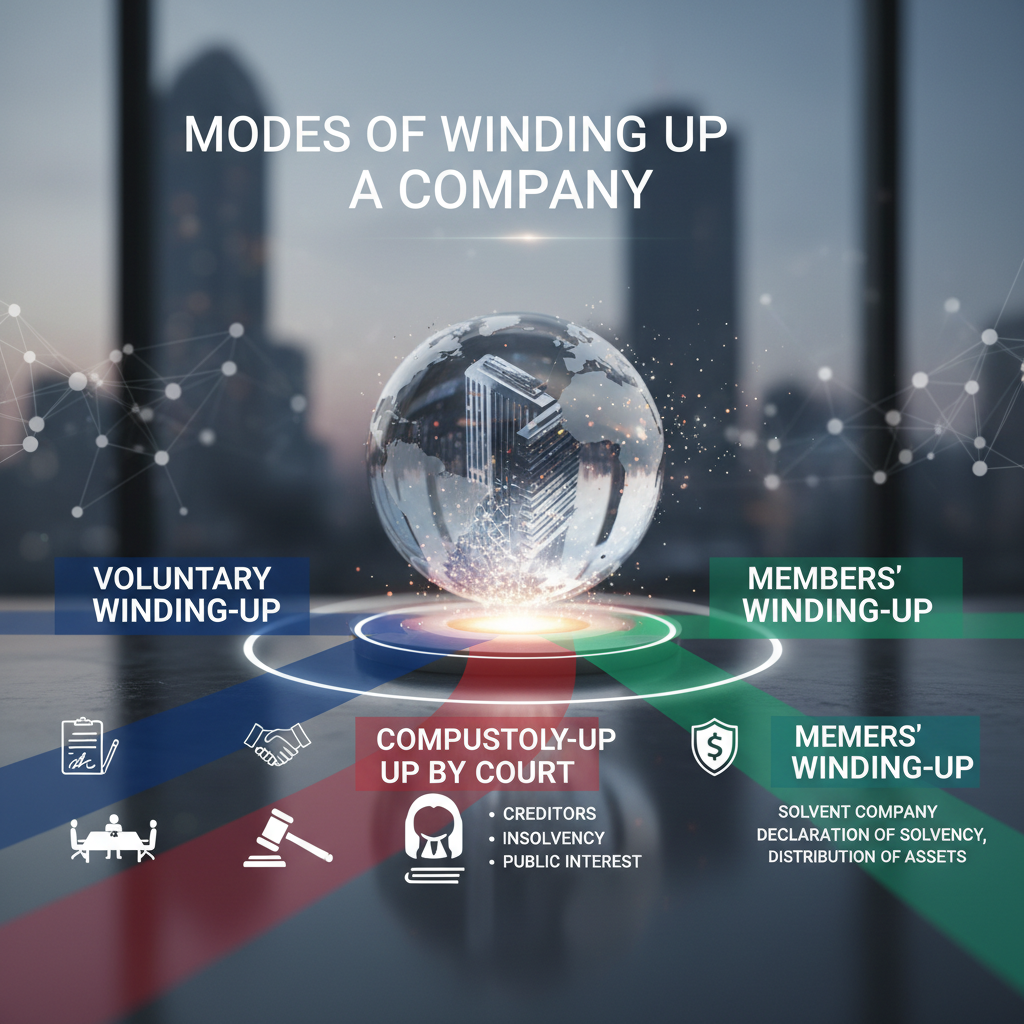
Compulsory vs. Voluntary Winding Up: At a Glance
Before we dive deep, let’s get a high-level view. The path you take depends almost entirely on one question: is the company solvent? Can it pay its debts? From our experience guiding businesses through this maze, understanding this distinction from day one is non-negotiable.
| Feature | Compulsory Winding Up | Voluntary Winding Up |
|---|---|---|
| Primary Trigger | Involuntary. Initiated by creditors, RoC, or others due to statutory grounds (e.g., inability to pay debts). | Voluntary. Initiated by the company’s own shareholders via a special resolution. |
| Governing Law | The Companies Act, 2013 | The Insolvency and Bankruptcy Code (IBC), 2016 |
| Core Prerequisite | Proof of grounds, most commonly the company’s insolvency. | A formal Declaration of Solvency by the directors. The company must be able to pay its debts. |
| Who’s in Control? | The National Company Law Tribunal (NCLT) and an appointed Official Liquidator. | An Insolvency Professional (IP) chosen by the company, with the NCLT giving the final dissolution order. |
| Best Suited For | Insolvent companies where creditors need legal intervention to recover dues. | Solvent companies seeking a planned, orderly, and efficient exit strategy. |
Mode 1: Compulsory Winding Up — The Court-Driven Exit
Think of compulsory winding up as a forced landing. It’s an involuntary process ordered by the National Company Law Tribunal (NCLT), typically when a company can no longer fly on its own. This is the path taken when a company is insolvent or has committed serious statutory breaches. It’s a creditor-centric process designed to salvage value under the watchful eye of the court.
When Can a Company Be Forcibly Wound Up?
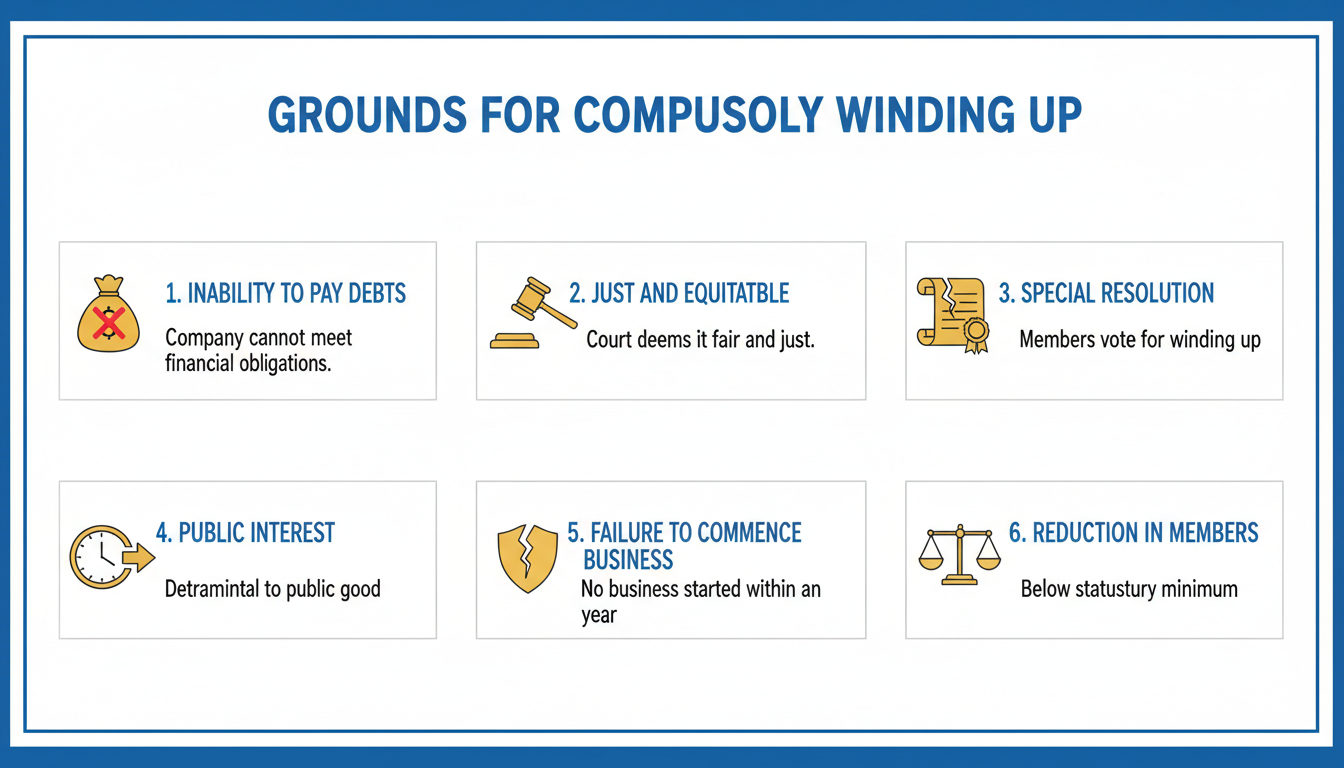
A petition can’t be filed on a whim. According to Section 271 of the Companies Act, 2013, specific grounds must be met. The most common trigger? Inability to pay debts.
- Inability to Pay Debts: This is the big one. A company is deemed unable to pay its debts if a creditor owed over ₹1 lakh serves a statutory demand, and the company fails to pay within 21 days.
- Company’s Own Resolution: The company itself can pass a special resolution deciding it wants to be wound up by the Tribunal.
- Fraudulent Conduct: If the NCLT finds the company was formed for fraudulent purposes or its affairs are being run in a fraudulent manner.
- Acting Against National Interest: A grave charge, but if a company acts against the sovereignty and integrity of India, it can be shut down.
- Filing Defaults: A consistent failure to file financial statements or annual returns with the Registrar of Companies (RoC) for five straight years is a major red flag.
- Just and Equitable Grounds: This is the NCLT’s discretionary power. It’s used in cases of complete management deadlock, loss of the company’s core business purpose (substratum), or severe oppression of minority shareholders.
⚠️ Watch Out
Director Liability is Real. Don’t assume winding up is a get-out-of-jail-free card. If a liquidator uncovers evidence of fraudulent trading or misfeasance (improper use of company funds) in the period leading up to liquidation, the NCLT can hold directors personally liable for the company’s debts. This is known as ‘lifting the corporate veil’, and it happens more often than you think.
The Compulsory Winding Up Process: A Step-by-Step Breakdown
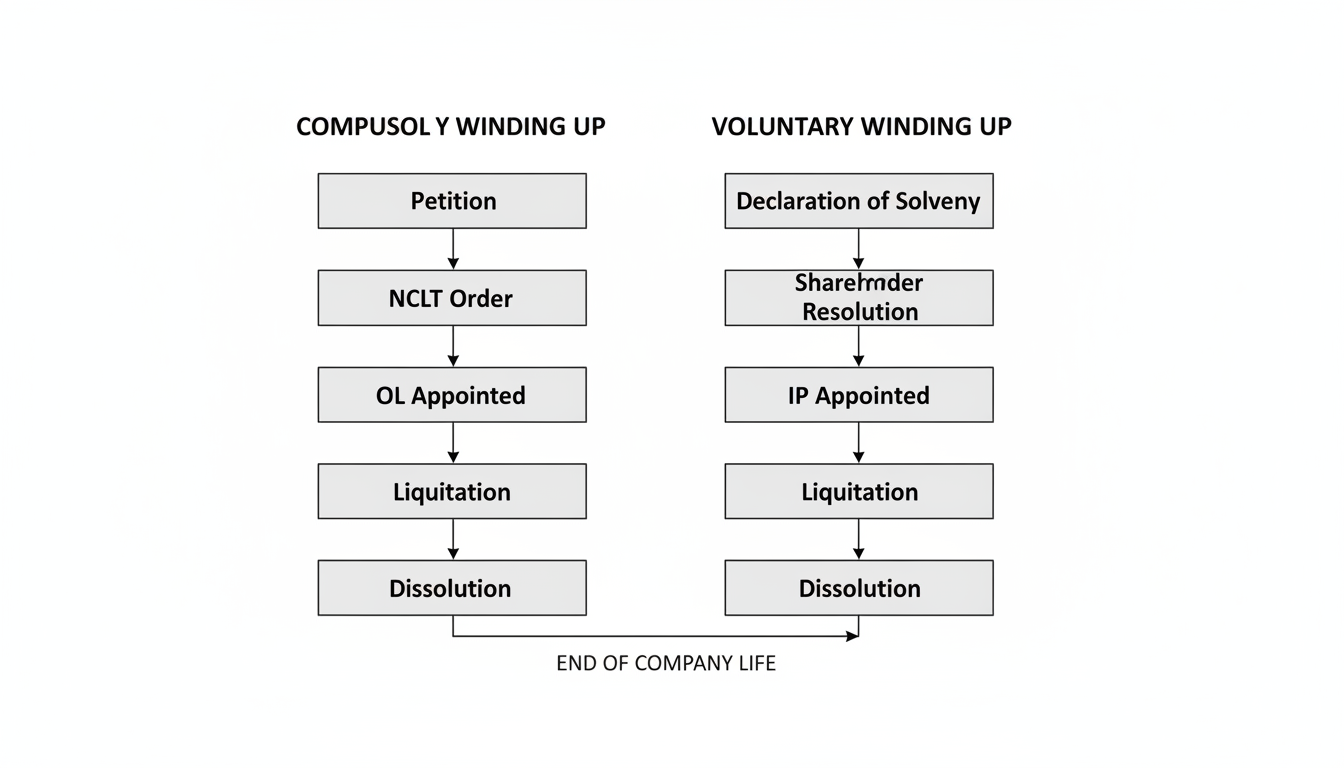
This is a formal, court-monitored procedure. Here’s how it typically unfolds:
- Filing the Petition: A creditor, the company itself, or the RoC files a detailed petition with the NCLT, outlining the grounds for winding up.
- Admission of Petition: The NCLT reviews the petition. If it finds a valid case, it admits the petition and sets a hearing date.
- Appointment of Provisional Liquidator: The Tribunal may appoint a Provisional Liquidator to take immediate control of the company’s assets and prevent any siphoning of funds before the final order.
- The Winding Up Order: After hearing all parties, if the NCLT is satisfied, it passes the formal winding-up order. This is the official start of liquidation.
- Official Liquidator Takes Charge: An Official Liquidator (OL), an officer attached to the court, is appointed. The board of directors loses all its powers, which now vest in the OL.
- Statement of Affairs: The company’s directors must submit a comprehensive ‘Statement of Affairs’ to the OL, detailing all assets and liabilities.
- Liquidation & Distribution: The OL systematically sells the company’s assets, verifies creditor claims, and distributes the proceeds according to a strict legal priority (more on this later).
- Dissolution: Once the company’s affairs are fully settled, the OL applies to the NCLT for a final dissolution order, which legally terminates the company’s existence.
Mode 2: Voluntary Winding Up — The Planned Exit Strategy
Now, let’s talk about the controlled landing. Voluntary winding up is a proactive choice made by a solvent company’s shareholders. Perhaps the business has achieved its purpose, a joint venture has concluded, or it’s simply no longer commercially viable despite having enough assets to clear all its debts.
Governed by the streamlined process under Section 59 of the Insolvency and Bankruptcy Code (IBC), 2016, this is the cleanest and most efficient way to close a solvent company.
💡 Pro Tip
Before you even think about drafting the Declaration of Solvency, conduct a ruthless internal audit. Unearth every potential hidden liability, contingent claim, or pending litigation. A surprise debt popping up mid-process can invalidate the entire solvency declaration, derailing the timeline and exposing directors to serious penalties for making a false declaration.
The Voluntary Winding Up Process Under IBC
Based on hands-on testing of this process, efficiency is its hallmark. But it demands meticulous preparation.
- Step 1: The Declaration of Solvency. This is the foundation. A majority of directors must swear an affidavit stating they’ve fully investigated the company’s finances and confirm two things: the company has no unpaid debts, OR it will be able to pay them in full from the asset sale. This must be backed by audited financials.
- Step 2: Board and Shareholder Approval. Within four weeks of the declaration, a board meeting must be held to approve the liquidation and appoint a registered Insolvency Professional (IP) as the liquidator. This is followed by a general meeting where shareholders must pass a special resolution to approve the winding up.
- Step 3: Public Announcement & Intimation. The company must notify the RoC and the IBBI within seven days. The appointed liquidator then makes a public announcement within five days, inviting creditors to submit their claims.
- Step 4: Claims Management & Asset Realization. The liquidator verifies all claims, prepares a final list of stakeholders, and proceeds to sell the company’s assets in a commercially prudent manner.
- Step 5: Distribution of Proceeds. The liquidator distributes the money collected according to the legal priority of payments.
- Step 6: Final Report & Dissolution. Once everything is settled, the liquidator prepares a final report. After it’s approved in a final general meeting, the liquidator files an application with the NCLT for the company’s dissolution. The NCLT passes the final order, and the company officially ceases to exist.
The Liquidator’s Role: The Captain of the Sinking Ship
Whether it’s an Official Liquidator in a compulsory case or an Insolvency Professional in a voluntary one, this person is the central figure. Their primary duty is to the creditors. They take complete control of the company, and their powers are extensive: How to Revoke Cancelled GST Registration After 180 Days
- Take custody of all company property, assets, and records.
- Sell the assets through public auction or private sale.
- Settle the list of creditors and pay them from the realized funds.
- Investigate the company’s past transactions for any fraudulent or preferential payments.
- Carry on the business of the company, but only if it’s beneficial for the winding-up process.
⚠️ Watch Out
Beware of Preferential Transactions. A liquidator has the power to scrutinize transactions made in the two years leading up to the winding up. If the company paid off a loan to a director’s family member while ignoring other suppliers, that’s a ‘preferential transaction’. The liquidator can legally void that payment and claw the money back into the asset pool to be distributed fairly among all creditors. Master GST Liability Calculation: 7-Step Guide (2025)
The Waterfall: Who Gets Paid First in Liquidation?
This is one of the most critical aspects of any winding up. The law, specifically the IBC, 2016, dictates a strict order of priority for payments, often called the ‘waterfall’. You can’t just pay who you want. Trust me on this one, the liquidator follows this to the letter. Unveiling the GST Revolution: A Closer Look at Petroleum Products, Alcoholic Beverages, and Electricity
| Priority Level | Description of Payment |
|---|---|
| 1 | Insolvency resolution and liquidation costs (the liquidator’s fees come first). |
| 2 | Workmen’s dues (for the preceding 24 months) AND debts owed to secured creditors. |
| 3 | Wages and unpaid dues to employees (other than workmen) for the preceding 12 months. |
| 4 | Financial debts owed to unsecured creditors (e.g., unsecured loans). |
| 5 | Government dues (taxes, etc.) AND any remaining debts of secured creditors. |
| 6 | Any other remaining debts and dues (e.g., trade creditors). |
| 7 | Preference shareholders (if any). |
| 8 | Equity shareholders (the owners, who get paid last, if anything is left). |
As you can see, equity shareholders are last in line. This hierarchy underscores a core principle of corporate law: when a company fails, creditors and employees get paid before the owners.
Conclusion: Choosing the Right Endgame
Winding up a company is the final, irreversible chapter in its lifecycle. It’s not a sign of failure; often, it’s a strategic necessity. The modes of winding up of a company in India provide two clear, albeit very different, paths.
The compulsory route is a court-mandated process for troubled, insolvent companies, designed to protect creditors. The voluntary route, governed by the IBC, is a streamlined, proactive strategy for solvent companies to close their affairs with dignity and efficiency.
Your next step? If you’re contemplating closure, your first action should be a brutally honest assessment of your company’s balance sheet with a legal and financial professional. Are you truly solvent? Answering that question honestly will determine your path and is the first step toward a clean and compliant conclusion to your corporate story. For official regulations and statutes, always refer to the source, such as the full text of The Companies Act, 2013, provided by the Ministry of Corporate Affairs.
❓ Frequently Asked Questions
Is ‘winding up’ the same as ‘dissolution’?
No, they are two distinct stages. Winding up is the process of liquidating assets and settling debts. Dissolution is the final event—the legal order from the NCLT that officially strikes the company’s name from the register, ending its corporate existence. A company still legally exists during winding up.
Can a profitable company choose to wind up?
Absolutely. A profitable, solvent company can opt for voluntary winding up. This often happens when a company was created for a specific project that is now complete, a joint venture term has ended, or the shareholders simply wish to exit the business and realize the value of their investment.
How long does winding up take in India?
It varies dramatically. From real-world campaigns, we’ve seen voluntary winding up under the IBC conclude in 9-12 months due to its time-bound nature. Compulsory winding up, however, is a different beast. It can easily stretch for several years, especially if there are complex assets, extensive litigation, or disputes among creditors.
What happens to employees during winding up?
A winding-up order acts as a notice of termination for all employees. Their outstanding dues (salaries, gratuity, etc.) are not lost. They become preferential creditors and are paid by the liquidator from the company’s assets according to the priority waterfall established by law.
What is the ‘obsolete’ third mode of winding up?
The old Companies Act, 1956, had a third mode called ‘Winding up subject to Court Supervision’. It was a hybrid where a voluntary process was overseen by the court. This provision was removed and is no longer in force under the Companies Act, 2013, making compulsory and voluntary the only two relevant modes today.