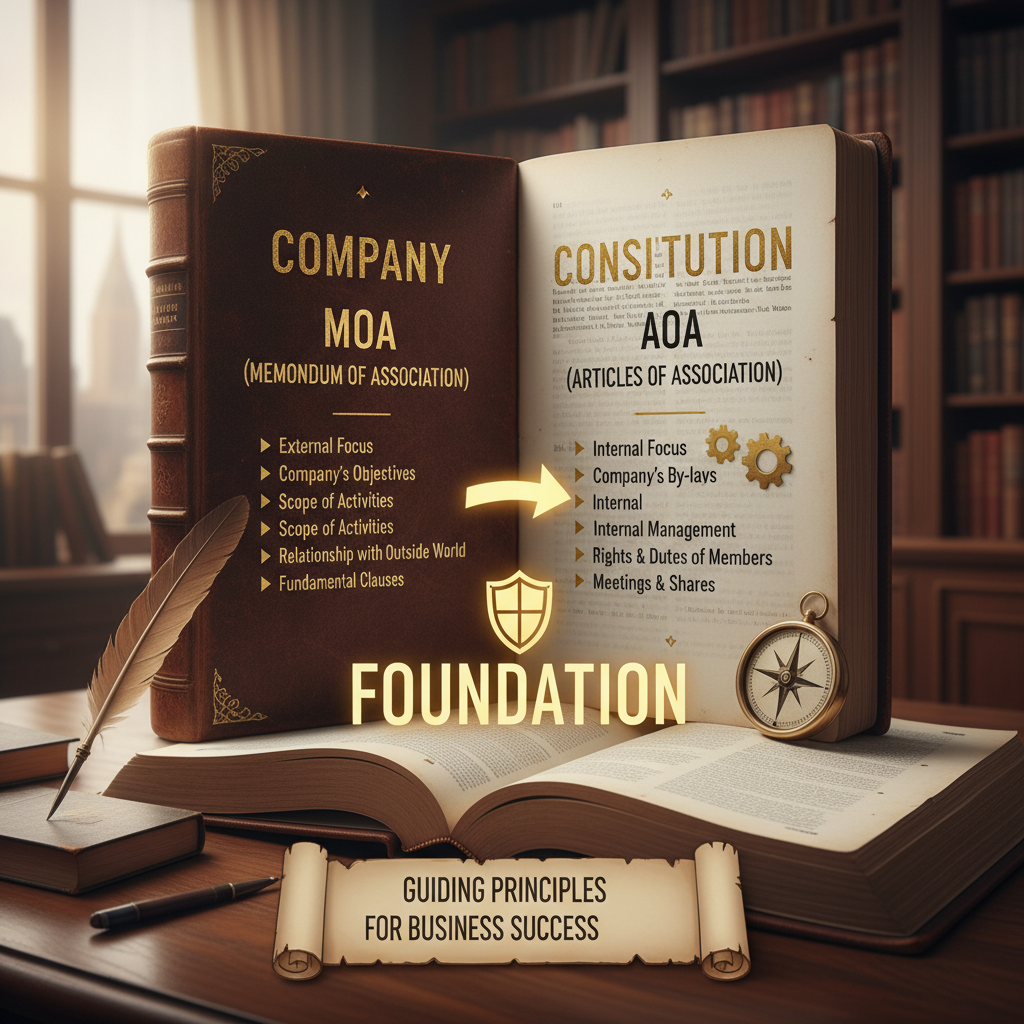
Decoding the Pillars of Corporate Governance: MOA and AOA Difference and Importance
For any entrepreneur venturing into the world of incorporated business, two documents stand above all others: the Memorandum of Association (MOA) and the Articles of Association (AOA). These documents are not mere paperwork; they are the foundational legal architecture upon which the entire company operates. Understanding the core concept of the MOA and AOA difference and importance is the first critical step toward compliant and successful corporate governance.
The MOA defines the company’s relationship with the external world and its foundational purpose, while the AOA dictates the internal management and administrative rules. Confusing one for the other, or failing to adhere to their mandates, can lead to serious legal complications, including actions being declared ultra vires (beyond the scope of power). This comprehensive guide will break down the crucial distinctions, mandatory clauses, and why these documents are indispensable for every registered entity.
What is the Memorandum of Association (MOA)?
The Memorandum of Association is often referred to as the charter or the constitution of the company. It is the primary document that defines the scope of the company’s activities and its relationship with external stakeholders, such as creditors, suppliers, and the general public. It essentially determines the limits beyond which the company cannot legally operate. If an action falls outside the scope defined in the MOA, it is generally considered void.
The Mandatory Clauses of the MOA
The MOA must contain several specific clauses, which clearly outline the company’s identity and structure. These clauses are fundamental and require stringent legal procedures for any alteration.
1. Name Clause
States the official, registered name of the company, ensuring it is unique and compliant with regulatory requirements (e.g., ending with ‘Limited’ or ‘Private Limited’).
2. Registered Office Clause
Specifies the state or jurisdiction where the company’s registered office is located. This determines the jurisdiction under which the company is governed.
3. Objects Clause
This is arguably the most critical section. It details the main business activities the company is authorized to pursue. Any activity not listed here may be considered ultra vires.
4. Liability Clause
Defines the extent of the liability of the members, typically limited by shares or guarantee, ensuring shareholders are protected up to the amount of their investment.
5. Capital Clause
Specifies the maximum amount of capital (Authorized Capital) the company can raise through shares, along with the division of that capital.
6. Subscription Clause
Contains the names, addresses, and signatures of the initial subscribers (first shareholders) to the Memorandum, confirming their intent to form the company.
The Objects Clause is particularly important for defining the parameters of the business. As the legal maxim states, “A company cannot travel beyond the four corners of its Memorandum.” This restriction ensures clarity and protects investors and creditors by setting clear expectations about the company’s purpose.
What are the Articles of Association (AOA)?
While the MOA looks outward, the Articles of Association look inward. The AOA is the subordinate document to the MOA, acting as the internal rulebook or bylaws for the company. It governs how the company is managed, detailing the rights, duties, and powers of the directors, members, and officers.
The AOA provides the mechanism for achieving the objectives laid out in the MOA. For instance, if the MOA states the company’s objective is to “manufacture automotive parts,” the AOA will detail how board meetings are held, how capital is issued, and how decisions are made to facilitate that manufacturing.
Key Matters Covered by the AOA
The AOA covers all aspects of the internal administration of the company. These provisions ensure smooth operational flow and conflict resolution among members.
- Share Capital: Rules regarding the issue, transfer, forfeiture, and alteration of share capital.
- Directors: Appointment, remuneration, removal, powers, and duties of the board of directors.
- Meetings: Rules governing Annual General Meetings (AGMs) and Extraordinary General Meetings (EGMs), including notice periods and quorum requirements.
- Voting Rights: Defining the rights of shareholders and the procedure for casting votes.
- Dividends and Reserves: Procedures for declaring and paying dividends and maintaining reserve funds.
- Common Seal: Regulations concerning the use and custody of the company’s official seal.
Because the AOA is focused on internal procedures, it is generally easier to alter than the MOA, though it still requires formal resolutions and adherence to statutory guidelines.
The Crucial MOA and AOA Difference and Importance
Understanding the distinction between these two documents is non-negotiable for proper Company Formation and ongoing compliance. While both are mandatory for incorporation, their legal status, scope, and ease of alteration differ significantly.
Legal Hierarchy and Functionality
The MOA is the supreme document, acting as the “parent” constitution. The AOA is the “child” rulebook. If there is any conflict between the provisions of the AOA and the MOA, the MOA always prevails. Furthermore, neither document can contain anything that contradicts the primary corporate statute (like the Companies Act in India or similar legislation globally).
MOA vs. AOA: A Comparison of Scope
Basis: Nature and Scope
MOA: Defines the fundamental conditions and objectives necessary for the company’s existence. It dictates the boundaries of the company’s external powers.
AOA: Defines the rules and regulations for the internal management of the company. It dictates how the objectives defined in the MOA will be executed internally.
MOA vs. AOA: Relationship Defined
Basis: Relationship Governing
MOA: Governs the relationship between the company and external parties (e.g., shareholders, creditors, public).
AOA: Governs the relationship between the company and its members, and between the members themselves.
MOA vs. AOA: Alteration Difficulty
Basis: Ease of Alteration
MOA: Extremely difficult to alter. Requires a Special Resolution and, often, approval from the regulatory authority (e.g., National Company Law Tribunal or government body).
AOA: Relatively easier to alter. Requires a Special Resolution passed by the members, but usually does not require external regulatory approval unless specific clauses are involved.
MOA vs. AOA: Legal Doctrine
Basis: Associated Legal Doctrine
MOA: Associated with the Doctrine of Ultra Vires (acting beyond powers). Actions outside the MOA are void.
AOA: Associated with the Doctrine of Indoor Management. Protects external parties dealing with the company, assuming internal procedures (AOA) have been followed correctly.
The Importance of Precision in Drafting and Compliance
The legal weight carried by the MOA and AOA means that their drafting must be precise, comprehensive, and forward-looking. Poorly drafted documents can severely restrict future growth or expose the company to unnecessary legal challenges.
Practical Implications of the MOA and AOA difference and importance
Consider a technology startup whose MOA states its object is solely “software development.” If the company decides to pivot and start manufacturing hardware components, that action is ultra vires. Directors undertaking such activities could be held personally liable, and the contracts signed for the hardware venture might be declared void. This demonstrates the critical limiting power of the MOA.
Conversely, the AOA ensures internal stability. If the AOA mandates that a board meeting requires three directors for a quorum, but a decision to issue new shares is made with only two directors present, that decision is internally invalid, even if the action itself falls within the MOA’s scope. Adhering strictly to the AOA’s rules on governance prevents internal disputes and ensures that corporate actions are legally binding on all members.
According to legal experts, “The Memorandum gives the company life, but the Articles give it the ability to function daily.” This highlights the synergistic necessity of both documents working in harmony.
Alteration Procedures: When the Rules Need to Change
Businesses evolve, requiring flexibility in their founding documents. While amendments are possible, the process reflects the rigidity of the documents themselves.
Altering the MOA
Since the MOA affects external parties and defines the very existence of the company, alteration is a serious undertaking. Changing the Objects Clause, for instance, requires:
- Passing a Special Resolution (typically 75% majority of members voting).
- Filing the resolution with the Registrar of Companies (ROC).
- In many jurisdictions, specific changes (like moving the registered office from one state to another, or significantly changing the Object Clause) require sanction from a regulatory tribunal or court.
Altering the AOA
Changing internal rules is simpler but still formal. Alteration of the AOA requires:
- Passing a Special Resolution.
- Filing the amended Articles with the ROC within the stipulated timeframe.
It is vital to remember that even an altered AOA cannot violate the MOA or the governing corporate law. For instance, the AOA cannot be altered to give directors powers that are explicitly restricted by the MOA.
Ensuring Compliance and Semantic SEO Keywords
When starting a new venture, expert guidance is invaluable. The initial drafting of these documents determines the future legal health and operational flexibility of the enterprise. Using standard templates (like Table A or Table F provided in some jurisdictions) can be a starting point, but customization is essential to reflect the unique business model, especially concerning share classes, voting rights, and director powers.
Compliance extends beyond formation. Companies must continuously ensure that all actions taken – whether issuing shares, declaring dividends, or entering major contracts – are fully compliant with both the internal rules set out in the AOA and the external boundaries established by the MOA.
For further reading on the foundational laws governing corporate entities, particularly concerning the duties and liabilities of directors, consulting authoritative sources is recommended. Understanding these legal frameworks ensures that the company operates within its legal mandate. Corporate governance is a complex field, and the MOA and AOA form its bedrock.
Furthermore, staying updated on regulatory deadlines is also part of maintaining good standing. While the MOA and AOA set the foundational rules, operational compliance relies on meeting statutory requirements, such as those related to financial filings or tax obligations. For example, keeping track of requirements like GST due dates and other compliance filings is crucial for operational continuity.
The MOA and AOA difference and importance also plays a role in attracting investment. Investors scrutinize these documents heavily to assess the stability, legal boundaries, and internal decision-making processes of the company before committing capital. A well-defined structure signals professionalism and reduced legal risk.
Conclusion: The Indispensable Corporate Documents
The Memorandum of Association and the Articles of Association are not interchangeable. The MOA is the constitution, defining the company’s existence, purpose, and external scope, while the AOA is the internal rulebook, detailing governance and administration. Together, they provide the necessary framework for a company to operate legally and efficiently.
For any entity – whether a small private company or a large public corporation – recognizing the hierarchy and mandatory compliance requirements of these documents is paramount to avoiding the pitfalls of ultra vires actions and internal conflicts. They are the essential blueprints for corporate success.
For more detailed information on corporate law structures and compliance requirements, you may wish to consult legal information resources, such as those provided by the Legal Information Institute (LII).
FAQs
If a company performs an action that is not authorized by the Objects Clause of its MOA, that act is considered ultra vires (beyond power). Such acts are void and cannot be ratified by the shareholders. Directors involved may face personal liability for the breach.
Yes, the Articles of Association (AOA) is subordinate to the Memorandum of Association (MOA). If any provision in the AOA contradicts a provision in the MOA, the MOA provision will prevail. Both documents must also comply with the overarching corporate law of the jurisdiction.
Many jurisdictions provide standard model articles (often referred to as Table A or similar schedules). A company can adopt these standard articles fully, or adopt them with modifications. However, custom drafting is often necessary for complex structures, especially concerning share classes or director appointment rules.
The Objects Clause defines the legal capacity of the company – what it is authorized to do. Its primary significance is protecting shareholders and creditors by ensuring the company’s funds are used only for the stated purposes, thereby limiting risk.
Yes. Both the Memorandum of Association and the Articles of Association must be filed and registered with the relevant regulatory body (like the ROC) during the company incorporation process to officially bring the corporate entity into existence.