Imagine this scenario: You’ve just launched a tech startup. You secure your first round of funding, and you’re ready to expand into manufacturing hardware. You sign the lease for a factory, hire staff, and order machinery. Then, a minor shareholder sues you. Why? Because your company’s founding document—specifically the “Object Clause”—only listed software development as a permitted activity.
Suddenly, every contract you just signed is legally void. The company technically didn’t have the power to sign them.
This isn’t a hypothetical nightmare; it’s a real legal trap known as Ultra Vires, and it happens when founders don’t respect the moa and aoa difference. In the fast-paced business world of 2026, where compliance is tighter than ever, treating these documents as “just paperwork” is a rookie mistake.
Whether you are incorporating a private limited entity or studying for a corporate law exam, you need to know exactly how these two documents interact. The Memorandum of Association (MOA) is your company’s constitution; the Articles of Association (AOA) is the rulebook. One defines your existence; the other manages your operations.
In this guide, we aren’t just going to define them. We’re going to dissect them, compare them, and show you exactly how to use them to build a bulletproof corporate structure.
The Core Concept: Constitution vs. Rulebook
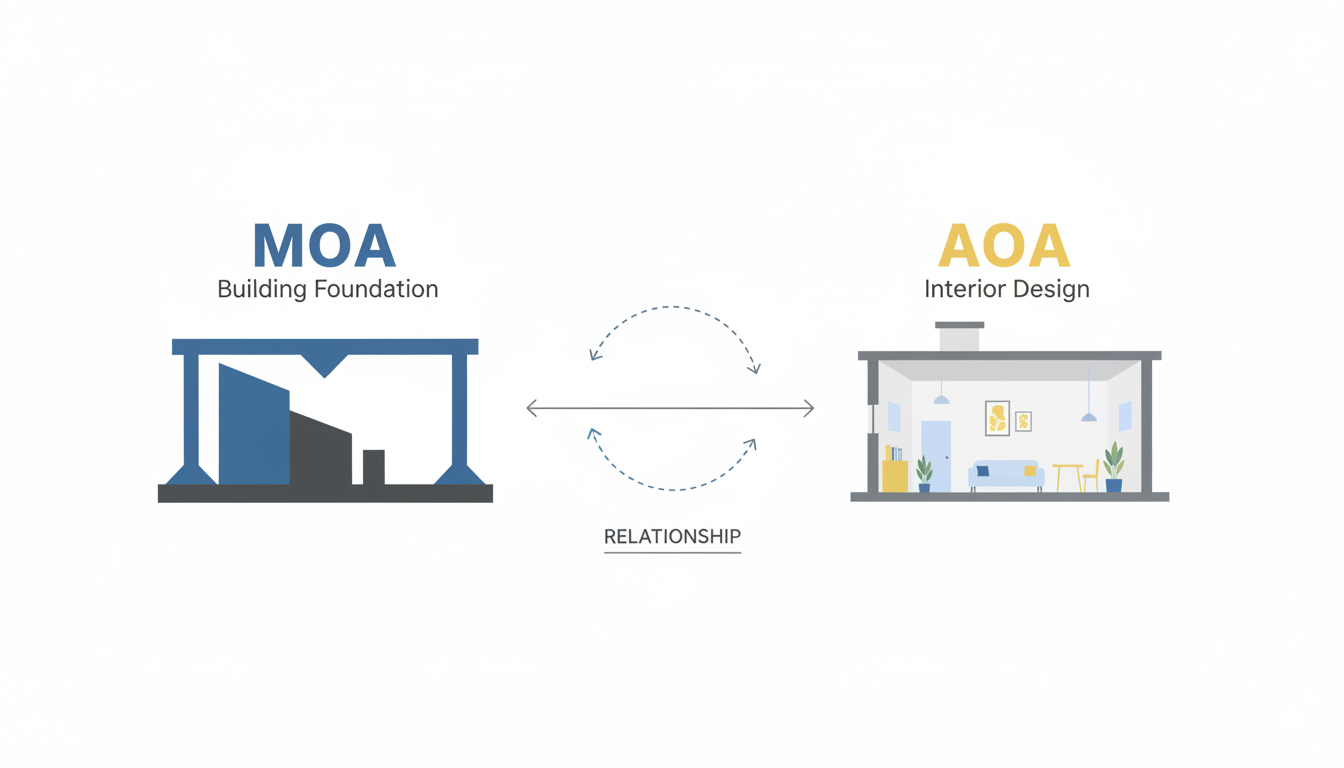
To truly grasp the moa and aoa difference, you have to stop thinking in legalese and start thinking in structural terms. In our experience consulting with new businesses, the “Building Analogy” works best.
Think of the MOA as the foundation and outer walls of a building. It defines the perimeter. It tells the city (the Registrar of Companies) and the public exactly where the building stands, how tall it is, and what it’s used for. You cannot step outside these walls without major reconstruction.
Now, think of the AOA as the internal layout and house rules. Who gets the corner office? What time do the lights go out? How do we resolve disputes between residents? These rules are crucial, but they exist inside the perimeter set by the MOA.
🎯 Key Takeaway
The MOA defines the company’s relationship with the outside world (investors, creditors, the government). The AOA governs the relationship between the company and its own members (shareholders, directors).
Deep Dive: The Memorandum of Association (MOA)
The Memorandum is the supreme document. It is the charter that gives your company its legal life. Without it, the company simply does not exist. In 2026, filing the MOA is a digital-first process, but the gravity of its content remains unchanged.
The MOA tells the world: “This is who we are, and this is the limit of our power.”
The 6 Pillars (Clauses) of the MOA
When drafting an MOA, you are essentially filling out six specific clauses. Messing these up is where most registration errors happen.
- Name Clause: The legal identity. It must be unique and not infringe on trademarks.
- Registered Office Clause: This determines your jurisdiction (e.g., which state laws apply to you).
- Object Clause: The most critical section. It defines the main business activities. If it’s not listed here, you generally can’t do it.
- Liability Clause: Protects the personal assets of shareholders. It states that members are only liable up to the unpaid amount on their shares.
- Capital Clause: The maximum amount of money the company is authorized to raise via shares.
- Subscription Clause: The signatures of the first shareholders who agree to buy the initial shares.
⚠️ Watch Out
The “Object Clause” Trap: Many founders write their Object Clause too narrowly. If you define your business solely as “selling coffee,” you might face legal hurdles if you later decide to sell pastries or coffee machines. Always include a broad range of ancillary activities to future-proof your business.
Deep Dive: The Articles of Association (AOA)
If the MOA is the “what,” the AOA is the “how.” The Articles of Association contain the bye-laws and regulations that govern the management of the company’s internal affairs.
While the Companies Act provides a standard format (known as Table F in many jurisdictions), smart companies customize their AOA. This document dictates:
- Director Powers: Who can sign checks? Who can hire executives?
- Shareholder Rights: Voting rules, dividend policies, and stock transfer restrictions.
- Meeting Protocols: How much notice is needed for a board meeting? What constitutes a quorum?
The AOA is subordinate to the MOA. If the AOA says “Directors can borrow unlimited money,” but the MOA says “The company can only borrow up to $1 million,” the MOA wins. Every time.
At a Glance: The 10 Critical Differences
Let’s break down the moa and aoa difference into a clear, actionable comparison. This table highlights the distinctions that matter most for compliance and governance.
| Feature | Memorandum of Association (MOA) | Articles of Association (AOA) |
|---|---|---|
| Fundamental Nature | The Charter / Constitution of the company. | The Internal Rulebook / Bye-laws. |
| Scope of Power | Defines the absolute limits of the company’s power. | Defines how those powers are exercised internally. |
| Relationship | Company vs. Outsiders (Creditors, Public). | Company vs. Members (and Members vs. Members). |
| Supremacy | Supreme document. Overrules the AOA. | Subordinate document. Must align with the MOA. |
| Violation Consequence | Acts are Ultra Vires (Void and illegal). | Acts are Intra Vires (Can be ratified by shareholders). |
| Necessity | Mandatory for all companies to draft and file. | Public companies limited by shares can adopt standard Table F. |
| Retrospective Effect | Cannot be amended retrospectively. | Can be amended retrospectively (with conditions). |
The “Ultra Vires” Doctrine: Why the Difference Matters
This is where the rubber meets the road. The legal concept of Ultra Vires (Latin for “beyond the powers”) is the scariest part of the moa and aoa difference.
If your directors do something that violates the AOA—for example, borrowing money without a proper board meeting—the shareholders can vote to forgive (ratify) that mistake. It’s an internal procedural error. The act stands, provided the shareholders agree. Easy Business Registration in India: Quick Guide
However, if the directors do something that violates the MOA—like investing in real estate when the MOA only allows for retail trading—that act is void ab initio (from the beginning). The shareholders cannot ratify it, even if 100% of them agree. The contract is dead. The money is gone. The directors can be held personally liable. व्हीलचेयर टेनिस पैरालंपिक्स: खेल का उत्सव
According to legal definitions found on Investopedia, this doctrine exists primarily to protect creditors and investors, ensuring their funds are not used for unauthorized risks.
Step-by-Step: Drafting Your Charters Correctly
In 2026, you likely won’t be handwriting these documents, but you will be directing the legal tech or professionals who do. Here is the workflow for getting it right.
- Define the Objective (MOA): Sit down with your co-founders. What is the business today? What could it be in 10 years? Draft the Object Clause to cover both.
- Determine Liability & Capital (MOA): Decide how much authorized capital you need. Remember, increasing this later requires paying fees to the government, so aim slightly higher than your immediate needs.
- Set the Rules (AOA): Don’t just accept the default template. Discuss dispute resolution. What happens if a founder wants to leave? Add “Pre-emptive Rights” clauses to the AOA to control share transfers.
- Review for Conflict: Ensure nothing in your AOA contradicts the MOA.
- File with the Registrar: Submit both documents simultaneously during incorporation.
💡 Pro Tip
The “Entrenchment” Clause: You can make your AOA harder to change than the law requires. By adding “Entrenchment Provisions,” you can specify that certain rules (like selling the company) require 90% or even 100% shareholder approval, rather than the standard 75%. This is a powerful tool for minority founder protection.
Alteration: Changing the Rules Later
Business pivots are inevitable. But changing these documents is not equally easy. This is another major moa and aoa difference regarding flexibility.
| Document | Difficulty to Change | Process Overview |
|---|---|---|
| MOA | High Difficulty | Requires a Special Resolution. For changes to the Object Clause or Registered Office (state-to-state), you often need Central Government or Regional Director approval. It’s time-consuming and costly. |
| AOA | Medium Difficulty | Usually requires only a Special Resolution (75% shareholder vote) at a General Meeting. Government approval is rarely needed unless you are converting a public company to a private one. |
Because the MOA affects the public interest, the government keeps a tighter leash on it. The AOA is considered a “family affair,” so the government generally lets the shareholders decide, provided they follow the Companies Act.
Why Investors Care About Your AOA
When Venture Capitalists (VCs) look at your startup, they go straight to the AOA. Why? Because the AOA dictates how they get their money back.
Investors will often demand that you amend your AOA to include:
- Liquidation Preference: Who gets paid first if the company is sold?
- Anti-Dilution Rights: Protection if you sell shares cheaper in the future.
- Board Seats: The right to appoint a director.
If you don’t understand the AOA, you might accidentally sign away control of your company. For a deeper understanding of corporate governance structures, Wikipedia’s entry on Articles of Association provides a global perspective on how these clauses function across different legal systems.
Conclusion
The moa and aoa difference is not just academic trivia for law students. It is the difference between a company that is agile and secure, and one that is paralyzed by legal disputes. The MOA sets your boundaries; the AOA sets your rhythm.
As we move through 2026, the complexity of corporate compliance is only increasing. Don’t treat these documents as mere formalities. Draft your MOA with a vision for the future to avoid the “Ultra Vires” trap, and craft your AOA to ensure fair, efficient internal management.
Your next step? If you are already incorporated, pull out your MOA and AOA today. Read them. Do they still reflect your business reality? If not, it’s time to call a General Meeting.
❓ Frequently Asked Questions
What is the main difference between MOA and AOA?
The MOA (Memorandum of Association) defines the company’s powers and relationship with the outside world (investors, public), while the AOA (Articles of Association) defines the internal rules, regulations, and management procedures for the company.
Which document prevails in a conflict: MOA or AOA?
The MOA always prevails. It is the supreme charter of the company. If a clause in the AOA contradicts the MOA, that specific clause in the AOA is considered void and invalid.
Can a company exist without an AOA?
Technically, a public company limited by shares can choose not to file a custom AOA and instead adopt “Table F” (a standard set of articles provided by the Companies Act). However, every company must have an MOA to be registered.
Is it harder to change the MOA than the AOA?
Yes. Changing the MOA is more rigid and often requires government approval (especially for moving states or changing objectives), whereas changing the AOA usually only requires a Special Resolution passed by shareholders.
What is the Doctrine of Indoor Management?
This legal principle protects outsiders dealing with the company. It states that people outside the company are entitled to assume that internal rules (as per the AOA) have been followed properly, even if they haven’t. You can read more about such principles at Cornell Law School’s LII.