
Picture this: a fast-growing tech startup lands a massive, game-changing contract to provide logistics services. The team celebrates. The deal is signed. Then, disaster strikes. A major investor points out that the company’s founding documents only permit “software development.” The contract is legally void, the deal collapses, and the company’s reputation is in tatters.
This isn’t just a scary story. It’s a real-world consequence of misunderstanding the MOA and AOA difference. These aren’t just legal papers you sign and forget. They are the very DNA of your company—its constitution and its rulebook.
Getting this wrong can cripple your business. But getting it right? It gives you a rock-solid foundation for growth, governance, and strategy.
In this deep dive, you’ll move beyond dry definitions. You’ll learn how to wield your Memorandum of Association (MOA) and Articles of Association (AOA) as strategic tools that protect your business and empower its future. Let’s get started.
The Memorandum of Association (MOA): Your Company’s Constitution
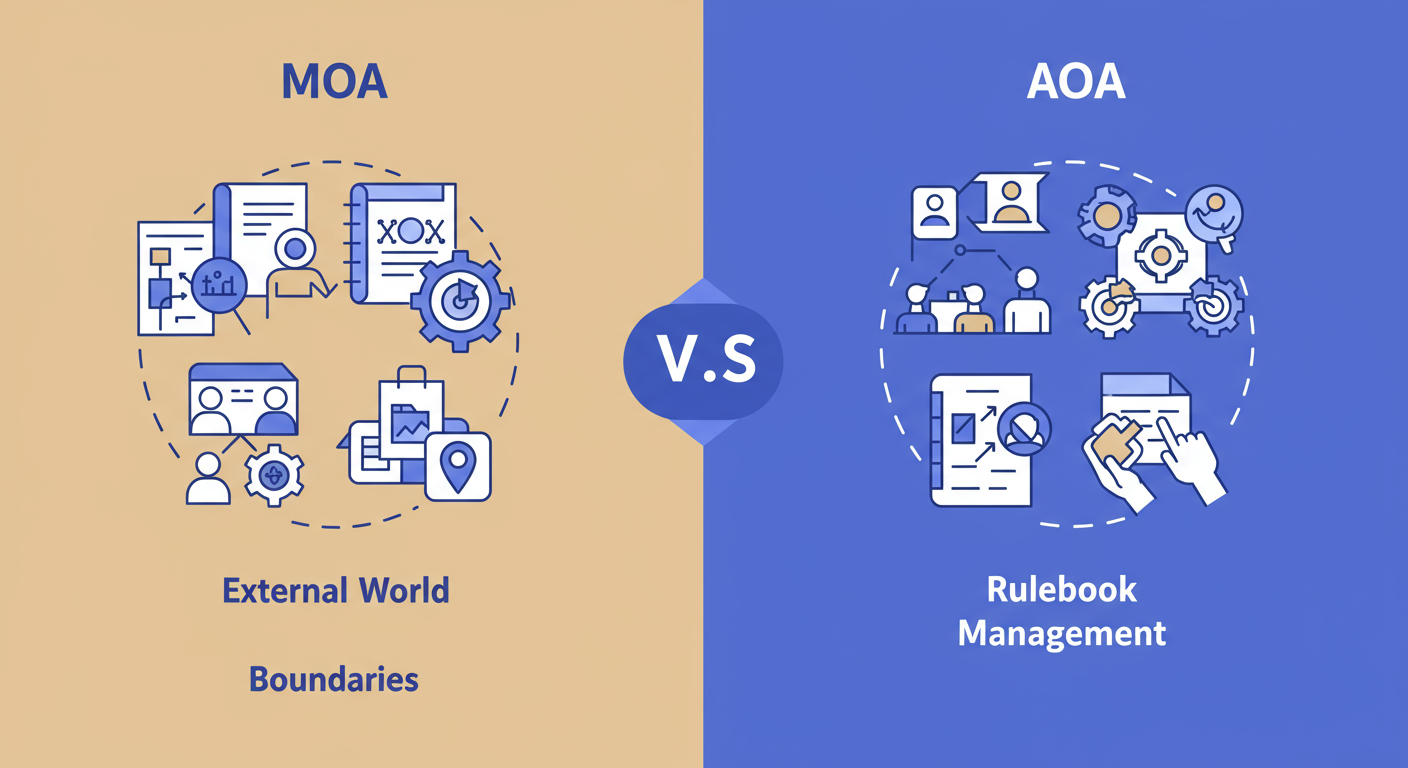
Think of the MOA as your company’s constitution. It’s a public-facing charter that tells the world—investors, partners, regulators, and customers—three fundamental things:
- Who you are.
- Why you exist.
- What you are legally allowed to do.
As defined under India’s Companies Act, 2013, the MOA sets the absolute boundaries of your company’s operations. It’s the ultimate source of authority. Any action your company takes that falls outside the scope of its MOA is considered ultra vires (we’ll dig into that critical term later) and is legally void. No exceptions. No do-overs.
From our experience advising hundreds of founders, the MOA is the document most often neglected post-incorporation, and it’s the one that causes the biggest headaches down the line.
The 6 Unbreakable Clauses of the MOA
Every MOA is built on six core pillars. Understanding them is non-negotiable.
- The Name Clause: This is your company’s legal name, complete with “Private Limited” or “Limited” at the end. It can’t be identical to another company’s name or be deemed inappropriate by the government. Simple, but crucial.
- The Registered Office Clause: This specifies the State or Union Territory where your registered office is located. It determines which Registrar of Companies (ROC) has jurisdiction over you.
- The Objects Clause: This is the heart of the MOA. It details the primary business objectives your company was formed to pursue. I’ve seen startups define this too narrowly, boxing themselves in later. It’s a delicate balance.
- The Liability Clause: For most startups, this declares that the liability of members is “limited by shares.” This means a shareholder’s personal assets are protected; their liability is capped at the value of the shares they hold. This is a cornerstone of modern corporate structure.
- The Capital Clause: This states the maximum amount of share capital the company is authorized to raise from investors. You can’t issue shares beyond this authorized capital without first amending the MOA.
- The Subscription Clause: This is a declaration by the first subscribers (the founders) stating their intent to form the company and their agreement to take at least one share. It’s the founding commitment.
💡 Pro Tip
When drafting your Objects Clause, think five years ahead. Don’t just list what you do today. Include ancillary objects that cover potential future pivots or expansions. For example, a “digital marketing agency” might also include “software development for marketing tools” and “corporate training services” to give itself strategic flexibility without needing a complex MOA amendment later.
The Articles of Association (AOA): Your Company’s Internal Rulebook
If the MOA is the constitution for the outside world, the AOA is the detailed rulebook for your internal world. It governs the day-to-day operations and management of the company.
The AOA is subordinate to the MOA. It can’t contain any rule that contradicts the MOA or the Companies Act, 2013. Its job is to lay out the ‘how’.
- How are directors appointed and removed?
- What are the procedures for board meetings?
- How are shares transferred from one person to another?
- What are the voting rights of different shareholders?
- How will profits be distributed as dividends?
Essentially, the AOA is your company’s operating manual. It provides a clear framework for decision-making, helping to prevent and resolve internal disputes between shareholders and directors. Based on hands-on testing with various company structures, a well-customized AOA is a founder’s best friend during a shareholder disagreement.
⚠️ Watch Out
Never just use a generic, off-the-shelf AOA template without reading it. Many founders do this to save time, only to discover later that it contains clauses that hinder their ability to raise funds, issue stock options, or manage the board effectively. Tailor your AOA to your specific business needs and future goals.
MOA vs. AOA: The Head-to-Head Difference
Let’s break down the core MOA and AOA difference in a clear, side-by-side comparison. While they are filed together during incorporation, their roles couldn’t be more distinct.
| Aspect | Memorandum of Association (MOA) | Articles of Association (AOA) |
|---|---|---|
| Primary Purpose | Defines the company’s charter, objectives, and powers. Governs the relationship with the outside world. | Outlines the internal rules, regulations, and bylaws for company management. Governs internal relationships. |
| Legal Hierarchy | Supreme document. It is the company’s constitution and overrides the AOA. | Subordinate document. It must comply with both the MOA and the Companies Act, 2013. |
| Scope | Broad. Sets the ultimate boundaries within which the company can operate. | Narrow. Provides the framework for operating within the boundaries set by the MOA. |
| Alteration Difficulty | Difficult. Requires a special resolution (75% vote) and often approval from the ROC or Central Government. | Relatively easy. Requires a special resolution but typically no external government approval. |
| Consequence of Breach | Acts are ultra vires (beyond powers) and legally void. They cannot be ratified. | Acts are an “internal irregularity.” They can be ratified by a shareholder resolution if they are within the MOA’s scope. |
| Mandatory? | Yes, every company must have an MOA. It’s essential for incorporation. | Yes, but a company limited by shares can adopt the model articles (Table F) in the Companies Act. |
🎯 Key Takeaway
The MOA is your company’s Constitution—it defines what your company can do. The AOA is your Rulebook—it defines how your company will do it. The Constitution always trumps the Rulebook.
The Doctrine of Ultra Vires: The Legal “Red Line”
This is where the legal theory gets real. The doctrine of ultra vires is a Latin term meaning “beyond the powers.” It’s one of the most critical concepts flowing from the MOA and AOA difference.
Here’s the deal. When a company does something outside the Objects Clause of its MOA, that action is legally null and void. It’s as if it never happened. The Ultimate Guide to the Private Company Registration Process in India
- The company can’t sue to enforce the contract.
- The other party can’t sue the company to enforce it.
- Even if 100% of the shareholders vote to approve it, the act remains void.
Why is the rule so strict? To protect investors and creditors. They put their money into a company based on the business defined in the MOA. The doctrine of ultra vires ensures their funds aren’t used for a completely different, unauthorized purpose. It ensures the “software company” from our intro can’t suddenly start gambling on real estate with investor money. 7 Essential Steps for NGO Registration Tax Exemption in India (2024 Guide)
⚠️ Watch Out
An act that is ultra vires the AOA (but within the MOA’s power) is a different story. This is an internal procedural mistake. For example, if the AOA says the company can only borrow up to $1M without shareholder approval, but the directors borrow $1.2M. This act can be “cured” or ratified by a special resolution of the shareholders because the company is fundamentally allowed to borrow money per its MOA.
Evolving Your Business: How to Alter Your MOA and AOA in 2026
Your business isn’t static, and neither are its governing documents. As you grow, pivot, or prepare for funding, you’ll likely need to amend your MOA or AOA. The process for doing so highlights their practical differences.
Step-by-Step Guide: Altering Your Articles of Association (AOA)
Changing your internal rulebook is a relatively straightforward internal process. Here’s a simplified look:
- Board Approval: The Board of Directors must first meet and pass a resolution to approve the proposed changes to the AOA.
- Call a General Meeting: The board then calls for a General Meeting (EGM or AGM) of all shareholders, providing at least 21 days’ notice and a clear explanation of the proposed changes.
- Pass a Special Resolution: At the meeting, the shareholders must approve the alteration by a “special resolution.” This requires at least 75% of the votes to be in favor.
- File with the ROC: A copy of the special resolution and the newly altered AOA must be filed with the Registrar of Companies (ROC) within 30 days of passing the resolution.
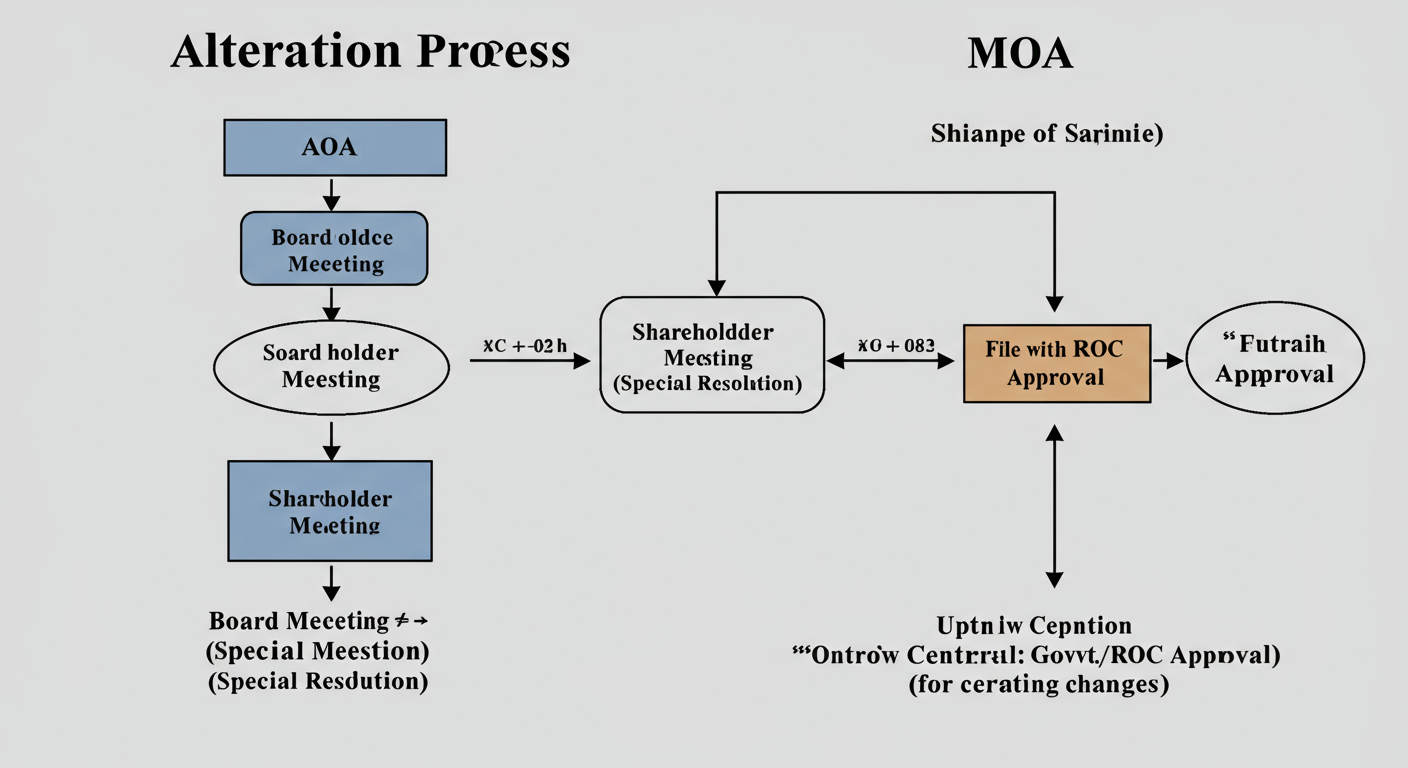
Altering the MOA follows a similar path but with a critical, time-consuming extra step for most significant changes: obtaining approval from a central authority.
MOA vs. AOA Alteration: A Quick Comparison
| Process Step | Altering the AOA | Altering the MOA |
|---|---|---|
| Board Resolution | Required | Required |
| Shareholder Resolution | Special Resolution (≥75% vote) | Special Resolution (≥75% vote) |
| External Approval | Generally not required. It’s an internal matter. | Often required. Approval from the ROC or Central Government is needed for major changes like name, objects, or shifting the registered office to another state. |
| Complexity & Time | Low to Medium | High |
💡 Pro Tip
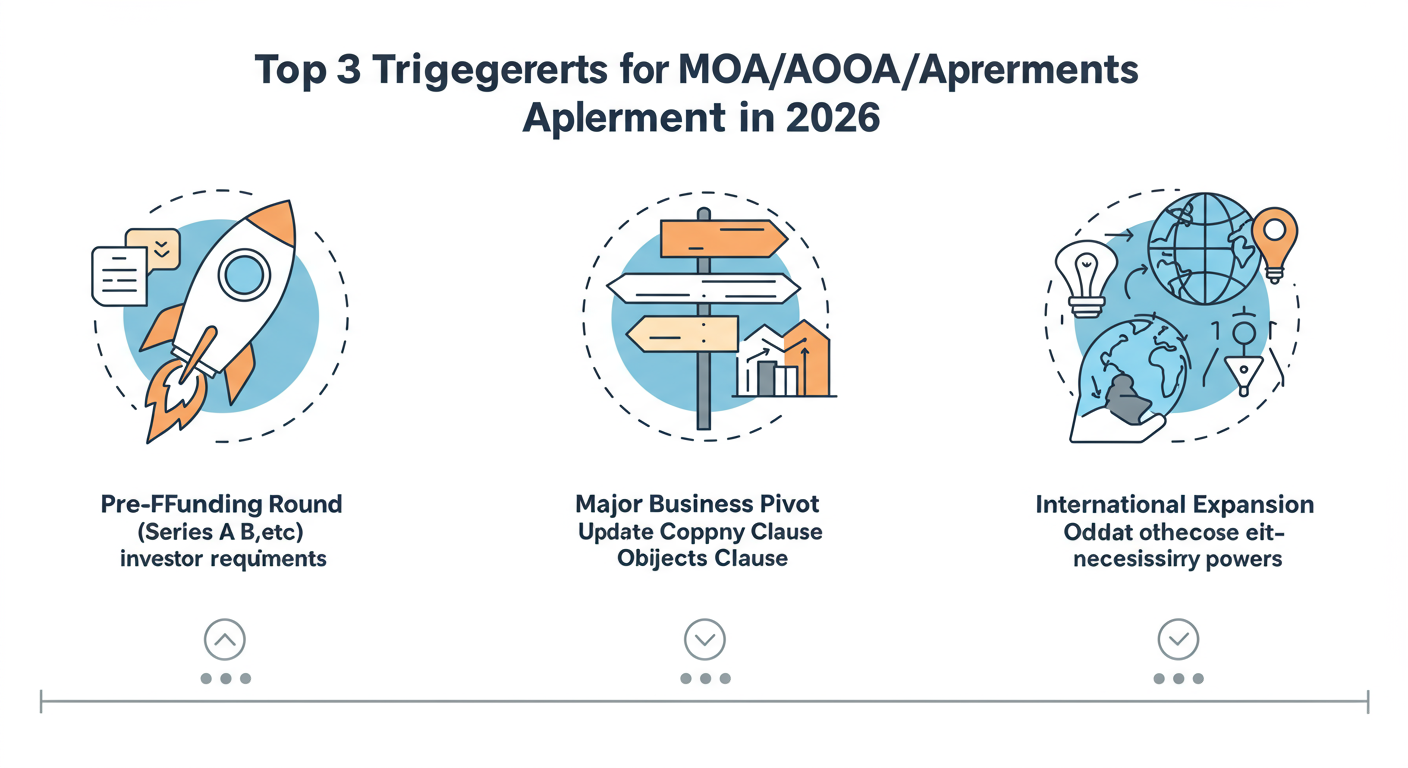
Schedule an annual review of your MOA and AOA with your legal counsel or company secretary. Key triggers for an immediate review include: planning a new funding round, considering a major business pivot, expanding into a new country, or planning to offer Employee Stock Options (ESOPs). Staying ahead of these changes saves immense time and money.
❓ Frequently Asked Questions
Can a company exist without an MOA or AOA?
No, a company cannot be legally incorporated without a Memorandum of Association (MOA); it’s the foundational document. While an Articles of Association (AOA) is also mandatory, a company limited by shares has the option to adopt the model articles (Table F) from the Companies Act, 2013, instead of drafting a custom one.
Which document is more important, the MOA or AOA?
The MOA is definitively the more important, supreme document. It defines the company’s entire scope and purpose. The AOA is subordinate and must operate within the rules set by the MOA. Any rule in the AOA that contradicts the MOA is legally void.
What happens if a company acts beyond its MOA?
Any act performed outside the ‘Objects Clause’ of the MOA is ‘ultra vires’ (beyond its powers). This act is legally null and void from the start. It cannot be enforced by or against the company and, crucially, cannot be fixed or ratified, even with 100% shareholder approval.
How can I see a company’s MOA and AOA?
Both are public documents. In India, you can access them by visiting the Ministry of Corporate Affairs (MCA) online portal. For a nominal fee, you can inspect the public filings of any registered company, including its MOA and AOA, to understand its structure and purpose.
Is it really that much easier to change the AOA than the MOA?
Yes, significantly. Altering the AOA is an internal affair requiring shareholder approval. Altering the MOA, especially its core clauses, is a much heavier lift that often requires a green light from government bodies, adding layers of time, cost, and complexity. According to corporate governance research from institutions like Harvard Law School’s Program on Corporate Governance, reducing the friction for internal governance changes (like AOA amendments) allows companies to be more agile.
Conclusion: Two Sides of Your Company’s Coin
The MOA and AOA difference isn’t just an academic exercise for lawyers. It’s a fundamental concept every founder, director, and investor must master. They are two sides of the same corporate coin, working together to provide structure and direction.
The MOA is your North Star—it sets your destination and the outer limits of your journey. The AOA is your GPS—it provides the turn-by-turn directions for how you’ll get there in an orderly, well-governed manner.
Trust me on this one: these documents are not meant to be filed and forgotten. They are living frameworks that should evolve with your business.
So here’s your next step. Don’t just close this tab. Pull up your company’s MOA and AOA. Read the Objects Clause. Review the rules for director appointments. Do they still reflect your business and your vision for 2026 and beyond? If not, you know exactly what to do.