Imagine a single missed deadline costing your company tens of thousands of rupees. A deadline that could get you, as a director, barred from any board for five years. It sounds extreme, but it happens every single year to hundreds of businesses in India. And the MGT-7 due date is precisely that deadline.
This isn’t just another piece of bureaucratic paperwork. Form MGT-7, the Annual Return, is your company’s public report card. It’s a legal declaration of your governance, structure, and financial health submitted to the Registrar of Companies (ROC). Getting it wrong—or worse, getting it in late—sends a clear signal of mismanagement.
But you’re here to avoid that. In this in-depth guide, we’ll cut through the legal jargon. You’ll learn:
- How to pinpoint the exact MGT-7 due date for FY 2025-26.
- The real, day-by-day cost of penalties (it’s more than you think).
- A foolproof, step-by-step process for a smooth and timely filing.
- Insider tips to avoid common mistakes that trip up even seasoned directors.
Let’s make sure your company stays compliant, credible, and clear of any trouble.
The Critical Timeline: Decoding the MGT-7 Due Date for FY 2025-26
Here’s the first thing to understand: the MGT-7 due date isn’t a fixed calendar date like your income tax return. It’s a floating deadline, entirely dependent on when your company holds its Annual General Meeting (AGM).
This connection is everything. Get the AGM date wrong, and you’ll miss the MGT-7 deadline. It’s that simple.
According to Section 92 of the Companies Act, 2013, every company must file its annual return (Form MGT-7) within 60 days from the date of its AGM.
So, the real question is: when must you hold your AGM?
- The AGM must be held within 6 months from the end of the financial year.
Let’s break this down for the current Financial Year 2025-26:
- Financial Year Ends: March 31, 2026.
- Last Possible Day to Hold AGM: September 30, 2026 (6 months after March 31).
- MGT-7 Filing Window Opens: The day after your AGM.
- MGT-7 Filing Deadline: 60 days from your AGM date.
If you hold your AGM on the absolute last day (September 30, 2026), your 60-day clock starts then. This makes your final, no-excuses-accepted deadline November 29, 2026.
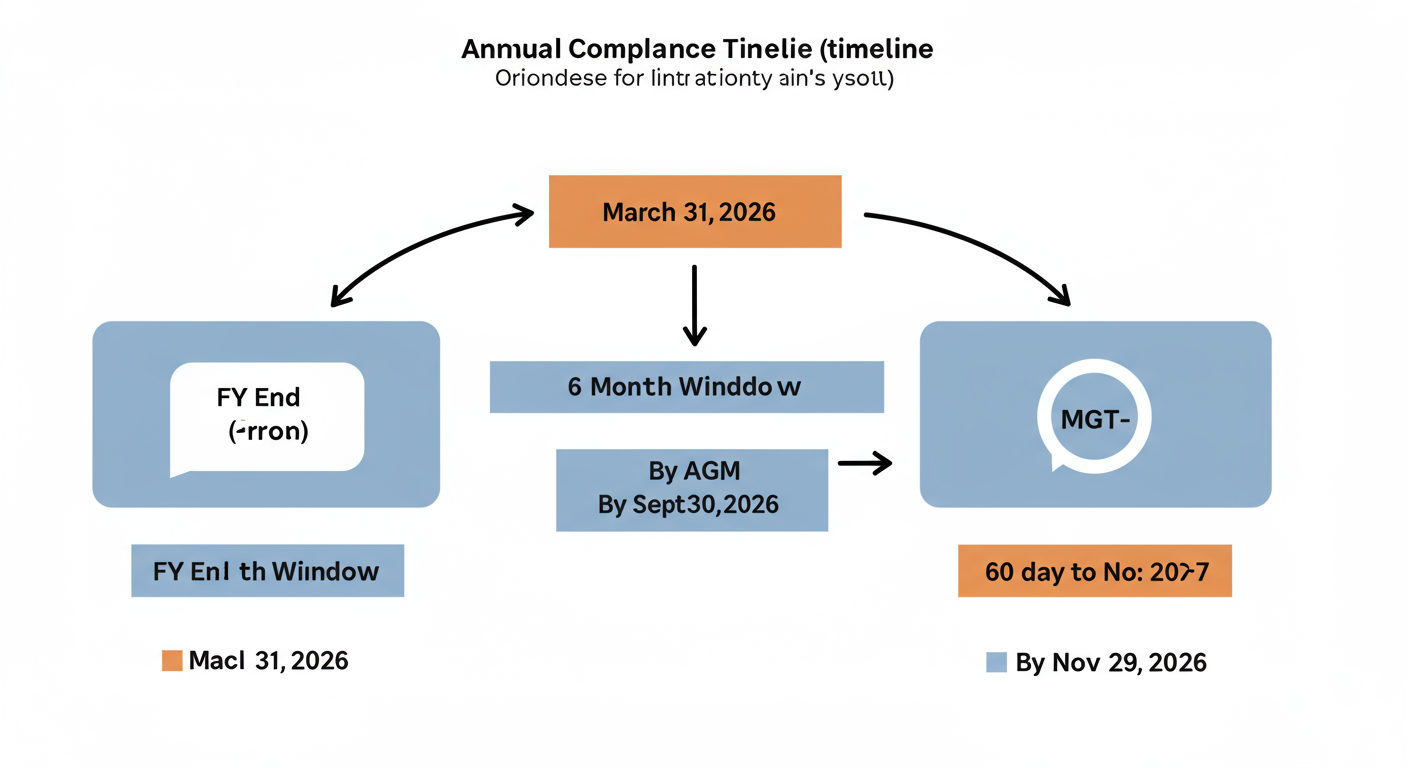
| Event | Statutory Deadline (for FY 2025-26) | Key Consideration |
|---|---|---|
| Financial Year End | March 31, 2026 | This is the closing date for the financial data you’ll report. |
| Hold Annual General Meeting (AGM) | On or before September 30, 2026 | The date you hold the AGM determines your MGT-7 due date. |
| File Form MGT-7 | Within 60 days of the AGM date | The absolute latest date is November 29, 2026 (if AGM is on Sep 30). |
💡 Pro Tip
Don’t wait until the last minute. We advise our clients to hold their AGM in early September. This builds a comfortable buffer for preparing and filing MGT-7, preventing a last-minute scramble that often leads to errors and late fees.
The High Stakes: What Happens When You Miss the Deadline?
Let’s be blunt. The Ministry of Corporate Affairs (MCA) is not forgiving about late annual returns. The penalties are designed to be painful, and they accumulate with frightening speed.
The law states that the company and every officer in default are liable for a penalty of ₹100 for each day the failure continues. There is no maximum cap on this penalty. It just keeps growing.
Think about that. It’s not a one-time fine. It’s a daily bleed.
Let’s say your company has two directors. If you delay filing by just 30 days, the calculation isn’t just ₹3,000. It’s:
- For the Company: 30 days x ₹100/day = ₹3,000
- For Director 1: 30 days x ₹100/day = ₹3,000
- For Director 2: 30 days x ₹100/day = ₹3,000
Total Penalty for a 30-day delay: ₹9,000. And it climbs every single day.
Beyond the Daily Fines: The Real Consequences
The financial drain is just the start. Based on our experience helping companies navigate compliance crises, the long-term damage is far worse.
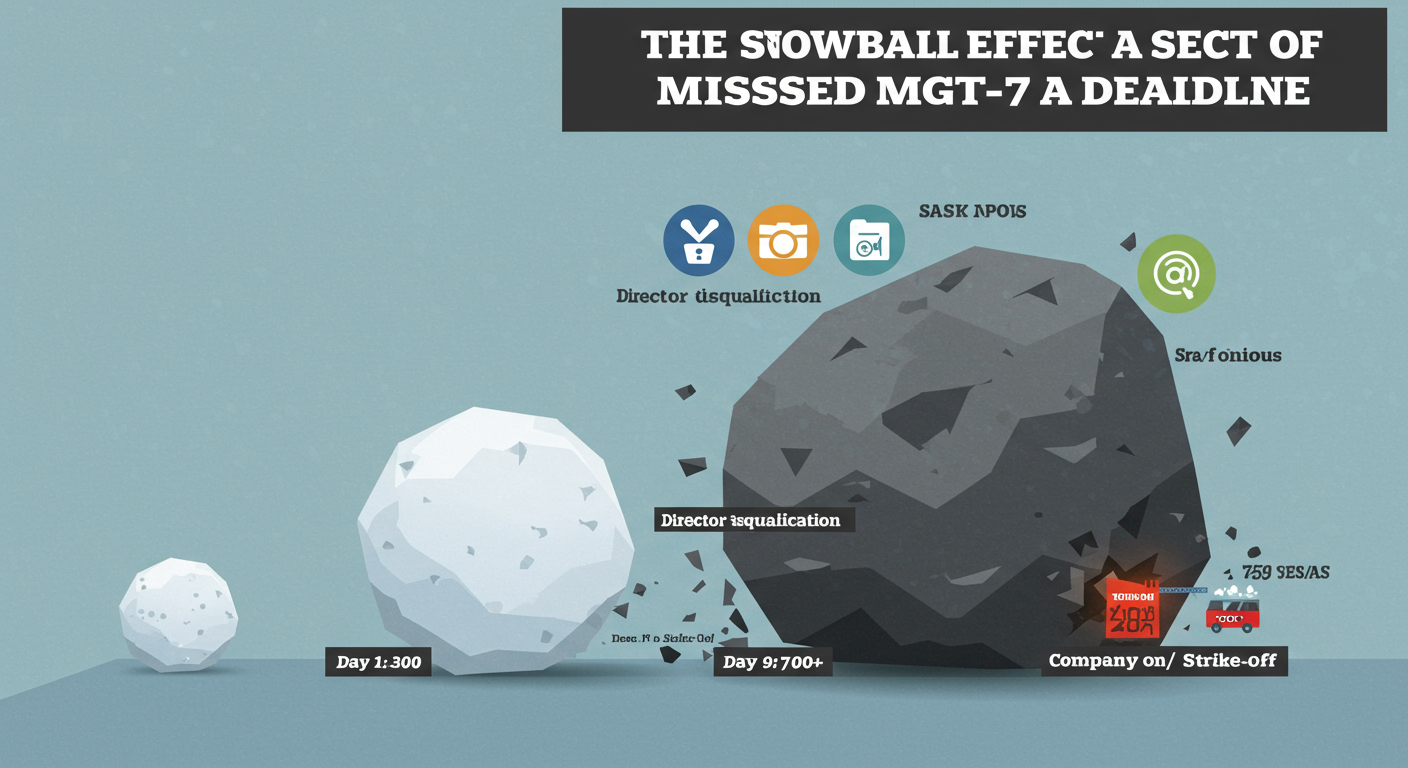
- Director Disqualification: Fail to file annual returns (or financial statements) for three consecutive years, and all directors of that company can be disqualified. This means they cannot be appointed as a director in any company for five years. It’s a career-killer.
- Company Strike-Off: Prolonged non-compliance signals to the ROC that your company might be defunct. They can initiate the process to strike its name from the Register of Companies. Getting your company’s status restored is a long, expensive, and uncertain legal battle.
- Reputational Suicide: Your company’s filing history is public on the MCA portal. Banks, investors, and potential clients check this. A record of non-compliance screams “unreliable” and can kill loan applications and partnership deals.
⚠️ Watch Out
The “officer in default” isn’t just a vague term. It includes directors, the Managing Director, the CEO, the CFO, and the Company Secretary. If you hold one of these titles, you are personally liable for the daily penalty. Ignorance is not a defense.
MGT-7 vs. MGT-7A: Which Form Is for You?
A common point of confusion is the difference between Form MGT-7 and Form MGT-7A. Filing the wrong one can lead to rejection and put you back at square one, dangerously close to the deadline.
The distinction is simple and was introduced to ease the compliance burden on smaller entities. Direct Tax Code 2026: A Guide to India's New Tax System
- Form MGT-7: This is the detailed, comprehensive annual return for all Private Limited and Public Limited Companies that do not qualify as a “Small Company.”
- Form MGT-7A: This is an abridged, simpler annual return for One Person Companies (OPCs) and Small Companies.
So, what’s a “Small Company”? According to the latest definitions, it’s a private company where: Unveiling the Budget 2026 Highlights: A Complete Guide to Tax Reforms and Economic Growth
- Paid-up share capital does not exceed ₹4 crore, AND
- Turnover does not exceed ₹40 crore.
If your company meets both these criteria, you can file the simpler MGT-7A. If you exceed even one, you must file the full MGT-7.
⚠️ Watch Out
Your company’s status as a “Small Company” can change year to year. If your turnover crossed the ₹40 crore threshold this year, you must switch from MGT-7A to MGT-7. Using the wrong form is a common and easily avoidable filing error.
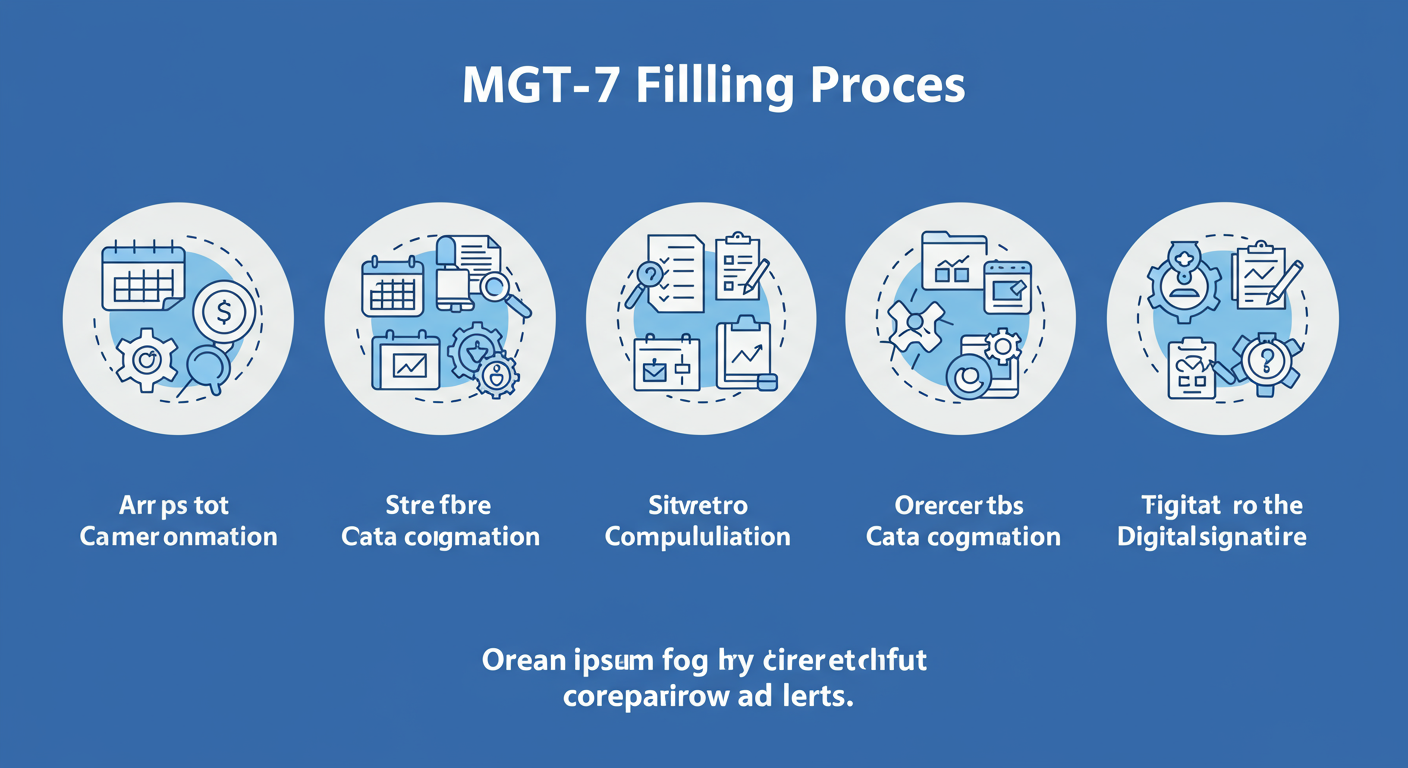
Your Foolproof 7-Step Guide to On-Time MGT-7 Filing
Panic is not a strategy. A structured process is. After guiding hundreds of companies through this, we’ve refined the process into these seven essential steps. Follow them, and you’ll file correctly and on time.
- Finalize Accounts & Hold Board Meeting: Well before your AGM, your accounts for FY 2025-26 must be finalized and audited. Then, hold a Board Meeting to formally approve the audited financial statements and the Board’s Report. In this meeting, you’ll also fix the date, time, and agenda for the AGM.
- Conduct the AGM: Hold your AGM on the decided date (no later than September 30, 2026). The key agenda item is the adoption of the annual accounts by the shareholders. The 60-day countdown for your MGT-7 filing starts now.
- Compile the MGT-7 Data Pack: This is the most time-consuming step. Don’t underestimate it. You need to gather a mountain of specific information:
- Details of share capital, debentures, and any changes during the year.
- A complete, up-to-date shareholding pattern.
- List of promoters, directors, and Key Managerial Personnel (KMP) with details of any appointments or resignations.
- Remuneration details for directors and KMP.
- Details of all board and committee meetings held during the year.
- Any penalties or compounding of offenses during the year.
- Draft and Prepare the e-Form: Download the latest MGT-7 (or MGT-7A) e-Form from the MCA portal. Carefully fill in all the compiled data. Accuracy is paramount.
- Attach Necessary Documents: The primary attachment is the list of shareholders, debenture holders, and other security holders. Ensure this is prepared in the correct format as an annexure.
- Digitally Sign and Pre-Scrutinize: The form must be digitally signed with a valid DSC. For most companies, it requires the signature of one director and a Company Secretary (CS). If your company doesn’t require a CS, a Company Secretary in Practice must sign it. Use the ‘Check Form’ and ‘Pre-scrutiny’ buttons to validate the data before final submission. This catches errors early.
- File, Pay, and Save Records: Log in to the MCA portal, upload the signed form, and pay the applicable statutory fees (which depend on your company’s share capital). Once payment is successful, an SRN (Service Request Number) is generated. Download the payment challan and the final filed form. Keep these safe as proof of compliance.
💡 Pro Tip
Create a “Compliance Master Sheet” in a shared document. List all the data points required for MGT-7 at the beginning of the financial year. Update it quarterly with any changes (like director changes or share transfers). This transforms Step 3 from a frantic data hunt into a simple copy-paste job.
🎯 Key Takeaway
The MGT-7 due date for FY 2025-26 is 60 days from your AGM, making the final deadline November 29, 2026. Missing it triggers a relentless daily penalty of ₹100 on the company and each defaulting officer, with severe long-term risks like director disqualification.
Can You Get an Extension on the MGT-7 Due Date?
This is a frequent question, and the answer is nuanced. No, you cannot directly apply to extend the 60-day filing period for Form MGT-7.
However, you can apply for an extension to hold your AGM. Since the MGT-7 deadline is tied to the AGM date, an AGM extension effectively pushes back the MGT-7 deadline as well.
A company can apply to the ROC for an extension to hold its AGM for up to three months. But trust me on this one, these extensions are not granted lightly. You need a “special reason” that is genuinely outside your control—for instance, a natural disaster affecting your registered office or the sudden incapacitation of key personnel. “We weren’t prepared” is not a valid reason and will be rejected.
| Action | Is it Possible? | Governing Rule | Practical Advice |
|---|---|---|---|
| Extend the MGT-7 Filing Period (60 days) | No | Section 92 of the Companies Act, 2013 | The 60-day window is non-negotiable. Do not plan on this. |
| Extend the AGM Deadline | Yes, for special reasons | Proviso to Section 96(1) of the Companies Act, 2013 | Apply well in advance with strong justification. Approval is not guaranteed. |
Conclusion: From Dreaded Deadline to Strategic Checkpoint
The MGT-7 due date doesn’t have to be a source of anxiety. By reframing it from a chore to a critical checkpoint in your corporate governance calendar, you can turn compliance into a strength.
Remember the key principles:
- Know Your Timeline: Your deadline is 60 days post-AGM, with November 29, 2026, as the final backstop for FY 2025-26.
- Respect the Penalties: The daily fines are real, personal, and relentless. The long-term consequences are even worse.
- Follow the Process: A systematic, step-by-step approach removes the risk of error and delay.
Your next step is simple. Mark your calendar for your target AGM date right now. Then, work backward and schedule time for data compilation and form preparation. Proactive compliance isn’t just about avoiding penalties; it’s about building a trustworthy, credible, and resilient business. Don’t leave it to chance.
❓ Frequently Asked Questions
What is the penalty for late filing of MGT-7 in 2026?
The penalty for late filing of Form MGT-7 remains ₹100 per day of delay. This is levied separately on the company and on each “officer in default” (like directors or the CEO), and it continues to accumulate without an upper limit until the form is filed.
Is a digital signature (DSC) mandatory for filing MGT-7?
Yes, a valid Class 2 or Class 3 Digital Signature Certificate (DSC) is absolutely mandatory. The form must be digitally signed by a director and a Company Secretary (CS). If the company is not required to appoint a CS, it must be signed by a Company Secretary in Practice.
What happens if I file MGT-7 with incorrect information?
If the ROC finds incorrect or incomplete information, they can mark the form for “Resubmission.” You’ll be given a short window to correct and re-upload the form. If the errors are significant or suggest willful misrepresentation, it can lead to penalties under Section 448 of the Companies Act for providing false statements.
Can a new company file MGT-7 in its first year?
A company must hold its first AGM within 9 months from the closing of its first financial year. The MGT-7 must then be filed within 60 days of that AGM. So yes, even a new company has to comply, though the timeline for its very first filing is slightly different. For more on general meetings, you can read the Wikipedia entry on AGMs.
Do I need to file MGT-7 if my company had no business activity?
Yes. Even a dormant or inactive company must file its annual return every year until it is officially struck off the Register of Companies. Failure to do so will still attract the same penalties. Filing a “Nil” return is still a mandatory compliance.