The One Mistake That Derails 50% of New Company Registrations
Imagine this. Your business plan is perfect. Your funding is secured. You’ve even bought the domain name and printed a test run of business cards. You submit your company name for registration with the Ministry of Corporate Affairs (MCA), expecting a quick approval. Days later, you get the email: REJECTED.
Suddenly, your launch timeline is in jeopardy. Frustration mounts. All because of a name.
This isn’t a rare scenario. In our experience handling hundreds of company incorporations, a poorly researched name is the single most common roadblock for aspiring founders. It’s a costly and demoralizing mistake. But it’s also completely avoidable.
This isn’t just another checklist. This is the definitive 2026 playbook for mastering the MCA company name search. You’ll learn the two-pronged search strategy that virtually guarantees first-attempt approval, how to decode the MCA’s cryptic rules, and the exact steps to take to secure your brand’s foundation, legally and permanently.
🎯 Key Takeaway
A successful company name approval isn’t just about checking the MCA portal. It’s a dual-front strategy: you must conduct a thorough MCA company name search AND a comprehensive trademark search. Skipping the second step is the most common and costly mistake founders make.
Why a 15-Minute Name Search Can Save You a Six-Figure Headache
Let’s be blunt. Treating the MCA name search as a mere formality is like building a skyscraper on a foundation of sand. It will eventually crumble, and the consequences are severe.
I’ve seen this play out firsthand. A promising tech startup, “Innovate AI,” had their name approved by the MCA. They launched, raised a seed round, and started gaining traction. Six months later, a cease-and-desist letter arrived. A larger, established software firm already held the trademark for “InnovateAI.” The result? A forced, expensive, and public rebranding that destroyed their early momentum.
A diligent search isn’t just about compliance; it’s about risk mitigation. Here’s what’s really at stake:
- Legal Survival: The Companies Act, 2013, is crystal clear. Your name cannot be identical or “undesirably similar” to an existing company or LLP. The Registrar of Companies (RoC) has the final say, and they don’t bend the rules.
- Brand Integrity: Your name is the hook upon which your entire brand hangs. A unique name prevents customer confusion and is the first step toward building valuable brand equity. A generic or copied name is a brand killer.
- Time & Money: A rejection means you’re back to square one. You lose the ₹1,000 filing fee and, more importantly, you lose weeks of precious time. In the startup world, that delay can be fatal.
- Trademark Protection: This is the big one. MCA approval does NOT grant you trademark rights. Only a separate trademark search and registration can protect you from infringement lawsuits that can cost you your entire business.
Before You Search: Decoding the MCA’s Naming Rules
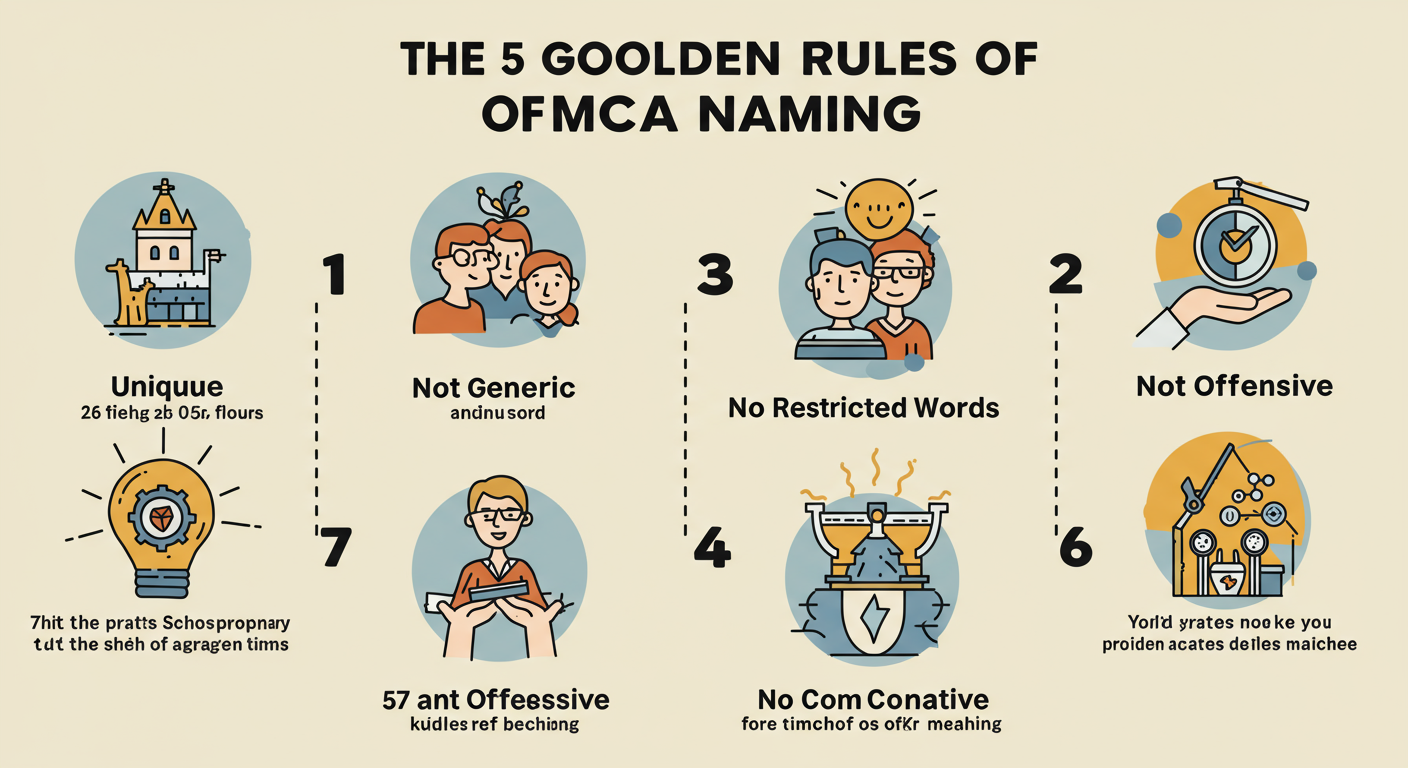
Before you even open the MCA portal, you need to think like the RoC. The government’s goal is to prevent public confusion. Your name must be distinct. According to Rule 8 of the Companies (Incorporation) Rules, 2014, your name is a non-starter if it’s:
- Phonetically Identical: “Brand New Ltd” and “Brand Nu Ltd” are the same in the eyes of the MCA. How it sounds matters more than how it’s spelled.
- Overly Generic: “Global Tech Solutions Pvt. Ltd.” is too vague and will likely be rejected. The name must have a distinctive component.
- Implying Patronage: Using words like ‘National’, ‘Union’, ‘Central’, ‘Prime Minister’, or any constitutional/government-related term is forbidden without explicit Central Government approval. Don’t even try it.
- Containing Restricted Words: Words like ‘Bank’, ‘Insurance’, ‘Stock Exchange’, or ‘Venture Capital’ require prior approval from regulatory bodies like RBI or SEBI.
- Offensive or Undesirable: This is subjective, but any name that is abusive or against public decorum will be rejected outright.
💡 Pro Tip
Brainstorm at least five names. Your first choice is rarely the one that gets approved. Think in terms of a “unique” component and a “descriptive” component. For example, in “Zerodha Broking,” ‘Zerodha’ is unique, and ‘Broking’ is descriptive. The RoC loves this structure.
To make this concrete, here’s a look at what passes and what fails.
| Proposed Name | Likely Verdict & Reason |
|---|---|
| Good: “Navi Technologies Pvt. Ltd.” | ✅ Approved. ‘Navi’ is a unique, coined word. ‘Technologies’ describes the business. Clear and distinct. |
| Bad: “Technology Solutions Pvt. Ltd.” | ❌ Rejected. Too generic and descriptive. Lacks a unique component to distinguish it from thousands of other firms. |
| Good: “Aetherium Logistics LLP” | ✅ Approved. ‘Aetherium’ is distinctive and memorable. Paired with the business activity, it’s a strong choice. |
| Bad: “4U Services Pvt. Ltd.” | ❌ Rejected. Phonetically similar to “For You Services.” The RoC’s system flags these sound-alike names. |
| Bad: “National Trading Company” | ❌ Rejected. Uses the word ‘National’ without government approval, implying state patronage. |
The Dual-Search Strategy: Your Step-by-Step Guide to Approval
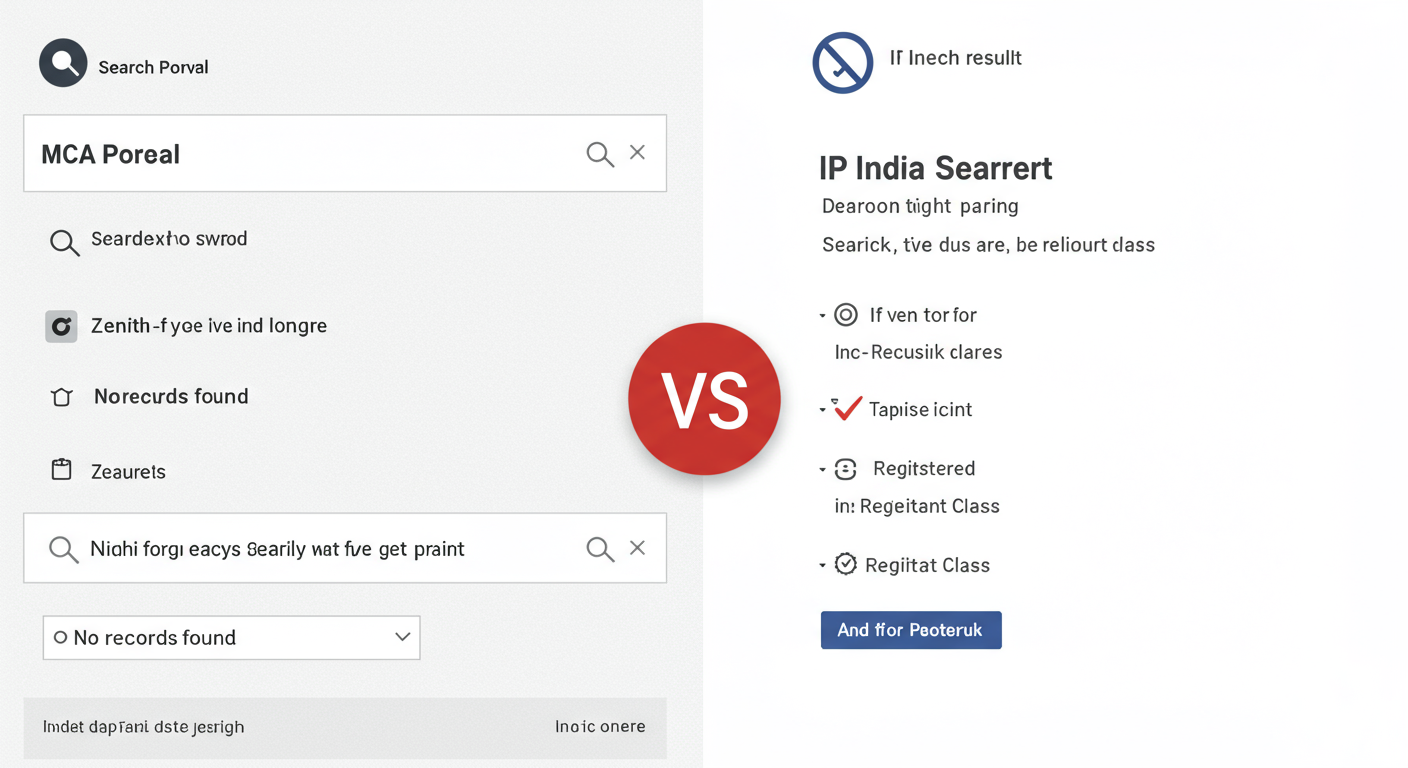
Ready to search? Don’t just go to the MCA website. That’s only half the job. A bulletproof name check involves two separate searches. Follow these steps precisely.
Step 1: The MCA Company Name Search (The Basics)
This is your initial screening to check for direct conflicts with existing company and LLP names.
- Go to the official Ministry of Corporate Affairs V3 portal: www.mca.gov.in.
- Log in with your credentials and navigate to ‘MCA Services’ > ‘Company e-Filing’ > ‘Company Services’.
- Select the ‘Check Company Name’ option.
- In the ‘Company/LLP Name’ field, type your core unique name. Do not add “Private Limited” or “LLP” yet.
- Enter your main business activity (e.g., “Software,” “Trading,” “Consulting”).
- Click ‘Search’.
How to Interpret the Results: If it says “No records found,” that’s a great first sign! But you’re not done. If it shows a list of similar names, analyze them carefully. Are they in the same industry? Do they sound alike? If it’s a close call, it’s safer to pick another name.
⚠️ Watch Out
The free MCA search tool is a good starting point, but it’s not foolproof. It primarily checks for exact and near-exact string matches. It can miss phonetic similarities that a human reviewing officer will catch. Never rely on this search alone.
Step 2: The Trademark Search (The Pro Move)
This is the step most founders skip, and it’s the one that leads to disaster. An MCA-approved name means nothing if it infringes on a registered trademark.
- Navigate to the IP India Public Search portal: ipindiaservices.gov.in/PublicSearch.
- For ‘Search Type’, select ‘Wordmark’.
- Enter your proposed name in the ‘Wordmark’ field.
- In the ‘Class’ field, enter the relevant class number for your goods or services. (You can find a list of trademark classes online; for example, Class 9 is for software, Class 35 is for business management/advertising). It’s best to search a few related classes.
- Hit ‘Search’.
How to Interpret the Results: Look for any names that are identical or “deceptively similar.” Pay close attention to the status: ‘Registered’ is a definite no-go. ‘Objected’ or ‘Opposed’ is also very risky. Even ‘Pending’ (‘Formalities Chk Pass/Fail’) means someone else is already in line for that name. If you see a conflict here, abandon the name, even if it was clear on the MCA portal.
From Search to Reservation: Filing SPICe+ Part A
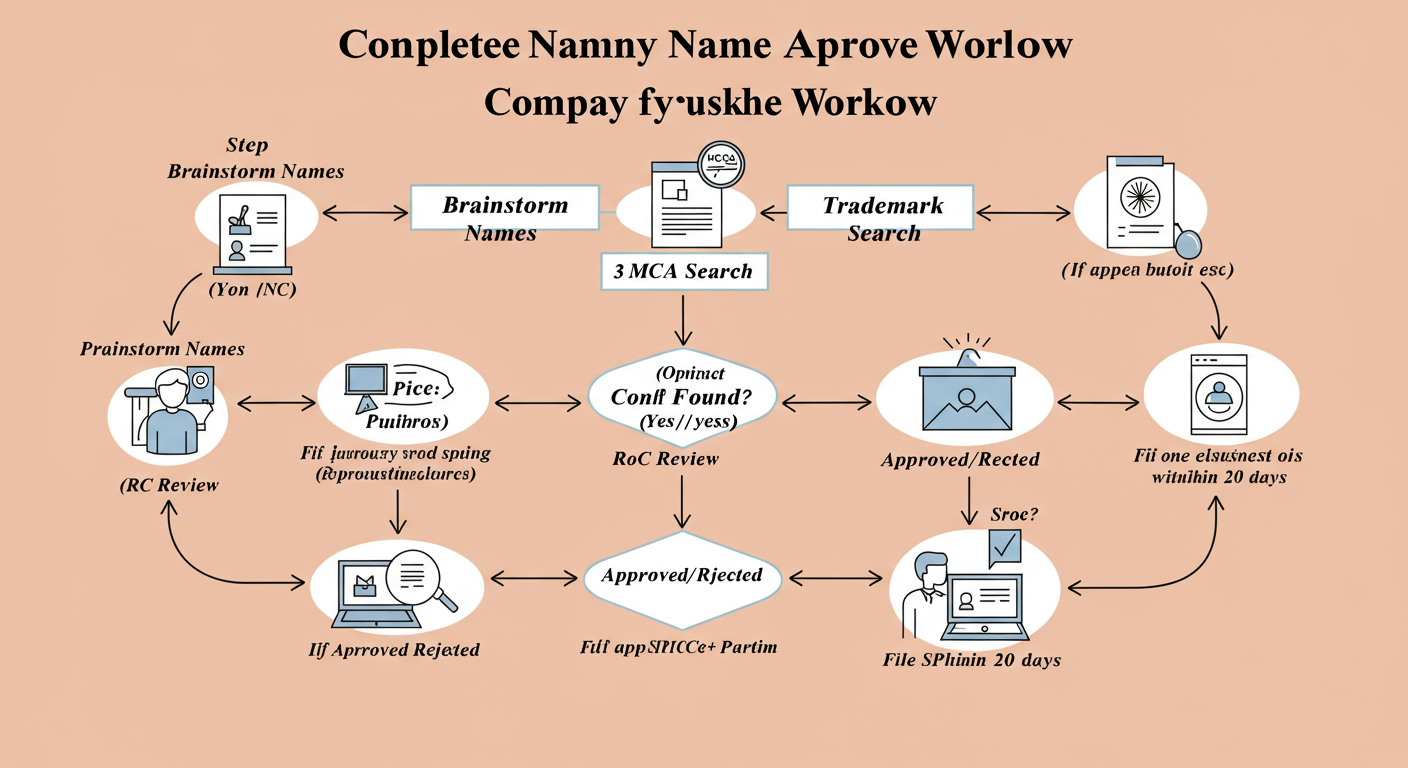
Once you have a name that has passed both the MCA and trademark checks, it’s time to reserve it officially.
For new companies, this is done via the SPICe+ Part A form on the MCA portal. This is an integrated web form for name reservation.
- Propose Two Names: The form allows you to submit two names in order of preference. Always use this feature! If your first choice is rejected for a reason you didn’t anticipate, the RoC will automatically consider your second choice without you having to re-file and pay again.
- Justify Your Name: You’ll need to provide an “objects” clause, briefly explaining what your company will do. Make sure this aligns with the name. If your name is “AquaFlow Plumbing,” your objects shouldn’t be about software development.
- Pay the Fee: The reservation fee is ₹1,000.
After submission, a Central Registration Centre (CRC) officer reviews your application. This usually takes 1-2 working days. If approved, your name is reserved exclusively for you for 20 days.
💡 Pro Tip
What if your ideal name is taken by a company that was “Struck Off”? Based on our hands-on testing, you can often get this name approved, but you may need to provide a justification. Explain that the previous company is defunct and there’s no risk of public confusion. It’s a judgment call by the RoC, but it’s worth a shot.
The 20-Day Countdown Clock
Once your name is approved, the clock starts ticking. You have exactly 20 days to file SPICe+ Part B and all other incorporation documents (like the e-MoA and e-AoA). If you miss this deadline, the name reservation lapses. It’s gone. You have to start the entire process over again, including paying the fee.
Why Names Get Rejected: Common Traps & How to Sidestep Them
We’ve analyzed hundreds of rejection orders. They almost always fall into a few predictable categories. Here are the most common traps and how to ensure you don’t fall into them.
⚠️ Watch Out
Using overly broad, generic words like ‘Enterprises’, ‘Products’, ‘Business’, ‘Ventures’, or ‘Global’ without a strong, unique prefix is a red flag for the RoC. They see these as attempts to create an overly broad and non-specific company identity, which they tend to reject.
| Common Rejection Reason | How to Fix It Before You File |
|---|---|
| “Name is considered identical…” | Your name is too close phonetically or in spelling to an existing one. Solution: Go back to brainstorming. Create a more distinct name. Don’t just change ‘Solutions’ to ‘Services’. |
| “Name is too general/vague…” | You used generic terms without a unique identifier (e.g., “Good Marketing Pvt. Ltd.”). Solution: Add a coined or unique word. “Zentrix Marketing Pvt. Ltd.” is much stronger. |
| “Significance and objects not justified…” | Your company’s proposed activities don’t match the name. Solution: Ensure your ‘objects’ clause clearly supports the name. If your name is “GreenLeaf Organics,” your objects must be about organic products, not IT consulting. |
| “Name includes a registered trademark…” | You skipped the trademark search. Solution: This is a fatal error. You must abandon the name and find a new one that is clear on both the MCA and trademark registries. |
Your Name Is Your First and Most Important Asset
Look, the MCA company name search isn’t just a box to tick. It’s the strategic act of laying the cornerstone for your entire brand. A rushed or incomplete search leads to rejections, delays, and potentially catastrophic legal battles down the road.
But by following the dual-search strategy—meticulously checking both the MCA portal and the trademark registry—you transform this process from a gamble into a calculated move. You’re not just seeking approval; you’re building a defensible, valuable, and legally sound brand from day one.
Don’t leave it to chance. Take the extra hour. Do the work. Secure your name, and you’ve already won your first major victory as a founder.
❓ Frequently Asked Questions
How long is an MCA name approval valid for in 2026?
Once the RoC approves your name via SPICe+ Part A, it is reserved for you for 20 days from the approval date. You must file the rest of your incorporation documents (Part B) within this window, or the name will be released.
What happens if my company name gets rejected?
If your name is rejected, the MCA will provide a brief reason. You can’t appeal this decision. You must start over by filing a new SPICe+ Part A application with two new name choices and paying the ₹1,000 fee again. This is why getting it right the first time is so critical.
Can I use a plural version of an existing name, like ‘Solutions’ instead of ‘Solution’?
Almost certainly not. The MCA’s rules are designed to prevent public confusion, and they consider plurals, different tenses, spacing, and minor spelling changes to be identical. ‘Excel Solution’ and ‘Xcel Solutions’ would both be flagged as conflicts.
Is it better to use the RUN service or SPICe+ Part A for name reservation?
For a brand-new company incorporation, you should always use SPICe+ Part A. It’s the integrated, modern method. The RUN (Reserve Unique Name) service is now primarily used for existing companies that want to change their name, or for reserving names for LLPs.
Do I really need a professional for this?
While you can do the initial research yourself, we strongly recommend engaging a professional (a CA, CS, or corporate lawyer) to file the official application. They understand the nuances and discretionary practices of the RoC officers, which dramatically increases your chances of a first-attempt approval and helps you avoid common pitfalls.