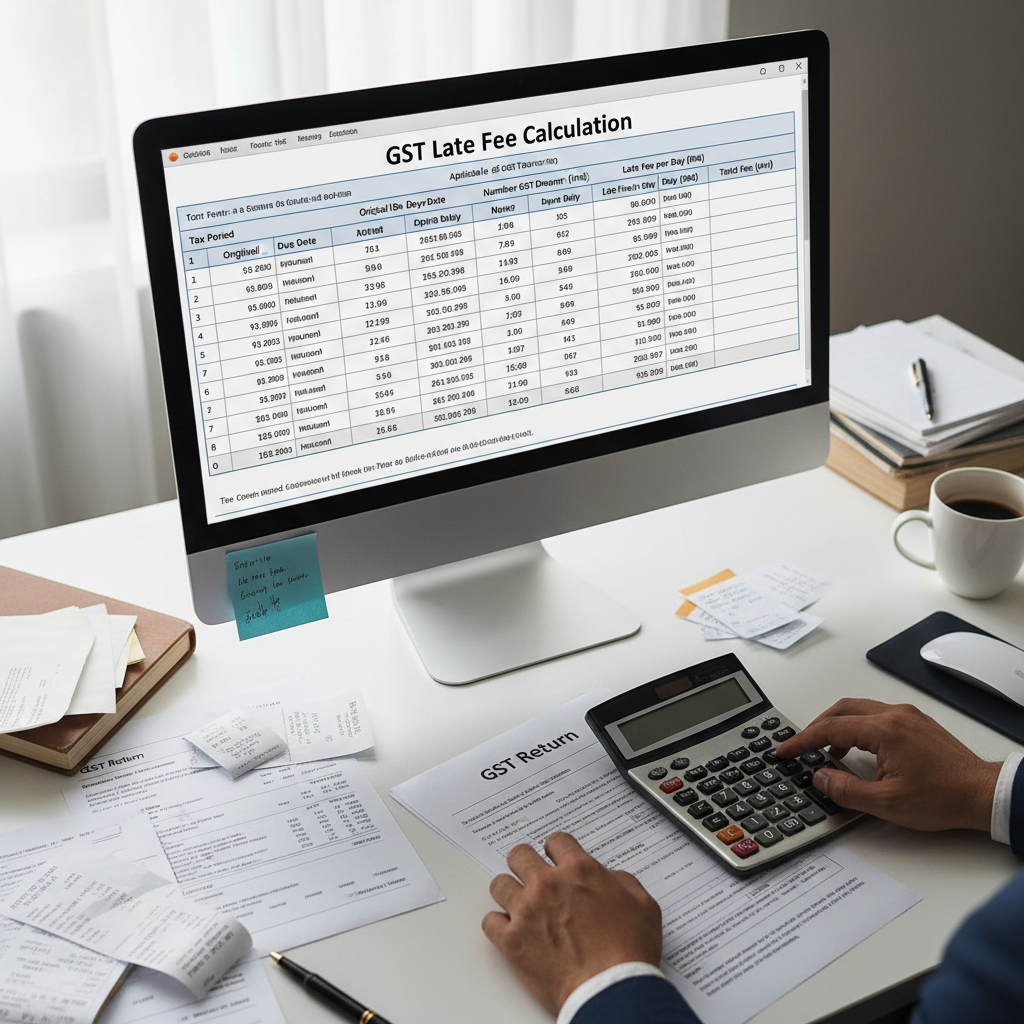
The Critical Importance of Timely GST Compliance
The Goods and Services Tax (GST) regime in India, while streamlining indirect taxation, places a significant emphasis on timely compliance. For businesses, adhering to the prescribed deadlines for filing returns like GSTR-3B and GSTR-1 is non-negotiable. Failing to meet these deadlines triggers a mandatory penalty known as the GST late fee calculation, which can significantly erode profit margins and increase operational overheads. Understanding precisely how this penalty is calculated, what the maximum caps are, and how different types of returns are treated is crucial for every registered taxpayer.
The late fee is not just a nominal charge; it is a daily accruing liability that continues until the date the actual return is filed. This guide provides a detailed, authoritative breakdown of the rules governing the GST late fee calculation, helping businesses navigate this complex aspect of tax compliance and implement effective strategies to avoid unnecessary costs.
Understanding the Mechanism of GST Late Fee Calculation
The late fee is levied under Section 47 of the CGST Act, 2017. It is applied when a registered taxpayer fails to furnish the details of outward supplies (GSTR-1) or the consolidated summary return (GSTR-3B) by the due date. The key factors influencing the penalty amount are the type of return and the taxpayer’s liability status (i.e., whether they have tax payable or Nil tax liability).
The Two Components of the GST Late Fee Calculation
The late fee structure is divided into Central Goods and Services Tax (CGST) and State Goods and Services Tax (SGST) components. The total daily fee is the sum of the fee levied under the CGST Act and the corresponding SGST Act.
CGST Late Fee
This fee is levied under the Central Goods and Services Tax Act. The amount collected goes to the Central Government.
SGST/UTGST Late Fee
This fee is levied under the respective State or Union Territory Goods and Services Tax Act. This amount goes to the relevant State or UT Government.
Total Daily Penalty
The total daily GST late fee is the sum of the CGST late fee and the SGST late fee. For example, if the statutory fee is ‘X’ per day, the total penalty is 2X per day.
Detailed Breakdown: GSTR-3B GST Late Fee Calculation
GSTR-3B is the most critical monthly return, summarizing supplies and input tax credit (ITC). The late fee calculation for GSTR-3B is heavily dependent on whether the taxpayer has any tax liability for the period.
Standard Statutory Rates for GSTR-3B
The standard rates, before considering any government relief notifications that often reduce the maximum caps, are as follows:
- If the taxpayer has a tax liability: Rs. 25 per day under CGST + Rs. 25 per day under SGST = Total Rs. 50 per day.
- If the taxpayer has Nil tax liability: Rs. 10 per day under CGST + Rs. 10 per day under SGST = Total Rs. 20 per day.
Example Calculation: Tax Liability Scenario
Imagine a business, “Tech Solutions Pvt. Ltd.,” had a GSTR-3B due date of July 20th. They had a tax liability of Rs. 50,000 for the month. They eventually filed the return on August 10th.
- Days of Delay: July 21st to August 10th = 21 days.
- Applicable Daily Fee: Rs. 50 (since there is tax liability).
- Total GST Late Fee Calculation: 21 days * Rs. 50/day = Rs. 1,050.
This amount must be paid electronically before the return can be submitted on the GST Portal.
Analyzing the Maximum Cap on GST Late Fee Calculation
While the late fee accrues daily, the government provides a maximum ceiling or ‘cap’ on the total penalty amount, which has been subject to frequent amendments and relief measures, especially during periods of economic distress. It is essential to refer to the latest notifications from the Central Board of Indirect Taxes and Customs (CBIC) or the GST Council for the current applicable caps.
As per recent standing notifications, the following caps generally apply to GSTR-3B for monthly filers (though these are subject to change based on turnover and specific relief packages):
Maximum Cap for Nil Liability Returns
For taxpayers who have no transactions or tax payable (Nil return), the maximum late fee is capped at Rs. 500 (Rs. 250 CGST + Rs. 250 SGST). This provides significant relief, ensuring that even a long delay does not result in an exorbitant penalty.
Standard Maximum Cap (Turnover > Rs. 5 Crore)
For large taxpayers (Annual Aggregate Turnover (AATO) exceeding Rs. 5 Crore) having tax liability, the maximum late fee is typically capped at Rs. 10,000 (Rs. 5,000 CGST + Rs. 5,000 SGST).
Reduced Maximum Caps (Small Taxpayers)
For smaller businesses (AATO up to Rs. 5 Crore) with tax liability, the cap is often reduced significantly, sometimes to Rs. 2,000 or Rs. 5,000, depending on the specific relief notification applicable at the time of filing. Always verify the latest applicable notification.
Understanding these caps is vital, as the daily accumulation stops once the total accumulated fee hits the prescribed maximum limit.
“Compliance is the bedrock of modern taxation. The GST late fee calculation mechanism is designed not just to penalize, but to encourage systemic regularity, ensuring the smooth flow of input tax credit across the supply chain.”
The Structure of GSTR-1 and GSTR-4 GST Late Fee Calculation
The penalty calculation also applies to other types of returns, primarily GSTR-1 (Statement of Outward Supplies) and GSTR-4 (Annual Return for Composition Dealers).
GSTR-1 Late Fee Calculation
GSTR-1 is crucial for recipients to claim their ITC. Failure to file GSTR-1 prevents the taxpayer from filing GSTR-3B. The late fee structure mirrors that of GSTR-3B, differentiating between Nil returns and returns with transactions.
- Daily Rate: Rs. 50 per day (Rs. 25 CGST + Rs. 25 SGST) if there are transactions.
- Daily Rate (Nil Return): Rs. 20 per day (Rs. 10 CGST + Rs. 10 SGST).
- Maximum Cap: Generally follows the same turnover-based caps as GSTR-3B, with the Nil return cap set at Rs. 500 and the standard cap often set at Rs. 10,000, subject to relief measures.
It is important to note that the late fee for GSTR-1 and GSTR-3B run concurrently. If both returns are delayed, the taxpayer must pay separate late fees for each return.
GSTR-4 Late Fee Calculation (Composition Scheme)
Taxpayers under the GST Composition Scheme file GSTR-4 annually (previously quarterly). The late fee for GSTR-4 is historically higher to emphasize compliance from this streamlined segment of taxpayers.
- Daily Rate: Rs. 50 per day (Rs. 25 CGST + Rs. 25 SGST). This rate applies regardless of whether the return is Nil or not.
- Maximum Cap: The maximum cap for GSTR-4 is often fixed at Rs. 10,000 (Rs. 5,000 CGST + Rs. 5,000 SGST).
Impact of Late Fees on Input Tax Credit (ITC)
The payment of the late fee is mandatory for filing the return. However, the late fee itself cannot be paid using the Input Tax Credit (ITC) balance available in the Electronic Credit Ledger. Late fees must be paid through the Electronic Cash Ledger, typically via an additional entry in the challan generation process (e.g., using PMT-06).
Furthermore, consistent delays can lead to the suspension of registration. If a taxpayer fails to file GSTR-3B for consecutive periods (the exact number varies based on turnover and return type), the GST authority may initiate cancellation proceedings, severely impacting the business’s ability to operate and issue valid tax invoices. For comprehensive guidance on ensuring smooth compliance, reading our detailed guide on GST Registration procedures is highly recommended.
Strategies for Minimizing and Avoiding GST Late Fees
Avoiding the GST late fee calculation is ultimately about meticulous planning and adopting automated systems. Proactive compliance not only saves money but also maintains a healthy compliance rating, which is increasingly important in the GST ecosystem.
One of the most effective ways to manage your compliance obligations is through timely and accurate GST Return Filing.
Automate Reminders
Implement calendar reminders or use accounting software that automatically alerts you several days before the GSTR-3B and GSTR-1 deadlines. Do not rely solely on email notifications from the GSTN.
Reconciliation is Key
Ensure your GSTR-2A/2B reconciliation is completed well before the 20th of the following month. This prevents last-minute scrambling for data which often leads to delays.
File Nil Returns Early
If you have a Nil liability, file the return immediately upon realizing this. The process is quick and eliminates the risk of accruing even the minimum Rs. 500 penalty.
Monitor Turnover Thresholds
Keep track of your Annual Aggregate Turnover (AATO). Changes in AATO might shift your filing frequency (e.g., from quarterly to monthly), which impacts deadlines and potential late fee exposure.
For businesses seeking absolute clarity on the latest amendments and notifications impacting late fees and caps, it is highly recommended to consult the official Central Board of Indirect Taxes and Customs (CBIC) website or the GST Portal regularly.
Consequences Beyond the Monetary Fine
While the monetary penalty from the GST late fee calculation is the most immediate consequence, repeated non-compliance carries deeper implications for the business ecosystem.
- Blocking of E-Way Bill Generation: If GSTR-3B returns are not filed for two consecutive tax periods, the taxpayer is blocked from generating E-Way Bills, effectively halting the movement of goods.
- Suspension and Cancellation of Registration: Failure to file returns for six consecutive months can lead to mandatory cancellation of GST registration.
- Impact on Credit Rating: Non-compliance flags can negatively affect your business’s reputation and creditworthiness, potentially hindering future loan applications or partnerships.
The GST framework is built on trust and timely reporting. Delays signal operational weaknesses and regulatory risk, making prompt filing not merely a legal requirement but a fundamental business practice. For detailed procedural guidelines and official communication regarding these matters, referring to the GST Council and Portal remains the authoritative source.
Conclusion
The intricacies of the GST late fee calculation emphasize the need for precision and promptness in tax compliance. Whether dealing with GSTR-3B, GSTR-1, or GSTR-4, the daily penalty accrues swiftly, capped only by government-mandated ceilings that vary based on turnover and liability status. By understanding the Rs. 50 per day (tax liability) and Rs. 20 per day (Nil liability) statutory rates, and by actively utilizing automation and reconciliation tools, businesses can effectively manage their GST compliance burden. Avoiding late fees is an active strategy that protects cash flow and ensures the seamless continuity of business operations under GST.
FAQs
The maximum cap for the GSTR-3B late fee varies based on the Annual Aggregate Turnover (AATO) and liability. For Nil returns, the cap is Rs. 500. For large taxpayers (AATO over Rs. 5 Crore) with tax liability, the cap is typically Rs. 10,000. Smaller taxpayers often benefit from reduced caps (e.g., Rs. 2,000 or Rs. 5,000), subject to specific relief notifications issued by the GST Council.
No. GST late fees are classified as ‘fees’ or ‘fines’ under the GST law, not tax liability. Therefore, they must be paid only through the Electronic Cash Ledger. You must deposit the required funds into your cash ledger (usually via net banking or UPI) before the system allows you to submit the delayed return.
Yes. The late fee is calculated separately for GSTR-1 and GSTR-3B. If you file GSTR-3B on time but delay GSTR-1 (the statement of outward supplies), you will still incur a late fee for GSTR-1 based on the number of delayed days and the applicable daily rate (Rs. 50/day or Rs. 20/day).
If you have a tax liability for the period, the standard daily penalty is Rs. 50 per day of delay (Rs. 25 under CGST and Rs. 25 under SGST). This daily accrual continues until the return is filed, up to the maximum prescribed cap for your turnover category.
Repeated failure to file GST returns leads to severe consequences beyond late fees. These include the blocking of your ability to generate E-Way Bills (after two consecutive missed GSTR-3B filings) and, eventually, the mandatory suspension and potential cancellation of your GST registration after six months of non-filing.
Read Also:
- The Ultimate GST Return Filing Guide: Essential Steps, Forms, and Compliance Checklist
- The Ultimate QRMP Scheme Filing Guide: Simplified GST Compliance for Small Businesses
- Comprehensive Form 27EQ Filing Guide 2024: TCS Return Basics and Due Dates
- The Comprehensive ROC Annual Filing Checklist: Mastering AOC-4, MGT-7, and Due Dates