That little calendar reminder pops up: “Pay Maharashtra Professional Tax.” Your stomach does a tiny flip. Is it for the company? Is it for me? Which portal do I use again? What was that weird login?
Look, nobody enjoys tax compliance. But for professionals and businesses in Maharashtra, it’s a non-negotiable part of the game. The good news? What used to be a bureaucratic nightmare of paper forms and long queues is now a streamlined digital process. You just need the right map.
This isn’t another dry, jargon-filled government circular. This is your definitive, battle-tested guide for 2026. We’ll walk you through every single step of the Maharashtra PT payment process, from figuring out *what* you owe to downloading that sweet, sweet payment receipt. By the end of this article, you’ll be able to handle your PT obligations confidently in under 10 minutes.
What is Maharashtra Professional Tax, Really?
Let’s demystify this. Professional Tax (PT) is a direct tax levied by the state government. Think of it as a license fee for practicing your profession or running your business within Maharashtra. It’s governed by the Maharashtra State Tax on Professions, Trades, Callings and Employments Act, 1975. The funds collected don’t just disappear into a black hole; they’re used by local municipal bodies to fund development and welfare schemes in your area.
So, who’s on the hook for it? The net is cast wide:
- Salaried Employees: If you earn a salary, your employer handles this for you. They deduct the PT from your monthly pay and remit it to the government.
- Professionals & Business Owners: This includes freelancers, doctors, lawyers, consultants, startup founders, and any business entity (sole proprietorship, partnership, company, etc.). You’re responsible for paying this yourself.
The entire system is managed by the Maharashtra Goods and Services Tax Department (MGSTD), and their online portal is where the magic happens.
PTEC vs. PTRC: Getting Your Registration Right is Crucial
Before you can even think about payment, you must understand which registration applies to you. Getting this wrong is one of the most common—and frustrating—mistakes we see. It’s the difference between a smooth process and a payment getting lost in the system.
There are two types of PT registration:
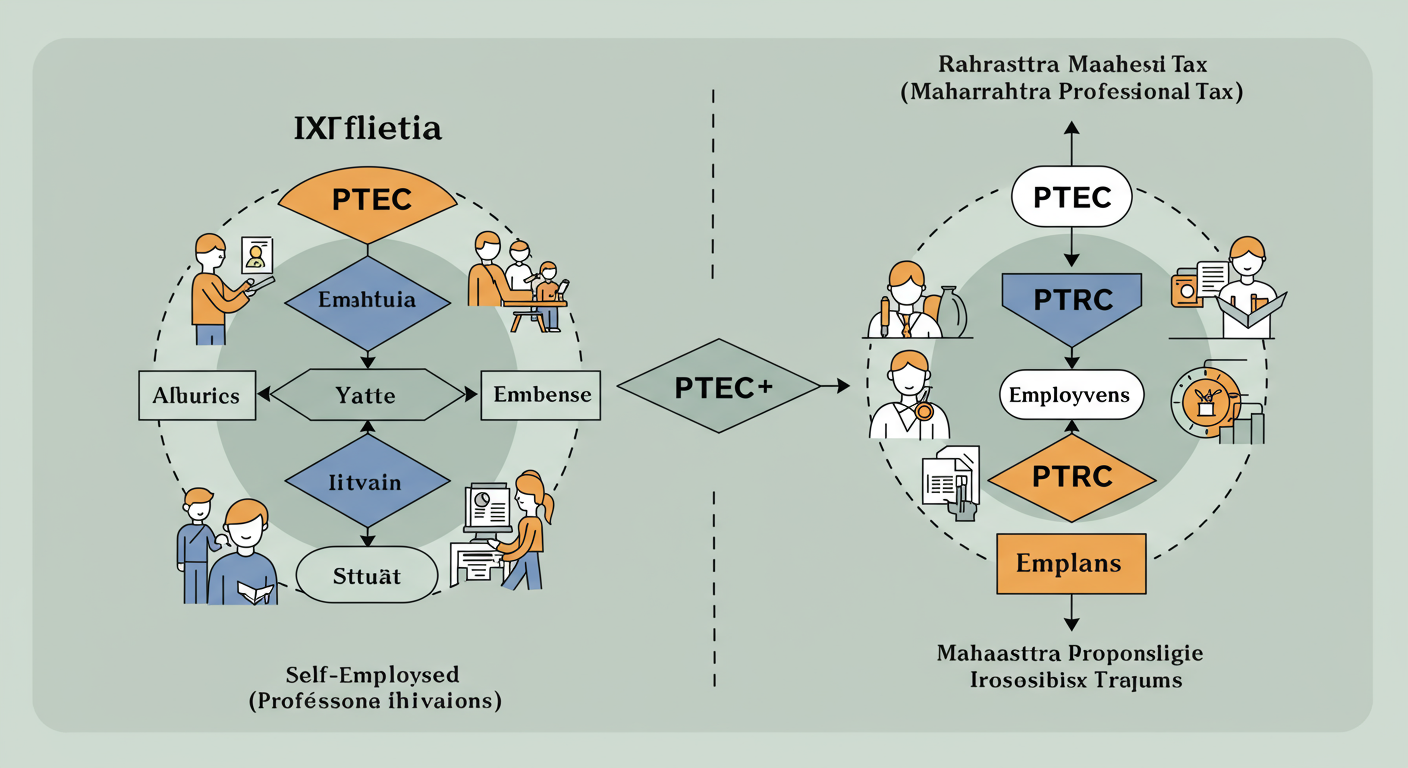
- PTEC (Professional Tax Enrollment Certificate): This is for the business entity itself or the self-employed professional. It’s an enrollment that makes you, the earner, liable to pay PT for practicing your profession.
- PTRC (Professional Tax Registration Certificate): This is for employers. If you have even one employee whose salary is in the taxable PT slab, you need a PTRC. This certificate makes you a collection agent for the government, responsible for deducting PT from your employees’ salaries and paying it.
Here’s a simple breakdown:
| Aspect | PTEC (Enrollment) | PTRC (Registration) |
|---|---|---|
| Who Needs It? | Self-employed individuals (freelancers, consultants, doctors) and all business entities (companies, LLPs, partnerships). | Employers responsible for deducting PT from their employees’ salaries. |
| Purpose | To pay tax for the privilege of practicing a profession in Maharashtra. | To authorize the employer to deduct and remit PT on behalf of employees. |
| Payment Frequency | Typically once a year. | Typically every month. |
| Due Date (for 2026-27) | June 30th, 2026 for the full financial year. | The last day of the month for which salary is paid (e.g., Jan 31 for Jan salary). |
| Common Scenario | A freelance graphic designer paying her annual professional tax. | A software company paying the collected PT for its 50 employees. |
⚠️ Watch Out
A company needs both a PTEC (for its own existence as a legal entity) and a PTRC (if it has employees). This is a frequent point of confusion. You’ll make two separate payments under two different registration numbers.
The 2026 Maharashtra PT Slabs: How Much Do You Owe?
For salaried individuals, the tax isn’t a flat rate. It’s based on your gross monthly income. The slabs are straightforward, but the calculation has one little quirk you need to know.
Here are the professional tax slabs applicable for the Financial Year 2026-27:
| Gross Monthly Salary (for Men & Women) | Monthly PT Deduction | Annual PT Liability |
|---|---|---|
| Up to ₹7,500 | ₹0 | ₹0 |
| ₹7,501 to ₹10,000 | ₹175 | ₹2,100 |
| Above ₹10,000 | ₹200 for 11 months + ₹300 in February | ₹2,500 |
That’s right. For anyone earning over ₹10,000 a month, the total annual tax is capped at ₹2,500. This is collected as ₹200 per month from March to January, with a final ₹300 deduction in February to round out the total. Forgetting this February adjustment is a common payroll error.
For PTEC holders (self-employed and businesses), it’s even simpler: a flat ₹2,500 per year, due by June 30th.
🎯 Key Takeaway
Your liability is either PTEC (for yourself/your business, paid annually) or PTRC (for your employees, paid monthly). For most earners, the total annual PT is ₹2,500. Knowing which applies to you is the first and most important step.
Your Step-by-Step Guide to Online Maharashtra PT Payment in 2026
Alright, let’s get to the main event. You’ve identified your registration type and know the amount. Now, let’s pay the tax. Based on our hands-on testing, this process should take less than 10 minutes once you’re familiar with it.
Bookmark this guide. You’ll thank yourself later.
-
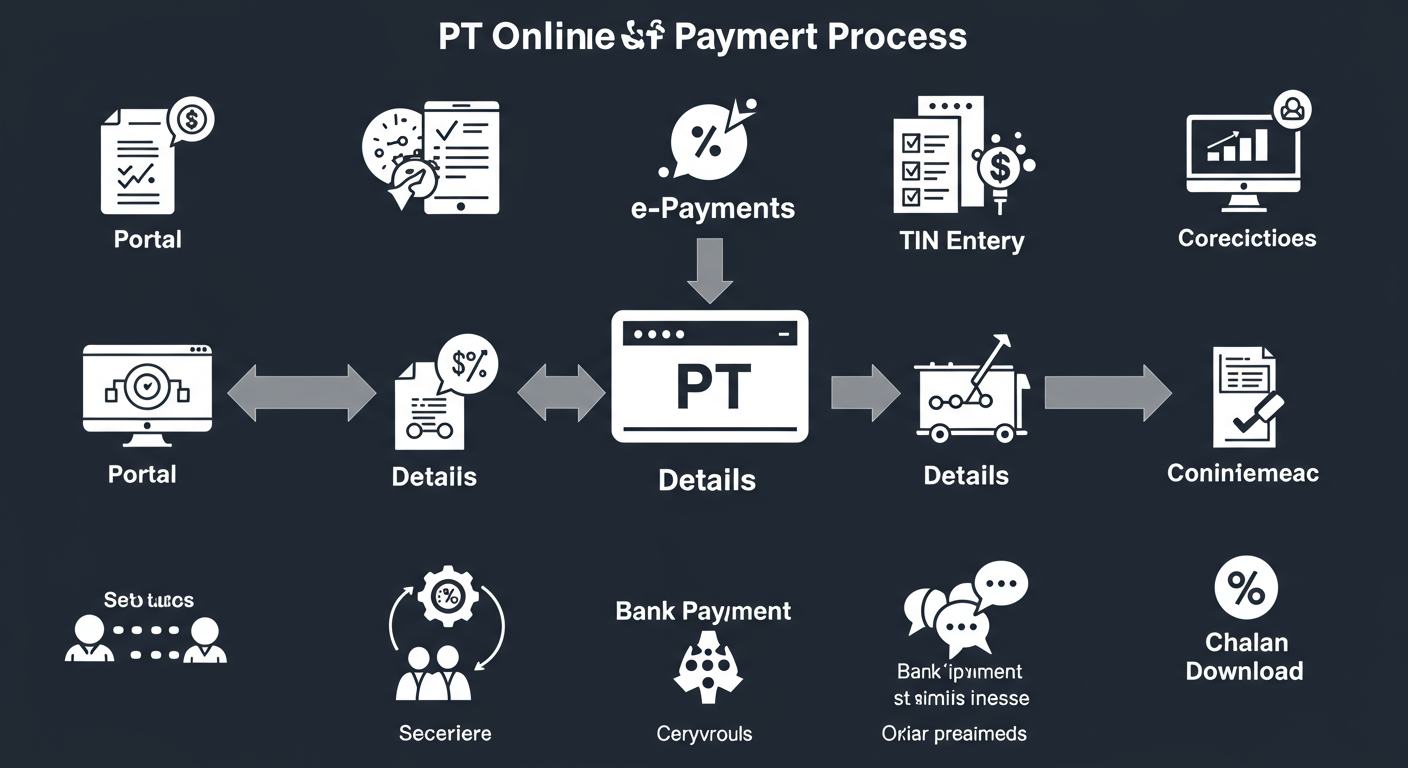
Go to the MGSTD Portal
Open your browser and navigate to the official MGSTD website: www.mahagst.gov.in. Avoid any third-party sites that offer to do this for a fee; the official portal is secure and free to use. -
Find ‘e-Payments’
On the homepage, hover over the “e-Services” tab. A dropdown menu will appear. Click on “e-Payments” and then select “Payment for various Acts”. -
Select Tax Type and Enter TIN
This is a critical step. On the payment form:- Under “Tax / Act”, select PTEC or PTRC from the dropdown. Double-check you’ve chosen the right one!
- Enter your 11-digit TIN (Taxpayer Identification Number) without any spaces or special characters. This is your unique registration number.
-
Fill in Payment Details
Now, you’ll specify what you’re paying for:- Financial Year: Select the correct year (e.g., 2026-2027).
- Period: For PTRC, select the month (e.g., April 2026). For PTEC, you’ll typically select the full year.
- Amount: Enter the exact tax amount. For PTRC, this is the total PT deducted from all employees for that month.
- Mobile & Email: Enter your contact details to receive payment confirmation.
-
Proceed to GRAS for Payment
After clicking “Proceed”, you’ll be redirected to the Government Receipt Accounting System (GRAS) portal. This is the secure payment gateway for the Maharashtra government. Verify that all your details (Name, TIN, Amount) are correct on this screen. -
Choose Payment Method and Pay
Select your payment mode (Internet Banking or Debit/Credit Card) and your bank. Follow the on-screen instructions from your bank’s secure gateway to complete the transaction, usually involving an OTP. -
Download and Save Your Challan!
Success! Once the payment is complete, an e-challan will be generated. It will have a CIN (Challan Identification Number) and BRN (Bank Reference Number). This is your proof of payment. Download it immediately as a PDF and save it in a dedicated “Tax Compliance 2026” folder. Trust me on this one.
💡 Pro Tip
Create a dedicated browser profile in Chrome or Firefox just for tax payments. Save the MGSTD and GRAS portal links as bookmarks. This keeps your logins separate and streamlines the process each month or year, reducing the chance of errors.
Deadlines, Penalties, and How to Avoid Them
Paying the right amount is only half the battle; paying it on time is the other half. The penalties for late payment can be frustratingly high, so it pays to be punctual.
“In our experience helping hundreds of small businesses, missed PT deadlines are the most common source of compliance notices. They are completely avoidable.”
Here’s a quick reference for due dates and penalties:
| Registration Type | Due Date for Payment | Penalty for Late Payment |
|---|---|---|
| PTRC (Employer) | Last day of the month for which salary is paid. | Interest at 1.25% per month of delay, plus a potential penalty of 10% of the tax due. |
| PTEC (Self-Employed/Business) | June 30th of the financial year (e.g., June 30, 2026, for FY 2026-27). | Same as above: Interest at 1.25% per month plus a potential 10% penalty. |
⚠️ Watch Out
The penalty clock starts ticking the very next day after the due date. There’s no grace period. A one-day delay in a PTRC payment can trigger a full month’s interest calculation. Set recurring calendar alerts for the 25th of each month to be safe.
Beyond the Payment: Filing Returns and Record-Keeping
Making the payment is a huge step, but it’s not the final one. You also have a responsibility to file a “return”.
A return is basically a formal declaration to the tax department summarizing the payments you’ve made. For employers (PTRC holders), this is typically done by filing Form III-B on the MGSTD portal. The due date for the return is the same as the payment due date: the last day of the month.
This is where saving your payment challans becomes critical. You’ll need the details from the challan (like the CIN and date) to file your return accurately. From real-world campaigns, we know that organized record-keeping is the single biggest factor in stress-free tax compliance.
💡 Pro Tip
Use a cloud storage service like Google Drive or Dropbox. Create a folder for each financial year (e.g., “FY 2026-27”). Inside, create subfolders for “PTEC” and “PTRC”. Save every single payment challan and filed return PDF with a clear file name, like “PTRC_Challan_Apr_2026.pdf”. This digital paper trail is invaluable during audits.
❓ Frequently Asked Questions
Who is exempt from paying Professional Tax in Maharashtra?
Several individuals are exempt. This includes senior citizens (above 65 years), members of the armed forces, and parents or guardians of a child with a significant physical or mental disability. Always check the latest regulations on the MGSTD website for the full list.
What’s the difference between PTEC and PTRC again, in simple terms?
Think of it this way: PTEC is the tax you pay for being a professional or a business. PTRC is the system you use to pay the tax for your employees that you’ve collected from their salary. A company needs both if it has staff.
Can I make a Maharashtra PT payment offline?
While the online method via the MGSTD and GRAS portal is strongly recommended for its speed and instant proof, it is sometimes possible to pay at designated bank branches using a pre-filled challan. However, the online process is far more efficient and less prone to error.
Help! I paid the wrong amount. What do I do?
If you underpaid, simply make another payment for the shortfall amount as soon as possible, using the same period details. If you overpaid, it’s more complex. You may be able to adjust the excess in a future payment or apply for a refund, but this requires navigating a specific process. It’s always better to double-check the amount before hitting ‘pay’.
Is there a PT liability for a dormant company with no employees?
Yes. As long as the company is incorporated and holds a PTEC, it is liable to pay the annual professional tax of ₹2,500, even if it has zero revenue or activity. The liability is for the company’s legal existence and ability to conduct a profession or trade.
Conclusion: Take Control of Your Tax Compliance
Navigating the Maharashtra PT payment system doesn’t have to be a source of anxiety. By breaking it down into simple, manageable steps, you can transform it from a dreaded chore into a routine task.
Let’s recap the winning formula:
- Identify: Know whether you’re dealing with PTEC (for you/your business) or PTRC (for employees).
- Calculate: Use the correct 2026 slabs to determine the exact amount due.
- Execute: Follow the step-by-step online payment guide to pay on time.
- Document: Save every payment challan and file your returns promptly.
By embracing the digital tools provided and staying organized, you’re not just paying a tax—you’re building a foundation of solid financial discipline for your professional career or business. Now, go set those calendar reminders and handle your PT payment with confidence.