Why Choose an LLP? Understanding the Appeal of Limited Liability Partnerships
For modern entrepreneurs seeking the flexibility of a partnership combined with the security of limited liability, the Limited Liability Partnership (LLP) structure is often the ideal choice. An LLP is a body corporate and a legal entity separate from its partners, offering significant advantages over traditional partnerships.
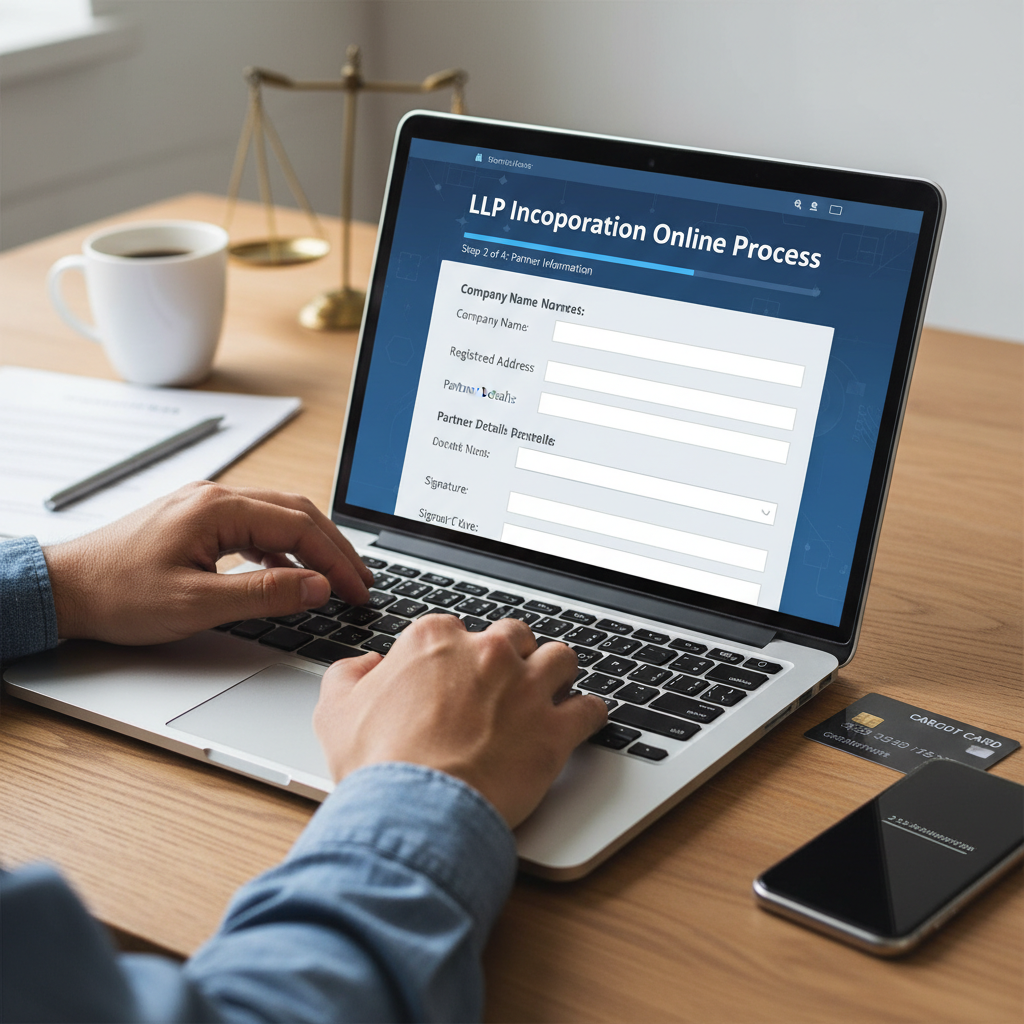
The entire procedure, thanks to digitalization efforts by the Ministry of Corporate Affairs (MCA), has been condensed and streamlined. Understanding the intricacies of the LLP incorporation online process is crucial for ensuring a quick and compliant setup.
The journey of establishing a robust business entity begins with meticulous planning and precise execution of statutory requirements. Below we break down exactly how you can navigate the modern digital filing system to register your LLP efficiently.
Corporate Shield
Partners are protected from the liabilities arising from the misconduct or negligence of other partners. Personal assets are typically safe from business debts.
Ease of Compliance
Compared to a Private Limited Company, an LLP generally faces fewer statutory compliance burdens, especially regarding board meetings and complex filings.
No Minimum Capital
Unlike some other corporate structures, there is no requirement for a minimum capital contribution to start an LLP, making it highly accessible for startups.
Flexibility
The internal structure and operational dynamics are governed by the LLP Agreement, allowing partners great flexibility in defining roles, rights, and profit sharing.
Essential Prerequisites for the LLP incorporation online process
Before initiating the formal application, certain basic requirements must be met by the prospective partners. These foundational steps ensure that you are ready for the digital filing phase.
Digital Signature Certificate (DSC)
Since the entire LLP incorporation online process is paperless, all documents must be digitally signed. Every designated partner who will be signing the forms (RUN-LLP and FiLLiP) must possess a Class 3 Digital Signature Certificate (DSC).
Designated Partner Identification Number (DPIN)
Every designated partner must have a DPIN, which is essentially a unique identification number issued by the MCA. If an individual already holds a Director Identification Number (DIN) from a previous company incorporation, this same number can be used as the DPIN for the LLP.
- An LLP must have a minimum of two partners.
- At least two designated partners must be individuals, and at least one of them must be an Indian resident.
Step-by-Step Guide to the LLP incorporation online process
The registration process is managed through the official portal of the Ministry of Corporate Affairs (MCA). Following these steps sequentially is critical for successful registration:
- Obtaining DSC and DPIN: Ensure all designated partners have their DSCs ready. DPINs can be applied for simultaneously within the incorporation form itself (FiLLiP), provided they do not already possess one.
- Name Reservation (RUN-LLP): The first official step is reserving a name for your LLP. This is done by filing the Reserve Unique Name – LLP (RUN-LLP) form. You can propose up to two names, listed in order of preference. The name must be unique and not identical or too similar to an existing company, LLP, or registered trademark.
- Filing the Incorporation Form (FiLLiP): Once the name is approved (which is usually valid for 90 days), the primary incorporation form, known as Form for Incorporation of Limited Liability Partnership (FiLLiP), must be filed. This form combines the application for DPIN (if needed) and the application for incorporation.
- Document Upload and Fee Payment: All necessary documents (subscriber sheets, address proofs, etc.) are attached to the FiLLiP form. The statutory fees, which vary based on the capital contribution, are paid online.
- Certificate of Incorporation: Upon successful scrutiny by the Registrar of Companies (RoC), the Certificate of Incorporation is issued electronically. The LLP is now officially registered.
For a detailed breakdown of what the process entails, particularly the initial stages of getting certified, you might want to review resources dedicated to the formal LLP Formation process.
Detailed Document Checklist for successful LLP incorporation online process
The success of the digital filing hinges on the accuracy and completeness of the documents submitted with the FiLLiP form. Any discrepancies can lead to rejection or significant delays.
Documents Required from Designated Partners
- Proof of Identity (PAN Card is mandatory for Indian nationals).
- Proof of Address (Voter ID, Passport, Driver’s License, or Aadhaar Card).
- Passport-size photographs.
- Consent to act as a Designated Partner (usually attached as an affidavit).
Documents Required for Registered Office
- Proof of address of the registered office (e.g., utility bill like electricity, telephone, gas, not older than two months).
- No Objection Certificate (NOC) from the owner of the premises.
- Lease agreement, if the premises are rented.
Partner Documentation Checklist
Ensure all ID proofs are self-attested and notarized/apostilled if the partner resides outside India. The PAN card acts as the primary identity verification.
Address Proof Nuances
Utility bills must be recent (typically within 60 days of the filing date). If the registered office is residential, clear consent from the owner is essential.
Filing the LLP Agreement (Form 3) and Post-Incorporation Steps
Receiving the Certificate of Incorporation is a major milestone, but the legal framework is incomplete without the LLP Agreement. This is the constitutional document that defines the mutual rights and duties of the partners and the duties of the LLP.
The Importance of Form 3
Within 30 days of receiving the Certificate of Incorporation, Form 3 (Information concerning the LLP Agreement and changes, if any) must be filed with the RoC. Failure to file this crucial form within the stipulated timeframe attracts significant penalties.
A well-drafted LLP Agreement should clearly specify:
- Name and business of the LLP.
- Contribution of each partner.
- Profit-sharing ratio.
- Rules for admission, retirement, and cessation of partners.
- Procedure for dispute resolution.
As noted by legal experts, "The LLP Agreement is the bedrock of the partnership, dictating its internal governance and preventing future conflicts." For authoritative guidance on the legal standing and requirements for LLPs, consulting the official Ministry of Corporate Affairs regulations is recommended. The LLP Act, 2008, outlines the framework for all operational and compliance aspects.
Navigating the Final Steps of the LLP incorporation online process
Once the incorporation is complete and the LLP Agreement is filed, the entity must fulfill subsequent regulatory requirements to become fully operational.
1. Obtaining PAN and TAN
After receiving the Certificate of Incorporation, the LLP must apply for a Permanent Account Number (PAN) and Tax Deduction and Collection Account Number (TAN). This is mandatory for all financial transactions and tax compliance. These applications are usually done offline or through separate online portals managed by the Income Tax Department.
2. Opening a Bank Account
Using the Certificate of Incorporation, the LLP Agreement, and the PAN card, a current bank account must be opened in the name of the LLP. This separates the entity’s finances from those of its partners, upholding the principle of limited liability.
3. Statutory Registrations
Depending on the nature of the business and turnover, the LLP may require further registrations, such as GST registration. If the LLP deals with specific goods or services, it might also need sector-specific licenses or registrations, such as MSME certification or import/export code (IEC).
Understanding these subsequent steps is just as important as the initial filing. For businesses dealing with regular tax deductions, understanding compliance requirements like TDS Challan Verification steps is essential for maintaining good standing with the tax authorities.
Fees and Compliance Costs for LLP incorporation online process
The costs associated with LLP registration can be broadly divided into two categories: statutory fees payable to the MCA and professional consultation fees.
MCA Statutory Fees Structure
The fees payable to the Registrar depend primarily on the amount of monetary contribution by the partners (the total capital). The fees cover the name reservation (RUN-LLP) and the incorporation filing (FiLLiP).
Contribution up to ₹1 Lakh
This falls under the lowest slab, incurring the minimum statutory filing fees. This is common for service-based LLPs starting with minimal capital.
Contribution over ₹5 Lakhs
As the contribution increases, the statutory filing fee increases incrementally, reflecting the size and scope of the proposed partnership.
Name Reservation Fee
A fixed fee is charged for filing the RUN-LLP form, regardless of the capital contribution. This fee is non-refundable even if the name is rejected.
It is important to budget for professional fees as well. Engaging a Chartered Accountant or Company Secretary to handle the entire LLP incorporation online process ensures accuracy, minimizes rejections, and guarantees timely filing of complex forms like FiLLiP and Form 3. While the exact professional fees vary widely, the investment ensures compliance from day one.
For the most current schedule of fees and detailed regulations regarding filing requirements, entrepreneurs should always refer to the official government notifications. A useful resource detailing various business structures and their liabilities can be found on reputable business education platforms. Understanding Limited Liability Partnerships further clarifies the liability structure.
Conclusion
The LLP incorporation online process is designed to be efficient and user-friendly, provided the applicant possesses the necessary documentation and follows the procedural hierarchy correctly. By securing the required Digital Signature Certificates, reserving a unique name, diligently filing the FiLLiP form, and crucially, executing the LLP Agreement (Form 3) within the prescribed 30 days, entrepreneurs can quickly establish a legally compliant and professionally recognized business structure. This foundational stability allows partners to focus on growth, leveraging the advantages of limited liability and operational flexibility that the LLP model provides.
FAQs
An LLP must have a minimum of two partners. There is no maximum limit on the number of partners. It is also mandatory that at least two designated partners are individuals, and one of them must be a resident of India.
Yes, filing the LLP Agreement in Form 3 is absolutely mandatory. It must be filed within 30 days of the date of incorporation (the date mentioned on the Certificate of Incorporation). Failure to do so attracts substantial penalties from the MCA.
Yes, a foreign national can be a designated partner. However, it is mandatory that at least one designated partner is a resident of India. The foreign designated partner must obtain a DPIN, and their identity and address proofs must be apostilled or notarized by the Indian embassy or a notary in their country.
If all documents are in order and the name approval is quick, the entire process—from name application to receiving the Certificate of Incorporation—typically takes between 10 to 15 working days. Delays often occur due to name rejections or errors in the FiLLiP form documentation.
No, the LLP Act, 2008, does not prescribe a minimum capital contribution. Partners can decide on any amount of capital contribution they deem fit for starting the business, making the structure very accessible for small enterprises and startups.