Let’s be honest: nobody likes paying taxes. But paying tax twice on the same money? That’s a nightmare scenario for any business owner. Yet, that is exactly what happens if you don’t have a solid grip on Input Tax Credit GST.
In my two decades of advising businesses—from scrappy startups to established manufacturers—I’ve seen the same story play out repeatedly. A business focuses entirely on sales growth but bleeds cash silently because their purchase invoices aren’t reconciled, or they missed a critical deadline. They treat GST as just another compliance headache rather than what it actually is: a massive opportunity to protect your working capital.
The Goods and Services Tax (GST) was pitched as a seamless flow of credit. Ideally, it prevents the cascading effect of taxes (tax on tax). But the reality? The path to claiming Input Tax Credit GST is a minefield of Section 16 conditions, Section 17(5) blocked lists, and strict timelines that wait for no one.
In this guide, I’m not just going to quote the law at you. We are going to break down exactly how to claim every rupee you are owed, avoid the traps that trigger tax notices, and handle the 2025 updates that have tightened the noose on non-compliant vendors.
What Is Input Tax Credit GST (And Why Should You Care)?
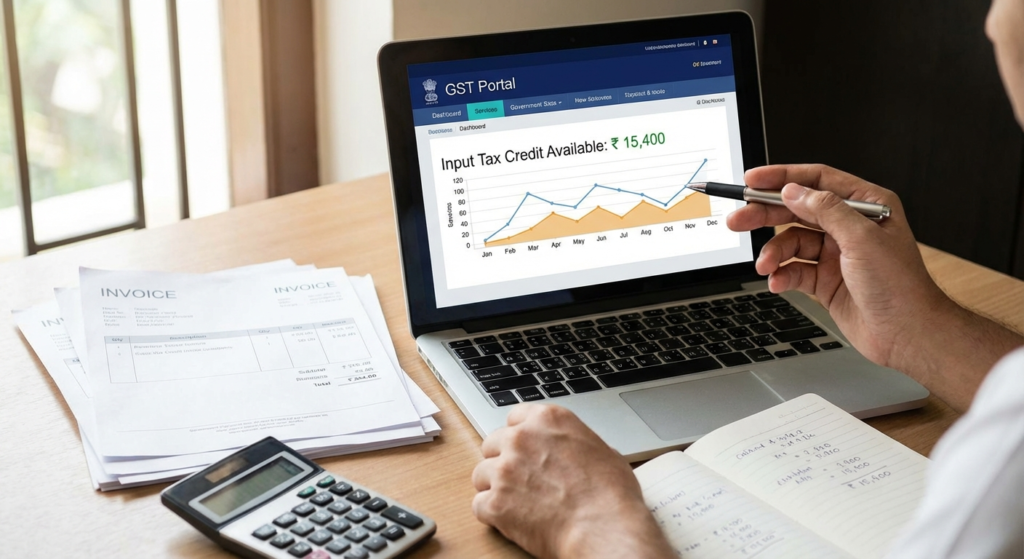
At its simplest, Input Tax Credit GST is the tax you pay on your business purchases (inputs) that you can subtract from the tax you collect on your sales (outputs). Think of it as a digital wallet managed by the government.
Every time you buy raw materials, pay rent for your office, or hire a legal consultant, you pay GST. That amount gets loaded into your electronic credit ledger—if you follow the rules. When you eventually sell your product or service, you don’t have to pay the full tax collected from your customer to the government. You use the balance in your “wallet” first.
The Mathematics of Saving Money
Let’s look at a concrete example to see the impact.
- Scenario A (Without ITC): You buy goods for ₹1,00,000 + ₹18,000 GST. You sell for ₹1,50,000 + ₹27,000 GST. If you can’t claim credit, your cost is ₹1,18,000. You pay the full ₹27,000 to the government.
- Scenario B (With ITC): You claim the ₹18,000 as credit. Your cost is effectively ₹1,00,000. When you collect ₹27,000 from your customer, you deduct the ₹18,000 credit and only pay ₹9,000 in cash.
That ₹18,000 difference is your Input Tax Credit GST working for you.
The 4 Pillars of Eligibility: Section 16 Breakdown
You cannot simply claim credit because you spent money. Section 16 of the CGST Act is the gatekeeper. To unlock your credit, you must satisfy four non-negotiable conditions simultaneously. If even one is missing, your claim is invalid.
1. Possession of a Valid Tax Invoice
You must have physical or digital possession of the tax invoice or debit note. A simple payment receipt or a proforma invoice won’t cut it. The invoice must contain all mandatory particulars—Supplier’s GSTIN, your GSTIN, invoice number, date, value, and tax amount.
2. Actual Receipt of Goods or Services
This sounds obvious, but it gets tricky. You generally cannot claim credit until the goods land at your premises.
- The “Bill-to-Ship-to” Exception: If you order goods and ask the supplier to deliver them directly to your customer (or a job worker), the law deems that you have received the goods, allowing you to claim credit even though you never physically touched the inventory.
- Lot Purchases: If you buy a machine that arrives in three parts, you cannot claim ITC until the last part arrives.
3. Tax Must Be Paid to the Government
This is the most controversial rule. For you to claim credit, your supplier must have actually paid that tax to the government (either via cash or their own ITC). If your supplier defaults or flees, the department can deny your credit, essentially punishing you for your vendor’s dishonesty.
4. Filing of Returns
You must have filed your GSTR-3B return. Possession of the invoice isn’t enough; you must formally claim it in the return.
The GSTR-2B Era: The “Auto-Drafted” Reality
Gone are the days when you could claim provisional credit based on your own books. Since the introduction of Rule 36(4) and subsequent amendments, your Input Tax Credit GST claim in GSTR-3B is strictly limited to what appears in your GSTR-2B statement.
GSTR-2B is a static statement generated on the 14th of the following month. If your vendor files their return late (e.g., on the 16th), that invoice will not appear in your current month’s GSTR-2B. You will have to wait until the next month to claim it.
Blocked Credits: The “Negative List” (Section 17(5))
Many business owners mistakenly believe that if an expense is “for business,” the GST is claimable. This is false. Section 17(5) defines specific categories where Input Tax Credit GST is blocked, regardless of business utility.
Here are the most common blocks you need to know:
1. Motor Vehicles
Buying a car for the director? You generally cannot claim ITC if the seating capacity is 13 or less.
- Exception: If you are in the business of transporting passengers (like a taxi service), selling cars (dealership), or providing driving training.
- Trucks & Tempos: Vehicles meant for transportation of goods are usually eligible for ITC.
2. Food, Beverages, and Catering
Ordering lunch for the office or hosting a client dinner? The GST paid is a cost. You cannot claim ITC on food and beverages, outdoor catering, beauty treatments, or health services.
3. Construction of Immovable Property
If you construct an office building or renovate your factory, the GST paid on cement, steel, and labor is blocked. The only exception is if you are constructing “plant and machinery” fixed to the earth.
4. Personal Use & Gifts
Any goods used for personal consumption (like buying a TV for your home on the company GSTIN) are strictly disallowed. Similarly, goods written off, stolen, or given away as free gifts disqualify the ITC.
The 180-Day Rule: A Ticking Clock
Here is a rule that catches many accountants off guard. If you have claimed Input Tax Credit GST on an invoice but fail to pay your supplier the invoice value (plus tax) within 180 days of the invoice date, you must reverse that credit. e Prerana Scholarship 2026: The Ultimate Guide to Apply
You will have to add the credit amount back to your output liability and pay interest on it. The good news? You can reclaim that credit once you finally make the payment to the vendor. But why pay interest unnecessarily? Keep a close watch on your Accounts Payable aging report. Unlocking the Mystery: How to Check MSME Registration by PAN number:-
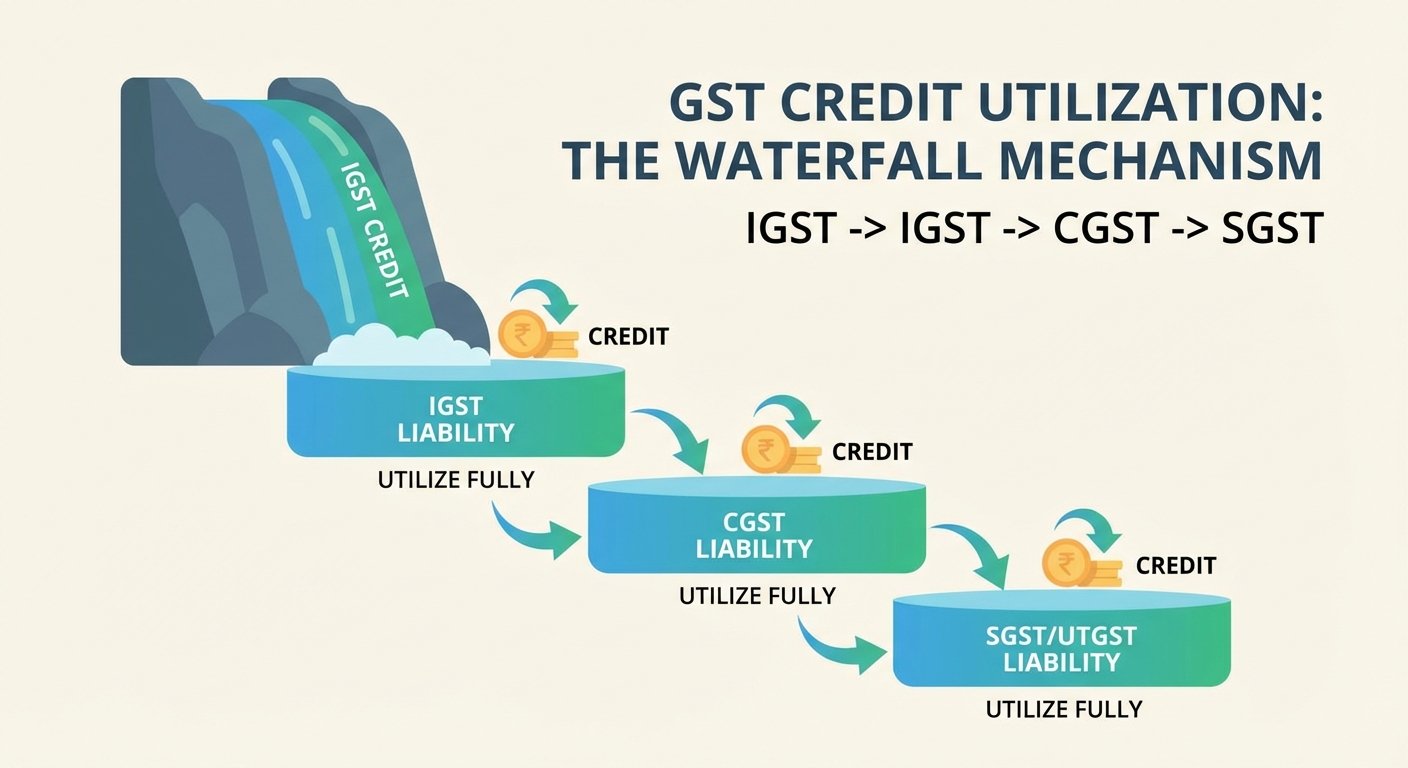
How to Utilize Credit: The Waterfall Mechanism
You cannot just mix and match credits. The government has set a strict hierarchy for utilizing Input Tax Credit GST. This order minimizes the balance in the IGST ledger. How to Update MSME Certificate – Step by Step Guide
| Credit Ledger | 1st Priority Set-off | 2nd Priority Set-off | 3rd Priority Set-off |
|---|---|---|---|
| IGST | IGST Liability | CGST Liability | SGST Liability |
| CGST | CGST Liability | IGST Liability | Cannot use for SGST |
| SGST | SGST Liability | IGST Liability | Cannot use for CGST |
Crucial Rule: You must exhaust your IGST credit completely before you can touch your CGST or SGST credit ledgers.
Critical Deadlines: The November 30th Cut-off
In the early days of GST, the deadline was September. That has changed. Now, the last date to claim Input Tax Credit GST for any invoice pertaining to a financial year is the 30th of November of the following financial year, or the date of filing the Annual Return, whichever is earlier.
For example, if you missed claiming an invoice dated January 15, 2024 (FY 2023-24), you have until November 30, 2024, to claim it in your GSTR-3B. Once this date passes, the credit is lost forever. It becomes a permanent cost to your business.
If you find yourself with excess accumulated credit that you cannot utilize (common in export businesses), you should look into the GST refund process in India to cash out that balance.
Documentation: Audit-Proofing Your Business
When the GST audit notice arrives—and eventually, it will—your documentation is your only shield. The burden of proof lies entirely on you.
Maintain a digital repository that includes:
- Tax Invoices: Organized month-wise.
- E-way Bills: As proof of movement of goods.
- Bank Statements: highlighting payments to specific vendors (proof of payment).
- Reconciliation Sheets: Monthly comparisons between your Purchase Register and GSTR-2B.
For freelancers, this can feel overwhelming. But just like ITR filing for freelancers in India requires diligence, GST compliance is the price of admission for doing business legitimately.
Common Pitfalls: What Most Business Owners Get Wrong
I’ve cleaned up enough messy ledgers to know where the bodies are buried. Here are the most frequent errors:
1. The “Friendly Vendor” Trap
You have a vendor you’ve worked with for years. They send the goods but delay the invoice or the filing. You claim the credit anyway because you “trust” them. When the system flags the mismatch, you are the one liable for interest and penalties, not your friend.
2. Ignoring Debit Notes
If you return goods to a supplier, you must reverse the ITC proportionate to that return. Often, businesses record the purchase return in their accounting software but forget to adjust the GST return, leading to excess claims.
3. Claiming on Exempt Supplies
If your business sells both taxable and tax-exempt goods (e.g., a grocery store selling branded snacks and unbranded rice), you cannot claim 100% of your common credits (like rent or audit fees). You must use Rule 42/43 to calculate and reverse the proportionate credit.
Conclusion: Master Your Input Tax Credit
Input Tax Credit GST is a powerful mechanism, but it is not a right—it is a conditional concession. The government allows it only if you play by their rules. By ensuring your vendors are compliant, reconciling your GSTR-2B monthly, and respecting the blocked credit list, you turn GST from a liability into a streamlined process.
Don’t leave this to chance. Review your purchase register today. Are there invoices older than 180 days unpaid? Are there credits missing from GSTR-2B? The sooner you catch these, the more cash you save.
Frequently Asked Questions
A: Generally, no. ITC on motor vehicles for transportation of persons with a seating capacity of 13 or less is blocked under Section 17(5). However, exceptions apply if you are in the business of selling cars, passenger transport, or driving instruction.
A: This is a critical risk. If your supplier fails to pay the tax, you are technically not eligible for the credit. The department may demand reversal of ITC along with interest. Always monitor your supplier’s filing status in GSTR-2B.
A: Yes. You must claim the credit by the 30th of November following the end of the financial year in which the invoice was issued, or the date of filing the annual return, whichever is earlier.
A: No. Possession of a valid tax invoice or debit note is a mandatory condition under Section 16. If lost, you should immediately request a duplicate copy from your supplier to maintain your eligibility.
A: If the renovation results in capitalization of immovable property (like constructing walls, flooring, etc.), the ITC is blocked. However, ITC on furniture, fixtures, and plant & machinery that are not permanently embedded to earth is generally allowed.