
Let’s be real—when you sit down to file your ITR, your focus is usually on the big numbers: your salary or your business profits. It’s easy to overlook the smaller stuff. But here’s the kicker: the tax department never overlooks it. That catch-all category, technically known as the residual head of income, is often where taxpayers slip up.
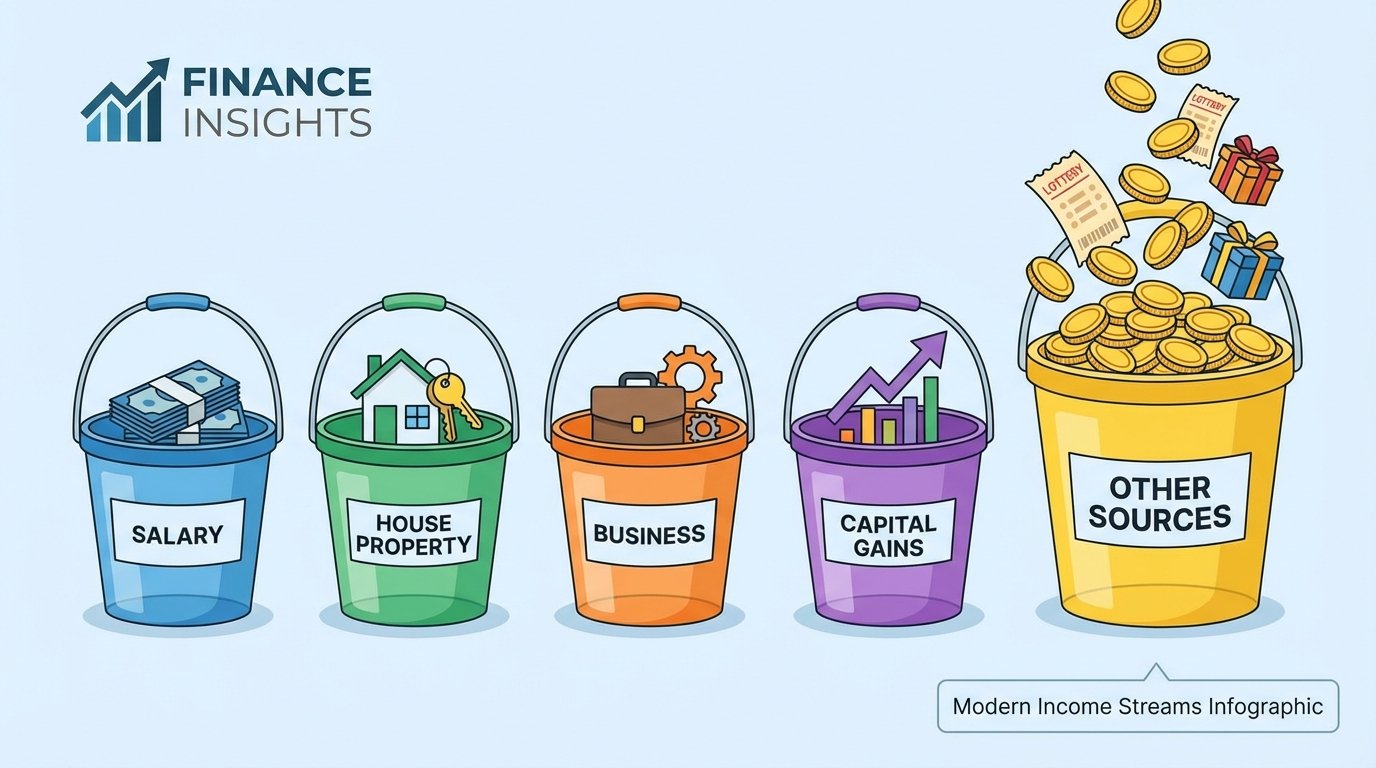
Getting a handle on income from other sources tax isn’t just about compliance; it’s about making sure you aren’t overpaying. Whether it’s that bit of interest sitting in your savings account, a family pension, or a sudden windfall from a lottery ticket, it all lands here.
Think of the Indian tax system as having five distinct buckets. If money hits your account and doesn’t fit into Salary, House Property, Business Profits, or Capital Gains, it automatically gets dumped into the "Other Sources" bucket. In this guide, I’m going to walk you through exactly how this works for FY 2025-26, so you can file with confidence and keep the taxman at bay.
1. What Exactly is Income from Other Sources Tax?
Section 56 of the Income Tax Act, 1961 is the governing law here. To master income from other sources tax, you just need to remember one rule: if it’s income and it’s not taxed elsewhere, it belongs here.
A lot of folks assume that small interest credits or one-off gifts are tax-free. That’s a dangerous assumption that often leads to defective return notices. This head covers a massive range of passive income.
Dividend Income
Gone are the days of tax-free dividends. Since April 2020, dividends are taxable in your hands at your applicable slab rates.
Interest Income
This is the most common one. Interest from Savings Accounts, FDs, RDs, and even interest on income tax refunds counts here.
Casual Income
Won money on a game show? Betting? Horse racing? Lottery? That windfall is fully taxable under this head.
Gifts
Money or property received without consideration (for free) exceeding ₹50,000 in a year is taxable, with exceptions for relatives.
2. The Big Components: Interest and Dividends
Let’s break down the bread and butter of income from other sources tax. You deal with these every year, so getting the math right is crucial.
The Shift in Dividend Taxation
It used to be that companies paid the tax (DDT) and you kept the full check. Now, the burden is on you. If your dividend income tops ₹5,000 in a year, the company might deduct TDS at 10%. You need to report this under ‘Other Sources’ and pay the difference if you fall into a higher tax bracket (like 20% or 30%).
Interest Income: Not All of It is Taxable
While interest on Fixed Deposits (FDs) is fully taxable, the government gives us a little breathing room on savings accounts. This is where Sections 80TTA and 80TTB come into play.
- Under 60? You can claim a deduction up to ₹10,000 on savings account interest under Section 80TTA.
- Senior Citizen? You get a much better deal under Section 80TTB—a deduction up to ₹50,000 covering both savings and FD/RD interest.
While managing business taxes often involves complex GST return filing and compliance checklists, handling ‘other sources’ is generally straightforward—provided you have your bank statements handy.
3. The Tricky Rules of Gift Taxation
This is where I see people get confused the most. Section 56(2)(x) outlines the rules for gifts. Here is the simple version: Who gave it to you?
If the gift is from a "relative" (spouse, sibling, parents, lineal ascendants/descendants), it is exempt. It doesn’t matter if they give you ₹100 or ₹1 Crore—it’s tax-free.
But, if a friend or non-relative gifts you cash or property, and the value exceeds ₹50,000 in a financial year, the entire amount is taxable. If you receive ₹51,000, you pay tax on the full ₹51,000, not just the extra ₹1,000.
4. Can You Lower Your Tax Liability? (Deductions)
Yes, you can. The Income Tax Act allows specific deductions under Section 57 to soften the blow of income from other sources tax.
- Family Pension: You can claim a standard deduction of 33.33% of the pension or ₹15,000, whichever is lower.
- Interest on Compensation: Received interest on a delayed motor accident claim? You get a flat 50% deduction on that interest.
- Earning Expenses: If you spent money solely to earn income (like collection charges for dividends), you can deduct that. Note: You generally cannot claim interest expenses on loans taken to buy shares beyond 20% of the dividend income.
5. The "Casual Income" Trap
Winning the lottery sounds great until you see the tax bill. The calculation for casual income is harsh compared to other streams.
The Flat 30% Rule
Winnings from lotteries, betting, gambling, or TV game shows are taxed at a flat rate of 30% (plus cess). It doesn’t matter if you are in the 5% tax slab—this income gets hit with the full 30%.
6. TDS: Don’t Leave Money on the Table
Tax Deducted at Source (TDS) is aggressive in this category. Banks will deduct 10% on FD interest if it crosses ₹40,000 (₹50,000 for seniors). For lotteries, the TDS cut is a steep 30% on winnings over ₹10,000.
You must reconcile your Form 26AS with your bank credits. If TDS was deducted, you need to file your return to adjust it. Missing deadlines can lead to penalties. I always recommend checking resources like the TDS return filing due dates for FY 2025-26 to stay on the right side of the law.
7. Common Mistakes to Avoid
After 15 years in this field, I see the same errors pop up repeatedly. Don’t be the person who makes these mistakes with income from other sources tax:
- Ignoring Savings Interest: It’s not tax-free by default; you have to claim the 80TTA deduction.
- Wedding Gift Confusion: Gifts received on the occasion of marriage are exempt. Gifts received a month later? Taxable.
- Clubbing Oversight: If you gift money to your spouse and they invest it, the income generated is clubbed with your income.
- Hiding Exempt Income: Even if your PPF interest is tax-free, report it in the ‘Exempt Income’ schedule. It builds a clean financial profile.
Bottom Line
Navigating income from other sources tax isn’t rocket science, but it does require attention to detail. From the flat 30% hit on winnings to the nuanced exemptions for gifts, this residual head of income can significantly swing your final tax liability.
Keep your records clean, reconcile your TDS, and maximize those Section 57 and 80TTA deductions. For more detailed statutory provisions, you can always refer to the Income Tax Department of India website. Remember, in taxation, ignorance isn’t bliss—it’s expensive. Stay informed and file smart.
Frequently Asked Questions (FAQs)
Yes, absolutely. The interest component of your refund is taxable under ‘Income from Other Sources’ at your regular slab rates.
If non-relatives gift you more than ₹50,000 in a year, the whole amount is added to your income. Gifts from relatives are tax-free.
Only interest expenses on loans taken to invest in those shares are allowed, capped at 20% of the dividend income. No other fees are deductible.
It is a flat 30% plus cess. No slab benefits, no deductions.
No. Gifts received specifically on your wedding day are fully exempt, regardless of value or who gave them.