Starting a business in India is an exciting journey, but it comes with its fair share of regulatory hurdles. One of the first and most critical questions every entrepreneur asks is: "Do I need to pay GST?" The answer isn’t always a simple yes or no; it depends entirely on the gst registration threshold. Understanding this limit is crucial to ensure you remain compliant with the law while optimizing your tax liabilities.
The Goods and Services Tax (GST), introduced as a unified tax regime, simplified indirect taxation. However, to protect small businesses from excessive compliance burdens, the government established specific turnover limits. If your annual aggregate turnover falls below the gst registration threshold, you might be exempt from registering. However, crossing this line without registering can lead to heavy penalties. In this guide, we will break down the current limits, the differences between goods and services, and the nuances of special category states.
Understanding the GST Registration Threshold in India
The gst registration threshold is essentially the turnover limit set by the GST Council. Once a business crosses this turnover value within a financial year, applying for GST registration becomes mandatory. This system ensures that micro and small enterprises are not burdened with monthly filings and tax payments, allowing them to focus on growth.
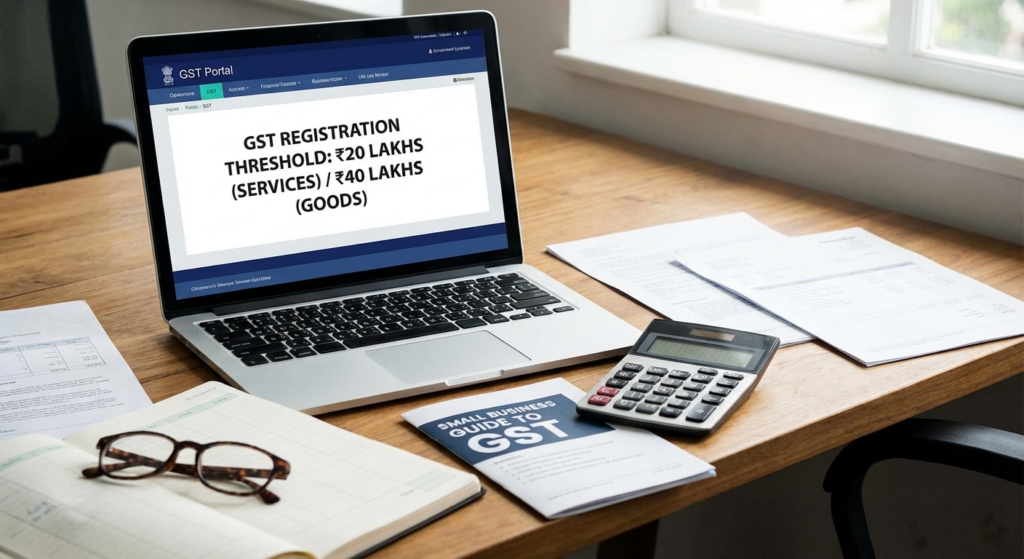
Initially, when GST was rolled out in 2017, the threshold was uniform at Rs. 20 Lakhs for most states. However, to further ease the doing of business, the government increased the gst registration threshold for suppliers of goods in many states to Rs. 40 Lakhs in April 2019. It is vital to note that this higher limit applies strictly to the sale of goods, not services.
Calculating your turnover correctly is the first step. This isn’t just your profit; it includes all taxable supplies, exempt supplies, exports, and inter-state supplies. If you operate under different business structures, such as a partnership or a private limited company, the rules remain tied to the aggregate turnover of the entity based on its PAN.
For those deciding on a business structure, understanding how liability works is key. You might find our guide on LLP vs Private Limited business structures helpful in planning your entity before registering for GST.
Current GST Registration Threshold Limits: Goods vs. Services
The distinction between goods and services is the most common point of confusion. The government recognizes that service providers generally have higher profit margins but lower turnover volumes compared to traders. Consequently, the gst registration threshold differs for these two categories.
Threshold for Service Providers
For businesses exclusively engaged in the supply of services (or both goods and services), the standard gst registration threshold is Rs. 20 Lakhs per financial year. This applies to consultants, freelancers, software agencies, and other service-oriented businesses in normal category states.
Threshold for Goods Suppliers
For businesses engaged exclusively in the supply of goods, the gst registration threshold was doubled to Rs. 40 Lakhs. However, this higher limit comes with conditions. You must not be making inter-state supplies, and you must not be engaged in trading specific goods like ice cream, pan masala, or tobacco.
Goods Only
Limit: Rs. 40 Lakhs*
Applicable to suppliers engaged exclusively in the sale of goods within the same state (Intra-state).
*Subject to state restrictions.
Services / Mixed
Limit: Rs. 20 Lakhs
Applicable to service providers or businesses selling both goods and services.
Special States
Limit: Rs. 10 Lakhs
Applicable to Manipur, Mizoram, Nagaland, and Tripura for both goods and services.
Special Category States and the GST Registration Threshold
India’s diverse economic landscape means a "one size fits all" approach doesn’t work. The constitution defines certain regions as Special Category States, often due to hilly terrain or strategic border locations. In these areas, the economic activity volume is naturally lower, so the gst registration threshold is reduced to ensure the tax base is captured effectively.
The constitution classifies these states into two tiers regarding GST:
- The Rs. 10 Lakh Limit: This is the strictest gst registration threshold. It applies to the "MMNT" states: Manipur, Mizoram, Nagaland, and Tripura. If you operate from these states, you must register once your turnover crosses just Rs. 10 Lakhs.
- The Rs. 20 Lakh Limit: Other states like Arunachal Pradesh, Meghalaya, Sikkim, Uttarakhand, Puducherry, and Telangana generally follow the Rs. 20 Lakh limit for both goods and services. They opted out of the higher Rs. 40 Lakh limit for goods to maintain revenue stability.
Why Geography Impacts Your GST Registration Threshold
The logic behind varying the gst registration threshold is based on the "capacity to pay." A turnover of Rs. 20 Lakhs in a metropolitan city like Mumbai represents a very small micro-business. However, the same turnover in a remote hill station in Mizoram represents a significant commercial enterprise. By lowering the limit in special category states, the government ensures that significant local businesses contribute to the national exchequer without penalizing small city traders.
Mandatory Registration: When the GST Registration Threshold Doesn’t Apply
This is the most dangerous pitfall for new business owners. There are specific scenarios where the gst registration threshold becomes irrelevant. In these cases, you are required to register under GST from the very first rupee of revenue, regardless of whether your turnover is Rs. 10,000 or Rs. 40 Lakhs.
If you fall into any of the categories below, do not wait for the turnover limit:
- Inter-state Taxable Supply: If you sell goods from one state to another (e.g., from Delhi to Haryana), mandatory registration applies. Note: There is an exemption for service providers making inter-state supplies up to Rs. 20 Lakhs.
- Casual Taxable Persons: If you do not have a fixed place of business but occasionally undertake transactions in a taxable territory (like setting up a stall at an exhibition in another state).
- Reverse Charge Mechanism (RCM): If you are liable to pay tax under the reverse charge mechanism.
- E-commerce Operators: Businesses that operate or sell through e-commerce aggregators (like Amazon or Flipkart) must register. While recent notifications have relaxed this for strictly intra-state supplies for unregistered dealers, generally, e-commerce selling triggers compliance.
For detailed official rules on these mandates, you can refer to the Official GST Portal.
Voluntary Registration vs. Waiting for the Threshold
Just because you are below the gst registration threshold doesn’t mean you shouldn’t register. Many businesses opt for voluntary registration. Why would someone choose to pay tax when they don’t have to?
The primary reason is the Input Tax Credit (ITC). If you are a B2B business, your clients will likely demand a GST invoice so they can claim credit. If you cannot provide one, they might switch to a vendor who can. Additionally, registering allows you to claim ITC on your own purchases (computers, rent, raw materials), reducing your overall cost.
To understand how this credit mechanism works in your favor, read our detailed breakdown on Input Tax Credit (ITC) GST Rules.
Calculating Aggregate Turnover for the GST Registration Threshold
When determining if you have crossed the gst registration threshold, you must calculate the "Aggregate Turnover." This is a PAN-based calculation, meaning if you have two branches in different states or two different verticals (e.g., a hardware shop and a consultancy firm), the turnover of all acts combined determines your liability.
What to Include:
- Taxable supplies.
- Exempt supplies (goods/services exempt from tax).
- Exports of goods or services.
- Inter-state supplies.
What to Exclude:
- The value of inward supplies on which tax is payable by a person on a reverse charge basis.
- Central tax, State tax, Union territory tax, Integrated tax, and Cess.
Consequences of Ignoring the GST Registration Threshold
Ignoring the gst registration threshold is not a risk worth taking. The GST department uses advanced data analytics to track business transactions. If you are found to be operating without registration despite crossing the limit, the consequences are severe.
Penalties include:
- 100% Tax Penalty: You may have to pay a penalty equivalent to the tax evaded or Rs. 10,000, whichever is higher.
- Confiscation of Goods: In severe cases, goods can be seized.
- Loss of ITC: You cannot claim Input Tax Credit for the period you were unregistered.
- Reputational Damage: Non-compliance can lead to blacklisting by large corporate clients.
For more insights on how government budgets and policies might affect these penalties in the future, check out reputable financial news sources like The Economic Times GST section.
Conclusion
Navigating the gst registration threshold is the first step toward building a compliant and scalable business in India. Whether the limit applicable to you is Rs. 40 Lakhs, Rs. 20 Lakhs, or Rs. 10 Lakhs depends on your location and the nature of your business. While the exemption provides relief to small players, growing businesses should constantly monitor their aggregate turnover.
Remember, GST is not just a tax; it is a digital trail of your business credibility. If you are close to the limit, proactive registration is often better than reactive panic. Consult with a tax professional to assess your specific situation and ensure seamless compliance.
Frequently Asked Questions (FAQs)
No, the Rs. 40 Lakh threshold is exclusively for businesses engaged in the supply of goods. For service providers, the limit remains Rs. 20 Lakhs (or Rs. 10 Lakhs in special category states).
generally, no. Selling goods through an e-commerce operator usually requires mandatory GST registration regardless of your turnover. However, recent amendments allow unregistered suppliers to make intra-state supplies through e-commerce operators subject to specific conditions.
GST turnover is calculated on a PAN-India basis. You must combine the turnover of all branches across all states. If the total aggregate turnover exceeds the applicable threshold, you must register in all states where you have a taxable presence.
Yes, you can opt for voluntary registration. This is beneficial if you want to claim Input Tax Credit (ITC) or if you want to sell to large B2B clients who require GST invoices.
The states with a Rs. 10 Lakh threshold for GST registration are Manipur, Mizoram, Nagaland, and Tripura. Other special category states generally follow the Rs. 20 Lakh limit.