There is a specific sinking feeling that every business owner in India knows too well: logging into the GST portal and seeing that ominous red notification flag. You click it, and there it is—a notice from the department. Your heart rate spikes. Did I miss a filing? Is my registration being cancelled? Is this going to cost me a fortune?
I have spent the last two decades helping businesses navigate India’s complex tax landscape, and I can tell you this: Panic is your worst enemy right now.
Here is the reality check most consultants won’t give you straight away: A GST notice is rarely an accusation of tax evasion. In 2025, the vast majority of these notices are automated triggers generated by algorithms, not by a tax officer personally hunting you down. They are often simple requests for clarification regarding data mismatches.
However, that doesn’t mean you can take them lightly. A poorly drafted GST notice reply—or worse, ignoring it completely—can turn a minor clerical error into a financial nightmare involving frozen bank accounts and blocked Input Tax Credit (ITC).
In this guide, I am going to walk you through the entire ecosystem of the GST notice reply process. We won’t just cover the “how-to”; we are going to look at the strategy behind drafting a response that satisfies the officer and closes the file for good.
The Anatomy of a GST Notice: What Are You Actually Looking At?
Before you rush to draft a reply, you need to understand what you have received. In the pre-GST era, notices were physical letters. Today, they are digital footprints. When you download that PDF from the portal, the first thing you must check is the DIN (Document Identification Number).
A GST notice is essentially a formal communication from the jurisdictional proper officer. It serves one of three purposes:
- Information Gathering: They want to know why your GSTR-3B liability is lower than your GSTR-1 liability.
- Demand: They have calculated that you owe tax, interest, or penalties and are asking you to pay up or explain why you shouldn’t.
- Action: They are threatening to cancel your registration due to non-compliance.
Your GST notice reply is your legal defense. It is the document that will stay on record permanently. If the matter ever goes to appeal or court, this initial reply will be scrutinized. That is why “I didn’t know” or “My accountant made a mistake” are not valid defenses.
Why You? The Algorithms Behind the Notice
“Why did I get this?” is the first question clients ask me. In the past, notices were random. Now, the GST Network (GSTN) uses advanced analytics and AI to cross-verify data across multiple platforms.
If you understand the trigger, you can draft a precise GST notice reply. Here are the most common algorithmic flags:
1. The Classic ITC Mismatch (GSTR-3B vs. GSTR-2A/2B)
This is the most frequent culprit. You claimed ₹1,00,000 ITC in your GSTR-3B, but your GSTR-2B (auto-generated from suppliers’ filings) shows only ₹80,000. The system automatically flags this ₹20,000 difference. This often happens when suppliers file late or wrongly classify a B2B transaction as B2C.
2. The Liability Mismatch (GSTR-1 vs. GSTR-3B)
You declared sales of ₹10 Lakhs in GSTR-1 (to please your customers so they see the credit) but paid tax on only ₹8 Lakhs in GSTR-3B (to manage cash flow). The system sees this immediately. Unless you have a valid reason—like a credit note issued later—this is a guaranteed notice.
3. E-Way Bill vs. GSTR-1 Discrepancies
If you generated E-Way bills worth ₹50 Lakhs during a month but reported turnover of only ₹30 Lakhs in your return, the department will suspect you of suppressing sales. Your GST notice reply here needs to prove that some E-Way bills were cancelled or goods were returned.
4. Inconsistent RCM Liability
Many businesses forget to pay tax under the Reverse Charge Mechanism (RCM) for services like Goods Transport Agency (GTA) or legal fees. The department cross-references your expense ledger (if audited) or data from third parties to catch this.
If these errors stem from the very beginning of your business journey, you might want to revisit the basics. I’ve written extensively about GST registration mistakes to avoid rejection, which often lead to these compliance headaches later on.
Decoding the “Alphabet Soup”: Types of Notices
The GST law loves its forms. Knowing the difference between an ASMT-10 and a DRC-01 is critical because the severity and the deadline for your GST notice reply differ for each.
ASMT-10 (Scrutiny)
Severity: Moderate. This is a scrutiny notice indicating discrepancies. It is not a demand yet; it is a question. You must reply using Form ASMT-11 explaining the differences or paying the tax. If the officer is satisfied, they issue ASMT-12 (Order of Acceptance).
GSTR-3A (Defaulter)
Severity: High. Issued to taxpayers who have failed to file their GST returns for a specific period. The only valid GST notice reply here is to actually file the pending returns along with late fees and interest immediately.
REG-17 (Cancellation)
Severity: Critical. This is a Show Cause Notice (SCN) asking why your GST registration should not be cancelled. Common reasons include not conducting business from the registered place or not filing returns for 6 months. You must reply via Form REG-18.
DRC-01 (Summary of Demand)
Severity: Very High. This accompanies a Show Cause Notice (SCN) under Section 73 or 74. It crystallizes the demand for tax, interest, and penalty. Your reply goes in Form DRC-06. This is often the precursor to litigation.
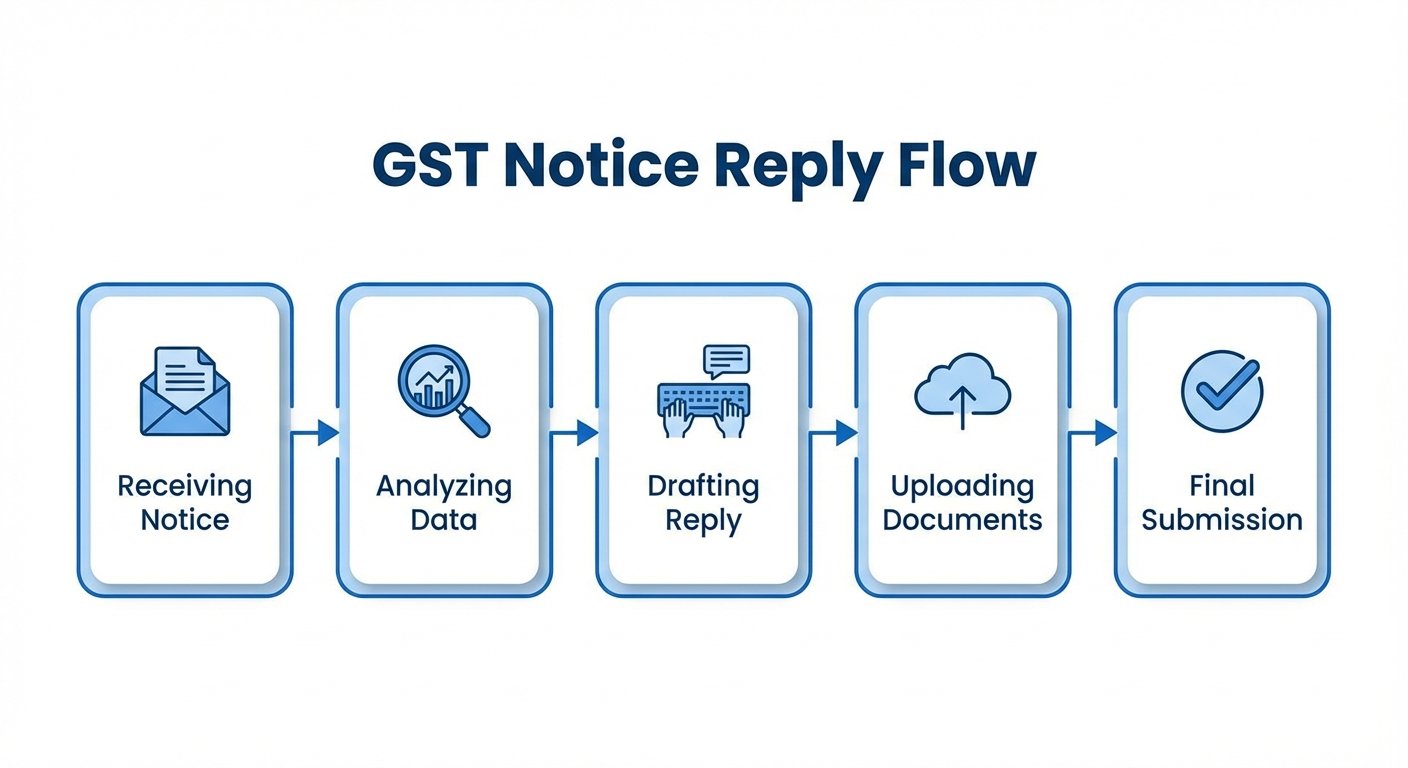
The 7-Step Protocol for Online GST Notice Reply
Gone are the days of carrying physical files to the ward office and waiting for hours. You can now submit your GST notice reply entirely online. However, one wrong click can categorize your reply incorrectly. Follow this exact protocol:
Step 1: Access the Portal Securely
Log in to the GST Portal. Ensure your Digital Signature Certificate (DSC) is plugged in if you are a Company or LLP, as you will need it for the final submission.
Step 2: Locate the Notice
Navigate to Services > User Services > View Notices and Orders. This is your inbox for official communication. Do not confuse this with the “View Additional Notices and Orders” tab, which is used for proceedings related to appeal or recovery.
Step 3: Download and Analyze
Click the ‘View’ button next to the Notice ID. Download the PDF attachment. Read the “Allegation” or “Discrepancy” section three times. Identify the exact period (Financial Year) and the amount in dispute. GST E-Way Bill Generation Rules India 2026: Mastering Compliance and Avoiding Penalties
Step 4: Prepare Your Response Offline
Do not draft directly in the text box on the portal. The session might time out, and you will lose your work. Draft your reply in a Word document first. Prepare your reconciliation sheets in Excel and convert them to PDF. GST for Ecommerce Sellers: 7 Essential Rules & 2024 Guide
Step 5: Select the Correct Tab for Reply
This is where people get stuck. If you received an ASMT-10, look for the “Scrutiny of Returns” tab to file ASMT-11. If it is a Show Cause Notice, look for the “Replies” tab to file DRC-06. Clicking the wrong link is a common procedural error.
Step 6: Upload Supporting Documents
You can attach supporting evidence. Note that the portal has a file size limit (usually 5MB per file). If you have bulky ledgers, compress them or split them into Part 1 and Part 2. Ensure they are in PDF or JPEG format.
Step 7: Verification and Filing
Check the verification box, select the Authorized Signatory from the dropdown, and file using DSC or EVC (OTP). Once filed, an Acknowledgement Reference Number (ARN) will be generated. Save this immediately.
How to Draft a “Bulletproof” Reply (The Secret Sauce)
The quality of your drafting determines whether the officer drops the case or issues a demand order. I have seen replies that are essentially emotional rants—”We are honest taxpayers, please excuse us.” These do not work.
A professional GST notice reply must be clinical, factual, and legally grounded. Here is the structure I use for my clients:
1. The Opening (Reference)
Start by referencing the Notice Number and Date.
“Ref: Your Notice No. [Number] dated [Date] issued under Section 61 of the CGST Act, 2017.”
2. The Facts of the Case
Briefly state what the business does.
“We are engaged in the business of trading electronic goods and are regular in filing our returns.”
3. The Para-wise Rebuttal (The Core)
Address each point raised in the notice separately. If the notice has three allegations, your reply should have three distinct headers.
- Admit if Correct: If there is a genuine error (e.g., you missed adding an invoice), admit it. “We agree with the discrepancy of ₹5,000. We have paid the tax via DRC-03 (Challan attached) along with applicable interest.”
- Deny with Evidence: If the allegation is wrong, be firm. “The discrepancy in ITC is due to the supplier filing their GSTR-1 after the due date. However, we are eligible for credit as per Section 16(2) conditions, which we have fulfilled. Please find attached the ledger confirmation and proof of payment to the supplier.”
4. The Prayer
Conclude with a formal request.
“In light of the above submissions and documents attached, we humbly request you to drop the proceedings and vacate the proposed demand.”
The Evidence Locker: Documents You Cannot Ignore
In the eyes of the law, if it isn’t documented, it didn’t happen. When submitting your GST notice reply, your attachments are more important than your arguments.
Depending on the notice type, ensure you have these ready:
- Reconciliation Sheets: A clean Excel-to-PDF conversion showing GSTR-3B vs Books vs GSTR-2B. Highlight the rows that explain the difference.
- Sample Invoices: If the dispute is about classification (HSN code), attach sample invoices and product photos.
- Chartered Accountant Certificate: For high-value discrepancies, a certificate from a CA certifying the correctness of your books carries immense weight.
- Proof of Payment: Bank statements highlighting the payment to suppliers within 180 days (crucial for retaining ITC).
- Valid Registration Proofs: Sometimes notices question the legitimacy of the business. Documents like your Udyam certificate can help establish your status as a verified MSME.
The Cost of Silence: Consequences & Penalties
I cannot stress this enough: Ignoring a GST notice is not an option. It does not go away; it grows.
Financial Implications
- Interest: You will be liable to pay interest at 18% per annum (for short payment) or 24% per annum (for unauthorized ITC claim) from the day the tax was due.
- Penalty: Under Section 73 (non-fraud cases), the penalty is 10% of the tax or ₹10,000, whichever is higher. Under Section 74 (fraud/suppression), it shoots up to 100% of the tax amount.
- Business Stoppage: The department can block your electronic credit ledger (Rule 86A) or cancel your registration, effectively shutting down your ability to bill customers.
When Should You Hire a Professional?
Can you file a GST notice reply yourself? Yes, absolutely—if the query is simple, like a small late fee or a minor data entry error. However, you should bring in a tax professional if:
- The tax demand is significant (e.g., above ₹50,000).
- The notice involves complex legal interpretations (e.g., taxability of a specific service).
- You have received a Section 74 notice alleging fraud or suppression.
- You are unsure about the reconciliation and need a forensic check of your books.
Final Thoughts
Receiving a GST notice is a standard part of doing business in India’s transparent, digital-first tax regime. It is not an indictment of your character; it is a query on your data. The secret to mastering the GST notice reply process is simply organization and timeliness.
Don’t let that red flag on the portal ruin your sleep. Download the notice, understand the trigger, gather your evidence, and draft a reply that is respectful yet firm. By following the steps outlined in this guide, you turn a potential crisis into a simple administrative task.
Frequently Asked Questions (FAQs)
For most notices like ASMT-10 or a Show Cause Notice (SCN), the standard time limit is 30 days from the date of receipt. However, the exact date will be mentioned in the notice itself. You can request an adjournment (extension) under Section 75(5) if you have a genuine reason, but this is at the officer’s discretion.
Generally, no. The GST ecosystem is designed to be faceless. All replies to ASMT-10, DRC-01, and other common notices must be filed online through the portal. Physical submissions are only accepted in rare cases where the portal is malfunctioning or for specific enforcement proceedings where personal hearings are summoned.
If you agree that you made a mistake, you should pay the tax along with applicable interest immediately using Form DRC-03. After payment, mention the ARN of the DRC-03 in your GST notice reply. This usually concludes the proceedings with a reduced or zero penalty.
It is not legally mandatory to hire a CA. You can draft and file the reply yourself. However, given the complexity of GST laws and the high stakes involved in penalties, it is highly recommended to consult a professional for notices involving scrutiny, mismatched ITC, or legal disputes.
Unfortunately, fake notices from scammers do exist. Always check for the Document Identification Number (DIN) on the notice. You can verify this DIN on the CBIC website (cbic.gov.in) under the “Verify CBIC-DIN” service. If the notice does not have a DIN or does not appear in your GST portal dashboard, it is likely fake.