
Let’s be honest: figuring out how much tax you actually owe the government isn’t exactly how most business owners want to spend their Friday afternoon. But in the world of indirect tax, getting your GST liability calculation right is non-negotiable. It’s not just a compliance box to tick—it directly impacts your cash flow and keeps the taxman away.
I’ve seen plenty of smart entrepreneurs and even seasoned accountants get tripped up here. Why? Because it’s not just about what you collected versus what you paid. It’s about the order in which you offset those amounts. A simple math error or a misunderstanding of the set-off rules can lead to hefty penalties or, worse, blocked working capital.
In this guide, we’re going to cut through the jargon. I’ll walk you through the GST liability calculation process step-by-step, explain the tricky set-off rules in plain English, and help you determine exactly what you need to pay via cash ledger.
Understanding the Mechanics of GST Liability Calculation
At its simplest level, the GST liability calculation is a math problem: Tax Collected on Sales – Tax Paid on Purchases = Net Tax Payable. But as with most things in Indian taxation, the devil is in the details.
To get this right, you need to be crystal clear on the three buckets of GST:
- CGST (Central GST): Goes to the Centre (intra-state sales).
- SGST/UTGST (State/Union Territory GST): Goes to the State (intra-state sales).
- IGST (Integrated GST): Levied on inter-state sales and imports.
You can’t just mix and match these buckets however you like. There are strict rules governing how money in one bucket can be used to pay off debt in another.
Output Tax Liability
This is the total GST you’ve collected (or should have collected) from customers. This money belongs to the government, not you.
Input Tax Credit (ITC)
This is the tax you paid to your vendors. It sits in your electronic credit ledger like a prepaid wallet waiting to be used.
Net Cash Liability
The formula is simple: Output Liability minus Eligible ITC. This is the actual cash outflow from your bank account.
Step-by-Step Process for Accurate GST Liability Calculation
Rushing through this process is the fastest way to invite a notice. Here is the workflow I recommend to my clients to ensure the GST liability calculation is audit-proof.
Step 1: Determine Total Outward Supplies
Gather all your sales invoices for the month. Don’t forget to include debit notes you’ve issued (which increase liability) and exclude credit notes (which decrease it). You need to separate these into intra-state (within the same state) and inter-state (across borders) columns.
Step 2: Calculate Total Output Tax
Apply the correct rates (5%, 12%, 18%, or 28%) to your taxable value. This gross figure is your starting point. Remember, if you are treating a transaction as zero-rated (like exports), ensure you have the Letter of Undertaking (LUT) in place; otherwise, tax is payable.
Step 3: Determine Eligible Input Tax Credit (ITC)
This is where 90% of errors happen. You cannot claim credit just because you have an invoice. Check your GSTR-2B. If the vendor hasn’t filed their return, you generally cannot take the full credit. Also, filter out blocked credits under Section 17(5)—like that car you bought for the office or catering services for a staff party.
The Set-Off Rules: The Heart of Calculation
This is the most critical part of the GST liability calculation. The government mandates a specific hierarchy for using your credits. If you mess this up, the portal might ask you to pay cash for CGST even while you have a huge balance sitting in SGST.
The Priority of Utilization
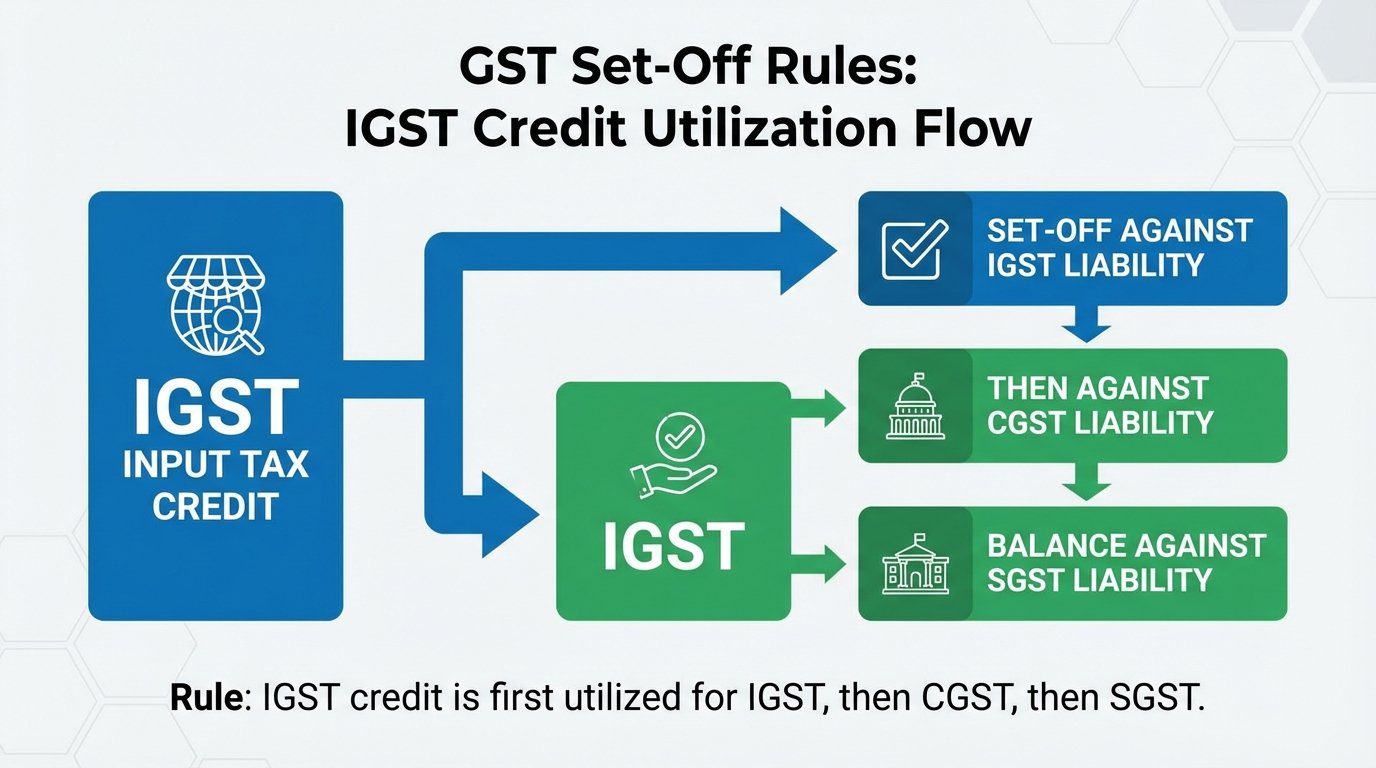
Think of IGST credit as the “Universal Donor.” It must be used first before you touch anything else.
- IGST Credit First: Use it to pay IGST liability. If any is left, use it for CGST, and then SGST.
- CGST Credit Second: Once IGST credit is gone, use CGST credit to pay CGST liability. If any is left, use it for IGST liability.
- SGST Credit Last: Use SGST credit to pay SGST liability. If any is left, use it for IGST liability.
For a practical walkthrough on reporting these figures, check out our guide on the process of filing GSTR-3B.
Practical Example of GST Liability Calculation
Let’s look at a real-world scenario. Imagine ‘ABC Traders’ in Maharashtra has the following figures for July: Ultimate Guide to MCA Company Name Approval: Rules, Steps, and Avoiding Rejection
- Sales (Inter-state): ₹10,00,000 (IGST @ 18% = ₹1,80,000 liability)
- Sales (Intra-state): ₹5,00,000 (CGST ₹45,000 + SGST ₹45,000 liability)
- ITC Available: IGST: ₹2,00,000 | CGST: ₹20,000 | SGST: ₹20,000
The Calculation Logic:
- Total Liability: ₹1,80,000 (IGST) + ₹45,000 (CGST) + ₹45,000 (SGST).
- Use IGST Credit (₹2,00,000):
- Pay off the ₹1,80,000 IGST liability first. (Balance IGST Credit: ₹20,000)
- Use the remaining ₹20,000 against CGST liability.
- Status Check: IGST Paid. CGST Liability remaining is ₹25,000 (45k – 20k). SGST Liability is still ₹45,000.
- Use CGST Credit (₹20,000): Pay towards the remaining CGST liability. You still owe ₹5,000 in CGST.
- Use SGST Credit (₹20,000): Pay towards SGST liability. You still owe ₹25,000 in SGST.
Final Check to be Written: ₹5,000 (CGST) + ₹25,000 (SGST) = ₹30,000.
Common Mistakes to Avoid
Even after 15 years in the field, I still see these errors popping up during audits. Watch out for them during your GST liability calculation.
1. Ignoring Reverse Charge Mechanism (RCM)
Most people focus on sales, but some purchases (like legal fees or goods transport agencies) require you to pay the tax. Crucially, RCM liability must be paid in cash. You cannot use your ITC balance to pay this.
2. Wrong Head Classification
If you accidentally pay IGST instead of CGST/SGST, the government considers it an unpaid tax. You’ll have to pay the correct tax (plus interest) and then file for a refund of the wrong one. It’s a cash flow nightmare.
3. Claiming Ineligible ITC
Just because it’s in GSTR-2B doesn’t mean it’s yours. If you claim credit on personal expenses or blocked categories, you are inflating your ITC and reducing your liability artificially. This is tax evasion, plain and simple. Always cross-verify with the CBIC GST Portal guidelines.
Interest on Delayed Payment
If your calculation is late, your filing is late. Interest ticks at 18% per annum on the net cash liability. Keeping up with indirect tax updates is vital to knowing if any amnesty schemes can save you.
Tools and Automation
If you have more than 50 invoices a month, stop doing this manually in Excel. Automation tools reduce human error in your GST liability calculation significantly. However, always do a manual “sanity check” of the final figures before you hit submit on the GST Common Portal.
Conclusion
Mastering the GST liability calculation isn’t rocket science, but it does require discipline. It’s about understanding the flow: Output Tax minus Input Tax, applied in the strict order of IGST > CGST > SGST. By keeping your invoices organized and staying updated on ITC rules, you can ensure your business remains compliant and penalty-free.
Frequently Asked Questions
No. This is the most important rule to remember: SGST and CGST credits cannot be cross-utilized.
Short payment attracts 18% interest and potential penalties. Excess payment locks up your funds until you claim a refund.
Composition dealers don’t deal with ITC. They simply pay a flat rate (usually 1% for traders/manufacturers) on their turnover.
No. ITC is only for paying the output tax liability. All interest, penalties, and late fees must be paid via the electronic cash ledger.
You should calculate this monthly before filing your GSTR-3B (usually by the 20th of the following month) to avoid interest.