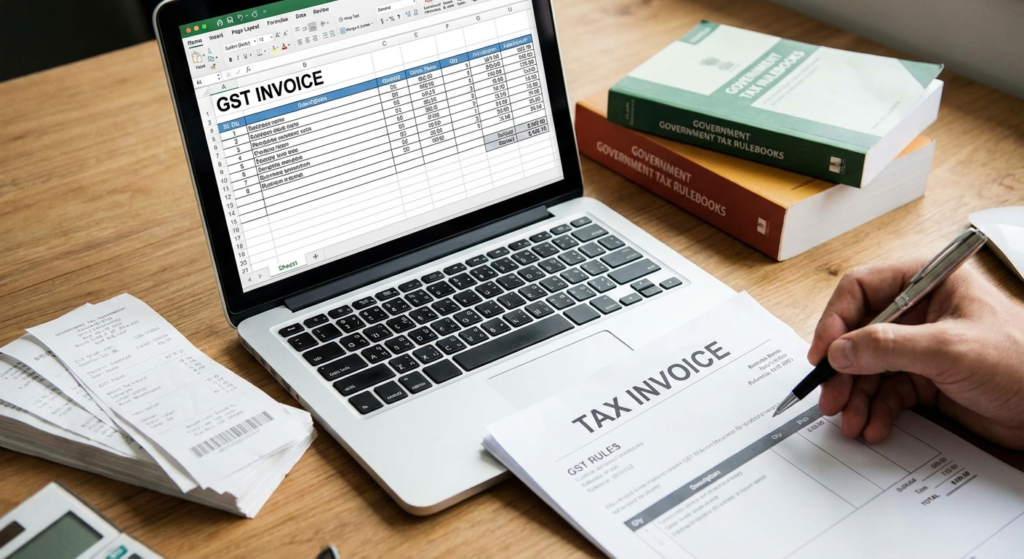
Understanding the Mandate: Why GST E-Way Bill Generation Rules India Matter
The Goods and Services Tax (GST) regime revolutionized indirect taxation in India, aiming for a seamless national market. Central to this efficiency is the Electronic Way Bill (E-Way Bill) system. For any business involved in the movement of goods, mastering the GST e-way bill generation rules India is not just a regulatory necessity; it's crucial for operational fluidity and avoiding significant financial liabilities. As we look towards 2026, these rules remain robust, demanding strict adherence from registered taxpayers.
The E-Way Bill serves as an electronic document required to be carried by the person in charge of the conveyance whenever goods exceeding a specified value are transported. Its primary function is to track the movement of goods and ensure that the tax authorities have a clear audit trail, preventing tax evasion. Non-compliance can lead to severe consequences, making detailed knowledge of the applicable thresholds and procedures mandatory.
What Triggers the Requirement for an E-Way Bill?
The fundamental trigger for generating an E-Way Bill is the value of the consignment being transported. While the rules are largely standardized across the nation, specific provisions apply based on whether the movement is between states or within a state.
Inter-State Movement Threshold
For the movement of goods from one state to another (Inter-State supply), the E-Way Bill is mandatory if the consignment value exceeds Rs 50,000. This applies regardless of the mode of transport or the nature of the transaction (supply, non-supply, inward, or outward).
Intra-State Movement Threshold
For movement entirely within a single state (Intra-State supply), the threshold is generally also Rs 50,000. However, individual states have the autonomy to lower this limit. Taxpayers must always check the specific state rules where the movement originates, as some states have reduced the limit to as low as Rs 1 lakh or Rs 50,000 for specific commodities.
Mandatory Generation Scenarios
Even if the value is below Rs 50,000, an E-Way Bill is required in two specific scenarios: movement of handicraft goods (exempted from GST registration) and movement of goods by a Principal to a Job Worker in another state.
The Essential Steps for GST E-Way Bill Generation Rules India
The process of generating the E-Way Bill is streamlined through the dedicated GST portal. It requires accurate data submission and is typically divided into two parts: Part A (Supplier details) and Part B (Transporter details). Understanding these steps is crucial for ensuring timely compliance.
Key Data Points Required for Successful Generation
Part A of the E-Way Bill captures the details related to the supply and the goods themselves. This must be filled out by the supplier, or the recipient if they are responsible for the movement (e.g., in an unregistered recipient scenario). The core information required includes:
- GSTIN of the recipient and the supplier.
- Place of delivery (PIN code).
- Invoice or Challan number and date.
- Value of the goods.
- HSN code of the goods (at least two digits for values up to Rs 5 crore, four or six digits for higher values).
- Reason for transportation (e.g., supply, job work, export, etc.).
Part B relates exclusively to the conveyance details. This information must be updated before the actual movement of goods begins. It includes the vehicle registration number and the transport document number. If the goods are moved through public transport, rail, or air, the transporter must update Part B.
It is important to remember that the responsibility for generating the E-Way Bill generally rests with the supplier. However, if the supplier fails to do so, the recipient is obligated to generate it. If the goods are moved by a transporter, and neither the consignor nor the consignee generates the bill, the transporter must generate it.
Validity Period and Distance Limitations Under GST E-Way Bill Generation Rules India
The validity of an E-Way Bill is not indefinite; it is directly tied to the distance the goods are expected to travel. This time limit is critical because if the validity expires, the movement must halt until a new E-Way Bill is generated or the existing one is extended.
Distance up to 200 km
The validity period is one day from the relevant date of generation. This duration is calculated from the time the bill is generated.
Every Additional 200 km or part thereof
An additional one day of validity is granted. For instance, if the distance is 350 km, the total validity would be two days (one day for the first 200 km + one day for the remaining 150 km).
Extension of Validity
If the goods cannot be transported within the validity period due to exceptional circumstances (e.g., vehicle breakdown, natural calamity, law and order issues), the person in charge can extend the validity period. This must be done within 8 hours before or 8 hours after the original expiry time, justifying the reason for the extension.
The distance calculation is based on the actual route taken, but authorities generally rely on the standard mapped distance available through the GST system. Misstating the distance to prolong the validity period is considered a violation of the GST e-way bill generation rules India.
Exemptions from E-Way Bill Requirements
While the rules are broad, certain goods and movements are specifically exempted from the requirement of generating an E-Way Bill, regardless of the value. These exemptions typically cover non-taxable supplies, goods of personal use, or specific low-risk movements.
Examples of exempted movements include:
- Movement of goods under customs bond or customs seal.
- Goods transported by non-motorized conveyance (e.g., cycle rickshaw).
- Movement of specific notified goods like precious stones, jewelry, and certain petroleum products (not covered under GST).
- Goods transported from the Customs port, airport, or air cargo complex to an Inland Container Depot (ICD) or Container Freight Station (CFS) for clearance.
It is paramount that businesses do not mistakenly assume exemption. When in doubt, compliance is the safest route. For comprehensive guidance on ensuring you meet all legal requirements, especially those pertaining to registered entities, refer to resources on GST composition scheme eligibility.
Consequences of Non-Compliance: Penalties for Violating GST E-Way Bill Generation Rules India
Failing to adhere to the GST e-way bill generation rules India can result in severe financial penalties and operational disruptions, including the detention or seizure of goods and vehicles. The penalties are designed to deter tax evasion and ensure accountability in the supply chain.
Financial Penalties Under Section 129
When goods are transported in violation of the rules (i.e., without a valid E-Way Bill, or with an expired or incorrect bill), the authorities may intercept the consignment and impose penalties under Section 129 of the CGST Act. The penalties vary depending on whether the owner of the goods comes forward to pay the penalty.
Scenario 1: Owner Comes Forward
If the owner of the goods comes forward to pay the penalty, the penalty levied shall be 200% of the tax payable on the goods transported. The goods and conveyance are released upon payment.
Scenario 2: Owner Does Not Come Forward
If the owner does not come forward, the penalty levied shall be 50% of the value of the goods, reduced by the tax paid thereon, or Rs 10,000, whichever is higher. This often results in a higher effective penalty.
Minor Technical Errors
The GST Council has provided relief for minor technical errors (like spelling mistakes in the address or minor errors in the HSN code) where the intent is clearly not to evade tax. In such cases, a penalty of Rs 1,000 per Act (CGST and SGST, totaling Rs 2,000) may be imposed instead of the severe 200% penalty. However, reliance on this is risky.
“Compliance is not merely about ticking boxes; it’s about maintaining the integrity of the tax ecosystem. A robust E-Way Bill system ensures that goods movement aligns perfectly with the tax declaration, minimizing opportunities for leakage,” notes a commonly accepted observation among tax experts.
Seizure and Confiscation (Section 130)
In cases where the authorities determine that the movement was undertaken with the explicit intent to evade tax, the provisions of Section 130 apply. This section allows for the seizure and subsequent confiscation of both the goods and the conveyance. The penalty under Section 130 is significantly higher, often requiring payment of the tax due plus a redemption fine to reclaim the assets.
It is vital for businesses to prioritize accuracy and timeliness. A small delay or a simple data entry error can lead to the goods being detained, causing logistical bottlenecks and heavy fines. Regular training for logistics staff on the proper generation and documentation required under the GST e-way bill generation rules India is highly recommended.
Ensuring Seamless GST Compliance in 2026
For businesses operating in India, proactive management of the E-Way Bill system is crucial for smooth operations. Integrating the E-Way Bill generation process directly into enterprise resource planning (ERP) systems can minimize manual errors and ensure real-time compliance.
Best Practices for E-Way Bill Management:
- Automated Validation: Use software that automatically validates the GSTINs and HSN codes before generating the bill to prevent immediate rejections.
- Expiry Alerts: Implement a system that alerts the logistics team well before the E-Way Bill validity period expires, allowing ample time for extension if necessary.
- Documentation: Always ensure the physical copy or the electronic reference number of the E-Way Bill is available with the driver, alongside the tax invoice or delivery challan.
- Rejection Handling: If an E-Way Bill is generated but the recipient rejects the consignment, the bill must be canceled within 72 hours of its generation, or within the time of delivery, whichever is earlier.
Staying current with all aspects of GST Compliance, including timely return filing and documentation, reinforces a business’s credibility and reduces the likelihood of scrutiny during audits. The government continues to enhance the digital infrastructure, making it easier yet more critical to comply precisely. For further official guidance on the E-Way Bill system and updates, referring to the official E-Way Bill Portal is the most reliable source of information. Additionally, the Central Board of Indirect Taxes and Customs (CBIC) regularly publishes circulars detailing procedural changes, which can be accessed on their official website, ensuring you are always operating under the latest legal framework. The CBIC website is an invaluable resource for all GST regulatory matters.
The evolution of the GST system means that rules are refined periodically. While the core framework governing the GST e-way bill generation rules India is stable, vigilance regarding state-specific nuances and technological updates remains essential for businesses aiming for efficient and penalty-free logistics.
Conclusion
The GST E-Way Bill system is a cornerstone of India’s unified tax structure, ensuring transparency and accountability in the movement of goods. Compliance hinges on strict adherence to the Rs 50,000 threshold (or state-specific limits), understanding the distance-based validity rules, and accurately filling out both Part A and Part B of the form. Failure to comply, whether through negligence or deliberate intent, triggers severe penalties, ranging from 200% of the tax due to the outright seizure of the consignment and vehicle. By prioritizing automation, training, and real-time data management, businesses can easily navigate the GST e-way bill generation rules India and maintain seamless supply chain operations well into 2026 and beyond.
FAQs
There is no maximum distance limit specified. However, the validity period is calculated based on the distance. For every 200 km (or part thereof), the validity is extended by one day. A 1000 km trip would therefore have a validity period of 5 days.
Yes. The E-Way Bill is required for the movement of goods exceeding the threshold value, regardless of whether the movement constitutes a ‘supply’ under GST. Reasons like ‘Job Work’, ‘Sales Return’, ‘Exhibition’, or ‘Repair’ still necessitate E-Way Bill generation if the value exceeds Rs 50,000 (or the state specific threshold).
In the case of transport by rail, air, or vessel, the E-Way Bill must still be generated by the consignor or consignee. However, the requirement to furnish vehicle details (Part B) is relaxed. The transporter (railways, airlines) will carry the E-Way Bill details along with the transport document (e.g., railway receipt). Part B details must be updated before delivery.
An E-Way Bill can be canceled electronically on the portal within 24 hours of its generation, provided that the goods have not yet been moved or transported. If the goods have already been moved, the bill cannot be canceled, but the transporter can update the vehicle details if the vehicle is changed.
If the E-Way Bill expires during transit, the movement of goods must stop. The person in charge of the conveyance must either generate a new E-Way Bill or, if applicable, apply for an extension of the existing bill's validity, providing a valid reason for the delay (such as vehicle breakdown or traffic congestion) within the allowed timeframe.
Read Also:
- Digital Signature Certificate for Company India: Types and Application
- ROC Annual Filing 2026: Understanding the Critical AOC-4 MGT-7 Filing Due Date 2026 and Penalty Structure
- New TDS Rates from 1 Oct 2024: What You Need to Know
- LLP Annual Compliance 2026: Form 8 and Form 11 Filing Guide
- Ultimate Guide to GST for Service Providers: 7 Key Compliance Rules (2025)