Introduction to the GST Composition Scheme
For millions of small and medium-sized enterprises (SMEs) across India, navigating the complexities of the Goods and Services Tax (GST) regime can be daunting. Recognizing this challenge, the government introduced the GST Composition Scheme, a simplified compliance framework designed specifically for smaller taxpayers. This scheme offers a pragmatic alternative to the standard GST rules, promising reduced paperwork, lower tax liability, and easier filing procedures.
Understanding the GST composition scheme eligibility and benefits is crucial for any small business owner looking to optimize their operations in 2026. This guide delves deep into the criteria, the advantages offered, the limitations imposed, and the specific tax rates applicable, ensuring you have the knowledge needed to make an informed decision about adopting this scheme.
The core philosophy behind the Composition Scheme is simple: pay tax at a fixed percentage of turnover, thereby eliminating the complex calculations involved in Input Tax Credit (ITC) and detailed invoicing. For businesses whose primary concern is managing day-to-day operations rather than intricate tax planning, the scheme provides significant relief.
Understanding the GST Composition Scheme Eligibility Criteria
The primary factor determining whether a business can opt for the Composition Scheme is its aggregate annual turnover. The eligibility limits are structured differently depending on the nature of the business (goods vs. services) and the geographical location.
Turnover Limits for Different Business Types
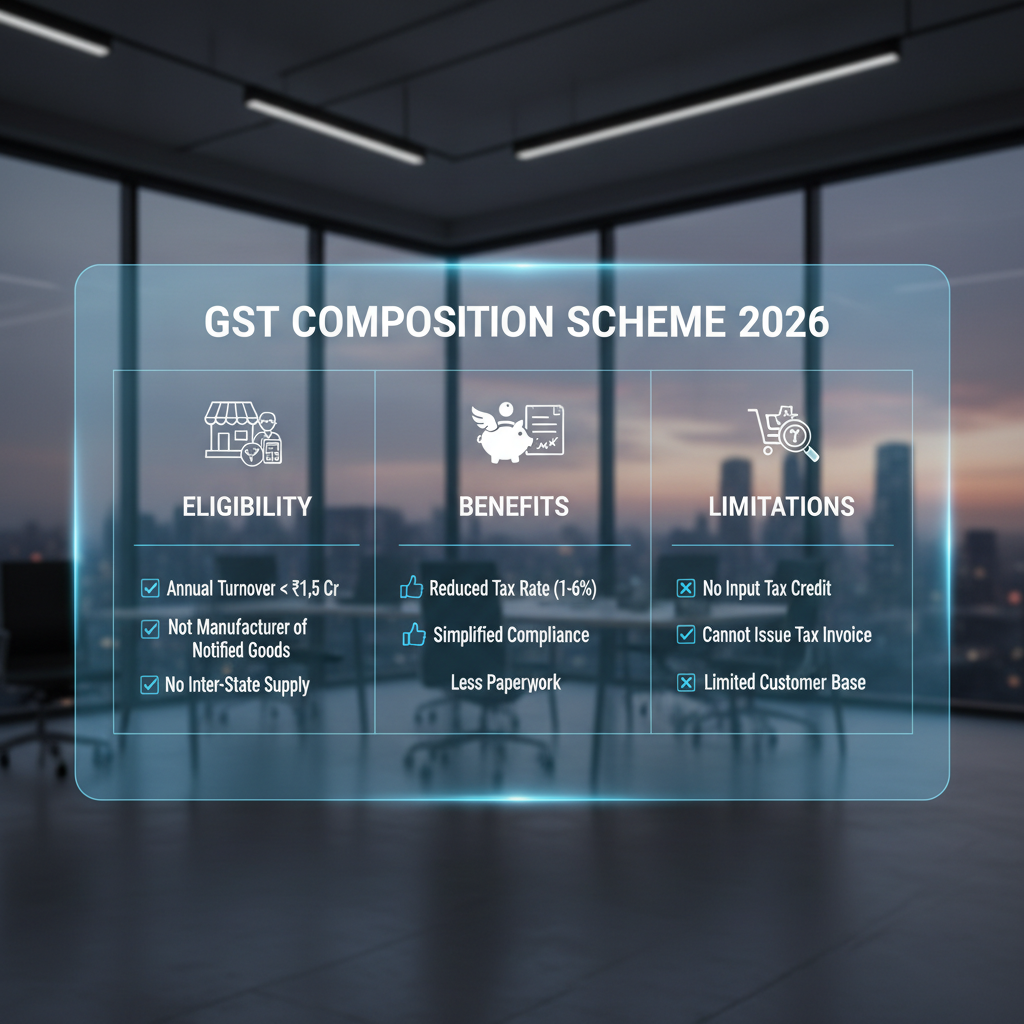
As of 2026, the turnover limits remain largely consistent with recent amendments, providing stability for long-term planning. To qualify for the GST composition scheme eligibility and benefits, a taxpayer must meet the following criteria based on the turnover in the preceding financial year:
- Manufacturers and Traders of Goods: The aggregate turnover must not exceed Rs. 1.5 Crore in the preceding financial year.
- Service Providers (or Mixed Suppliers): A separate Composition Scheme exists for service providers. Their aggregate turnover must not exceed Rs. 50 Lakh in the preceding financial year. They pay tax at a slightly higher rate (6%) than goods suppliers.
- Special Category States: For states like Arunachal Pradesh, Meghalaya, Sikkim, Tripura, etc., the turnover limit for goods suppliers is generally capped at Rs. 75 Lakh.
It is important to note that "aggregate turnover" includes the value of all taxable supplies, exempt supplies, exports of goods or services, and interstate supplies of persons having the same Permanent Account Number (PAN), computed on an all-India basis.
Who Cannot Opt for the Scheme?
While the scheme offers tremendous advantages, not all businesses are eligible. Several specific exclusions prevent certain taxpayers from leveraging the GST composition scheme eligibility and benefits:
- Suppliers of services (unless they opt for the specific service provider scheme with the Rs. 50 lakh limit).
- Suppliers who make any inter-state outward supply of goods.
- A manufacturer of certain notified goods (e.g., ice cream, tobacco products, and pan masala).
- Casual taxable persons or non-resident taxable persons.
- Businesses supplying goods through an e-commerce operator who is required to collect TCS (Tax Collected at Source).
Key GST Composition Scheme Benefits for Small Taxpayers
The attraction of the Composition Scheme lies primarily in its promise of simplicity and reduced compliance costs. These advantages are particularly valuable for micro and small businesses that lack dedicated accounting teams.
Minimal Compliance Burden
Instead of filing detailed monthly returns (GSTR-1 and GSTR-3B), composition dealers only need to file one annual return (GSTR-4) and one quarterly statement for tax payment (CMP-08). This drastically cuts down on administrative work and professional fees.
Lower Tax Liability
Composition dealers pay tax at a very low, fixed percentage of their turnover (ranging from 1% to 6%). This lower rate significantly reduces the effective tax burden compared to standard rates (which often range from 12% to 28%).
Enhanced Liquidity
Since the tax rate is low and compliance is quarterly, businesses retain more working capital throughout the year, improving cash flow and liquidity—a critical benefit for growing businesses.
Simple Invoicing
Composition dealers do not need to issue tax invoices. They issue a ‘Bill of Supply’ instead, which is far simpler and does not require detailed tax calculations or HSN codes, further streamlining the sales process.
Compliance Simplified: Tax Rates and Quarterly Filing
One of the most appealing aspects of the scheme is the fixed, nominal tax rate structure. This predictability allows small businesses to easily forecast their tax obligations without complex accounting software.
GST Composition Scheme Tax Rates
The applicable tax rates are based on the category of the registered person:
- Manufacturers and Traders (Goods): 1% of the turnover in the state or union territory (0.5% CGST + 0.5% SGST).
- Restaurants (Not Serving Alcohol): 5% of the turnover in the state or union territory (2.5% CGST + 2.5% SGST).
- Other Service Providers (and Mixed Suppliers) Eligibility: 6% of the turnover in the state or union territory (3% CGST + 3% SGST). This 6% scheme is vital for small service providers who were previously excluded.
A key point emphasized by tax experts is that these rates are applicable to the total turnover, not just the taxable turnover, ensuring administrative ease. If you require assistance in understanding these filing requirements or need help with your application, consider utilizing specialized GST Services.
Quarterly Return Filing (GSTR-4 and CMP-08)
The compliance cycle for a composition dealer is straightforward and centers around two forms:
- Form GST CMP-08 (Quarterly Statement): This is a statement cum challan used for the payment of tax every quarter. The tax must be paid by the 18th day of the month succeeding the quarter. For instance, tax for the April-June quarter must be paid by July 18th.
- Form GSTR-4 (Annual Return): This is the consolidated annual return detailing the total turnover, taxes paid, and the details of inward supplies (purchases). This must be filed by April 30th following the end of the financial year.
This shift from monthly to quarterly payments and annual filing significantly reduces the compliance burden, freeing up valuable time and resources for the business owner. According to the Central Board of Indirect Taxes and Customs (CBIC), the simplified return process is aimed at boosting compliance among MSMEs. Refer to the official CBIC guidelines for detailed rules on filing deadlines.
Limitations and Restrictions of the Composition Scheme
While the Composition Scheme offers undeniable benefits, it comes with specific trade-offs that business owners must carefully weigh. The most significant limitation relates to Input Tax Credit (ITC).
The Critical Constraint: No Input Tax Credit (ITC)
A composition dealer cannot claim Input Tax Credit on the purchases they make. This means that the GST paid on raw materials, services, or capital goods cannot be utilized to offset the output tax liability. This restriction is the primary reason why businesses dealing in B2B (Business-to-Business) transactions often choose the regular scheme, even if their turnover is below the limit.
Furthermore, composition dealers are prohibited from charging GST to their customers. They must absorb the tax liability themselves, paying it out of their own pocket based on their turnover.
Other Key Restrictions
- No Interstate Supply: Composition dealers cannot sell goods or services to customers outside their home state. Their market is restricted to intra-state transactions.
- No Export Sales: Exports of goods or services are strictly prohibited under this scheme.
- No B2B Invoicing: Since they cannot charge GST, they cannot issue tax invoices. This means their B2B buyers also cannot claim ITC on purchases made from a composition dealer, often making the composition dealer less attractive to corporate buyers.
Regular GST Scheme
- Tax Rate: Standard rates (5% to 28%).
- ITC: Full eligibility for claiming Input Tax Credit.
- Market: Can supply goods/services across states (interstate).
- Compliance: Monthly filing (GSTR-1, GSTR-3B).
- Invoicing: Issues Tax Invoices, enabling B2B buyers to claim ITC.
GST Composition Scheme
- Tax Rate: Low fixed rates (1%, 5%, or 6%).
- ITC: Not eligible to claim Input Tax Credit.
- Market: Restricted to intra-state supply only.
- Compliance: Quarterly payment (CMP-08) and Annual return (GSTR-4).
- Invoicing: Issues Bill of Supply, B2B buyers cannot claim ITC.
Navigating the Application Process and Key Decisions
Choosing the Composition Scheme is a strategic decision that depends heavily on the nature of your business and your customer base. A business that primarily sells directly to end consumers (B2C) and has low input costs will likely benefit immensely from the reduced tax rate and compliance burden.
Conversely, if your business primarily sells to other registered businesses (B2B) or involves high import costs where ITC is significant, the regular scheme might be financially superior, despite the increased compliance requirements.
Steps to Opt-In
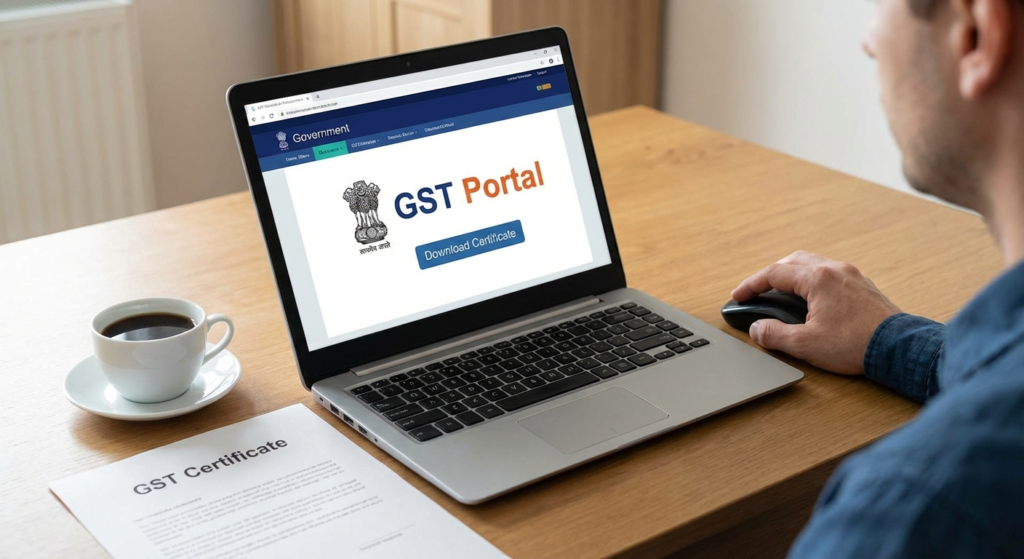
A registered taxpayer intending to opt for the Composition Scheme must file Form GST CMP-02 electronically on the GST Portal. This must be done before the commencement of the financial year for which the option is exercised. For new businesses applying for GST registration online, they can indicate their intent in Part B of the registration application (Form GST REG-01).
It is paramount that businesses continually monitor their turnover. If the turnover exceeds the prescribed limit (Rs. 1.5 crore or Rs. 50 lakh) at any point during the financial year, the taxpayer must immediately switch to the regular GST scheme and file Form GST CMP-04.
"The Composition Scheme is the government’s recognition that compliance complexity is a major non-monetary cost for small businesses. Leveraging this scheme correctly can translate directly into operational efficiency and higher profit margins for B2C-focused entities."
The revised rules for the GST composition scheme eligibility and benefits for service providers (6% rate) have been a game-changer, allowing smaller consultants, freelancers, and other service sector entities to access streamlined compliance. This is particularly important as India’s service economy continues to grow robustly. Financial analysts often highlight the positive impact of this 6% scheme on micro-service businesses.
Conclusion
The GST Composition Scheme remains an essential pillar of tax simplification in India, offering small businesses a clear path to reduced compliance and predictable tax payments. By thoroughly understanding the GST composition scheme eligibility and benefits, particularly the turnover limits (Rs. 1.5 Cr for goods, Rs. 50 Lakh for services) and the critical restriction on Input Tax Credit, business owners can confidently decide whether this simplified framework aligns with their strategic goals for 2026. For those focused on local B2C sales and operational simplicity, the Composition Scheme is undoubtedly the superior choice.
FAQs
Yes, you can. If your primary business is the supply of goods and the value of your services (other than restaurant services) does not exceed 10% of the turnover in the preceding financial year (or Rs. 5 lakh, whichever is higher), you can opt for the 1% Composition Scheme. Otherwise, you must opt for the 6% scheme designed for service providers/mixed suppliers, provided your turnover is below Rs. 50 Lakh.
If your aggregate turnover crosses the threshold (e.g., Rs. 1.5 Crore or Rs. 50 Lakh) during the financial year, you must immediately inform the authorities by filing Form GST CMP-04. You will then be required to switch to the regular GST scheme and comply with the standard filing requirements from the date the turnover limit was exceeded.
No. Composition dealers are strictly prohibited from collecting GST from their customers. They must pay the fixed percentage tax out of their own pocket based on their gross turnover. They must mention ‘Composition Taxable Person, not eligible to collect tax on supplies’ on their Bill of Supply.
No. A significant limitation of the Composition Scheme is the restriction on interstate outward supplies. If your business involves selling goods or services to customers located outside your home state, you are ineligible and must register under the regular GST scheme.
CMP-08 is the quarterly statement and challan used solely for the payment of the fixed composition tax liability. GSTR-4 is the annual return that provides a comprehensive summary of the total turnover, tax payments made via CMP-08, and details of inward supplies (purchases) for the entire financial year.