Navigating the Crucial GST Cancellation Filing Steps
For businesses operating under the Goods and Services Tax (GST) regime in India, compliance is paramount. However, circumstances change. A business might close down, change its constitution, or perhaps the aggregate turnover drops permanently below the mandatory registration threshold. In these scenarios, maintaining an active GST registration becomes an unnecessary administrative and financial burden.
Understanding the precise GST cancellation filing steps is essential to ensure a smooth, legal exit from the regime without inviting future penalties or demands. Unlike the initial process of GST Registration, cancellation requires careful handling of final returns and tax liabilities. This comprehensive guide details every step, timeline, and compliance requirement needed to successfully surrender your GST registration.
The process, governed primarily by the CGST Rules, 2017, involves submitting an application, settling pending liabilities, and receiving formal acceptance from the tax authority. Failure to follow the correct GST cancellation filing steps can leave the business liable for ongoing compliance obligations, even if the business activity has ceased.
When Should You Consider GST Cancellation Filing Steps?
The decision to initiate the GST cancellation process should not be taken lightly. It signifies a significant change in the business’s compliance status. There are specific circumstances under which cancellation is necessary or permissible.
Voluntary Cancellation (Taxpayer Initiated)
This occurs when the registered person chooses to surrender their registration. Common reasons include cessation of business, transfer of business (merger/amalgamation), or a change in the constitution of the business (e.g., a partnership converting to a sole proprietorship, if the new entity registers separately). The most frequent reason is when turnover falls below the prescribed threshold.
Mandatory Cancellation (Officer Initiated/Suo Moto)
The proper officer may initiate cancellation if the taxpayer fails to comply with GST regulations. Examples include:
- Non-filing of GST returns for a continuous period (six months for regular taxpayers, three periods for composition scheme dealers).
- Non-commencement of business within six months of registration (if registered voluntarily).
- Fraud, wilful misstatement, or suppression of facts.
- Violation of anti-profiteering provisions.
Change in Business Structure
If a proprietorship firm is dissolved, or if a company undergoes a major restructuring where the GSTIN changes, the old registration must be formally cancelled. This ensures the compliance burden shifts correctly to the new entity.
Key Prerequisites Before Starting the GST Cancellation Filing Steps
Before submitting Form GST REG-16, ensure you have addressed the following foundational requirements:
- Filing of All Pending Returns: All GSTR-3B and GSTR-1 returns up to the date of application must be filed. The portal will not allow cancellation if returns are pending.
- Settlement of Tax Liability: Any outstanding tax, interest, or penalty must be paid.
- Input Tax Credit (ITC) Reversal: You must reverse the ITC on the stock held on the date of cancellation, including capital goods. This liability is reported in the final return, GSTR-10.
The Step-by-Step Guide to GST Cancellation Filing Steps (Form GST REG-16)
The application for voluntary cancellation of GST registration is filed electronically using Form GST REG-16 on the official GST portal. This process is detailed and requires accurate submission of financial data related to inventory and liabilities.
Initiating the Application: Form GST REG-16 Submission
The following sequence outlines the precise GST cancellation filing steps an applicant must follow:
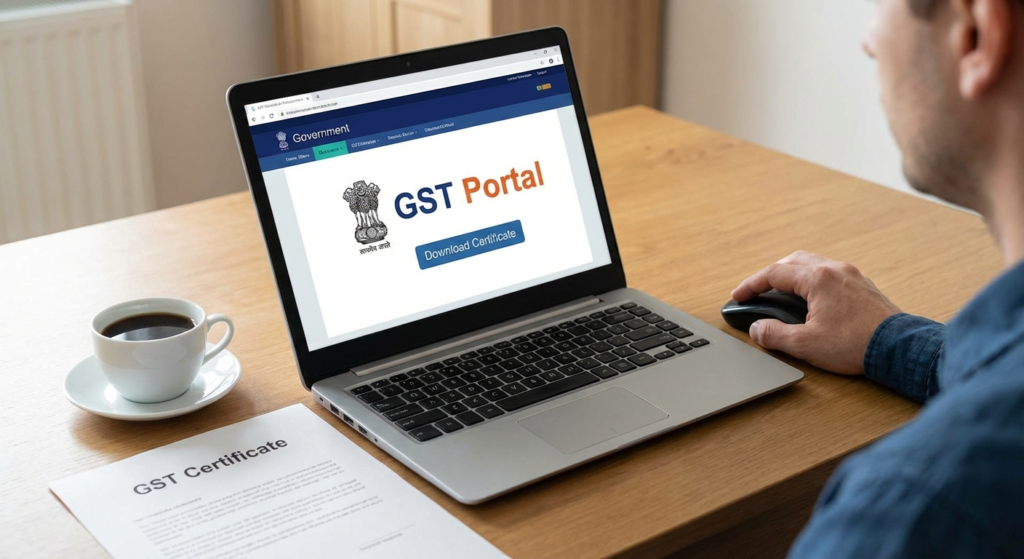
- Login to the GST Portal: Access the official GST portal using your credentials.
- Navigate to Cancellation Application: Go to Services > Registration > Application for Cancellation of Registration (Form GST REG-16).
- Provide Basic Details: The application form will auto-populate basic details like your legal and trade name. You must select the appropriate reason for cancellation from the dropdown menu (e.g., Discontinuance of business, Transfer of business, etc.).
- Specify Date of Cessation: Enter the date from which you wish the cancellation to be effective. This cannot be a date in the future.
- Provide Details of ITC Reversal: This is the most crucial step. You must calculate and declare the amount of ITC reversal required on capital goods, plant and machinery, and finished/semi-finished goods held in stock on the date of cessation.
- Input Tax Payable: You must calculate the tax payable (output liability) or the ITC reversal amount, whichever is higher, and ensure this liability is settled through the electronic cash or credit ledger.
- Details of Final Return (GSTR-10): Although GSTR-10 is filed after the cancellation order, the application requires acknowledgement that you understand the requirement to file GSTR-10 within three months of the date of the cancellation order.
- Verification and Submission: Verify all information and submit the application using DSC (Digital Signature Certificate) or EVC (Electronic Verification Code).
Upon successful submission of Form GST REG-16, an Application Reference Number (ARN) will be generated, which can be used to track the status of the application.
Expert Insight: “Accurate computation of Input Tax Credit reversal is the cornerstone of a successful GST cancellation application. Any discrepancy here can lead to delays or the rejection of the application by the Proper Officer.”
Understanding Notices and Timelines in the GST Cancellation Filing Steps
Once the application is submitted, the Proper Officer reviews the submission. If the application is incomplete or if they require clarification, they will issue a notice. Alternatively, if the officer initiates the cancellation themselves (suo moto), a different set of forms and timelines applies.
Dealing with Suo Moto Cancellation Notices (GST REG-17/19)
If the tax authorities believe you have violated compliance norms (e.g., non-filing of returns), they will issue a show cause notice (SCN) in Form GST REG-17, requiring you to explain why your registration should not be cancelled.
- Response to SCN: You must reply to the SCN within seven working days using Form GST REG-18, justifying your compliance or rectifying the non-compliance (e.g., filing pending returns).
- Officer Review: If the officer finds the reply satisfactory, they drop the proceedings using Form GST REG-20.
- Cancellation Order: If the reply is unsatisfactory, the officer proceeds with the cancellation order using Form GST REG-19.
This officer-initiated cancellation route is often more stressful and requires immediate corrective action to avoid losing registration status.
Key Timelines for the Cancellation Process
Adhering to strict timelines is crucial, especially when responding to official notices.
Timeline 1: Officer Review (Voluntary)
The Proper Officer must issue an order for cancellation (Form GST REG-05 or REG-19) within 30 days of receiving the application (REG-16) or the clarification (REG-18).
Timeline 2: Response to SCN (Suo Moto)
If you receive a Show Cause Notice (REG-17), you have 7 working days to file your response (REG-18).
Timeline 3: Filing the Final Return (GSTR-10)
The final return (GSTR-10) must be filed within three months from the date of the cancellation order (REG-19) or the date of the cessation of business, whichever is later. Failure to file GSTR-10 will result in late fees.
Timeline 4: Revocation Window
If your GST registration was cancelled by the officer (suo moto), you have 90 days from the date of the cancellation order to apply for the revocation of cancellation (Form GST REG-21), provided you have addressed all underlying non-compliance issues.
Post-Cancellation Compliance Requirements (GSTR-10)
The issuance of the cancellation order (Form GST REG-19) does not mark the end of your obligations. Every registered person whose registration is cancelled must file a final return in Form GSTR-10.
GSTR-10 provides a summary of all tax liabilities and Input Tax Credit (ITC) reversals for the period leading up to the effective date of cancellation. This return is mandatory, even if the business had no operations during the final period. Failure to file GSTR-10 can lead to a continuous levy of late fees and penalties, potentially hindering future attempts to restart business or obtain clean records.
If you are an MSME or dealing with complex compliance issues, professional assistance can streamline this process. For instance, managing various compliance filings related to business structures, such as incorporation of a private company, often necessitates a clear understanding of tax exits.
Liabilities on Stock Held
A critical component of GSTR-10 is the settlement of liability on stock. Under Section 29(5) of the CGST Act, 2017, when a registration is cancelled, the taxpayer must pay an amount equivalent to:
- The ITC taken on inputs, semi-finished goods, and finished goods held in stock on the date of cancellation; OR
- The output tax payable on such goods.
The higher of the two amounts must be paid. This rule prevents taxpayers from exiting the regime while retaining the benefit of unutilized input tax credits on goods that will no longer attract GST upon sale.
Revocation of GST Cancellation
If your registration was cancelled by the Proper Officer (suo moto) due to non-compliance, but you wish to continue the business, you can apply for the revocation of cancellation. This application is filed in Form GST REG-21.
The key requirement for successful revocation is the rectification of the initial cause for cancellation. This usually means filing all pending returns (including GSTR-3B and GSTR-1) and paying all associated taxes, interest, penalties, and late fees. The application must be filed within 90 days of the service of the cancellation order. The officer will review the application and, if satisfied, issue an order for revocation (GST REG-22), restoring the GSTIN.
The timely adherence to compliance requirements is vital for businesses. For deeper understanding of regulatory processes, refer to reliable government resources, such as the Central Board of Indirect Taxes and Customs (CBIC) official guidelines, which provide detailed rules regarding all GST forms and procedures.
The process of GST cancellation, while procedural, is critical for businesses winding down operations or simplifying their tax structure. By following the precise GST cancellation filing steps, taxpayers can ensure a clean break from the compliance cycle and avoid future litigation. Proper documentation and timely filing of GSTR-10 are the final safeguards in this journey.
According to reports published in authoritative financial media, like this recent analysis by Business Standard on tax compliance, simplifying exit procedures remains a priority for the government to foster ease of doing business, making the accurate filing of cancellation requests even more pertinent for taxpayers.
Effective tax management requires proactive planning, whether it involves cancellation or ensuring documents like Form 16A are correctly utilized for credit purposes, as detailed in guides like The Definitive Guide to Download Form 16A Online.
Conclusion: Ensuring a Clean Exit through Proper Filing
The GST cancellation filing steps are designed to be thorough, ensuring that all liabilities accumulated during the period of registration are accounted for before the GSTIN is surrendered. Whether voluntary or mandatory, the key to a successful cancellation lies in the accurate preparation and timely submission of Form GST REG-16, followed by the compulsory filing of the final return, GSTR-10. By addressing pending returns and settling ITC liabilities upfront, businesses can minimize scrutiny and quickly finalize their tax exit, freeing themselves from the perpetual burden of GST compliance.
FAQs
Yes, GSTR-10 (Final Return) is mandatory for every taxpayer whose GST registration has been cancelled, regardless of whether the cancellation was voluntary or initiated by the tax authorities. It must be filed within three months of the date of the cancellation order or the date of cessation of business, whichever is later.
Upon cancellation, any unutilized ITC balance in the electronic credit ledger must be reversed. Furthermore, you must reverse the ITC proportional to the stock (inputs, semi-finished, or finished goods) and capital goods held on the effective date of cancellation. This liability must be discharged through your electronic cash ledger.
The cancellation process typically takes around 30 days from the date of application submission (Form GST REG-16), provided the application is complete, all pending returns are filed, and there are no discrepancies found by the Proper Officer. Delays occur if notices (REG-03) are issued requiring clarification.
Yes. If the Proper Officer cancelled your registration (suo moto), you can apply for revocation using Form GST REG-21 within 90 days of the date of the cancellation order. You must first resolve the reason for cancellation (e.g., file all overdue returns and pay associated dues) before applying for revocation.
The effective date of cancellation is generally the date you specify in your application (Form GST REG-16) for voluntary cancellation. However, if the registration is cancelled suo moto by the officer, the effective date is determined by the Proper Officer and specified in the cancellation order (REG-19).
Read Also:
- The Comprehensive Guide to Obtaining and Using TAN for TDS Filing Compliance
- Mastering the GST Late Fee Calculation: Penalenses, Caps, and How to Minimize Compliance Costs
- The Complete Guide to the 12A 80G Registration Process: Benefits, Eligibility, and Documentation
- Decoding the MSME 45 Days Rule: Section 43B(h) Impact on Timely Payments and Buyer Compliance