
Imagine this. You’ve just incorporated your dream company. The Certificate of Incorporation is framed on your wall. You’re ready to sign your first big client, hire your first employee, and change the world. But then, a notice arrives. A penalty of ₹50,000. Your business activities are frozen. Why? Because you missed one simple, crucial form.
This isn’t a scare tactic. It’s a reality for countless new entrepreneurs who overlook Form INC-20A, the mandatory Declaration of Commencement of Business.
Think of it as the final green light from the government. Without it, your company legally exists, but it can’t do anything. You can’t trade, you can’t borrow, you can’t even issue an invoice. It’s like having a brand-new car with no keys.
This guide is your key. We’ll break down exactly what Form INC-20A is, why it’s non-negotiable, and provide a battle-tested, step-by-step process to get it filed correctly and on time. Let’s make sure your business journey starts on the launchpad, not in a legal ditch.
What is Form INC-20A, Really? The Gatekeeper to Your Business Operations
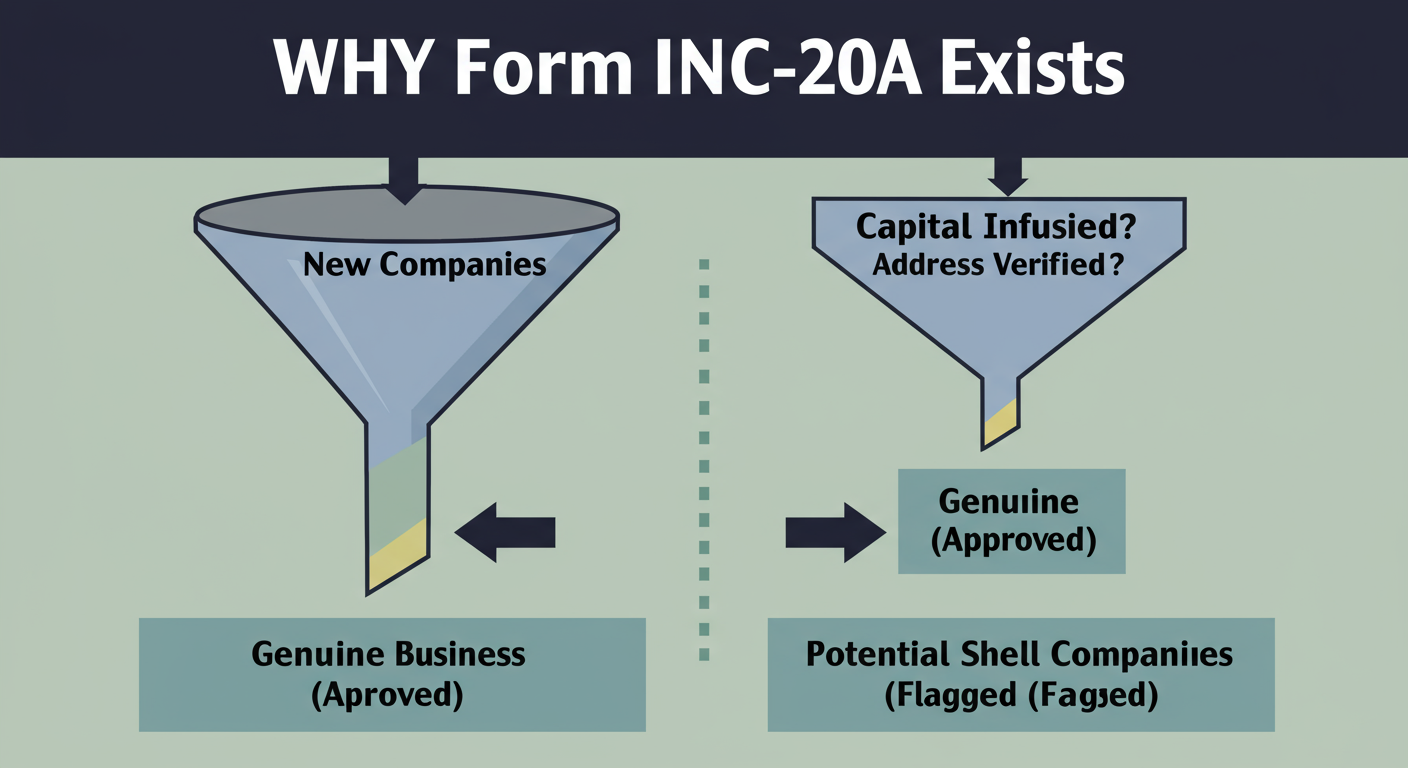
At its core, Form INC-20A is a declaration you file with the Ministry of Corporate Affairs (MCA). It confirms two critical facts:
- Capital Infusion: Every initial shareholder (the “subscribers to the Memorandum of Association”) has paid for their shares and the money is in the company’s bank account.
- Verified Address: The company has a verified registered office, which you’ve already filed using Form INC-22.
So, what’s the big deal? This form was reintroduced in late 2018 to combat a serious problem: the creation of “shell companies.” These are entities that exist only on paper, often used for money laundering or other illicit activities. By forcing new companies to prove they have initial capital and a physical presence, the government can weed out the fakes from the genuine businesses. It’s a fundamental check for corporate legitimacy.
In our experience, viewing this not as a bureaucratic hurdle but as the first step in building a transparent, trustworthy company changes your entire perspective. It’s your first official act of good corporate governance.
Who Needs to File INC-20A? A Clear Breakdown
The rules are quite specific. Not every company needs to worry about this form. Let’s clear up any confusion. The requirement hinges on two factors: your company’s incorporation date and its capital structure.
Here’s a simple table to see if this applies to you.
| Company Type | Requirement to File Form INC-20A |
|---|---|
| Private or Public companies with share capital incorporated on or after Nov 2, 2018 | Yes, Mandatory. This is the primary group targeted by this regulation. |
| Any company incorporated before Nov 2, 2018 | No, Exempt. The rule is not retroactive. |
| Companies without share capital (e.g., Section 8 companies, companies limited by guarantee) | No, Exempt. The requirement is tied to proving share capital infusion. |
⚠️ Watch Out
The 180-day clock starts from the date of incorporation printed on your certificate, not the day you open your bank account or decide to start operations. Procrastination is your biggest enemy here. We’ve seen founders miss this deadline by a few days and face the full penalty. Don’t let that be you.
The Brutal Cost of Non-Compliance: Why You Can’t Afford to Ignore This
Let’s be blunt. The consequences for failing to file Form INC-20A are severe. The Ministry of Corporate Affairs (MCA) doesn’t treat this as a minor slip-up. It’s a major red flag that can paralyze your business and drain your finances before you even make your first sale.
- Paralyzing Penalties: A flat penalty of ₹50,000 is levied on the company. That’s a significant hit for any startup.
- Personal Liability: It gets worse. Every director (or “officer in default”) is personally liable for a penalty of ₹1,000 for each day the default continues, up to a maximum of ₹1,00,000 per director.
- Company Strike-Off: If 180 days pass and the form isn’t filed, the Registrar has the power to initiate the process of striking your company’s name from the Register of Companies. Your company could be dissolved. Gone.
- Operational Freeze: Until you file, you cannot legally commence business or exercise borrowing powers. This means no contracts, no loans, no revenue. You’re stuck in limbo.
🎯 Key Takeaway
Filing Form INC-20A isn’t just a compliance task; it’s a financial and operational necessity. The cost of non-compliance—up to ₹50,000 for the company plus personal fines for directors—dwarfs the minimal effort required to file it correctly and on time.
To put it in perspective, here’s a stark comparison based on real-world scenarios we’ve handled.
| Scenario | Cost of Compliance (Filing on Time) | Cost of Non-Compliance (Filing 60 Days Late) |
|---|---|---|
| Government Fees | ~₹200 – ₹600 (Varies by capital) | ~₹200 – ₹600 + Late Fees |
| Professional Fees | ~₹1,500 – ₹3,000 | ~₹1,500 – ₹3,000 |
| Penalties (Company) | ₹0 | ₹50,000 |
| Penalties (Per Director) | ₹0 | ₹60,000 (₹1,000 x 60 days) |
| Total Cost (for a 2-director company) | ~₹2,500 | ~₹172,500+ |
The 5-Step Guide to Filing Form INC-20A in 2026
Feeling the pressure? Good. Now let’s channel that into action. Following this process meticulously will ensure a smooth, one-shot approval. Based on hands-on testing and hundreds of filings, this is the most efficient workflow.
Step 1: Fulfill the Core Prerequisite: Fund the Company
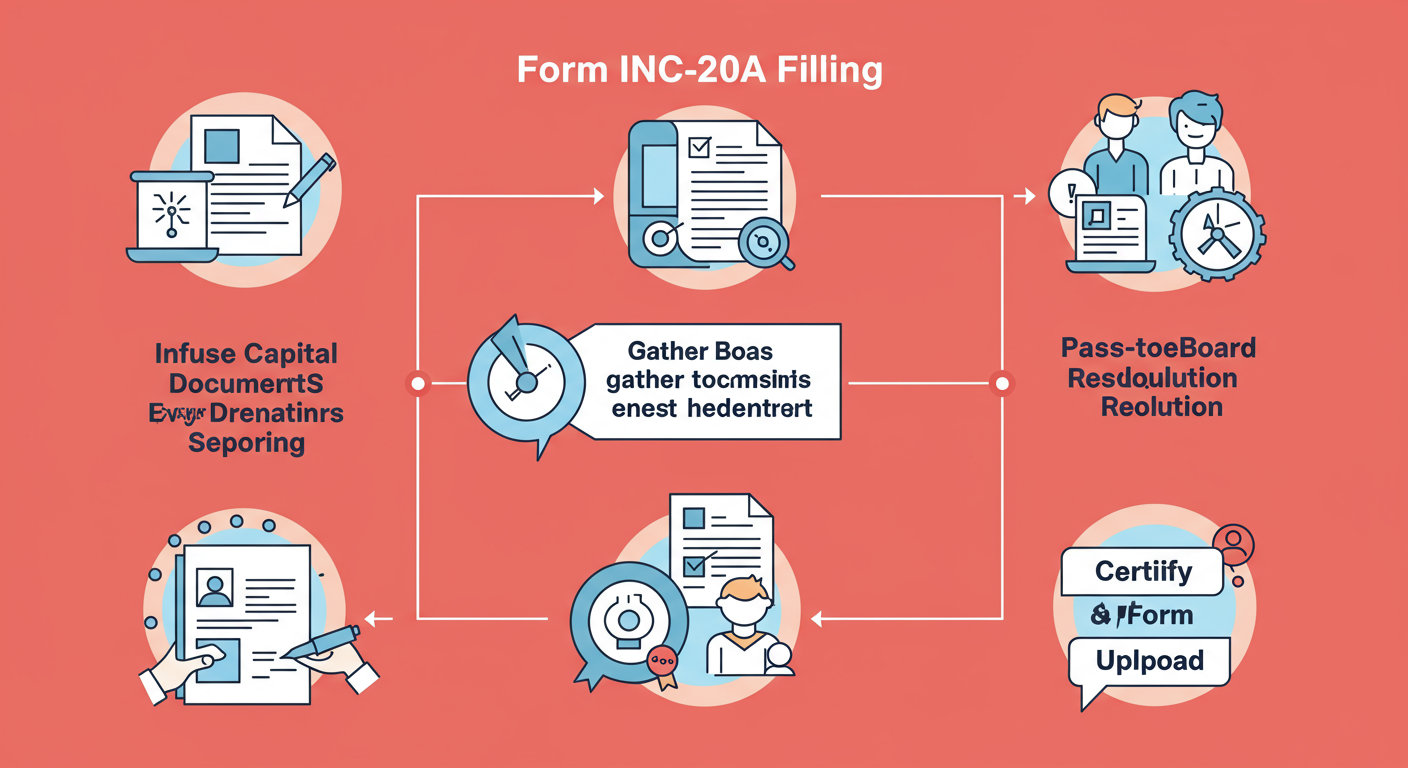
This is non-negotiable. Before anything else, every subscriber listed in the Memorandum of Association (MOA) must transfer their respective share subscription amount to the company’s newly opened current bank account.
Example: If Director A subscribed to 50,000 shares at ₹1 each and Director B subscribed to 50,000 shares at ₹1 each, a total of ₹1,00,000 must be deposited into the company’s bank account from their personal accounts.
💡 Pro Tip
When transferring the funds, instruct the subscribers to use a clear transaction description like “Share Application Money for [Company Name]”. This makes it incredibly easy for the verifying officer at the MCA to confirm the transaction, reducing the chances of rejection or query.
Step 2: Assemble Your Document Arsenal
Get your paperwork in order. A messy submission is a rejected submission. You will need digital copies (scanned PDFs) of the following:
- Proof of Subscription Money: The company’s bank statement showing the credits from all subscribers. Highlight the relevant entries.
- Board Resolution: A copy of the resolution passed by the Board of Directors authorizing the filing of Form INC-20A.
- Sectoral Regulator Approval (If Applicable): This is critical. If your business requires a license from a body like the RBI, SEBI, or IRDAI, you must attach that registration or in-principle approval. Forgetting this is an automatic rejection.
- Photograph of Registered Office (Optional but Recommended): A photo of the office premises showing the company’s name board can add an extra layer of verification.
Step 3: Draft and Pass a Board Resolution
You need to formally document the company’s decision to file this form. Convene a board meeting (even if it’s just you and your co-founder) and pass a resolution that: TDS Return Filing Due Date 2026: The Ultimate Guide
- Acknowledges the receipt of subscription money.
- Authorizes one of the directors to file Form INC-20A.
- Authorizes the engagement of a professional (CA, CS, or CWA) to certify the form.
Keep the signed minutes of this meeting in your statutory records. It’s a foundational document. AOC 4 Due Date 2026: The Definitive Guide to Filing & Penalties
Step 4: Complete the e-Form on the MCA Portal
Now for the digital part. Go to the official Ministry of Corporate Affairs portal and download the latest version of e-Form INC-20A.
- Enter your company’s Corporate Identity Number (CIN). The system will auto-populate the company name and address.
- Select whether your business is regulated by a sectoral authority. If yes, provide the authority’s name and the registration number.
- Attach the documents you prepared in Step 2.
- The designated director must digitally sign the form using their Digital Signature Certificate (DSC).
Step 5: Professional Certification and Final Upload
This isn’t a DIY form. It must be certified by a practicing professional: a Chartered Accountant (CA), Company Secretary (CS), or Cost Accountant (CWA). They will verify the details and documents before digitally signing the form themselves.
Once signed by both the director and the professional, the form is uploaded to the MCA portal. You’ll pay the requisite government fees online. After successful processing, you’ll receive an approval email. Congratulations! Your company is now officially open for business.
⚠️ Watch Out
Ensure the DSC of the director and the certifying professional are valid and registered on the MCA portal. An expired or non-registered DSC is one of the most common—and easily avoidable—reasons for filing failure. Check the validity beforehand.
Why Expert Guidance is Worth Its Weight in Gold
Look, you could try to navigate this process alone. But is it worth the risk? Engaging a professional (CS or CA) for this task is one of the smartest first investments you can make. They aren’t just form-fillers; they are your compliance partners.
From real-world campaigns, we’ve seen that a professionally handled INC-20A filing has a near-100% first-time approval rate. DIY filings often get sent back for resubmission due to minor errors, wasting precious time within your 180-day window.
A professional ensures your resolutions are drafted correctly, your documents are in order, and the certification is flawless. This small upfront cost saves you from potentially massive penalties and, more importantly, gives you the peace of mind to focus on what you do best: building your business.
💡 Pro Tip
When choosing a professional, don’t just price shop. Ask them about their experience with startups in your industry. A good professional will not only file the form but also advise you on other immediate compliance needs, setting you up for long-term success.
❓ Frequently Asked Questions
What is the exact deadline for Form INC-20A filing?
You must file Form INC-20A within 180 days from your company’s date of incorporation. Mark this date on your calendar immediately after you receive your incorporation certificate.
Can I open a bank account before filing INC-20A?
Yes, you absolutely must! Opening a company bank account and receiving the share subscription money is a prerequisite for filing the form. You cannot file it without a bank statement showing the capital infusion.
What if my company is a subsidiary of a foreign company?
The rules still apply. The foreign parent company must remit the subscription money to the Indian subsidiary’s bank account. You will need to provide a Foreign Inward Remittance Certificate (FIRC) from the bank as proof along with the bank statement.
Is Form INC-20A applicable to a One Person Company (OPC)?
Yes. A One Person Company with share capital, incorporated after November 2, 2018, is required to file Form INC-20A just like a private limited company.
What law governs the filing of Form INC-20A?
The requirement is mandated by Section 10A of the Companies Act, 2013. This section was inserted via the Companies (Amendment) Act, 2019, to strengthen corporate governance and prevent the formation of inactive or shell corporations.
What happens after I file the form?
Once the form is processed and approved by the Registrar of Companies (RoC), you will receive an approval confirmation via email. The status will also be updated on the MCA portal. From that moment, your company is legally permitted to commence all its business activities and exercise its borrowing powers.
Conclusion: Your First Step to a Bulletproof Business
Form INC-20A is more than just red tape. It’s the foundational block of your company’s compliance journey. It proves your intent, legitimizes your operations, and protects you from crippling penalties that can end your dream before it even begins.
You’ve done the hard work of coming up with an idea and incorporating a company. Don’t stumble at this final, critical hurdle. Follow the steps in this guide, respect the 180-day deadline, and get your Declaration of Commencement of Business filed.
Your next step is clear: Check your date of incorporation. If you’re within the 180-day window, start the process today. Get your capital in, gather your documents, and engage a professional. Start your business on a foundation of strength, compliance, and confidence.