
Imagine this: You’ve just launched your dream Limited Liability Partnership (LLP). The energy is high, clients are trickling in, and you’re focused on growth. Six months later, a notice arrives from the Ministry of Corporate Affairs (MCA). The subject? A penalty of over ₹15,000 for a filing you barely remember hearing about.
It sounds like a nightmare, but it’s a reality I’ve seen play out for too many new entrepreneurs. The culprit is almost always the same: a missed Form 3 LLP filing.
This isn’t just another piece of bureaucratic red tape. It’s the legal bedrock of your partnership. Getting it wrong—or worse, ignoring it—can cripple your new venture with daily penalties and expose you to future disputes. But don’t worry. By the end of this article, you’ll have a crystal-clear, step-by-step roadmap to nail your Form 3 filing, secure your business, and sleep soundly knowing you’re 100% compliant.
What is Form 3 LLP? (It’s Not Just a Form, It’s Your LLP’s Constitution)
Let’s get one thing straight. While your incorporation documents (like the FiLLiP form) give your LLP its birth certificate, the LLP Agreement—filed via Form 3—gives it a soul and a rulebook. It’s the legally binding constitution that governs how you and your partners operate.
According to Section 23 of the Limited Liability Partnership Act, 2008, every LLP must execute an LLP Agreement and file its details with the Registrar of Companies (RoC). Form 3 is the official vehicle for that filing.
Think of it this way:
- Without Form 3: Your partnership operates on assumptions and verbal agreements. When a disagreement arises (and it will), you have no legal ground to stand on. The default, and often unfavorable, provisions of the LLP Act will apply.
- With Form 3: You have a government-registered document that explicitly defines every critical aspect of your partnership. It’s your single source of truth for everything from who contributes what to how you make decisions.
In our experience, LLPs that treat this filing as a top priority face significantly fewer internal conflicts down the road. It forces you to have the tough conversations upfront.
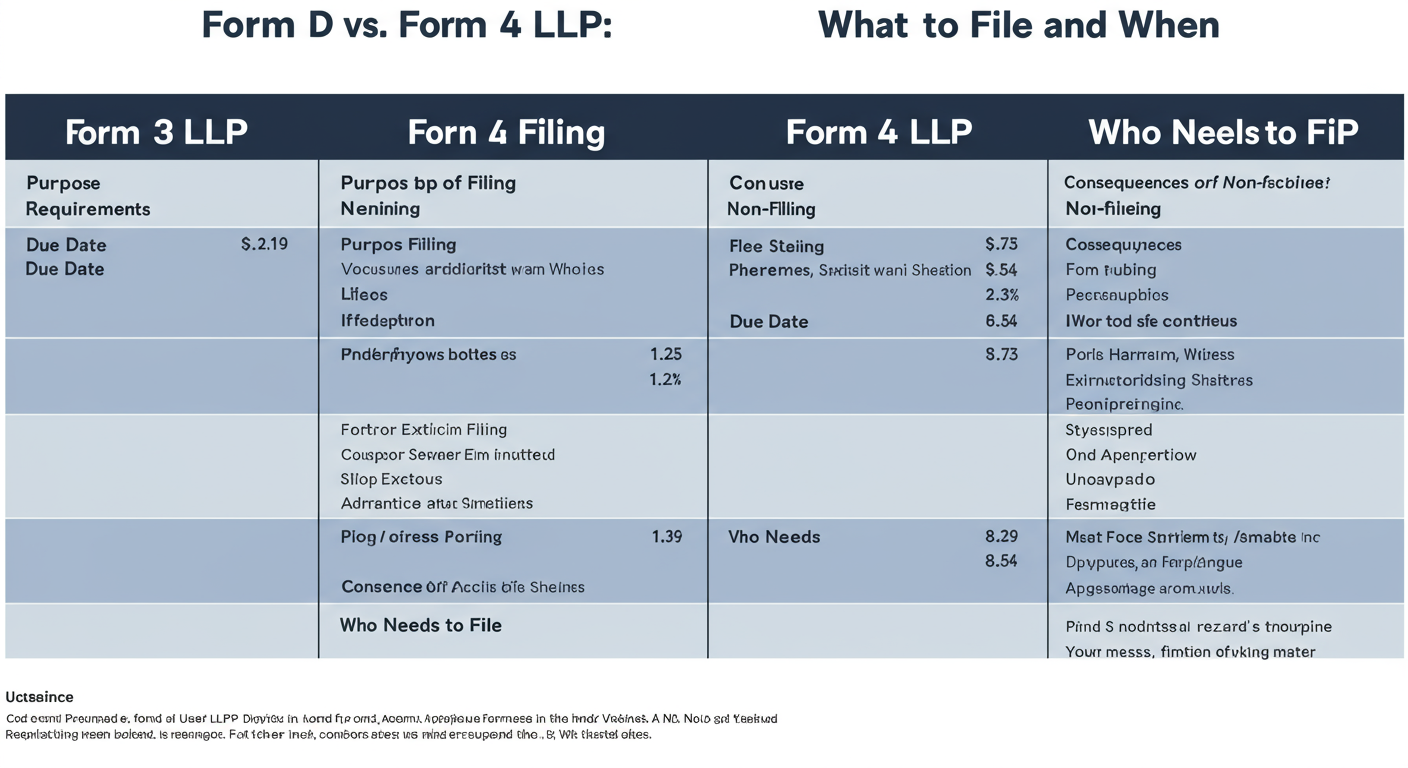
Form 3 vs. Form 4 LLP: Understanding the Critical Difference
One of the most common points of confusion for new LLP owners is the difference between Form 3 and Form 4. Filing the wrong one is a waste of time and money. It’s simple when you break it down:
- Form 3 LLP is about the “What & How” of the business.
- Form 4 LLP is about the “Who” of the business.
Here’s a clearer comparison:
| Aspect | Form 3 LLP | Form 4 LLP |
|---|---|---|
| Primary Purpose | Filing the initial or a modified LLP Agreement. | Notifying changes in Partners or Designated Partners. |
| Triggering Event | – Initial incorporation of the LLP. – Any change in the LLP Agreement (e.g., profit ratios, business scope, capital). |
– Appointing a new partner. – Resignation or removal of a partner. – Change in a partner’s name or address. |
| Core Focus | The LLP’s internal governance, rules, and structure. | The individuals who manage and own the LLP. |
| Key Analogy | Updating the company’s Rulebook. | Changing the Players on the team. |
⚠️ Watch Out
A classic mistake is changing a partner’s role or responsibilities within the LLP Agreement but forgetting to file Form 3. If you only file Form 4 for a partner’s designation change but the underlying rights and duties in the agreement are also modified, you need to file both forms.
The Anatomy of a Bulletproof LLP Agreement
The quality of your Form 3 filing is only as good as the LLP Agreement you attach. A generic, copy-pasted agreement is a recipe for disaster. A robust agreement, which forms the basis of your filing, must be meticulously drafted. It’s a private document that becomes a public record, so precision is key.
Here are the non-negotiable components:
- Official Details: The full name of the LLP, its registered office address, and a clear definition of its main business objectives. Be specific here!
- Capital Contribution: This isn’t just a number. It details the form of contribution (cash, assets, expertise) and the amount from each partner.
- Profit/Loss Sharing Ratio: The exact percentage split. Don’t leave this ambiguous. Is it based on capital, effort, or a hybrid model? Define it.
- Rights & Duties: Who has the final say? What requires a unanimous vote? Outline the powers and limitations of each partner, especially the Designated Partners who hold statutory responsibilities.
- Partner Lifecycle Management: Clear procedures for admitting new partners, and equally important, the terms for a partner’s retirement, resignation, or forced exit. This section prevents messy business “divorces.”
- Dispute Resolution Clause: Your pre-nup for the business. Specify a mechanism like arbitration to resolve disagreements. Trust me, this can save you from years of costly and draining court battles.
💡 Pro Tip
Include a “deadlock” provision in your LLP Agreement. If you have an even number of partners, what happens when a critical vote is tied? A deadlock clause outlines a specific procedure (like mediation or a third-party tie-breaker) to resolve the impasse and keep the business moving.
The Step-by-Step Guide to Form 3 LLP Filing in 2026
Navigating the MCA portal can feel intimidating, but it’s a straightforward process if you follow the steps precisely. Let’s walk through it.
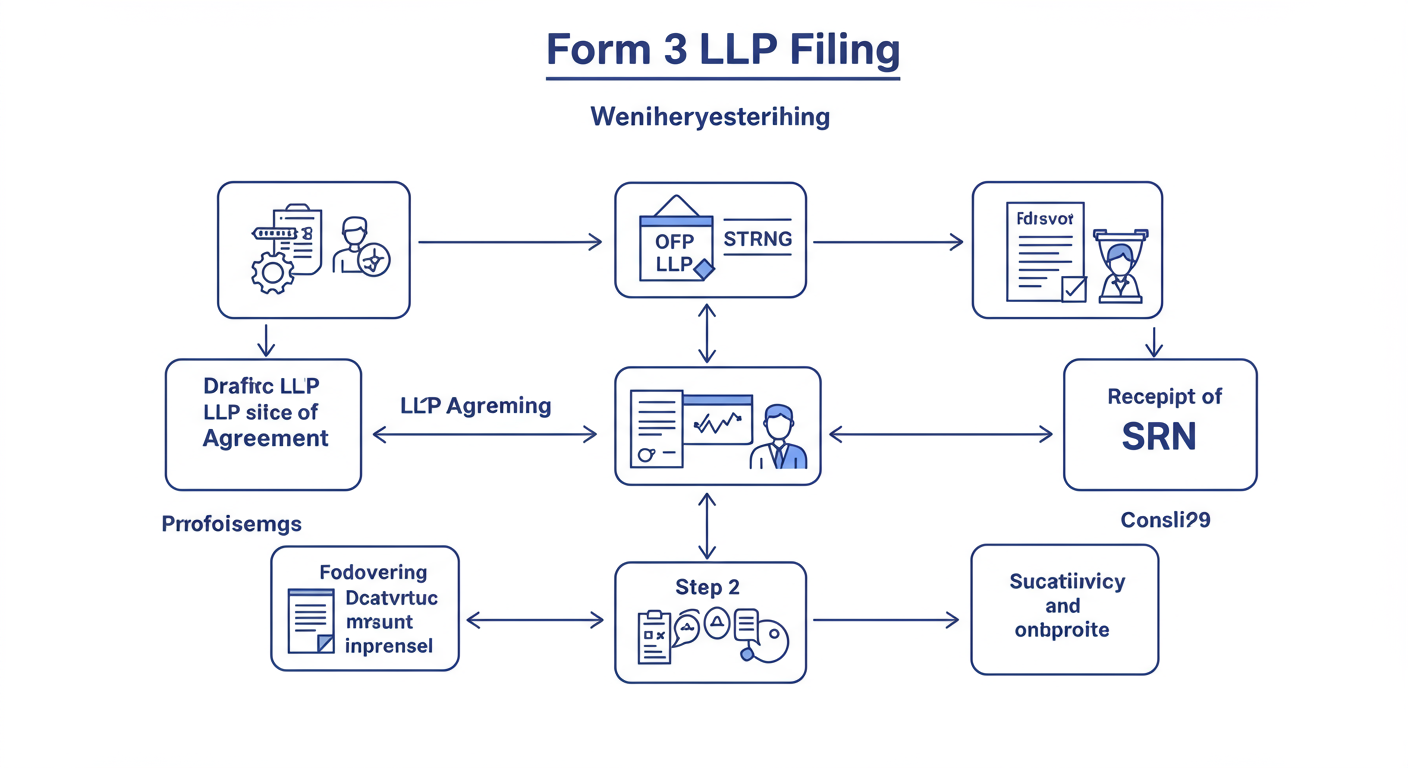
- Draft and Execute the LLP Agreement: This is step zero. Before you even think about the form, get your LLP Agreement professionally drafted. It must be printed on non-judicial stamp paper of the correct value for your state. After printing, all partners must physically sign it.
- Download the E-Form from the MCA Portal: Head over to the official Ministry of Corporate Affairs (MCA) website. Go to the ‘MCA Services’ -> ‘Company E-Filing’ -> ‘LLP Forms Download’ section and get the latest version of ‘Form 3’.
- Fill the E-Form Accurately: Open the PDF form. Enter your LLPIN (Limited Liability Partnership Identification Number), and the LLP name will auto-populate. You’ll need to specify the date of the agreement and state whether it’s the initial agreement or a supplementary one.
- Prepare and Attach the Agreement: Scan the fully signed and stamped LLP Agreement. The scan must be clear and under the file size limit (usually 6 MB). This is the most critical attachment. If you’re filing a supplementary agreement, you must also attach the original agreement.
- Affix Designated Partner DSCs: The form requires the Digital Signature Certificates (DSC) of at least two Designated Partners. This is the electronic equivalent of a signature and authenticates the filing.
- Get Professional Certification: This is mandatory. A practicing professional—a Chartered Accountant (CA), Company Secretary (CS), or Cost Accountant (CWA)—must verify the form’s contents and affix their own DSC. This certification adds a layer of trust and accountability.
- Upload, Pay, and Save the SRN: Log in to your MCA portal account. Upload the completed and signed e-form. The system will calculate the fee based on your LLP’s capital contribution. Pay the fee online. Upon successful payment, an SRN (Service Request Number) is generated. Save this number! It’s your only proof of filing and is used to track the status.
⚠️ Watch Out
DSC errors are the #1 reason for filing rejections. Before you start, ensure your Designated Partners’ DSCs are valid, not expired, and properly registered on the MCA V3 portal. A common issue we see is using a DSC that was registered on the old V2 portal but not re-registered on V3.
The Ticking Time Bomb: Deadlines and Brutal Penalties
This is the part you cannot afford to ignore. The Ultimate Form 24Q Filing Guide: Compliance, Steps, and Accurate Salary TDS Reporting
The deadline for filing Form 3 is brutally simple: within 30 days of your LLP’s incorporation date. Not a business day more. For any subsequent changes to the agreement, the clock resets—you have 30 days from the date the new agreement is executed. MCA Master Data: The Ultimate Guide for Due Diligence (2026)
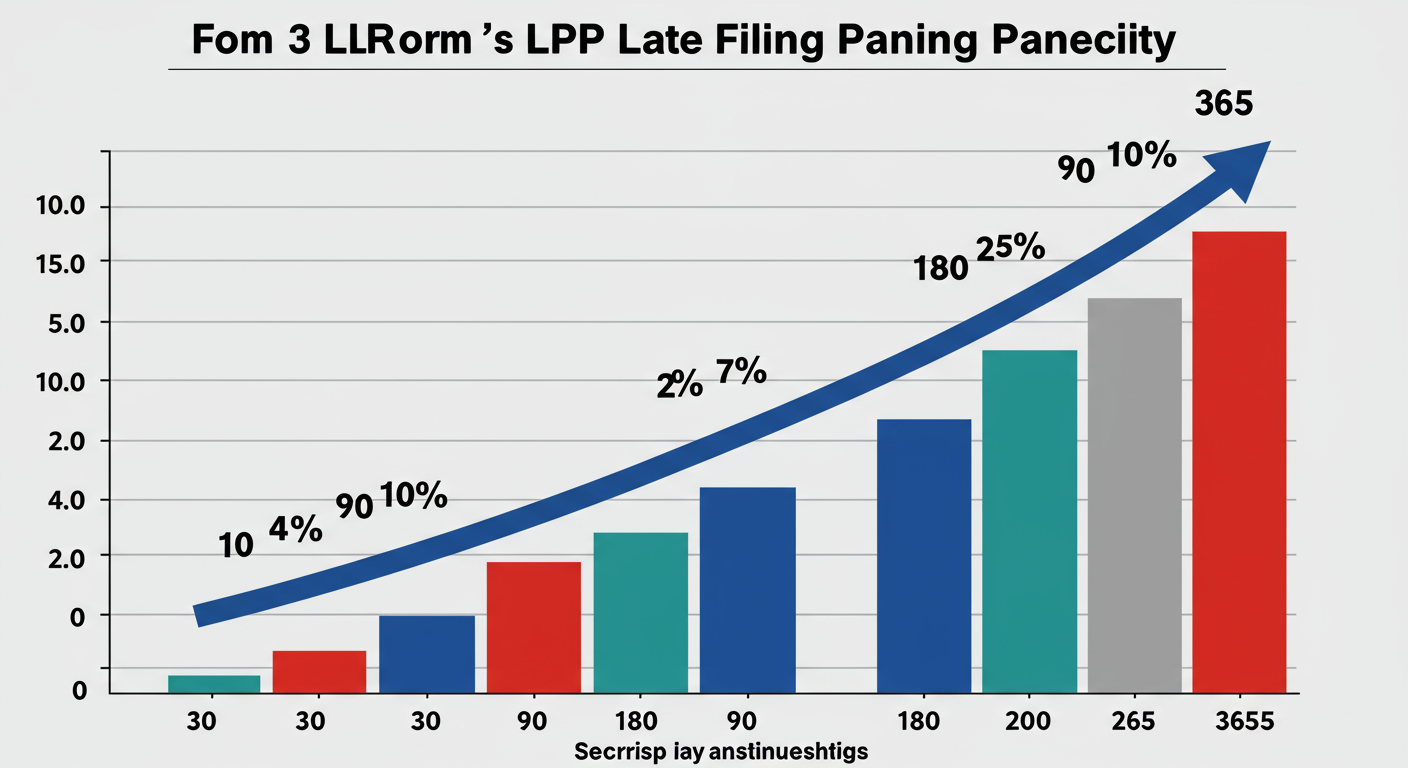
What happens if you’re late? The penalty is a relentless ₹100 per day of delay. And the worst part? There is no upper limit. The penalty keeps accumulating indefinitely until you file.
“Compliance is not a cost; it’s an investment in sustainability.” Forgetting this principle with Form 3 can lead to a completely avoidable five or six-figure penalty.
Let’s see how quickly this “small” penalty can spiral out of control:
| Delay Period | Calculation | Total Penalty |
|---|---|---|
| 30 Days Late (60 days from incorporation) | 30 days x ₹100/day | ₹3,000 |
| 90 Days Late (120 days from incorporation) | 90 days x ₹100/day | ₹9,000 |
| 6 Months Late (~180 days) | 180 days x ₹100/day | ₹18,000 |
| 1 Year Late (~365 days) | 365 days x ₹100/day | ₹36,500 |
🎯 Key Takeaway
Form 3 LLP must be filed within 30 days of incorporation to avoid a crippling, uncapped penalty of ₹100 per day. This filing transforms your LLP Agreement into a legally enforceable constitution, protecting your business from internal disputes and ensuring regulatory compliance from day one.
💡 Pro Tip
When choosing a professional (CA/CS) for certification, don’t just price shop. Ask them about their experience with LLP filings on the new MCA V3 portal. A seasoned professional can spot potential issues in your agreement or filing details that a less experienced person might miss, saving you from a costly resubmission.
❓ Frequently Asked Questions
What is the government fee for filing Form 3 LLP in 2026?
The filing fee is tiered based on your LLP’s total capital contribution. For contributions up to ₹1 lakh, the fee is a nominal ₹50. It increases from there: ₹100 for capital between ₹1 lakh and ₹5 lakh, and so on. The penalty for late filing is a far greater financial concern than the fee itself.
Can I file Form 3 without a signed LLP Agreement?
Absolutely not. The entire purpose of Form 3 is to submit the details of your executed LLP Agreement to the RoC. A scanned copy of the agreement, signed by all partners and properly stamped, is a mandatory attachment. Without it, the form is incomplete and cannot be filed.
What if I make a mistake in the filed Form 3?
Once an e-form is uploaded and the SRN is generated, you can’t edit it. If the RoC approves the form with an error, you’ll typically have to file a new Form 3 with the corrected details, often requiring a fresh supplementary agreement. Based on hands-on testing, it’s far easier to double-check everything meticulously before that final click.
Do all partners need to digitally sign Form 3?
No. The e-form itself only needs to be digitally signed by two Designated Partners. However, the physical LLP Agreement that you scan and attach must be signed by all partners of the LLP. This is a crucial distinction.
What if we don’t have an LLP Agreement?
If you fail to file an LLP Agreement within 30 days, the mutual rights and duties of the partners will be governed by the default provisions laid out in Schedule I of the LLP Act, 2008. These default rules are very basic and may not suit your business needs (e.g., they mandate equal profit sharing, regardless of capital contribution). It’s always better to define your own terms. For more on this structure, you can review the basics of a Limited Liability Partnership on Wikipedia.
Conclusion: Your First and Most Important Post-Incorporation Step
Look, launching a business is chaotic. It’s easy to let compliance slip down the priority list. But as we’ve seen, putting off your Form 3 LLP filing isn’t just procrastination—it’s a direct financial risk and a failure to properly structure your new company.
You’ve done the hard work of bringing your LLP to life. Now, take the final, critical step to protect it. Get your agreement drafted, mark the 30-day deadline in bold on your calendar, and follow the process outlined above.
By treating Form 3 not as a chore but as the foundational act of building a resilient and well-governed business, you’re setting yourself up for long-term success. Get it done, get it right, and get back to what you do best: growing your business.