You’ve found it. The perfect property. The negotiations are done, the loan is approved, and you can already picture your life there. But wait. Before you pop the champagne, there’s a single, crucial piece of tax compliance that trips up countless buyers: Form 26QB.
Get this wrong, and you could be facing penalties that run into lakhs. Get it right, and you ensure a clean, seamless transaction. The problem? Most people treat it as just another piece of paperwork to be rushed through.
That’s a huge mistake.
This isn’t just another guide. This is your definitive playbook for mastering Form 26QB in 2026. We’ll break down the entire process—from the exact calculation to filing the form online and avoiding the hidden traps that cost others dearly. By the end of this article, you’ll handle this critical step with the confidence of a seasoned pro.
What is Form 26QB, Really? (And Why It’s Not Just Paperwork)
Let’s cut through the jargon. Form 26QB is a return-cum-challan form required for paying Tax Deducted at Source (TDS) on the sale of immovable property. It’s mandated by Section 194-IA of the Income Tax Act, and it kicks in for any property transaction valued at ₹50 lakh or more.
Think of it this way: the government wants to track high-value property deals to prevent tax evasion. To do this, they’ve made the buyer responsible for collecting a small portion of the tax upfront. You, the buyer, are essentially acting as a tax agent for this one transaction.
Your job is to deduct 1% of the total sale price from the payment you make to the seller and deposit it with the government using Form 26QB. It’s a non-negotiable legal duty. Trust me on this one, ignoring it is one of the most expensive mistakes a property buyer can make.
The Key Players and Their Roles
Understanding who does what is the first step to getting it right. The process involves three main parties, each with a distinct responsibility.
| Player | Role & Responsibility | Key Action |
|---|---|---|
| The Buyer (You) | Also known as the ‘Deductor’. You are legally responsible for deducting the tax from the sale price. | Deduct 1% TDS, file Form 26QB, pay the tax, and issue Form 16B to the seller. |
| The Seller | Also known as the ‘Deductee’. They receive the sale amount minus the 1% TDS. | Provide their PAN, receive Form 16B, and claim the TDS credit in their income tax return. |
| The Government | The tax authority that receives the TDS payment and tracks the transaction. | Processes the payment and reflects the TDS credit in the seller’s Form 26AS. |
The Core Calculation: Getting the TDS Math Right
The math itself is simple, but a common misunderstanding can lead to big problems. The TDS rate is 1% of the total sale consideration.
Here’s the critical part: If the property value is ₹50 lakh or more, you deduct 1% on the entire amount, not just the amount exceeding ₹50 lakh.
Let’s see a real-world scenario:
- Property Sale Price: ₹90,00,000
- TDS Calculation: 1% of ₹90,00,000 = ₹90,000
- Amount Paid to Seller: ₹90,00,000 – ₹90,000 = ₹89,10,000
- Amount Deposited to Govt (via Form 26QB): ₹90,000
It’s that straightforward. You pay the seller ₹89.10 lakh and remit the remaining ₹90,000 to the tax department.
⚠️ Watch Out: The “No PAN, Big Pain” Scenario
If the seller fails to provide their Permanent Account Number (PAN), the situation changes dramatically. According to Section 206AA of the Income Tax Act, the TDS rate skyrockets from 1% to a punitive 20%. On a ₹90 lakh property, that’s a TDS of ₹18 lakh instead of ₹90,000. Always, always verify the seller’s PAN before making any payment.
💡 Pro Tip: Handling Joint Buyers or Sellers
What if you’re buying with a spouse, or the property has multiple owners? The rule is simple: Form 26QB must be filed for each unique buyer-seller combination. For example, if two buyers purchase from one seller, both buyers must file a separate Form 26QB for their respective share of the purchase. This ensures the TDS is correctly attributed to everyone involved.
The Ultimate 7-Step Guide to Filing Form 26QB Online in 2026
Filing Form 26QB is an entirely online process. Follow these steps precisely, and you’ll be done in no time. Before you start, grab these details—it’ll make everything much smoother:
- PAN of both buyer(s) and seller(s).
- Full address and contact details for everyone.
- Complete address of the property.
- Date of the sale agreement, total sale value, and the date you made the payment.
-
Step 1: Head to the Official e-Filing Portal
Your journey begins at the official Income Tax Department portal. You don’t even need to log in for this. On the homepage, find the ‘e-Pay Tax’ option under ‘Quick Links’ and click on it.
-
Step 2: Select the Right Form
Click on the ‘New Payment’ button. You’ll see a list of tax payment tiles. Scroll down until you find ‘TDS on Sale of Property (Form 26QB)’ and click ‘Proceed’.
-
Step 3: Enter the Transaction Details (The Critical Part)
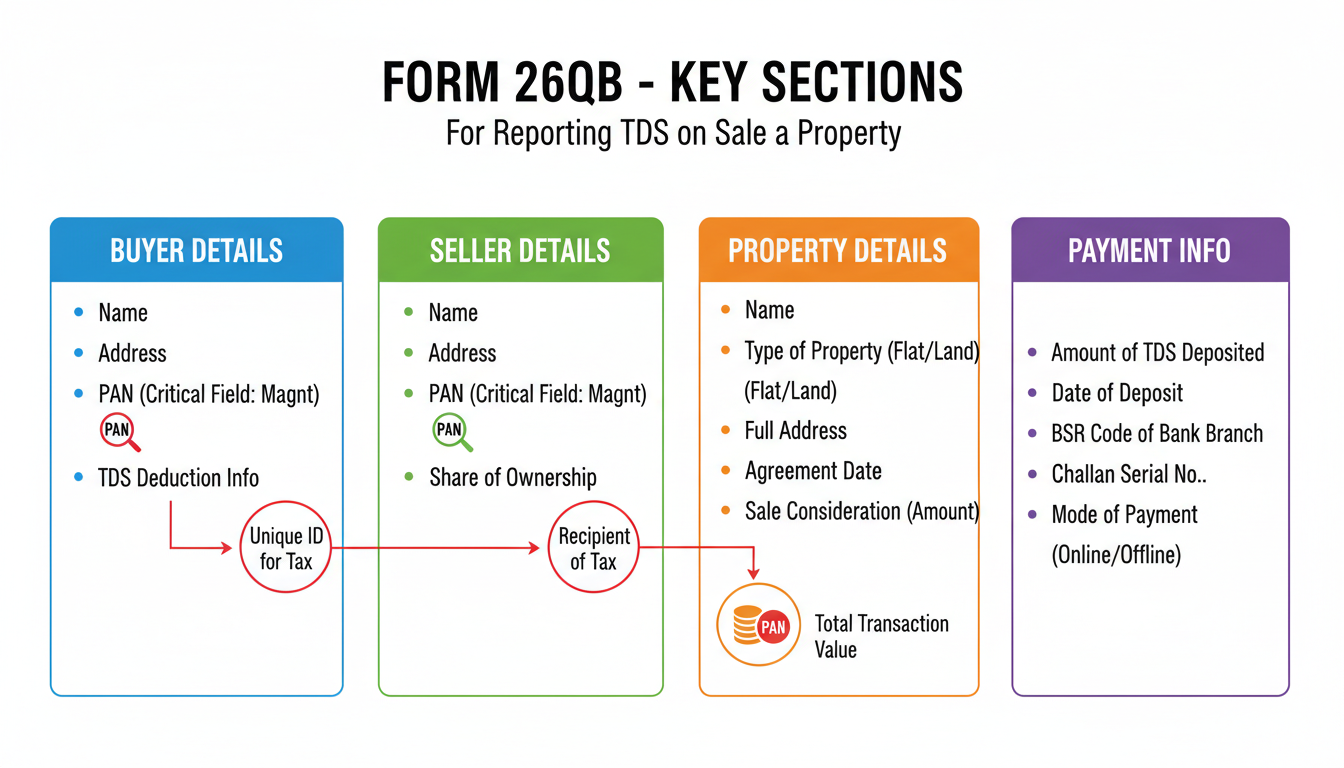
This is where accuracy is king. Double-check every single field. The form is broken into a few parts:
- Buyer’s Details: Enter your PAN, address, and contact info.
- Seller’s Details: Enter the seller’s PAN and details. The system will validate the PAN, so an incorrect one will stop you in your tracks.
- Property Details: Provide the full address of the property being sold.
- Tax & Payment Details: Input the total sale value, the 1% TDS amount, the date of agreement, and the date of payment.
-
Step 4: Choose Your Payment Method
After submitting the details, you’ll be taken to the payment screen. You have several options:
- Net Banking: The easiest and most common method.
- Debit Card: A straightforward card payment.
- Pay at Bank Counter: You can generate a challan and pay with cash or a cheque at an authorized bank branch.
- RTGS/NEFT: For larger amounts, you can generate a mandate form for an RTGS/NEFT transfer.
-
Step 5: Download and Secure Your Proof of Payment
Success! Once your payment is processed, a challan counterfoil is generated. This is your golden ticket. It contains the Challan Identification Number (CIN) and confirms your tax deposit. Download and save this PDF immediately. You’ll need it for the next step. 7 Essential Rules of NRI Taxation India: The 2024 Comprehensive Guide
-
Step 6: Register on the TRACES Portal
Your work isn’t done yet. The next stop is the TRACES portal (TDS Reconciliation Analysis and Correction Enabling System). As the buyer, you need to register here as a ‘Tax Payer’. The registration process will ask for your PAN and the details from the challan you just downloaded. This step is essential for issuing the TDS certificate.
-
Step 7: Download and Issue Form 16B (The Final Step)
After a few days, log in to your TRACES account. Go to the ‘Downloads’ tab and request ‘Form 16B (for Buyer)’. Once the request is processed (usually within a day), you can download the form. This Form 16B is the official TDS certificate. It’s your legal obligation to provide this to the seller as their proof of tax payment.
🎯 Key Takeaway
For any property purchase over ₹50 lakh, the buyer’s duty is threefold: Deduct 1% TDS from the sale price, Deposit it using Form 26QB within 30 days from the end of the payment month, and Document it by issuing Form 16B to the seller. This is a non-negotiable compliance cycle.
Deadlines and Penalties: The High Cost of Getting It Wrong
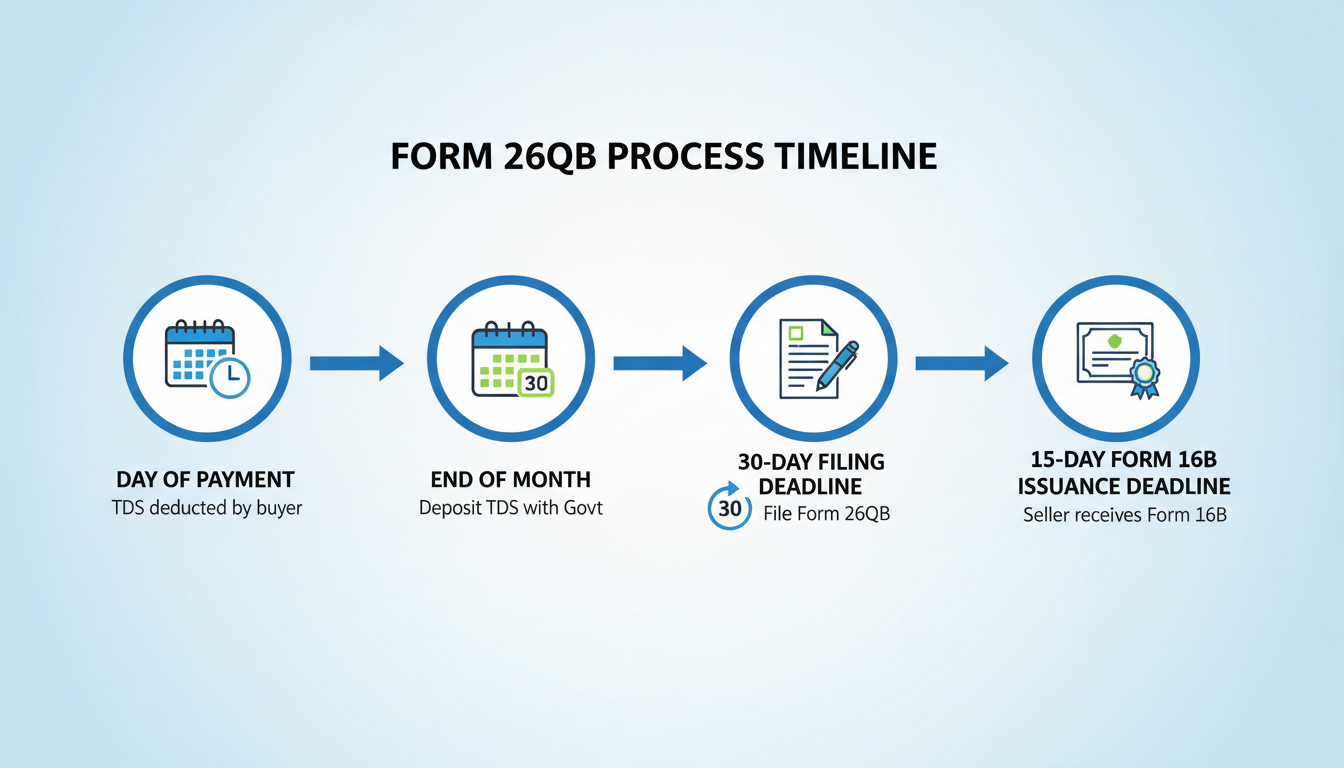
The tax department doesn’t mess around with deadlines. You must file Form 26QB and deposit the TDS within 30 days from the end of the month in which you paid the seller.
For example, if you make the payment on August 10, 2026, your deadline to file and pay is September 30, 2026.
Missing this deadline triggers a cascade of penalties that can quickly become a financial nightmare. Based on real-world cases we’ve handled, these penalties add up fast.
| Type of Default | Penalty / Interest Rate | Governing Section |
|---|---|---|
| Late Deduction of TDS | Interest at 1% per month (or part of a month) | Section 201(1A) |
| Late Deposit of TDS | Interest at 1.5% per month (or part of a month) | Section 201(1A) |
| Late Filing of Form 26QB | Late fee of ₹200 per day of delay | Section 234E |
| Failure to File / Incorrect Info | Discretionary penalty from ₹10,000 to ₹1,00,000 | Section 271H |
⚠️ Watch Out: The Installment Payment Trap
Many under-construction properties are paid for in installments. A huge mistake buyers make is waiting to deduct TDS on the final payment. The law is clear: TDS must be deducted from every single installment paid. You must file a separate Form 26QB for each installment payment you make to the developer or seller.
Closing the Loop: How Form 16B and 26AS Connect
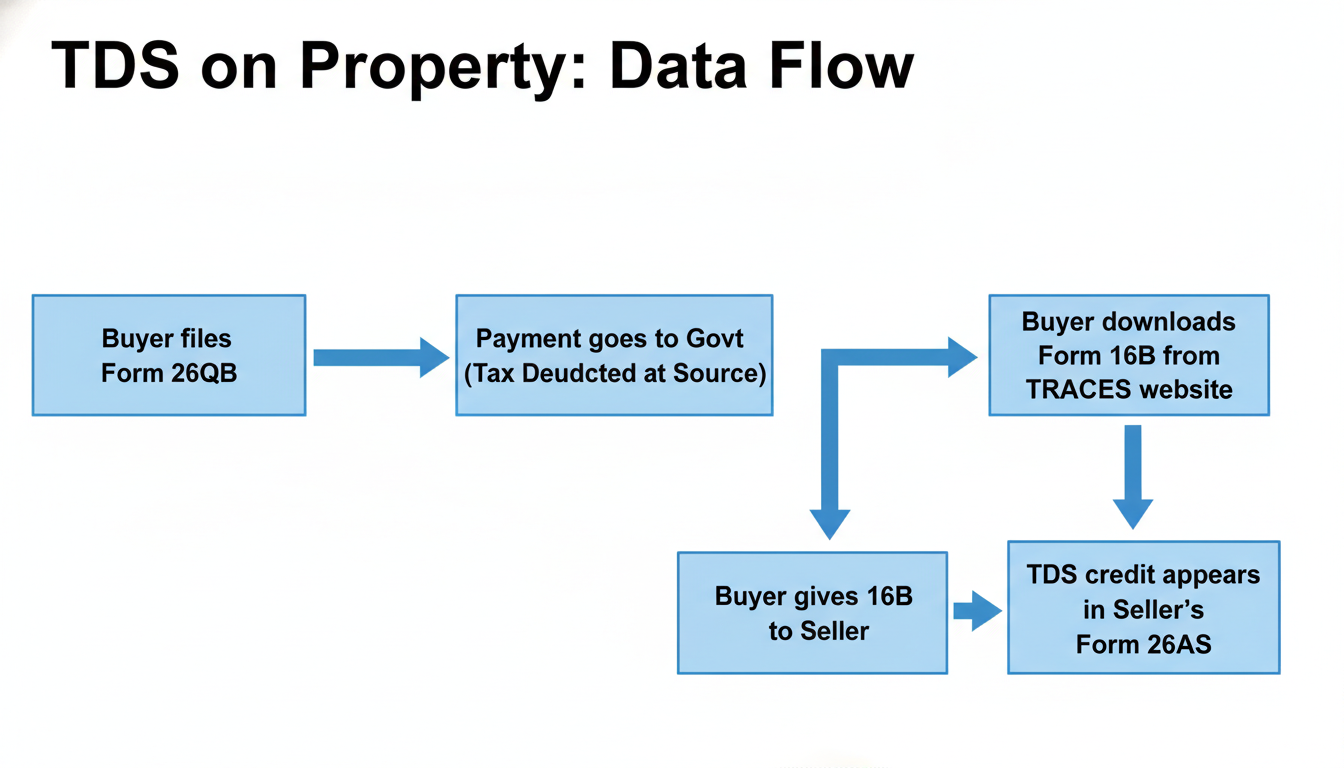
Filing Form 26QB is the main event, but Form 16B and Form 26AS are the crucial follow-ups that complete the process. Think of them as the final two links in the compliance chain.
- Form 16B (The Seller’s Proof): As we covered in Step 7, this is the TDS certificate you provide to the seller. You must issue it within 15 days of the due date for filing Form 26QB. It’s the seller’s official document proving that you’ve paid the tax on their behalf.
- Form 26AS (The Government’s Record): This is the seller’s annual tax credit statement. The TDS you paid will automatically appear as a tax credit in their Form 26AS. When they file their income tax return, they can claim this amount, reducing their overall tax liability. It’s a beautiful, self-verifying system when done correctly.
💡 Pro Tip: Proactive Verification
To ensure a smooth relationship with your seller, offer to help them check their Form 26AS a couple of weeks after you’ve filed. Seeing the tax credit appear gives them peace of mind and confirms you’ve done everything correctly. It’s a small gesture that demonstrates experience and builds immense trust.
Conclusion: Close Your Property Deal with Confidence
Navigating tax compliance during a property purchase can feel overwhelming, but it doesn’t have to be. Form 26QB isn’t a bureaucratic hurdle; it’s a straightforward process designed to ensure transparency.
By now, you understand the what, why, and how. You know the critical 1% calculation, the unforgiving deadlines, and the step-by-step digital process. More importantly, you’re aware of the common traps—like the 20% PAN penalty and the installment payment rule—that others fall into.
Remember the three core actions: Deduct, Deposit, and Document.
You’re no longer in the dark. You’re equipped with expert knowledge to handle this crucial step flawlessly. Go close that deal with the absolute confidence that you’ve got your tax obligations covered.
❓ Frequently Asked Questions
What if there are multiple buyers or sellers?
A separate Form 26QB must be filed for each buyer-seller pair. For instance, if two buyers (A and B) purchase a property from two sellers (X and Y), four separate Form 26QB filings are required (A-X, A-Y, B-X, B-Y), with the sale value and TDS amount split accordingly.
Do I need a TAN to file Form 26QB?
No, you don’t. The process is simplified for individual property buyers. You only need your PAN and the seller’s PAN to file Form 26QB.
How can I correct a mistake in a filed Form 26QB?
Mistakes can be rectified by filing a correction statement through the TRACES portal. You’ll need to log in, find the original statement, and submit a correction request for details like PAN, amount, or assessment year. It’s best to avoid this by double-checking everything before your initial submission.
Is TDS applicable on the purchase of agricultural land?
No. As defined by the Income Tax Act, TDS under Section 194-IA is not applicable on the transfer of agricultural land. However, the land must meet the specific criteria to be classified as agricultural, which usually relates to its location relative to municipal limits. For more details, you can check the definition on a resource like Wikipedia’s page on TDS.
What if the property payment is made in installments?
TDS must be deducted from each installment paid. You are required to file a separate Form 26QB for every installment within 30 days from the end of the month in which that installment was paid. You cannot wait until the final payment to deduct and deposit the entire TDS.